The three best-selling products in this category measure the wrong gas. They are carbon monoxide detectors, and this page is about carbon dioxide. Those are not variations on a theme: carbon monoxide is a poison produced by incomplete combustion, and carbon dioxide is what you breathe out. One device will not do the other’s job, and the search runs them together as though it might.

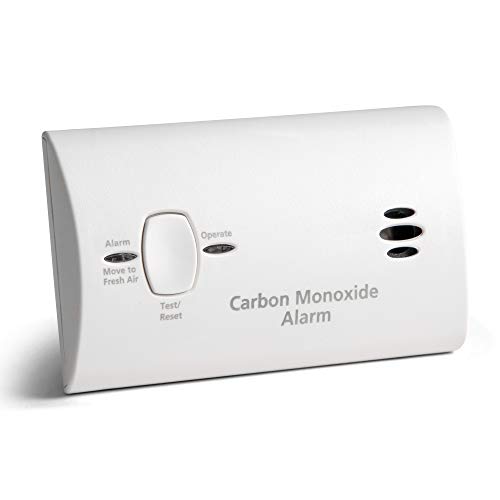

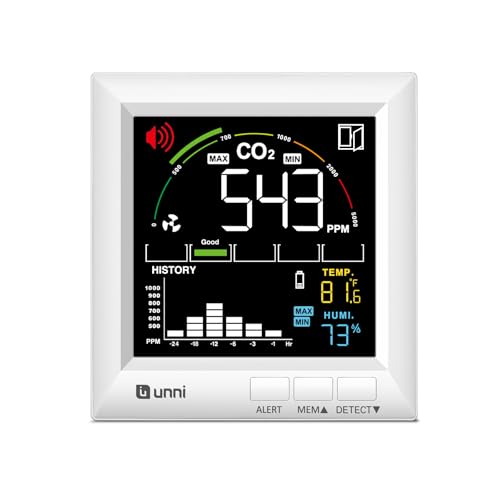


A carbon monoxide detector sits silent for years and screams once, if ever. A carbon dioxide monitor shows a number all day and tells you whether the room you are sitting in is actually getting fresh air. Most homes want both, and they are two purchases.
At a glance
| Monitor | Standout feature | Price tier | Link |
|---|---|---|---|
| Dienmern 5-in-1 | Cheapest real CO2 monitor here | Budget | |
| Kidde CO Detector | The best seller here; a different gas entirely | Budget | |
| Temtop CO2 Meter | Publishes its range: 400 to 5000 ppm | Budget | |
| U UNNI | Names the sensor maker, not just the country | Mid-range | |
| SwitchBot Meter Pro | 92mm screen; publishes size and weight | Mid-range | |
| GoveeLife | The only accuracy figure on this page | Premium | |
| Aranet4 Home | Four years of battery on an e-ink screen | Premium | |
How to choose a CO2 monitor
CO and CO2 are not the same purchase
This is the one thing on this page that genuinely matters. Carbon monoxide comes from incomplete combustion, from a faulty boiler, a blocked flue, an engine, and a CO detector’s whole job is to sit dormant and sound an alarm. The Kidde units here use electrochemical sensors, alarm at 85 decibels, and are excellent at that. Carbon dioxide is what everyone in the room is exhaling, and a CO2 monitor reports a number in parts per million so you know whether the air is being refreshed. Neither device covers the other’s gap. If you own one, you still need the other.
Accuracy is the specification, and one brand publishes it
This is a measuring instrument, so the only question that matters is how close the number is to the truth. GoveeLife is the only product on this page to answer it: it names the sensor as an SCD4x and quotes an accuracy of plus or minus 40 ppm plus a proportional term. That is a specification you could hold it to. Everything else here says high precision, which is not a measurement. On a device whose entire output is a number, a stated tolerance is worth more than any other feature on the page.
Swiss-made is four brands and one company
Temtop, Dienmern, SwitchBot and U UNNI all describe their sensor as Swiss-made or Swiss-engineered, which tells you they are buying from the same small pool of manufacturers rather than making anything themselves. Only U UNNI goes further and names it: Sensirion. That is more useful than the nationality, because a named part is one you can look up, and it also explains why several of these monitors behave similarly despite very different prices. When four brands cite a country, they are all pointing at the same box.
NDIR and photoacoustic, and one listing claims both
NDIR means non-dispersive infrared: shine infrared through the air and measure what the CO2 absorbs. Photoacoustic is a newer variant that listens to the tiny sound the gas makes when the infrared pulses, which allows a much smaller and lower-power sensor. GoveeLife describes its SCD4x accurately as working on a photoacoustic NDIR principle. Temtop’s listing manages to claim high-precision NDIR sensing in one bullet and a recently introduced photoacoustic sensor in another, which are two different sensors and only one can be inside.
Battery life ranges over a factor of twenty
This is the practical difference nobody weighs properly. Dienmern runs 72 hours on a 1600mAh cell, so it lives near a charger. Temtop claims 70 days of standby. Aranet4 claims up to four years, because an e-ink screen draws power only when the number changes rather than lighting continuously. That is the difference between a gadget you keep charging and an instrument you mount on a wall and forget. For a device meant to tell you something all day, every day, the screen technology decides whether it is still running in month three.
A number is only useful if it changes something
All of these measure. The useful ones tell you when to act. SwitchBot, GoveeLife and Aranet4 all offer alerts against thresholds you set, and Aranet4 adds color coding and an optional buzzer so the reading is legible from across a room without reading digits. GoveeLife runs a tri-color light bar. Aranet4’s app stores 90 days of history, which is what shows you that your bedroom climbs every night rather than that it happens to be high right now. A monitor without a threshold is a decoration.
Dienmern 5-in-1
The cheapest genuine CO2 monitor here and it covers the basics without pretending otherwise. It tracks CO2, air quality index, temperature and humidity in real time on a bright LED screen, which is what you want from something sitting on a desk telling you to open a window. The sensor is described as Swiss-made and high precision, which places it in the same supply chain as monitors costing several times as much. A built-in 1600mAh battery runs it for up to 72 hours, so it is portable within a room and it lives near a charger.
Pros:
- Cheapest real CO2 monitor on this page
- Tracks CO2, AQI, temperature and humidity together
- Swiss-made sensor; the same supply chain as the premium units
- Portable on a built-in 1600mAh battery
Cons:
- 72 hours of battery; it lives near a charger
- No accuracy figure and no measuring range published
- Swiss-made without naming the sensor
Best for: finding out whether your office is stuffy, cheaply.
Kidde CO Detector
The best-selling product in this category, and it is a carbon monoxide detector. It does not measure carbon dioxide and does not claim to. As a CO alarm it is a good one: an electrochemical sensor, an 85-decibel alarm with a red LED, a green LED confirming power, and event memory that records the last time carbon monoxide was detected or the unit was tested. It runs on two AA batteries so it works through a power cut, which is exactly when a generator or a heater is most likely to be running. Every home should have one. It is not a CO2 monitor.
Pros:
- The best-selling product in this category
- Electrochemical CO sensing with an 85-decibel alarm
- Runs on AA batteries; works during a power cut
- Event memory records the last detection or test
Cons:
- Measures carbon monoxide, not carbon dioxide
- Tells you nothing about ventilation or stuffiness
- An alarm, not a meter; there is no number to watch
Best for: carbon monoxide, which every home needs and this page is not about.
Temtop CO2 Meter
The only monitor here that tells you the range it can actually read: 400 to 5000 ppm, which brackets everything from fresh outdoor air at the bottom to a sealed meeting room at the top. That is a genuinely useful thing to publish and nobody else does. It also claims 70 days of standby, which is far beyond the cheap units, and it is slim with several mounting options. The listing is confused about its own sensor, describing advanced NDIR technology in one bullet and a photoacoustic sensor in another. Those are different sensors.
Pros:
- The only monitor publishing its measuring range: 400 to 5000 ppm
- 70 days of standby; far beyond the cheap units
- Measures CO2, temperature and humidity together
- Slim, with several mounting options
Cons:
- Claims NDIR in one bullet and photoacoustic in another
- No accuracy figure published
- Swiss-engineered without naming the sensor
Best for: knowing what it can read, if you can live with the confusion.
U UNNI
The only monitor here that names its sensor manufacturer rather than its passport. Sensirion, Swiss-made, photoacoustic, and that is worth considerably more than the Swiss-made three other brands offer, because a named company is one you can research and a country is not. Around it sit sensible touches for a device that lives in a bedroom: three adjustable alert volumes and three backlight levels, so it can be informative in the day and invisible at night, and a switch between Celsius and Fahrenheit. It reports CO2 in real time alongside temperature.
Pros:
- Names the sensor maker, Sensirion, not just the country
- Photoacoustic sensing; the newer, lower-power approach
- Three alert volumes and three backlight levels
- Switches between Celsius and Fahrenheit
Cons:
- No accuracy figure or measuring range published
- No app or history; the number is on the device only
- Sells modestly
Best for: a bedroom, where an alert you can turn down matters.
SwitchBot Meter Pro
The most legible monitor here and the only one that tells you what it physically is: 92mm by 79mm by 25mm and 154 grams, with a 92-millimeter screen showing five readings at once. That size matters because a CO2 number you have to walk over and squint at is a number you stop checking. The sensor is Swiss-made NDIR, the traditional and well-proven approach. Three alert methods let you set ranges for CO2, temperature and humidity and be told when they are exceeded, which is what turns a display into something that changes your behavior.
Pros:
- Publishes its size and weight; 92mm screen, 154g
- Five readings visible at once, legible across a room
- Swiss-made NDIR; the proven approach
- Three alert methods against ranges you set
Cons:
- No accuracy figure published
- Swiss-made without naming the sensor
- Sells poorly for a known smart-home brand
Best for: a reading you can see from the other side of the room.
GoveeLife
The only monitor on this page that behaves like an instrument. It names the sensor, an SCD4x, describes the principle correctly as photoacoustic NDIR, and then does the thing nobody else does: publishes an accuracy figure, plus or minus 40 ppm plus a proportional term. On a device whose entire purpose is producing a number, that tolerance is the specification and its absence everywhere else on this page is glaring. Four metrics display at once, a triple alert system fires when your thresholds are crossed, and a tri-color light bar reports the state without you reading anything.
Pros:
- The only accuracy figure on this page: plus or minus 40 ppm and a proportional term
- Names the sensor, an SCD4x, and describes its principle correctly
- Triple alerts on CO2, temperature and humidity thresholds
- Tri-color light bar; readable without reading
Cons:
- Costs several times the cheap monitors
- No battery life or measuring range published
- Sells poorly against the cheaper units
Best for: a number you can actually trust, with a tolerance attached.
Aranet4 Home
Four years of battery, and that number changes what the device is. An e-ink display draws power only when the reading changes rather than lighting continuously, so this is not a gadget you charge, it is an instrument you put on a wall and forget until it needs a new cell in several years. It measures CO2, temperature, humidity and atmospheric pressure, shows a large number with color coding and an optional buzzer so it reads at a glance, and the free app stores 90 days of history, which is what reveals that your bedroom climbs every single night. It is by far the most expensive thing here.
Pros:
- Up to four years of battery; roughly twenty times anything else here
- E-ink; no charging, no cable, mount it and forget it
- 90 days of history in a free app; shows patterns, not moments
- Color coding and an optional buzzer; readable at a glance
Cons:
- The most expensive monitor here by a wide margin
- No accuracy figure or sensor named
- E-ink means no bright display in a dark room
Best for: mounting on a wall and never thinking about it again.
The verdict
Before any of this: check which gas you are buying for. The best-selling products in this category are carbon monoxide alarms, which every home should have and which tell you nothing about ventilation. The carbon dioxide monitors are everything else on this page, and they are a separate purchase.
Best overall: GoveeLife. The only monitor on this page that behaves like a measuring instrument rather than a display. It names its sensor, an SCD4x, describes the principle plainly as photoacoustic NDIR, and publishes an accuracy of plus or minus 40 ppm and a proportional term. Everyone else says high precision, which means nothing. It alerts on thresholds you set and reports state through a light bar you can read without reading.
Best value: Dienmern 5-in-1. The cheapest real CO2 monitor here, tracking CO2, air quality, temperature and humidity on a bright screen, with a Swiss-made sensor that puts it in the same supply chain as monitors several times the price. Its 72-hour battery means it lives near a charger, and it publishes neither accuracy nor range. For finding out whether a room needs a window open, that is enough.
Best premium: Aranet4 Home. Four years of battery on an e-ink screen is not a specification, it is a different category of object: you mount it and forget it, where everything else here is a gadget you charge. The 90 days of history in the app is the other half, because a CO2 reading right now tells you far less than the pattern of your bedroom every night for three months.
FAQ
What is the difference between CO and CO2?
Everything. Carbon monoxide comes from incomplete combustion, a faulty boiler or a blocked flue, and a CO detector’s job is to sit silent and alarm. Carbon dioxide is what you exhale, and a CO2 monitor reports parts per million so you know whether the room is getting fresh air. Neither substitutes for the other.
Why are carbon monoxide detectors in a CO2 search?
Because the abbreviations look alike and the search engine cannot tell them apart. The best-selling products in this category are Kidde CO alarms, and they are good ones. They simply do not measure the gas this page is about.
What accuracy should I expect?
Nobody will tell you, except GoveeLife: plus or minus 40 ppm and a proportional term, from a named SCD4x sensor. Everyone else says high precision. On an instrument whose entire output is a number, that gap is worth noticing.
Is NDIR better than photoacoustic?
They are related. NDIR shines infrared through the air and measures absorption; photoacoustic listens to the sound the gas makes as the infrared pulses, which allows a smaller, lower-power sensor. GoveeLife describes its SCD4x correctly as photoacoustic NDIR. Temtop’s listing claims both, which cannot be right.
Does battery life matter on a monitor?
More than you would think. Dienmern gives 72 hours, Temtop claims 70 days of standby, and Aranet4 claims four years by using e-ink that only draws power when the number changes. That is the difference between something you charge and something you mount and forget.
This article may contain affiliate links; see our Affiliate Disclosure.