One brand in this search explains the trick the rest of the category runs on, and it does it while attacking its rivals. A coiled cable is quoted at the length of the straight wire before anyone coiled it. LISEN says its cable starts as a full 1.5 meters and coils down to a true 1.2, then accuses imitators of starting with a meter and shrinking to 0.7. Go and look at the best-selling cable here. Its title says 1.5 meters. Its own bullets say 1.2.




At a glance
| Cable | What it is | Price tier | Link |
|---|---|---|---|
| Coiled C-to-C 2 Pack | Cheapest here. 60W, two cables | Budget | |
| ATTACK SHARK C01 ULTRA | Keyboard cable. 5mm core, screw-lock aviator | Budget | |
| GUNMJO Pro | Keyboard cable. The best seller here | Budget | |
| LISEN A-to-C | Explains the coiled length con | Budget | |
| SMALLRIG | The only fast one. 20Gbps, 100W, angled | Mid-range | |
| LISEN C-to-C | Explains why your 60W won’t be 60W | Mid-range | |
| GLORIOUS | Keyboard cable. 25mm coil. Admits USB 2.0 | Premium | |
How to choose
Two different products share this search
Half these cables are made for mechanical keyboards, with a detachable metal aviator connector partway along and a look that is most of the point. The other half are made for a car, retracting into a center console so nothing catches the gear lever. They both coil and they are not interchangeable in spirit. Work out which one you are shopping for before you compare a single specification, because the keyboard cables optimize for how they look on a desk and the car cables optimize for surviving a footwell.
Coiled length is quoted before the coiling
This is the one to know. A coiled cable is sold at the length of the wire it was made from, not the distance it reaches. The best seller here says 1.5 meters in its title and then, in its own bullets, gives the real breakdown: a coil section of about 5.9 inches plus 1.2 meters of straight cable. That is the same cable, described twice, at two different lengths. Read the bullets and add the parts up. The title is the raw material and the bullets are what arrives.
Almost everything here is USB 2.0
Only one cable in this search moves data at any speed: SMALLRIG’s, at 20 gigabits with 100 watts of power delivery. Every other cable that publishes a figure says 480 megabits, which is USB 2.0. The keyboard cables mostly say nothing at all, beyond high speed charging and sync. Now, a keyboard needs almost no bandwidth, so USB 2.0 is entirely correct for the job. The point is that you are buying looks, not throughput, and only one brand here is plain enough to print the number.
Sixty watts is a chain, not a cable
LISEN pre-empts its own bad reviews with the best paragraph in this search: 60 watts requires a 60 watt port, a 60 watt device and a 60 watt cable, and the speed is set by the weakest link. It then says outright that this is how power delivery works and not a defect. That is the single most common misunderstanding in USB-C, answered before you buy. Nobody else here mentions it, and everybody else here is selling you a number that depends on two things they did not sell you.
The coil diameter is what you are actually buying
On a keyboard cable the coil is the product, and the diameter decides whether it reads as chunky or tidy. GUNMJO runs a 16mm inner diameter over a coil about 5.9 inches long. GLORIOUS runs 25mm over roughly 6 inches, so noticeably fatter for the same run. ATTACK SHARK stretches its coil to about 19 inches, three times longer than the others, which changes the look entirely. These are the numbers that matter on a desk and nobody puts them side by side.
The aviator is a real feature, not just a look
The metal connector partway along a keyboard cable unscrews, which sounds like jewelry and is not. It means you can pull the desk half away and leave the keyboard plugged in, swap the coil for a different color without rewiring, and stop a yanked cable from taking the keyboard with it. GLORIOUS specifies a heavy-duty 5-pin aviator, and ATTACK SHARK adds a screw-lock mechanism on full-steel connectors. That screw thread is the difference between a connector that holds and one that works loose.
Coiled C-to-C 2 Pack
The cheapest thing in this search and you get two of them, which makes the price per cable faintly ridiculous. It is 60 watts at 20 volts and 3 amps, 480 megabits of data, in PU that springs back after stretching. The real touch is the caveat printed twice: your car must have a USB-C port, and because both ends are USB-C you need a dedicated USB-C charger to use it. That trips people constantly. It stretches comfortably from one foot to two and a half, reaching three at a push.
Pros:
- Cheapest cable here, and it is a two-pack
- Publishes its full 60W spec as volts and amps
- Warns that both ends being USB-C needs a USB-C charger
- Publishes its real stretch range, not just a maximum
Cons:
- USB 2.0 data only
- Shortest reach on the page
- No aviator; not a keyboard cable
Best for: two cheap coiled cables, if a car is the real destination.
ATTACK SHARK C01 ULTRA
The cheapest keyboard cable here and the one that publishes the specification that matters in a cable: a 5.0mm copper core, which it says is 25 percent thicker than the 4.0mm standard. That is a real number about the wire itself, and nobody else on this page mentions their conductor at all. The aviator is full steel with a screw-lock, so it clamps rather than pushes together. The coil runs about 19 inches, roughly triple the others, over a meter of straight cable. RGB in both plugs, and a velcro strap in the box.
Pros:
- The only cable publishing its copper core thickness
- Screw-lock steel aviator; clamps instead of pushing
- Cheapest keyboard cable on this page
- Velcro strap included; nano-TPU sleeve
Cons:
- No data rate published anywhere
- The long coil is a strong look, not a neutral one
- Dimensions given in awkwardly converted units
Best for: a thick conductor and a connector that locks.
GUNMJO Pro
The best seller in this search by a comfortable margin and it costs very little. Double-sleeved over copper wire with aluminum shielding foil, a detachable metal aviator, and a reversed coil that GUNMJO says resists the damage overstretching does. The bullets are more accurate than the title: 16mm inner coil diameter, a coil about 5.9 inches long and 1.2 meters of straight cable, where the title claims 1.5. It comes in three colors, and one of them costs more than the other two for word-for-word identical everything.
Pros:
- The best-selling cable in this search
- Publishes coil diameter and the real straight length
- Double-sleeved over shielded copper
- Detachable metal aviator at a budget price
Cons:
- The title says 1.5m; the bullets say 1.2m
- No data rate published
- One color costs more for an identical cable
Best for: the aviator look, for the least money, from the cable most people buy.
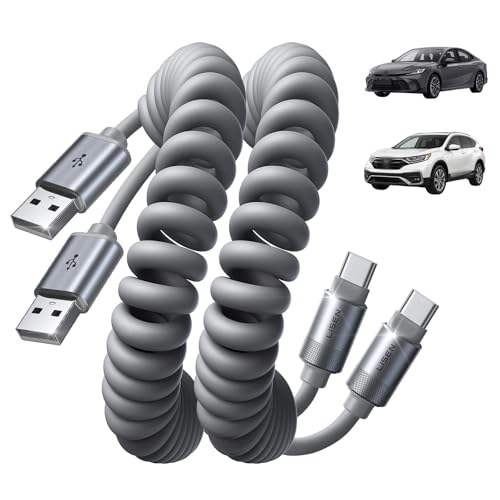
LISEN A-to-C
The listing that explains the category’s oldest trick and names the people doing it: this cable is made from a full 1.5 meters of straight wire coiled down to a true 1.2 meters, unlike imitations built from a meter that shrink to 0.7. That is a brand telling you how to measure its rivals. The silicone survives from minus 40 to 392 degrees Fahrenheit, the connectors are rated for 30,000 plug cycles and the joint where metal meets cable is tested to 10,000 bends. It also says plainly that this is USB-A to USB-C, twice.
Pros:
- Explains how coiled length is quoted, and how to check
- Publishes cycle counts and bend tests, not adjectives
- Enormous temperature range; a two-pack
- States its connector type plainly to stop wrong orders
Cons:
- USB 2.0 at 480 megabits
- USB-A end; wrong for a modern laptop
- No aviator; built for a car, not a keyboard
Best for: knowing exactly how much cable you are getting.
SMALLRIG Coiled Data Cable
The only cable here that moves data at any real speed: 20 gigabits and 100 watts of power delivery, against 480 megabits everywhere else on this page. That is roughly forty times the throughput for a couple of pounds more, and it matters the moment a camera or an external drive is involved rather than a keyboard. One end is straight and one is angled at 90 degrees, which is the detail that keeps a plug from standing proud of a laptop edge. TPU coil, aluminum alloy connectors.
Pros:
- The only genuinely fast cable in this search
- 100W power delivery, against 60W elsewhere
- Angled end sits flat against a laptop or camera
- Publishes the USB standards it complies with
Cons:
- No aviator; it is not a keyboard cable
- Only one cable, where rivals give you two
- No coil diameter or length published
Best for: a camera or a drive, where the data rate is the whole point.
LISEN C-to-C
The most useful sentence in this whole search is buried in this listing: 60 watts needs a 60 watt port, a 60 watt device and a 60 watt cable, the slowest link decides, and that is how power delivery works rather than a fault. It then adds a second clarity most brands would cut, saying four feet is the maximum stretch and meant for occasional use, not constant. Triple-reinforced connectors, silicone rated from minus 40 to 392 Fahrenheit, and it retracts to a foot when idle.
Pros:
- Explains why your 60W will not always be 60W
- Admits its maximum stretch is for occasional use
- Triple-reinforced connector; silicone over a metal hub
- Two cables in the box
Cons:
- USB 2.0 at 480 megabits
- Dearest of the car cables here
- No aviator; not built for a keyboard
Best for: understanding what you bought before it disappoints you.
GLORIOUS Coiled Keyboard Cable
Three to four times the price of every other keyboard cable here, and it is the only one that tells you its data rate: USB 2.0. That is not a slip, it is confidence. A keyboard needs almost no bandwidth, so USB 2.0 is exactly right, and GLORIOUS is charging for the coil rather than pretending otherwise. The numbers back the look: a 25mm coil diameter over a six inch coil, 4.5 feet total, double-braided sleeving, gold-plated contacts and a heavy-duty 5-pin aviator. Device side plus 90 degrees.
Pros:
- The only keyboard cable here publishing its data rate
- 25mm coil; the fattest, most deliberate look on the page
- 5-pin aviator with gold-plated contacts
- Publishes coil length, diameter and total length
Cons:
- Three to four times the price of its rivals
- USB 2.0, and USB-A at the computer end
- No copper core thickness given
Best for: the coil as the point, bought from a brand that says so.
The verdict
Two products share this search: keyboard cables with an aviator connector, and car cables that retract into a console. Almost everything here is USB 2.0, which is fine for a keyboard and worth knowing. And every coiled length is quoted before the coiling, so read the bullets and add up the parts.
Best overall: GUNMJO Pro. The best seller in this search by a clear margin, at a price that makes the decision easy, with a detachable metal aviator, double sleeving over shielded copper, and a reversed coil built to survive overstretching. Its bullets are more accurate than its title, publishing a 16mm coil diameter and 1.2 meters of straight cable where the title says 1.5. Check the colors before ordering, because one of them costs more for nothing.
Best value: ATTACK SHARK C01 ULTRA. The cheapest keyboard cable here and the only cable on the page that tells you about its actual conductor: a 5.0mm copper core, 25 percent thicker than standard. The aviator screws together instead of pushing, which is the connector detail that decides whether it stays put. RGB in both plugs and a velcro strap thrown in.
Best premium: GLORIOUS. It costs several times its rivals and it is the only keyboard cable here confident enough to print USB 2.0 on its own listing, because a keyboard has never needed more. What you get for the money is measurable: a 25mm coil where the budget cable runs 16mm, double-braided sleeving, gold-plated contacts and a 5-pin aviator. If the coil is the point, this is the coil.
FAQ
Why is the cable shorter than the title says?
Because coiled cables are quoted at the length of the wire before coiling. LISEN spells it out: 1.5 meters of straight cable coils to a true 1.2. The best seller here says 1.5 in the title and 1.2 in its bullets. Both are true; only one is what reaches your keyboard.
Do I need more than USB 2.0?
For a keyboard, no. A keyboard sends a keystroke, which is nothing. USB 2.0 at 480 megabits is correct, and GLORIOUS is the only keyboard cable here that says so. For a camera or an external drive, SMALLRIG’s 20 gigabits is the only option on this page.
What is the aviator connector for?
It unscrews partway along, so you can detach the desk half without unplugging the keyboard, swap coils, and stop a yanked cable dragging the keyboard off. ATTACK SHARK adds a screw-lock, which holds better than a push fit.
Why isn’t my 60W cable charging at 60W?
Because 60 watts needs a 60 watt port, a 60 watt device and a 60 watt cable, and the weakest one sets the speed. LISEN explains this on its own listing and calls it standard behavior rather than a defect, which is more than anyone else here does.
Can I use a keyboard cable in my car?
You can, but it is the wrong tool. Keyboard cables are USB-C to USB-A with a rigid aviator midway, built to look good on a desk. Car cables retract to a foot, use silicone that survives a hot dashboard, and are built so nothing catches the gear lever.
This article may contain affiliate links; see our Affiliate Disclosure.