Go looking for a corded robotic pool cleaner to compare against a cordless one and you run into the answer immediately: there is not one here. Every robotic cleaner on this page is cordless, without exception. The debate people still have about cords has already been settled by what is actually on sale, and the real decisions have moved somewhere else entirely.


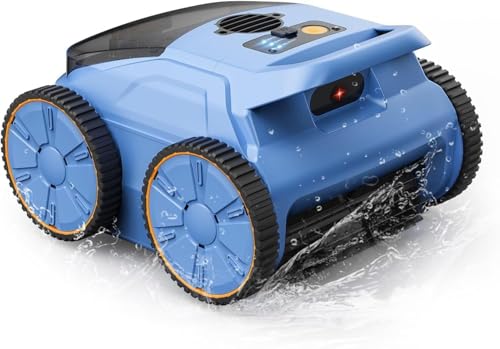
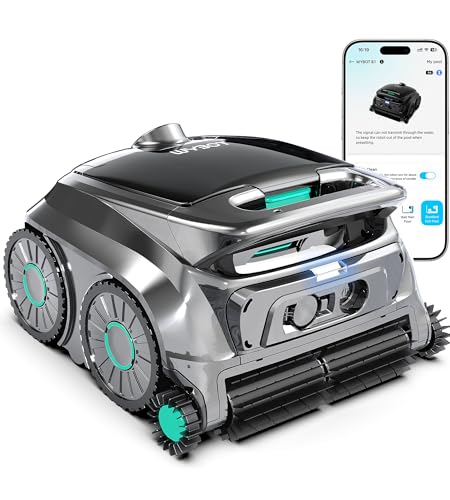

What replaced the cord question is a straight trade between suction and runtime, because both come out of the same battery. The cleaners with the biggest suction figures here are quiet about how long they run. The one that runs longest quotes a suction number so small it cannot mean the same thing. That tension is what this page is really about.
At a glance
| Cleaner | Standout feature | Price tier | Link |
|---|---|---|---|
| TALOSBO S2 | Cheapest here; publishes nothing at all | Budget | |
| STARRYBOT | Dual motors; 90 minutes | Budget | |
| OUCAXIA Y10 | 150 minutes on a published 5200mAh pack | Budget | |
| WYBOT A1 | Best seller; 2280 GPH and 130 minutes | Mid-range | |
| ABNEMEN | Longest runtime here at 180 minutes | Mid-range | |
| WYBOT B1 | Triple motors; floor, wall and waterline | Premium | |
| WYBOT C2 | 3792 GPH and a 10 micron filter layer | Premium | |
How to choose a robotic pool cleaner
The corded question answers itself
A corded robot draws mains power through a floating cable, which means it can run as long as you like and never needs charging. That was a real advantage and it came with a real cost: the cable tangles, it limits how far the robot can wander, and you are running electricity to a machine sitting in water. What killed it is that batteries got good enough. Runtimes here reach three hours, which covers most domestic pools in one go, and the machine parks itself at the edge when it is done. For a very large pool that needs continuous work, a corded unit still makes sense. You will not find one on this page.
Do not rank on the suction figures
These numbers do not compare, and it is worth saying plainly. WYBOT quotes 2280 GPH on the A1 and 3792 GPH on the C2, which is a sensible progression within one brand. ABNEMEN, at a similar price to the A1, quotes 80 GPH of filtration. That is not a cleaner forty-seven times weaker than a WYBOT; it is a different thing being measured and labeled with the same units. Compare suction within a brand, where the figures were produced the same way, and ignore it across brands.
Runtime and suction come out of the same battery
This is the real trade and the listings arrange themselves neatly around it. ABNEMEN claims the longest run here at 180 minutes. OUCAXIA gives 150 minutes and is the only brand to publish the pack behind it, a 5200mAh six-cell. WYBOT’s A1 does 130 and the B1 125. STARRYBOT is shortest at 90. Now notice what the C2, with the biggest suction number on the page, says about runtime: nothing at all. Harder suction empties a battery faster, and the quiet on that specification is itself information.
Filtration is where the money actually goes
The upgrade worth paying for is the one that gets the least attention. WYBOT’s A1 pairs a 180 micron filter with a textured foam layer, which catches leaves and grit. The C2 adds a 10 micron ultra-fine layer on top of the same 180 micron filter, and that is a different job: 10 micron catches the fine silt, pollen and dust that makes water look cloudy rather than dirty. If your pool has trees over it, the coarse filter is enough. If your water goes hazy, the fine one is the reason to spend.
Floor only, or walls and waterline too
Cheaper robots clean the floor. That is most of the dirt and it is not all of it, because the scum line at the waterline is where oils and sunscreen collect and it is the part guests notice. The WYBOT B1 and C2 both climb walls and work the waterline, with the B1 offering separate floor, wall and waterline modes so you can send it at the specific problem. ABNEMEN also claims wall climbing at a much lower price. If your floor is fine and your tiles are not, the modes matter more than the suction.
When a listing says nothing, that is the specification
The TALOSBO S2 sells well and its entire published feature list reads, in full, “pool cleaner”. No runtime, no suction, no filtration rating, no pool size, no battery. That is not a criticism of how it cleans, which nobody outside its owners can know. It is a straightforward statement that there is nothing here to check, at a price low enough that some people will take the chance anyway. Every other cleaner on this page commits to at least one number you could hold it to.
TALOSBO S2
The cheapest robotic cleaner here by a wide margin, and it sells respectably, which is the interesting part. Its published specification consists of the words “pool cleaner”. There is no runtime, no suction figure, no filter rating, no battery capacity and no statement of what size or type of pool it suits. That is unusual on a page where even the budget brands commit to a runtime. It may well work perfectly. What is certain is that there is nothing to compare, nothing to hold the brand to, and no way to know before it arrives whether it will finish your pool on one charge.
Pros:
- Cheapest robotic cleaner here by a distance
- Cordless, like everything else on this page
- Sells better than several better-documented rivals
Cons:
- No runtime, suction, filtration or battery published at all
- No stated pool size or type
- Nothing to verify before it arrives
Best for: a small pool and a willingness to find out the hard way.
STARRYBOT
A dual-motor cleaner at a genuinely low price, and the two motors are the point: one drives, one draws, so the suction does not fall away as the machine works its way around. It parks itself at the pool edge when the job is done, so you are not fishing it out of the deep end with a pole. The runtime is the real weakness at 90 minutes, the shortest here, which is fine for a small pool and marginal for anything larger. It is fully cordless with no tangling cable to manage. For a modest pool that needs a regular sweep, it is a lot of machine for the money.
Pros:
- Dual motors keep suction steady while driving
- Auto-parks at the edge; no fishing it out
- Very cheap for a documented cordless robot
- Publishes its runtime plainly
Cons:
- 90 minutes; the shortest runtime here
- No suction or filtration figures published
- Sells poorly against the WYBOT range
Best for: a small pool where 90 minutes finishes the job.
OUCAXIA Y10
The best-documented cheap cleaner here. It runs 150 minutes, and unlike everyone else quoting a runtime, OUCAXIA tells you what produces it: a 5200mAh six-cell rechargeable pack. That is the difference between a claim and a checkable claim, and it is the only battery figure on this page. Twin suction inlets and a long brush do the cleaning, systematic navigation covers the pool in a pattern rather than bouncing around at random, and it suits a wide range of pool types. Two and a half hours is enough for most domestic pools in a single charge.
Pros:
- 150 minutes, backed by a published 5200mAh six-cell pack
- The only battery capacity stated on this page
- Dual suction inlets with a long brush
- Systematic navigation rather than random bouncing
Cons:
- No suction or filtration rating given
- Floor cleaning; no waterline mode
- Sells modestly
Best for: a long run on a battery the brand will actually describe.
WYBOT A1
The best-selling pool robot here by a clear margin, and the specification explains why: it is the one that commits to everything. 2280 GPH of suction, 130 minutes of runtime, and a dual-layer filter pairing a 180 micron precision element with a textured foam layer, so both leaves and grit are caught rather than pushed around. You drop it in and it starts, cleans the edges, and parks itself when it is finished. The battery recharges quickly. Nothing here is the biggest number on the page, and everything here is a number, at a price well below the machines above it.
Pros:
- Comfortably the best-selling cleaner here
- Publishes suction, runtime and filtration; a rare full set
- Dual-layer 180 micron filter with textured foam
- Drop in, self-parks, fast recharge
Cons:
- No fine filtration layer for cloudy water
- Floor and edges; no waterline mode
- 130 minutes is mid-pack here
Best for: most pools, most people, with every number on the table.
ABNEMEN
Three hours, which is the longest run on this page and the reason to look. It pairs that with a 180W motor and wall climbing, so it reaches the waterline as well as the floor, at a price where that combination is unusual. There is an auto-return and an LED alert so you are not checking the battery yourself. The awkward figure is the 80 GPH filtration rate quoted alongside WYBOT’s thousands: those cannot be the same measurement, so take neither as a ranking. Judge this one on the runtime and the wall climbing, which are both clear claims.
Pros:
- 180 minutes; the longest runtime here
- Wall climbing at a mid-range price
- 180W motor with auto-return and an LED alert
- Suits above-ground pools
Cons:
- The 80 GPH figure cannot be compared with rivals’ thousands
- No filter micron rating given
- Sells modestly
Best for: a big pool that needs one long uninterrupted run.
WYBOT B1
The one built around brushes rather than raw suction. A triple-motor system drives it over obstacles smoothly, and a quad-roller arrangement, two main rollers plus dual side brushes, reaches into the corners and along the edges where a round robot simply cannot put a brush. Separate cleaning modes cover floor, wall and waterline, so you can send it at the specific problem rather than running a full cycle every time. Runtime is up to 125 minutes with a quick clean option for a shorter job. It is aimed at inground pools and priced accordingly.
Pros:
- Quad-roller brushes reach corners and edges
- Separate floor, wall and waterline modes
- Triple motors handle obstacles smoothly
- Quick clean option for shorter jobs
Cons:
- 125 minutes; shorter than cleaners a third of the price
- No suction figure published, unlike its stablemates
- Roughly double the A1 for the same brand
Best for: an inground pool with corners a round robot keeps missing.
WYBOT C2
The most capable machine here and the one worth understanding properly. Its 3792 GPH is the biggest suction figure on the page, but the real upgrade is the filter: the same 180 micron element as the A1, with a 10 micron ultra-fine layer added on top. That second layer is what takes out the silt and pollen that leaves water looking hazy rather than dirty, and no amount of suction does that job. Add dual scrubbing brushes, wall and waterline cleaning, app scheduling with intelligent path planning, and coverage of pools up to 2,260 square feet. It is by some way the most expensive thing here.
Pros:
- 10 micron fine filter layer; the answer to cloudy water
- 3792 GPH, the strongest suction here
- Floor, wall and waterline with dual scrubbing brushes
- App scheduling and planned cleaning paths; up to 2,260 sq ft
Cons:
- The most expensive cleaner here by a wide margin
- Publishes no runtime at all, which on this page is telling
- Overkill for a small pool under trees
Best for: a big pool where the water goes hazy rather than leafy.
The verdict
Two rules before the picks. Do not compare suction figures across brands, because they are clearly not measuring the same thing. And check the runtime against the size of your pool, because a robot that stops halfway has not cleaned it.
Best overall: WYBOT A1. The best seller here and the only cleaner that puts every number on the table: 2280 GPH, 130 minutes, and a dual-layer filter combining a 180 micron element with textured foam so leaves and grit both get caught. Nothing about it is the biggest figure on this page, and everything about it is a figure you could hold WYBOT to. Drop it in, it cleans, it parks itself. For most pools that is the job finished.
Best value: OUCAXIA Y10. Two and a half hours of cleaning, and the only brand here that tells you what delivers it: a 5200mAh six-cell pack. That is a claim you can check rather than one you have to trust. Dual suction inlets, a long brush and systematic navigation that covers the pool in a pattern rather than at random. It cleans floors, not waterlines, and for a lot of pools that is all that was ever needed.
Best premium: WYBOT C2. The reason to spend here is not the 3792 GPH, it is the 10 micron filter layer sitting on top of the standard 180 micron one. Suction moves debris; a fine filter is the only thing that takes out the silt and pollen that makes water look cloudy. Add wall and waterline scrubbing, app scheduling and coverage to 2,260 square feet. Note that it publishes no runtime, which on a page like this is worth registering.
FAQ
Should I buy corded or cordless?
The market has decided: every robotic cleaner here is cordless. A cord gives unlimited runtime and gives you a cable to untangle and mains power beside your pool. Batteries now reach three hours, which finishes most domestic pools in one go. For a very large pool needing continuous work, corded still has a case, and you will not find one on this page.
Why is one cleaner 80 GPH and another 3792?
Because they are not measuring the same thing. WYBOT’s 2280 and 3792 GPH figures make sense against each other within one brand. ABNEMEN’s 80 GPH sits at a similar price to the A1, and no cleaner is forty-seven times weaker than a rival at the same money. Compare suction only within a brand.
How much runtime do I need?
Enough to finish your pool in one charge. STARRYBOT gives 90 minutes, WYBOT’s A1 130, OUCAXIA 150, ABNEMEN 180. Bigger pools want the longer numbers. Note that the strongest-suction machine here quotes no runtime at all, because suction and runtime both come out of the same battery.
What does the micron rating mean?
How fine the debris caught is. A 180 micron filter catches leaves and grit, which is most pools’ problem. The 10 micron layer on the C2 catches silt, pollen and dust, which is what makes water hazy rather than dirty. If your water is cloudy rather than leafy, that is the upgrade that matters.
Do I need wall and waterline cleaning?
Only if the waterline is your problem. That scum line is where oils and sunscreen collect and it is what guests notice. WYBOT’s B1 and C2 both handle it with separate modes, and ABNEMEN claims wall climbing for much less. If the floor is the issue, save the money.
This article may contain affiliate links; see our Affiliate Disclosure.