One brand in this search shouts DENSEST in capital letters across every listing it owns, and publishes the number to back it: Shore A 20-N, against what it calls an industry standard of 13. It is a good argument, plainly made. It is also beaten. A cheaper competitor on the same page publishes 22-N on the same scale and a thicker cushion besides. Nobody is going to tell you that, because the two listings never mention each other, and the number only means something once you put them side by side.


At a glance
| Guard | Density, coverage and the catch | Price tier | Link |
|---|---|---|---|
| Roving Cove HeftyFit Corners | 20-N, 0.4in. Corners only. Cheapest here | Budget | |
| Clear Corner Protectors | PVC, spherical. The best seller. Corners only | Budget | |
| 12 Pack Pre-Taped | NBR foam, fully pre-taped. One minute to fit | Budget | |
| Bestore | 22-N, 0.42in. Denser than the DENSEST brand | Mid-range | |
| Roving Cove Slimfit | 20-N but 0.3in. 15ft plus 4 corners | Mid-range | |
| Furniture Edge and Corner Set | 18ft plus 8. No density figure at all | Premium | |
| Roving Cove HeftyFit Kit | 20-N, 0.4in, 18ft plus 8. The fit maths checks out | Premium | |
How to choose
Shore A density is the only comparable number here
Two brands publish one and the rest describe their foam as soft, thick or high-density, which are adjectives. Shore A measures how much a material resists being pressed, so a higher number is firmer. Roving Cove prints 20-N across every listing it has and points out that the industry standard is 13. Bestore prints 22-N and a 0.42 inch thickness against Roving Cove’s 0.4. Whether firmer is better is a real argument, covered below. Whether you can compare anything else on this page is not: you cannot.
Firmer or squishier is a genuine disagreement
Roving Cove’s case is that density beats thickness for softening an impact, because a very soft cushion simply bottoms out and you meet the table through it. The best-selling guard here makes a different case for the same conclusion: soft silicone and foam hold adhesive poorly, so small hands pull them off, and they dent inwards or flake over time. Its answer is firm PVC that resists biting. Both brands are arguing against squishy. Nobody in this search is defending the soft end, which tells you something.
A guard your child removes is not a guard
This is the sharpest point anybody makes here and only one listing makes it. The failure mode is not the cushion being too thin; it is the whole thing coming off, at which point you have an unprotected table and a small object on the floor. That listing supplies three custom-cut adhesive pieces, one per side, and notes that other brands include two. Look at what holds the guard on before you look at what the guard is made of, because the second is irrelevant if the first fails.
Check the fit arithmetic yourself
Two kits here quote 18 feet of edge guard and then tell you what it will wrap. Roving Cove says 18 feet fits a round table up to 69 inches across. Eighteen feet is 216 inches, and the distance around a 69 inch circle is about 217. That is exact, and it is the work of a company that measured. The other kit offers 18.1 feet, barely more, and claims a 73 inch round table, which needs about 229 inches to go around. It is a foot short. The maths takes ten seconds and one of these two numbers does not survive it.
Pre-taped or not is the whole afternoon
Corners generally arrive pre-taped. Edge guards frequently do not, and Roving Cove says so plainly: its 18 foot kit ships 36 feet of tape for you to apply yourself, two runs down the length of the strip. That is a real job on a floor with a toddler nearby. One guard here is fully pre-taped and claims the whole thing takes under a minute. Neither approach is wrong and the difference is an hour of your life, so read for the words not pre-taped before you buy.
The warning nobody else prints
Roving Cove attaches a warning to its corner guards that is worth the price of the page: do not use them on anything with a weak or easily removable finish, meaning antique or veneer furniture. Strong adhesive plus veneer equals a stripped table when you take it off. One other listing here suggests testing a hidden area first. Everybody else sells you industrial-strength 3M tape and says nothing. If your coffee table is veneered, that sentence is the most important one in this search.
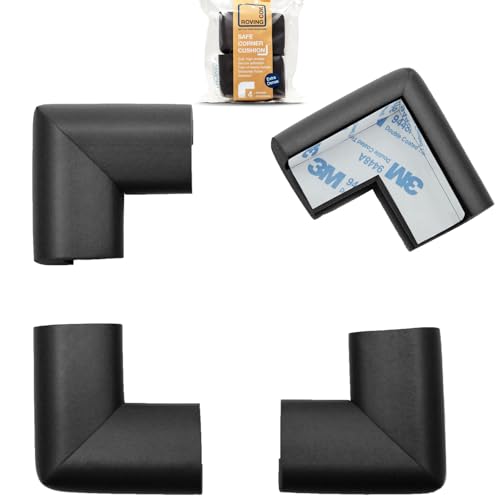
Roving Cove HeftyFit Corners
The cheapest thing here and the way into Roving Cove’s foam without buying a kit: four large corners at Shore A 20-N and 0.4 inches thick, pre-taped with 3M’s 9448A, in a black that suits dark oak, walnut or granite. The material is free of BPA, phthalates, heavy metals, latex and flame-retardant chemicals, and it passed flammability testing under US regulations without them. This is also the listing carrying the warning about veneer and antique finishes, which is the sentence to read twice.
Pros:
- The cheapest guard in this search
- Publishes density and thickness; pre-taped with named 3M tape
- Flame-resistant without flame-retardant chemicals
- Carries the veneer warning nobody else prints
Cons:
- Corners only; the long edge stays bare
- Four pieces; you may need two packs
- Brown or black foam is visible on a table
Best for: the sharp corners only, on dark furniture, cheaply.
Clear Corner Protectors
The best seller in this search by a wide margin, and the only product here arguing about adhesive rather than cushioning. Its case: soft foam and silicone do not hold glue, so children pull those guards off, and they dent or flake with age. Its answer is firm PVC in a spherical shape it says is denser and more protective than a flat L-shaped guard, near-invisible so it does not clash with furniture, resistant to discoloring and to biting. Twelve in a pack, three adhesive pieces each, third-party tested and free of phthalates, BPA and flame retardants.
Pros:
- The best seller in this category, by a distance
- Three adhesive pieces per guard, not two
- Clear; it does not announce itself on your furniture
- Twelve pieces; enough for three tables
Cons:
- Corners only; no edge protection at all
- No density figure published, despite the argument
- Firm PVC is a real trade against a softer cushion
Best for: guards that stay on, and stay invisible.
12 Pack Pre-Taped
The one that respects your afternoon: everything is pre-taped, so you clean the corner, peel, align, press, and the listing claims the whole job takes under a minute. Given that a rival kit ships 36 feet of loose tape for you to apply by hand, that is a genuine difference. The material is NBR rubber foam, which it argues has more elasticity and softness than silica gel and absorbs a stronger impact, and it is widened and thickened. Compliant with US and EU child safety regulations, free of BPA, phthalates, latex, lead and flame retardants.
Pros:
- Everything pre-taped; a genuinely quick job
- Cites US and EU child safety regulations
- NBR foam, and it explains the choice
- Twelve pieces at a low price
Cons:
- No density or thickness figure published
- Argues for softer foam where two rivals argue against
- No coverage length stated
Best for: fitting the whole room before the nap ends.
Bestore
The quiet winner on paper. It publishes Shore A 22-N and 0.42 inches thick, which is denser and thicker than the brand whose entire marketing is the word densest, at roughly half the price, in a full kit of 18.1 feet of edge plus 8 pre-taped corners. It is SGS certified and tested without flame-retardant chemicals. The 3M tape sticks to wood, glass, tile, steel and ceramic. The one thing to distrust is the fit claim: it says 18.1 feet wraps a 73 inch round table, and that needs about a foot more material than it supplies.
Pros:
- 22-N and 0.42 inches; the best published numbers here
- Full kit of edge and corners, at half the premium price
- SGS certified; no flame-retardant chemicals
- Tape rated for wood, glass, tile, steel and ceramic
Cons:
- Its round-table fit claim is about a foot short
- Edge guard needs cutting and gluing to size
- Sells poorly against the established brands
Best for: the numbers, if you measure your own table.
Roving Cove Slimfit
The same 20-N foam as its bigger sibling in a slimmer profile: 0.3 inches thick and 0.6 deep against 0.4 and 0.8, so it protrudes less and looks less like a safety product bolted to your furniture. That is the whole trade and Roving Cove is clear about it. You get 15 feet of edge and 4 corners, enough for a round table up to 56 inches or a rectangle up to 36 by 60. Oyster white suits maple, birch and light furniture. The edge tape is supplied loose, not pre-applied.
Pros:
- Same 20-N density in a much slimmer profile
- Publishes exact thickness and depth for both versions
- Light color for pale furniture; 4 corners pre-taped
- Fit figures given for round, square and rectangular tables
Cons:
- 0.3 inches; the thinnest cushion here
- 30 feet of edge tape to apply yourself
- The same guard costs more in the darker color
Best for: the same foam, less visible, on a smaller table.
Furniture Edge and Corner Set
An 18 foot kit with 8 corners in white, on upgraded 3M adhesive that it says stays put against pulling, which is the right worry. The strip cuts to size for tables, desks and countertops. What it does not do is give you a single number: no density, no thickness, no fit dimensions, just high-density foam and soft thick foam repeated in different orders. The one genuinely useful line is buried at the end of a bullet, advising you to test the adhesive on a hidden area first and remove it gently to avoid surface damage.
Pros:
- Full 18 feet plus 8 corners; white for pale furniture
- Advises testing the adhesive on a hidden area first
- Upgraded adhesive aimed at pulling
- Cuts to size for tables, desks and countertops
Cons:
- No density, thickness or fit figures at all
- Heavily keyword-padded listing
- Costs nearly double a kit with better published numbers
Best for: white foam, if the numbers do not sway you.
Roving Cove HeftyFit Kit
The most expensive kit here and the one whose numbers survive checking. Shore A 20-N at 0.4 inches thick and 0.8 deep, 18 feet of edge plus 8 corners covering 20.4 feet in total, and the fit claims are exact rather than optimistic: 18 feet wraps a 69 inch round table, which is what the geometry says. It is flame-resistant without flame-retardant chemicals and passed flammability testing under US regulations. The 8 corners arrive pre-taped; the 36 feet of tape for the edges does not.
Pros:
- Fit claims that check out exactly against the geometry
- Publishes density, thickness and depth
- Flame-resistant without flame-retardant chemicals
- The deepest cushion here at 0.8 inches
Cons:
- The most expensive kit on this page
- 36 feet of tape to apply by hand
- A rival publishes higher density for half the money
Best for: a big table, done properly, with real numbers.
The verdict
Shore A density is the only comparable number and two brands publish it. The one shouting densest is out-numbered by a cheaper rival, and the cheaper rival’s fit claim does not survive arithmetic. Nobody here defends soft foam. And a guard that comes off is not a guard, which is the argument only the best seller makes.
Best overall: Clear Corner Protectors. The best seller in this search, and the only listing that identifies the real failure: the guard coming off, not the cushion being thin. It answers with three adhesive pieces per corner where others give two, and firm PVC that holds glue and resists biting where soft foam does neither. Being clear, it does not turn your coffee table into a safety notice. It covers corners only.
Best value: Bestore. On paper it beats the brand that markets itself on density, publishing Shore A 22-N and 0.42 inches against 20-N and 0.4, in a full edge and corner kit for roughly half the price, SGS certified and free of flame retardants. Measure your own table rather than trusting its fit chart, which claims about a foot more reach than 18.1 feet can deliver.
Best premium: Roving Cove HeftyFit Kit. The dearest kit here and the one that measured. Eighteen feet of edge wrapping a 69 inch round table is exactly what the geometry allows, which after checking the alternative is worth something. Shore A 20-N at 0.4 inches thick and 0.8 deep, flame-resistant without flame-retardant chemicals, and the brand plain enough to warn you off veneer.
FAQ
Should the foam be soft or firm?
Firm, according to everyone selling here. Roving Cove argues density beats thickness because soft foam bottoms out. The best seller argues soft materials do not hold adhesive and children pull them off. Nobody in this search defends the squishy end.
What does Shore A 20-N mean?
It measures how much the material resists being pressed, so higher is firmer. Only two brands publish it: 20-N on one and 22-N on the other, against what the first calls an industry standard of 13. Everything else on this page says high-density and leaves it there.
Will 18 feet go round my table?
Check it yourself. Eighteen feet is 216 inches and a 69 inch round table measures about 217 inches around, which is exactly what one brand claims. Another offers 18.1 feet for a 73 inch table, which needs about 229. Measure your table and do the multiplication.
Will the adhesive damage my furniture?
It might. Roving Cove warns plainly against using guards on anything with a weak or easily removable finish, meaning antique or veneer furniture, and one other listing suggests testing a hidden area first. Everyone else supplies industrial 3M tape and says nothing.
Are the edge guards pre-taped?
Often not, and it matters. Roving Cove says so plainly: its 18 foot kit includes 36 feet of loose tape for you to apply. One product here is fully pre-taped and claims the job takes under a minute. That difference is your afternoon.
This article may contain affiliate links; see our Affiliate Disclosure.