One listing here has a bullet headed odor control, and the bullet says the flap door seals in odors. That is the whole covered litter box bargain stated by accident. The smell does not go anywhere. It stops reaching you, and it stays in a small dark box with your cat, who has a considerably better nose than you do.




At a glance
| Product | What it does about odor | Price tier | Link |
|---|---|---|---|
| IRIS Open Top | Nothing. It is open, and argues against hoods | Budget | |
| IRIS Covered | Seals it in, it says. Publishes interior size | Budget | |
| Amazon Basics Standard | Carbon filter. Replacements sold separately | Budget | |
| Foldable Enclosed | A deodorizing bag. Cats up to 12 lbs only | Mid-range | |
| Nature’s Miracle | Built-in charcoal filter, and it does not say if it swaps | Mid-range | |
| Amazon Basics with Lid | Carbon filter. 26x23x20, the biggest box here | Mid-range | |
| Tevila Stainless | Non-porous steel. The only material fix here | Premium | |
How to choose
Odor resistant and won’t absorb odor are different sentences
The plastic boxes here say they are crafted from durable plastic that resists stains and odors. The two steel boxes say their trays are non-porous and will not absorb odors, and one adds, unlike plastic options. That gap is the whole category. Plastic is porous and cats have claws, so a plastic pan accumulates fine scratches that hold urine, and after a year or two the box itself is the smell. Resistant is a rate. Non-porous is a property.
The filter is a consumable, and one brand says so
Four boxes here have a carbon or charcoal filter, which genuinely does trap odor, right up until it saturates and quietly stops. Only one brand tells you that, noting that replacement filters are sold separately for continued freshness. Another calls its filter built-in and never mentions changing it. If the filter is the odor plan, then the odor plan has a subscription attached, and it is worth knowing which of these boxes you can keep feeding.
A hood moves the smell rather than removing it
Read one listing’s odor control bullet closely: the flap door seals in odors and keeps particles from spilling onto the floor. Sealed in is not gone. It is concentrated in a small enclosed space that your cat then has to put its head into, and cats are considerably more sensitive to it than we are. That is the real trade of a covered box: it is a device for protecting the room, and the cat pays for it. Scoop daily and the trade is fine. Scoop weekly and your cat may start going somewhere else.
One brand sells the counter-argument in the same search
An open box appears in this covered-box search, and its own listing makes the case against hoods rather neatly: tall walls form a scatter shield offering the privacy of a hooded litter box with the easy access and cleaning of an open pan. Same brand also sells a hooded box on this page. High walls stop the scatter, which is the other reason people buy hoods, and they let the air move. If the smell is the problem, an open box that gets scooped is often the better answer than a hood that does not.
The outside measurement is not the box
Exactly one listing here publishes both numbers, and the difference is startling: 21 inches long on the outside, 15.25 inches on the inside. Nearly six inches vanish into the hood’s walls. Every other covered box here gives you an exterior figure only, and one of them is also 21 inches outside while describing itself as spacious. Your cat uses the interior. The listing that publishes it is also the one plain enough to say it suits small to medium cats.
Check the weight limit, and count how often it is repeated
One box here states it is for cats up to 12 pounds, and states it three separate times inside a single bullet. Many ordinary house cats are heavier than that. Elsewhere a steel box says big cats up to 25 pounds. When a seller repeats a limit three times in one paragraph, it is usually because the message has not been getting through, and the returns have.
Top exit is the answer to a dog
Three boxes here offer front entry with a top exit, and one adds a lockable latch specifically to keep dogs out. This is a real design rather than a gimmick: a dog can follow a cat into a front-entry hood, and it cannot follow one out through the roof. One box lets you switch the exit from top to front with a knob, and use the same knob to shut the dog out. If you have both animals, this is the specification to shop on.
IRIS Open Top
An open box in a covered box search, and it is here because it argues its own case well: tall walls form a scatter shield that gives the privacy of a hood with the access and cleaning of an open pan. It is 19 by 15 by 11.75 inches with a scoop included, smooth surfaces and rounded edges so nothing builds up in a corner, and it is made in the USA. The open top lets you see when it needs doing, which is the single biggest factor in whether a litter box smells.
Pros:
- You can see when it needs scooping
- Tall walls stop scatter without trapping air
- Smooth rounded interior; nothing builds up
- Scoop included; made in the USA
Cons:
- Not covered, in a covered box search
- No filter and no lid; nothing contains smell
- Plastic, which absorbs odor over time
Best for: scooping daily and letting the air move.
IRIS Covered
The only listing in this search that publishes both dimensions, and that clarity is worth the price on its own: 21 by 18.75 by 17 inches outside, 15.25 by 14 by 15.5 inside. It also tells you plainly that this suits small to medium cats rather than calling itself spacious. The door opening is a specific 9.25 by 9 inches, the buckles and handle let you carry the whole thing to the bin without the hood falling off, and the scoop has a hook so it hangs under the hood instead of on your floor.
Pros:
- Publishes interior as well as exterior dimensions
- States it suits small to medium cats; no overselling
- Door opening measured; buckles and carry handle
- Scoop hooks under the hood, out of the way
Cons:
- Its odor control bullet says the door seals odors in
- 15.25 inches of usable length; small for a big cat
- Plastic, and no carbon filter
Best for: a small cat, from the listing that measured properly.
Amazon Basics Standard
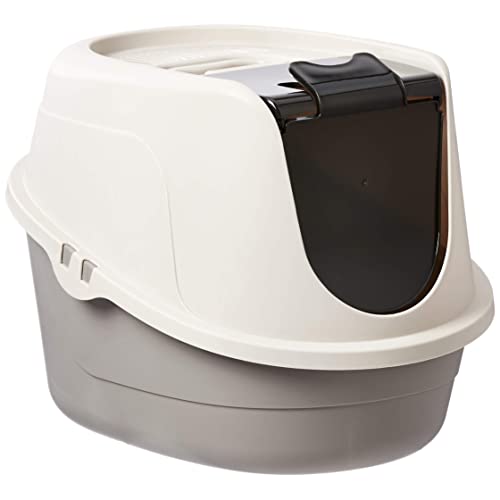
A plain hooded box at 21 by 16 by 15 inches with a swinging door and a carbon filter fitted from the start, and it is the brand that admits the filter runs out: replacements are sold separately, for continued freshness. That sentence is the most useful thing on this page about how odor control actually works. It is the cheapest of the three sizes in this range, and it is also the one whose bullets drop the built-in carrying handle its larger siblings list.
Pros:
- Carbon filter fitted from new
- Says outright that filters need replacing
- Swinging door keeps litter and smell inside
- The cheapest hooded box in its range
Cons:
- No built-in handle, unlike the bigger versions
- 21 inches outside; no interior figure given
- Odor resistant plastic, not non-porous
Best for: a filtered hood at the lowest price.
Foldable Enclosed
The most flexible box here and the smallest cat. It converts between open, high fence and fully enclosed, folds flat for storage or travel, and its control knob does something genuinely clever: it switches the exit between top and front, and the same knob shuts a dog out of the front door. A pull-out drawer makes cleaning a matter of sliding rather than lifting, and a deodorizing bag handles the smell. It is rated for cats up to 12 pounds, which its first bullet says three times.
Pros:
- Three modes: open, high fence, fully enclosed
- Knob switches top or front exit, and blocks dogs
- Folds flat for storage or travel
- Pull-out drawer; slide rather than lift to clean
Cons:
- Cats up to 12 lbs only, repeated three times
- A deodorizing bag rather than a carbon filter
- Plastic construction
Best for: a small cat and a household that moves things around.
Nature’s Miracle
The flip top is the best cleaning idea in this search. Simple latches release and the whole front opens upward, so you are not wrestling a hood off and putting it somewhere while you scoop, which is the small daily friction that decides whether a covered box gets cleaned often enough. It has a built-in charcoal filter for the odor and front-entry access for the cat, from a brand whose name is built on removing pet smells. What the listing never says is whether that built-in filter can be changed.
Pros:
- Flip top opens on latches; no hood to remove
- Built-in charcoal filter for odor
- Front entry; simple and familiar for cats
- From an established odor-control brand
Cons:
- Does not say whether the filter can be replaced
- Publishes no dimensions at all
- Plastic; five bullets and very little detail
Best for: making the daily scoop as easy as possible.
Amazon Basics with Lid
The biggest box in this search by a clear margin at 26 by 23 by 20 inches, and the interesting part is what it costs: about a dollar more than the same brand’s large hooded box, which is 24 by 18 by 17. Two more inches of length, five more of width and three more of height, for the price of nothing. Size is the most underrated feature in this category, because a cat that cannot turn around comfortably starts using the edges. Carbon filter fitted, swinging door, built-in handle, and it snaps into place for scooping.
Pros:
- 26 by 23 by 20 inches; by far the biggest here
- Costs about a dollar more than a much smaller box
- Carbon filter fitted; replacements available
- Built-in handle; snaps together for cleaning
Cons:
- Publishes no interior dimensions
- Takes up a lot of floor
- Odor resistant plastic, not non-porous
Best for: a big cat, or two, with room to turn round.
Tevila Stainless
The only box here that fixes odor with the material rather than a filter: a non-porous stainless tray that will not absorb smell, which is what eventually happens to every scratched plastic pan. It comes apart into three configurations, fully enclosed, semi-covered or open, so you can change your mind. Front entry with a top exit and a lockable latch keeps dogs out. It is 23.6 by 15.7 by 15.7 with an 80 liter body holding up to 40 liters of litter, and a carbon filter pack, scoop, step board and non-slip pads come with it.
Pros:
- Non-porous steel tray; will not absorb odor
- Three configurations from one box
- Front entry, top exit, lockable dog-proof latch
- Step board, scoop, filter pack and pads included
Cons:
- The highest price on this page
- 15.7 inches wide; narrower than the big plastic box
- Steel is loud when a cat digs
Best for: ending the smell rather than filtering it.
The verdict
Odor has two sources and this page only really addresses one. The waste you scoop; the box itself absorbs urine into scratched plastic until the pan is the problem. The plastic boxes say odor resistant. The steel ones say non-porous and will not absorb odors. And the hoods, by one listing’s own admission, seal the smell in rather than remove it.
Best overall: Tevila Stainless. Steel is the only answer here to the odor that a filter cannot touch, because a non-porous tray has nowhere for urine to soak into and no scratches for it to sit in. On top of that it converts between fully enclosed, semi-covered and open, gives you a front entry with a top exit so the dog cannot follow, locks that door, and arrives with a carbon filter pack, a scoop, a step board for older cats and non-slip pads.
Best value: IRIS Covered. The only listing in this search that publishes what your cat actually stands in: 15.25 by 14 inches inside a 21 inch box, with nearly six inches lost to the hood. It also tells you it suits small to medium cats instead of calling itself spacious, measures its door opening, and hangs the scoop on a hook under the hood. Buy it for a small cat and read its odor bullet, which admits the door seals the smell in.
Best premium: Amazon Basics with Lid. At 26 by 23 by 20 inches it is far and away the biggest box here, and it costs about a dollar more than the same brand’s much smaller large model, which is the easiest decision on this page. Room to turn around is what stops a cat using the edges. It has a carbon filter fitted, a swinging door, a built-in handle, and the brand is fair that filters are a consumable you will keep buying.
FAQ
Does a covered box actually reduce odor?
It reduces the odor reaching you. One listing here files “the flap door seals in odors” under odor control, which is exactly right and not quite the same thing. The smell concentrates inside, where your cat has to put its head, so daily scooping matters more with a hood, not less.
Why do steel boxes cost more?
Because they solve a different problem. Plastic is porous and gets scratched by claws, so it slowly absorbs urine until the pan itself smells. The two steel boxes here say non-porous and will not absorb odors; the plastic ones say odor resistant.
Do carbon filters need replacing?
Yes. They saturate and stop working. One brand here says replacement filters are sold separately for continued freshness. Another calls its filter built-in and never mentions changing it.
How big should the box be?
Bigger than the outside measurement suggests. One listing here publishes both: 21 inches outside, 15.25 inside, with nearly six inches eaten by the hood. Everyone else gives an exterior figure only, and your cat uses the interior.
What if I have a dog?
Look for a top exit. Three boxes here offer front entry with a top exit, and one adds a lockable latch. A dog can follow a cat into a front-entry hood and cannot follow it out through the roof.
This article may contain affiliate links; see our Affiliate Disclosure.