Every dog tracker sold without a subscription is answering the same question in the same way, and almost nobody explains it on the box. The monthly fee on a true GPS collar pays for a mobile phone plan inside the device. Remove the fee and you remove the phone plan, so the tracker has to find another way to phone home: it borrows the phones of everyone who walks past.


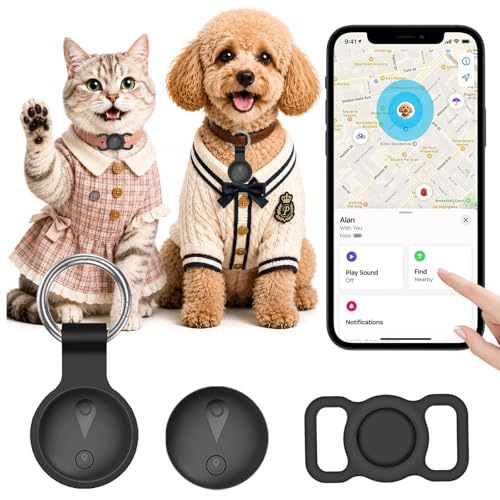

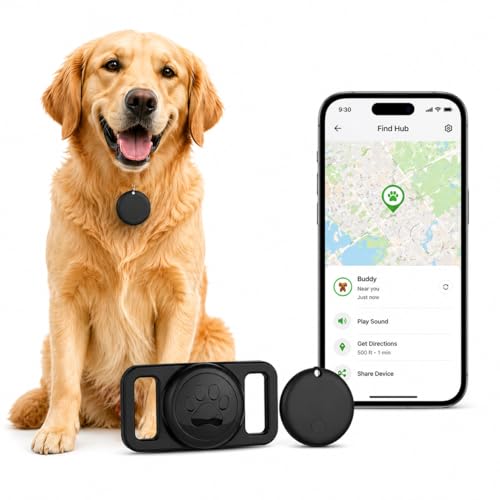
Understood properly, that trade is excellent value for some dogs and close to useless for others. This guide explains which is which, then compares the five subscription-free trackers worth considering, whether you live in a dense suburb, an apartment block, or somewhere the nearest stranger is a mile away.
At a glance
| Product | Standout feature | Price tier | Link |
|---|---|---|---|
| Wnrfg No Monthly Fee Pet Tracker | Up to 12 months of standby; audible alarm; collar included | Premium | |
| Jdeetve Smart Dog Tracker | Works on both iPhone and Android; QR route sharing; IP68 | Mid-range | |
| Focushine Pet Tracker | Apple Find My with no extra app; spare battery and two cases | Mid-range | |
| JOYGIEE Ultra-Slim Pet Tracker | Slimmest body; magnetic case; Apple Find My; safe zones | Budget | |
| MDTZULIK Pet Tracker Smart Tag | Google Find My Device network; Android only; lowest price | Budget | |
How subscription-free dog tracking actually works
Why there is no monthly fee
A true GPS collar contains a satellite receiver and a cellular radio with a SIM card. It works out where it is, then uses a mobile network to tell you, anywhere there is signal. The SIM needs a data plan, and that plan is the monthly fee. It is not a trick; it is a phone bill.
Every tracker here states plainly that it needs no SIM card. That means no mobile plan, and no way to transmit a position over the phone network on its own. Instead these devices use Bluetooth, which reaches perhaps 10 to 70 meters, and rely on other people’s phones to pass the location along. The battery life confirms the design: a device running a satellite receiver and a cellular radio continuously lasts days between charges, not the many months quoted here. Long battery life and no SIM are the signature of a Bluetooth finder tag.
The crowd network is the product
Apple’s Find My and Google’s Find My Device turn hundreds of millions of ordinary phones into anonymous relays. Your dog’s tag whispers a Bluetooth signal; any nearby phone that hears it quietly reports where it heard it; you see that spot on a map. The owners of those phones learn nothing, and it works remarkably well.
The catch is density. In a city, a busy park or an apartment block, phones pass constantly and updates feel almost live. On a rural lane, a forest trail or a mountain, nobody walks past, so no report is generated and the map keeps showing where your dog was last seen rather than where they are. This is the single most important thing to understand before buying. These trackers are excellent at finding a dog who is somewhere among people, and poor at following a dog running across empty country.
Check the platform before the features
Find My networks do not mix. A tag built for Apple Find My works with iPhones and iPads and cannot be used by an Android household. A tag on Google’s Find My Device network is Android only. Some trackers avoid the issue with their own app that runs on both. Getting this wrong makes the device useless, and it is stated clearly in every listing if you look for it.
What “real-time” plainly means here
Within Bluetooth range, roughly the length of a garden, your phone talks to the tag directly and can ring it, which is genuinely real-time and superb for a dog hiding under a shed or a cat inside a wall. Beyond that range you are reading the last report from a passing stranger’s phone, which may be seconds old or hours old. Safe-zone alerts work the same way: they fire when the network notices, not the instant your dog crosses a line. Take these as finders rather than followers.
Waterproofing, weight and attachment
Dogs swim, roll and dig, so an IP rating is not optional. IP67 covers rain, mud and brief immersion. IP68 adds a little more submersion tolerance. Weight matters for small dogs and cats especially: a tag around a third of an ounce is unnoticeable, while a true GPS collar unit is many times heavier, which is a real advantage of this category. Attachment is where these tags fail most often. A holder that clamps firmly beats a loop of plastic, because a tag lost in undergrowth has solved nothing.
What this cannot replace
A tracker is a recovery aid, not containment and not identification. It does not stop a dog leaving, it depends on batteries and other people’s phones, and it can be pulled off in a hedge. A microchip and a physical ID tag with your phone number remain the things that actually reunite lost dogs, because they work without power. Buy a tracker as a useful extra layer on top of those, not instead of them.
Wnrfg No Monthly Fee Pet Tracker
The best seller of the group, and the most complete package. It runs on its own free app for iOS and Android rather than locking you to one platform, weighs just 0.36 ounces, and carries an IP67 rating that shrugs off rain and mud. The standout is endurance: up to twelve months of standby, with the app showing the battery level so the thing never quietly dies in a drawer. It keeps location history so you can review where a wanderer has been, and it has a built-in audible alarm, which is the feature that most often actually finds a pet hiding nearby. An adjustable collar is included, and it works equally well clipped into a bag or a suitcase.
- Pros: Works on both iOS and Android through its own free app; up to 12 months of standby with battery level shown in the app; very light at 0.36 oz; IP67 waterproof; built-in audible alarm for close-range searching; location history; collar included; doubles as a luggage and asset tracker.
- Cons: Priciest here despite the same underlying no-SIM approach; IP67 rather than IP68; relies on the maker’s own app and network rather than Apple’s or Google’s larger ones.
Best for: Mixed iPhone and Android households wanting one tracker and a year between charges.
Jdeetve Smart Dog Tracker
Also cross-platform, through the free DEONETAG app, with one-click pairing that keeps setup short. It carries a full IP68 rating, so heavy rain, snow and brief submersion are handled, and it comes with a dedicated holder that clamps tool-free to a collar without wobbling, which matters for a dog who runs through hedges. Seven days of route playback shows a dog’s habits and favorite escape lines. The unusual feature is QR code sharing: the app generates an encrypted code, and anyone who scans it can see the pet’s live path, which turns a neighborhood search party into something coordinated rather than chaotic.
- Pros: Works on both Android and iPhone; full IP68 rating; dedicated clamping holder resists being shaken loose; 7 days of route history playback; encrypted QR sharing lets others help search; no activation fee; pet-safe materials; slim and light.
- Cons: Depends on a smaller proprietary network than Apple’s or Google’s; battery life is not stated; the extra app is one more account to hold.
Best for: Owners who want others to help look, and dogs who spend real time in water and mud.
Focushine Pet Tracker
This is the real one, and it is worth respecting for it: the listing states plainly that it works over a 10 to 70 meter Bluetooth connection and pairs directly to Apple’s Find My with no extra app at all. That means no third-party account, no separate login, and access to by far the largest finder network in existence. It is IP68 rated, tiny, and rings audibly to help you close the last few meters. Safe zones are set in the Find My app itself, and it keeps seven days of history. The package is generous for the price: the tracker, a keychain case, a collar case and a spare battery.
- Pros: Uses Apple’s Find My network, the largest of them all, with no extra app or account; real about its Bluetooth range; IP68; audible ringing for close searches; safe zones and alerts inside Find My; spare battery, keychain case and collar case included; needs iOS 15.4 or later.
- Cons: iOS, iPadOS and iPod touch only, so useless in an Android household; a coin-cell design that will need battery swaps; no owner’s app means no features beyond what Find My offers.
Best for: iPhone households in towns and cities, where the Find My network is thick with relays.
JOYGIEE Ultra-Slim Pet Tracker
The slimmest body here, riding on Apple’s Find My with no third-party app, and the cheapest way onto that network. It ships with a magnetic protective case plus a keychain case and a spare accessory, so it attaches to a collar, a backpack, a wallet or a suitcase without buying anything else. Seven days of movement history are available, and safe zones around home, yard or park push a notification when your dog strays past them. One point of caution worth knowing before you order: the listing claims IP68 in its title and IP67 in its detail, so take it as rain and splash proof and do not count on submersion.
- Pros: Lowest price on the Apple Find My network; ultra-slim and light enough for cats and small dogs; magnetic case plus keychain case and spare accessory included; safe zone alerts and 7-day history through Find My; no extra app or account.
- Cons: iOS only; the waterproof rating contradicts itself between IP68 and IP67 in its own listing, so assume the lower one; its claim of satellite positioning does not match a Bluetooth finder tag’s actual method.
Best for: iPhone owners wanting the smallest, cheapest tag for a cat or a small dog around home.
MDTZULIK Pet Tracker Smart Tag
The Android answer, and the cheapest tracker here. It connects to Google’s Find My Device network, which means every compatible Android phone in the country can quietly relay your dog’s position, and it needs no extra app because the function is already built into the phone in your pocket. The body is waterproof and rugged enough for rain, puddles and the scratching that follows, it is light enough not to bother a small dog, and it clips to any collar. For an Android household this is the direct counterpart to what the Apple tags do, at the lowest price in the group.
- Pros: Cheapest here; uses Google’s Find My Device network, a very large relay pool; no extra app, since it is built into Android; waterproof and rugged; light and comfortable on any collar size; no fees of any kind.
- Cons: Android only, and useless with an iPhone; no specific IP rating published, only “waterproof”; no audible alarm mentioned for close-range searching; no stated battery life.
Best for: Android households wanting basic, fee-free location on any size of dog.
The verdict
Best overall: the Wnrfg pet tracker. It is the strongest seller here and the most flexible: it works on iPhone and Android alike, runs up to twelve months on a charge with the level visible in the app, weighs almost nothing, survives rain and mud, and includes both a collar and an audible alarm, which is the feature that most often ends a search.
Best value: the MDTZULIK smart tag on Android, or the JOYGIEE on iPhone. Both put you on a nationwide finder network for the least money and no app to install, because the network is already in your phone.
Best premium: in a category this affordable, spend the extra on capability rather than badge. The Focushine earns it for pairing Apple’s enormous network with an IP68 body, a ringer and a spare battery, and for being straight about how it works. The Jdeetve is the pick if QR route sharing and a clamping holder appeal.
Frequently asked questions
Are these really GPS trackers?
Not in the way a subscription collar is. They carry no SIM card and no mobile plan, so they cannot transmit a position over the phone network by themselves. They use Bluetooth and rely on passing phones to relay the location, which is why they cost nothing to run and why their batteries last months rather than days. Several of these listings say GPS or satellite positioning; the underlying method is a finder network.
Will one work if my dog runs off into the countryside?
Probably not well, and this is the real limit. With no phones nearby, nothing relays the position, so the map keeps showing the last place a phone heard the tag. In a town or a busy park these tags are genuinely impressive. On empty land, a subscription GPS collar with its own mobile connection is the tool that works, and the fee is what buys that.
Can I use an Apple tag with an Android phone?
No. Apple’s Find My and Google’s Find My Device are separate networks and do not interoperate. Two of these are iOS only, one is Android only, and two use their own app across both. Check that first, because nothing else about the product matters if the network is wrong.
Does it replace a microchip?
No, and nothing should. A microchip needs no battery, cannot fall off in a hedge, and is what a vet or shelter scans when a stranger brings your dog in. A tracker helps you find a dog yourself in the first hour. Keep the chip details current, keep a physical ID tag on the collar, and take the tracker as a third layer.
How long do the batteries last?
It varies widely, and only some listings say. One here quotes up to twelve months of standby with the level shown in the app; the coin-cell tags typically run for months and one includes a spare. The rule is simple: check the battery in the app if you can, replace it on a schedule rather than when it fails, and remember a flat tracker is a plain lump of plastic.
This article may contain affiliate links; see our Affiliate Disclosure.