Rip a sheet of MDF on a benchtop saw and the coarse chips hit the floor in a second. The fine stuff never lands. It hangs at head height, drifts into the next room, and settles on everything you own by morning.



A one-tool shop has a specific problem: you need real capture at the machine, but you have no room for a two-stage cyclone bolted to a wall and no ducting budget to match. The units below all solve some version of that, and they do it in genuinely different ways. Knowing which way you need is most of the decision.
At a glance
| Product | Standout feature | Price tier | Link |
|---|---|---|---|
| WEN DC3401 | 660 CFM from a 17-pound body that wall-mounts | Budget | |
| WEN DC1300 | 1,300 CFM and dual 4-inch inlets for two tools | Premium | |
| WEN DC3474 | Induction motor built for long runs | Mid-range | |
| Mullet Cyclone Separator | Drops over 99% of debris before your vac filter | Premium | |
| Abestorm Tabletop | MERV-13 media that scrubs the air you breathe | Mid-range | |
How to choose a dust collector for a one-tool shop
Decide first: capture at the tool, or clean the room?
This is the split that trips up most buyers, and it is worth being blunt about. A dust collector with a 4-inch port hooks to the machine and pulls chips out at the source before they ever reach the air. A tabletop air filtration unit does something else entirely: it sits on the bench and pulls already-airborne dust through a filter. One avoids the mess, the other cleans up after it. They are not substitutes, and a shop that sands or carves regularly benefits from both. If you buy only one, buy the one that connects to your tool.
CFM is a headline, not a promise
Airflow ratings are measured at the inlet with nothing attached. Add ten feet of flex hose, a blast gate, and a 90-degree bend and real delivered airflow drops well below the number on the box. A rough working rule: a benchtop saw or sander wants somewhere around 350 CFM at the port to capture properly, and a jointer or planer throwing heavy chips wants more. Buying a unit rated near your minimum means you land under it once the hose goes on. Headroom is not vanity here.
Brushed motor or induction motor
A brushed universal motor is light, cheap, and loud, and its brushes wear. An induction motor is heavier and costs more, but it runs cooler, lasts longer, and hums instead of screaming. For fifteen-minute bursts on a weekend, brushed is fine. If your collector runs for an hour while you mill a stack of boards, the induction motor earns its weight.
What a 5-micron bag actually does
Standard collection bags are rated around 5 microns. They catch chips and the visible dust well. The particles that matter most for your lungs are smaller than that, and a 5-micron bag passes a fair share of them straight back into the room. This is not a reason to avoid these machines; it is a reason to understand them. Pair the collector with either an upgraded fine-filtration bag, an ambient air cleaner, or a respirator when you are making fine dust.
Where it will live
Floor space is the scarcest thing in a one-tool shop. Two of the units here mount to a wall, which turns dead vertical space into your collector’s home and keeps the footprint at zero. Others ride on casters so you can roll the machine to whichever tool needs it. Measure before you buy, and remember the collection bag needs clearance to fill.
Budget for the hose and fittings too
The machine is not the whole purchase. A 4-inch port needs 4-inch hose, clamps, and an adapter to whatever fitting your tool actually has, and benchtop tools rarely have a 4-inch outlet waiting for you. Reducers cost airflow, so keep the large diameter as close to the tool as the port allows. If you plan to serve two machines from one collector, add blast gates: an open gate on an idle tool bleeds off the suction you need at the working one. None of this is expensive, but discovering it after delivery is how a Saturday project turns into a parts run.
Noise is a real specification
Collectors are loud, and the motor type is most of the reason. A brushed universal motor makes a high whine that wears on you within minutes; an induction motor is a lower, steadier hum. Ambient filtration units are the quiet ones by comparison, typically well under the level of a shop vac. If your shop shares a wall with a bedroom or your sessions run long, take noise as a spec you shop on rather than something you tolerate afterwards.
WEN DC3401 Dust Collector, 5.7-Amp Motor with 12-Gallon Bag
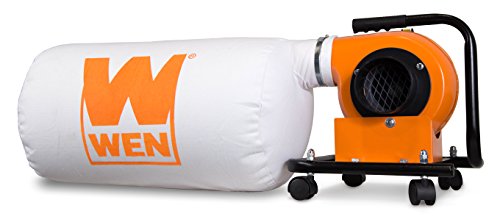
This is the most popular collector in the group by a wide margin, and the reason is easy to see. It weighs 17 pounds, measures 34.25 by 13 by 14.2 inches, and moves up to 660 CFM through a 6-inch impeller on a 5.7-amp motor. That is enough air for a single benchtop machine, delivered by something you can lift with one hand and hang on a wall. The 4-inch port takes standard fittings, the 12-gallon zippered bag empties without a fight, and lockable swivel casters let it follow you around the shop when you would rather not mount it.
- Pros: 660 CFM is real capture for one tool; 17 pounds with a carry handle; optional wall mount frees the floor entirely; lockable swivel casters; standard 4-inch port; two-year warranty; the lowest price in this group.
- Cons: Brushed motor is loud and wears over time; 12-gallon bag fills quickly under a planer; 5-micron bag passes fine dust; single port means one tool at a time.
Best for: a garage or basement shop built around one benchtop machine, where floor space is short and the collector needs to disappear onto a wall between sessions.
WEN DC1300 1,300 CFM Dust Collector with 50-Gallon Bag
Twice the airflow of anything else here. A 14-amp motor spins a 10-inch steel impeller at up to 3,450 RPM for 1,300 CFM, and the dual 4-inch inlets mean two machines can stay connected at once, each behind its own blast gate. The vertical bag swallows 50 gallons of chips, so a full day of milling does not end in an emptying ritual. It rides on a four-caster mobile base because at this size you are not lifting it anywhere.
- Pros: 1,300 CFM handles chip-heavy work a small unit cannot; dual inlets serve two tools; 50-gallon bag means far fewer emptyings; 10-inch steel impeller; mobile base included.
- Cons: The largest footprint here and no wall-mount option; 14 amps is a serious draw on a shared circuit; loud; still a 5-micron bag; the highest price in the group.
Best for: a shop that has outgrown one tool, especially with a planer or jointer in the mix, and has the floor space and circuit to feed it.
WEN DC3474 Dust Collector, 7.4-Amp Induction Motor with 15-Gallon Bag
The interesting trade in this lineup. Its 7.4-amp induction motor and 9-inch impeller move up to 600 CFM, slightly less than the smaller DC3401 on paper, yet it weighs 41.1 pounds instead of 17 and costs more. What you are buying is the motor. Induction motors have no brushes to wear, run cooler under sustained load, and are markedly quieter. The bag is bigger at 15 gallons, it still wall-mounts, and it keeps the carry handle and swivel casters.
- Pros: Induction motor for long runs and a longer life; quieter than a brushed unit; 15-gallon bag; wall-mountable despite the weight; two-year warranty.
- Cons: 600 CFM is marginally below the cheaper DC3401; 41.1 pounds is a two-hand lift to a wall bracket; a bigger 43.3-inch body; costs more for less airflow, which only makes sense if you value the motor.
Best for: anyone whose collector runs for long stretches rather than short bursts, and who would rather have durability and lower noise than a slightly higher CFM figure.
Mullet High-Speed Cyclone Dust Collector for Shop Vacuum
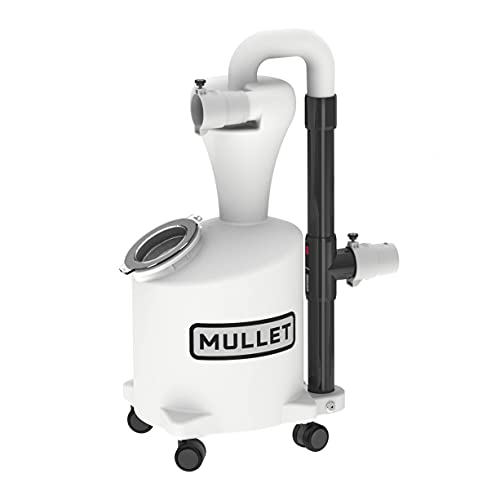
Not a collector at all, and that is the point. The Mullet is a cyclone separator that sits between your existing shop vac and the tool, spinning over 99% of the debris into a bucket before it can reach the vac’s filter. Anyone who has watched a shop vac lose half its suction three minutes into sanding knows the problem it fixes. The parabolic, one-piece body accelerates the airstream for better separation than a straight-wall cyclone-and-bucket setup, and the rigid cut-to-fit PVC connection replaces the usual tangle of bungees and duct tape. Hose adapters cover effectively any wet/dry vac.
- Pros: Keeps vac suction near constant instead of fading; over 99% pre-separation; no clogged filters and far longer filter life; rigid airtight connection; universal vac compatibility; uses gear you already own; made in the USA.
- Cons: Needs a shop vac and a bucket, so it is not a standalone answer; total cost climbs once you count the vac; a shop vac’s small hose still moves far less air than a 4-inch collector at a saw port; takes up bench or floor room alongside the vac.
Best for: a shop that already has a good wet/dry vac and wants to stop killing filters, or anyone whose tools have small ports where a 4-inch collector is the wrong shape of solution.
Abestorm Tabletop Dust Collector and Air Filtration System
The true benchtop unit in the group, and the one that handles the dust the others miss. It sits at 14.57 by 9.45 by 11.81 inches in a metal housing with a handle, pulls 580 or 780 CFM through a MERV-13 filter, and captures the fine airborne particles a 5-micron bag lets through. The timer runs up to 120 minutes, which is the right way to use it: start it, leave the shop, come back to clean air. A piano-key switch handles on and off, a circuit breaker cuts power on overcurrent, and an auxiliary outlet chains a second Abestorm unit. The filter lasts up to six months, and the cord wraps on the side.
- Pros: MERV-13 media catches the fine dust bag collectors pass; small enough to live on the bench beside the work; 120-minute timer for unattended clearing; two speeds; sturdy handle and 11.5-foot cord; circuit breaker protection.
- Cons: Does not connect to a tool port, so it never stops dust at the source; filter is a consumable at roughly six-month intervals; 0.9-amp fan cannot move air like a 660-CFM collector; a bench-level unit gives up bench space.
Best for: carving, sanding, turning, and finish work where dust goes airborne no matter what, and for anyone who wants the air breathable rather than merely tidy.
The verdict
Best Overall: WEN DC3401. It is the best seller of this group by a clear margin and it deserves that spot. For a shop built around one benchtop machine, 660 CFM through a 4-inch port is genuine capture, and packing it into 17 pounds that hang on a wall solves the floor-space problem that defines small shops. It is also the least expensive unit here. Nothing else in the group matches that combination.
Best Value: WEN DC3474. Paying more for slightly less airflow sounds backwards until you notice the induction motor. If the collector runs long and often, the quieter, brush-free motor and the larger 15-gallon bag return the difference over years rather than months.
Best Premium: WEN DC1300. When one tool becomes two and chips start coming off a planer, 1,300 CFM and dual inlets stop being luxury and start being the requirement. The 50-gallon bag is the quiet luxury of the thing.
The other two are specialists worth knowing. The Mullet is the answer when a shop vac is already the hub. The Abestorm is the answer to the dust you cannot see, and it pairs with any of the WEN units rather than competing with them.
Frequently asked questions
Is a tabletop air filtration unit the same as a dust collector?
No, and the shared shelf space causes real confusion. A dust collector connects to a tool’s port and removes chips at the source. A tabletop filtration unit filters dust that is already floating in the room. Both are useful; only the first stops the mess from happening.
Can a shop vac replace a dust collector?
For small ports on sanders and routers, a shop vac is often the better shape of tool: high suction through a narrow hose. For a saw or planer port, a collector wins, because it moves far more air even though it pulls at lower pressure. Adding a cyclone separator to a shop vac fixes its worst habit, which is losing suction as the filter loads.
How much CFM do I actually need for one benchtop tool?
Aim for roughly 350 CFM delivered at the port for a benchtop saw or sander, and more for anything that throws heavy chips. Because hose length and bends eat airflow, buy a unit rated comfortably above your target rather than exactly at it.
Are 5-micron collection bags good enough?
They handle chips and visible dust well and pass a share of the finer particles back into the room. If you make a lot of fine dust, add an upgraded fine-filtration bag, run an air filtration unit, or wear a respirator. Take the bag rating as a starting point, not the finish line.
Does a wall-mounted collector lose any performance?
Mounting does not change the machine’s airflow. What changes is your ducting: a fixed position means fixed hose runs, so plan the shortest, straightest path to the tool you use most. Every extra bend costs you real air.
This article may contain affiliate links; see our Affiliate Disclosure.