Dried beans, no soak, forty minutes. A pot roast that would take an afternoon, done before the table is set. That compression of time is why an electric pressure cooker earns its counter space, and why one brand became so dominant that people use its name as the noun. The interesting question is whether the competition has caught up.



A great electric pressure cooker gets three things right: a capacity that matches how you cook, a steam release that feels safe rather than alarming, and an inner pot you are happy to sear in and then put in the dishwasher. The five below cover the dominant Instant Pot line at three sizes and feature levels, plus two competitors that undercut it or rethink the details. A solo cook making a week of lunches, a couple batch-cooking on Sundays, or a household feeding six on a weeknight will each find a sensible size here.
At a glance
| Cooker | Standout feature | Price tier | Link |
|---|---|---|---|
| Instant Pot Duo Plus 6QT | Nine functions including sous vide, easy release | Mid-range | |
| Instant Pot Duo 6QT | The classic seven-function workhorse | Mid-range | |
| Instant Pot Pro 8QT | Large capacity, quiet diffused steam release | Premium | |
| Cosori 6QT | Angled steam release, ceramic inner pot | Mid-range | |
| DUMOS 16-in-1 6QT | Most functions for the lowest price | Budget | |
How to choose an electric pressure cooker
Size: bigger is not automatically better
Capacity is the decision you cannot undo later. A 6-quart pot is the popular default, comfortable for around six servings and big enough for a whole chicken, a large pot of soup, or a batch of chili for the week. An 8-quart handles about eight servings and suits big-batch cooking, canning-sized jobs, and larger cuts of meat, at the cost of counter space and a slightly longer time to come up to pressure. Smaller 3-quart and 4-quart models exist for singles, small households, and side dishes, and they store far more easily. Bear in mind a pressure cooker should only be filled to about two-thirds, so pick a size above what you think you need, not right at it.
The functions you will actually use
Marketing counts functions in the double digits, but most people live on four: pressure cook, saute, slow cook, and keep warm. Saute matters most, because browning meat and onions in the same pot before pressure cooking is what separates a flat stew from a good one. Beyond the basics, yogurt making, sous vide, sterilizing, and rice programs are useful if you will genuinely use them. One-touch smart programs are convenient shortcuts, though a manual time-and-pressure setting is what experienced cooks reach for most.
Steam release and safety
The moment that intimidates new users is releasing pressure, and makers have worked hard on it. Look for a switch-style release you can flip without putting your hand over the vent, and a design that angles or diffuses the steam away from cupboards and faces. Modern cookers stack up ten or more safety mechanisms, including lid locks that prevent opening under pressure, overheat protection, and dry-boil monitoring, so the appliance simply will not let you make the classic mistakes.
Inner pot material
Stainless steel is the traditional choice and the more versatile one: an 18/8 pot with a tri-ply bottom takes high-heat searing, resists scratching from metal utensils, and is dishwasher safe. Ceramic-coated pots are the nonstick alternative, easier on cleanup and gentler with sticky grains, though the coating needs softer utensils and more care over the years. An anti-spin design that stops the pot rotating while you stir is a small feature you will appreciate every time you saute.
Controls and convenience
A clear display showing time, temperature, and pressure keeps you informed rather than guessing. A delay-start timer lets you load the pot in the morning and have dinner begin without you, and keep-warm holds it until you are home. Detachable power cords make storage tidier. These are small things individually, and together they decide whether the cooker lives on the counter or in a cupboard.
Instant Pot Duo Plus 9-in-1 (6 Quart)
The Duo Plus is the best-seller of the entire category, and it is the model most people should buy. It covers nine functions, pressure cook, slow cook, saute, sous vide, steam, sterilize, keep warm, rice, and yogurt, with fifteen one-touch smart programs behind them. The Easy-Release steam switch makes venting fast and simple rather than nerve-wracking, and an easy-to-read display shows cooking time, temperature, and pressure as you go. The pro-grade 18/8 stainless pot has an anti-spin tri-ply bottom that sears properly, and the lid and pot are dishwasher safe. It ships with two spare sealing rings and a steam rack, packs over ten safety mechanisms, and the detachable cord makes it easy to put away.
Pros
- Nine functions including sous vide and yogurt
- Easy-Release steam switch for safe, simple venting
- Tri-ply anti-spin stainless pot sears well
- Spare sealing rings and steam rack included
Cons
- Costs a little more than the plain Duo
- Some functions will go unused by casual cooks
Best for: almost anyone buying their first or next pressure cooker for a household of up to six.
Instant Pot Duo 7-in-1 (6 Quart)
The original Duo is the model that built the category’s reputation, and it remains a superb buy. Seven functions cover pressure cooking, slow cooking, saute, steam, rice, yogurt, and keep warm, with thirteen one-touch programs, which is everything most weeknight cooking asks for. It cooks up to 70 percent faster than slow-cooking methods, uses the same Easy-Release steam switch, and has the stainless 18/8 tri-ply pot that browns properly before you seal the lid. The 6-quart size serves about six, making it a natural fit for batch cooking and meal prep, and the lid and inner pot go in the dishwasher. If you do not need sous vide or sterilizing, this saves money for no real loss.
Pros
- Covers every core function most cooks need
- Proven, hugely popular design
- Stainless tri-ply pot for searing
- Costs less than the Duo Plus
Cons
- No sous vide or sterilize programs
- Fewer one-touch presets than newer models
Best for: cooks who want the trusted classic and would rather not pay for extras they will skip.
Instant Pot Pro 10-in-1 (8 Quart)
The Pro is the step up for people who cook in volume. Its 8-quart capacity handles around eight servings, which means big-batch soups, larger roasts, and enough chili to freeze half. Ten functions span pressure cooking, slow cooking, sous vide, saute, sterilizing, yogurt, rice, baking, steaming, and keep warm, backed by 28 one-touch programs, the deepest preset list here. It preheats about 20 percent faster and cooks up to 70 percent faster than slow cooking, and the standout refinement is a gentle steam release with a diffusing cover, so venting is quiet and controlled rather than a jet across your kitchen. Easy-grip pot handles, an auto-sealing lid lock, and a 1400-watt element round it out.
Pros
- Large 8-quart capacity for batch cooking
- Quiet, diffused steam release
- 28 one-touch programs and ten functions
- Faster preheat with easy-grip pot handles
Cons
- Highest price of this group
- Takes up real counter and cupboard space
Best for: batch cooks, big households, and anyone who freezes half of everything they make.
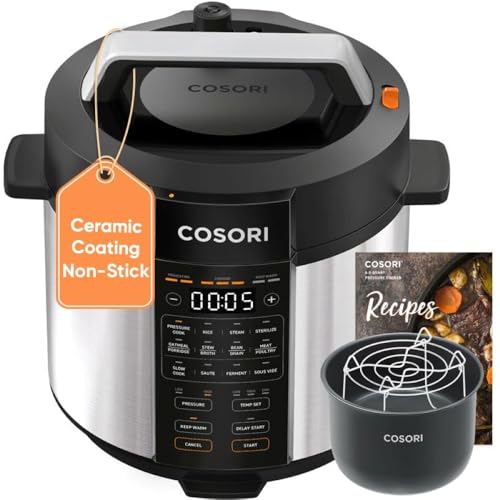
Cosori 6QT 9-in-1 Multi Cooker
The Cosori is the strongest direct challenger, and it wins on a couple of thoughtful details. Its venting design puts the seal and vent button away from the steam release valve and angles the release 30 degrees backward, so steam goes away from your hand, which is a genuinely reassuring touch. It runs 9 machines in one, covering pressure cooking, rice, steam, sterilize, porridge, stew, beans, meat, slow cook, saute, ferment, sous vide, and keep warm, and it pairs a stainless fingerprint-resistant housing with a ceramic inner pot for easier cleanup. A widened pot gap and dishwasher-safe lid, pot, and accessories make washing up simple, and twelve safety features including a double-layer anti-scald lid back it up.
Pros
- Angled steam release directs steam away from you
- Twelve safety features including an anti-scald lid
- Ceramic inner pot for easy cleanup
- Fingerprint-resistant stainless housing
Cons
- Ceramic coating needs gentler utensils than steel
- Smaller recipe community than the market leader
Best for: cooks who want the safest-feeling steam release and an easy-clean ceramic pot.
DUMOS 16-in-1 Electric Pressure Cooker (6 Quart)
The DUMOS is the budget play, and it is a lot of appliance for the money. It claims 16 functions with 12 one-touch presets, standing in for a pressure cooker, rice cooker, steamer, yogurt maker, and more, and its smart presets set time and pressure for you. A 24-hour delay start means you can load it in the morning and have cooking begin while you are out. The 6-quart pot suits three to five people and handles whole chickens, hearty soups, and bulk grains, and the ceramic inner pot resists sticking and scratching with a dishwasher-safe lid and sealing ring. Safety covers overheat protection, dry-boil monitoring, and a lid indicator that blocks operation if the lid is not secured.
Pros
- Lowest price with the longest function list
- 24-hour delay start for hands-off scheduling
- Non-stick ceramic pot that is easy to clean
- Overheat, dry-boil, and lid-lock protections
Cons
- Ceramic pot does not sear as well as tri-ply steel
- Less established track record than the big names
Best for: budget-conscious cooks who want plenty of programs and delay-start convenience.
The verdict
Best overall: the Instant Pot Duo Plus. It is the runaway best-seller for good reason: nine genuinely useful functions, a safe and simple steam release, a stainless pot that sears properly, and spare sealing rings in the box, all at a mid-range price. It is the one to buy unless you have a specific reason not to.
Best value: the DUMOS 16-in-1. It brings a long list of programs, delay start, and a clean-friendly ceramic pot for the lowest price here, which makes it the sensible entry point if you are testing whether pressure cooking fits your kitchen.
Best premium: the Instant Pot Pro 8QT. The bigger capacity, quiet diffused steam release, faster preheat, and 28 presets make it the most capable cooker here for anyone regularly feeding a crowd or filling a freezer.
Frequently asked questions
What size pressure cooker should I buy?
Six quarts is the versatile default, serving around six and fitting a whole chicken or a big pot of soup. Choose 8 quarts if you batch cook, freeze meals, or feed a larger group. Smaller 3-quart and 4-quart models suit singles, small households, and side dishes, and store more easily. Remember that you should not fill past about two-thirds.
Is an Instant Pot really better than the competitors?
It has the largest recipe community, the deepest accessory range, and a very strong track record, which counts for a lot when you are learning. That said, the Cosori answers back with a smarter steam release and a ceramic pot, and the budget models offer more presets for less money. The gap is narrower than the brand’s fame suggests.
Stainless steel or ceramic inner pot?
Stainless with a tri-ply bottom is better for searing and browning, tolerates metal utensils, and lasts indefinitely. Ceramic is nonstick, so it is easier to clean and kinder to sticky rice and grains, but it wants soft utensils and gentler treatment to protect the coating. If browning meat matters to you, choose stainless.
Are electric pressure cookers safe?
Modern ones are built around this concern. They stack ten or more safety mechanisms, including lids that lock and will not open while under pressure, overheat protection, and dry-boil monitoring. Newer steam-release designs let you vent with a switch and direct steam away from your hand. Follow the fill limits and the manual, and they are very safe appliances.
Can one appliance really replace a slow cooker and a rice cooker?
For most kitchens, yes. Every cooker here does slow cooking, rice, and steaming alongside pressure cooking, and several add yogurt, sous vide, and sterilizing. Pressure cooking will do in under an hour what a slow cooker takes most of a day to do, though some people still prefer a slow cooker’s texture on certain stews.
This article may contain affiliate links; see our Affiliate Disclosure.