Four gallons is roughly thirty-three pounds on your back before you have taken a step, and a manual sprayer asks you to work a lever the entire time you carry it. Anyone who has done a long fence line with a leaking pump knows the two things that matter: the chemical stays out of your shirt, and your arm still works tomorrow.



A four-gallon backpack sprayer is the sweet spot for a large garden, a paddock, a long driveway or a small commercial round: enough capacity to finish a job without refilling, not so much that you cannot stand up. The picks below split between battery pumps that spray for hours and manual pumps that never need charging, and both approaches have a genuine case.
At a glance
| Product | Standout feature | Price tier | Link |
|---|---|---|---|
| OGERY Battery Powered Backpack Sprayer | Two wands for different chemistries; 6 nozzles; 90 min runtime | Budget | |
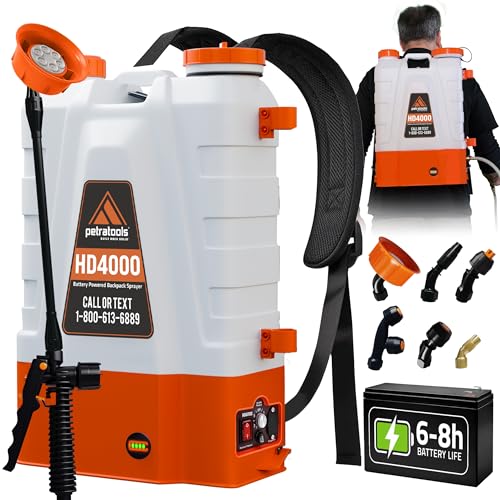
| PetraTools HD4000 Battery Backpack Sprayer | 12V 8Ah battery, 200+ gallons per charge, 40-90 PSI control | Premium | |
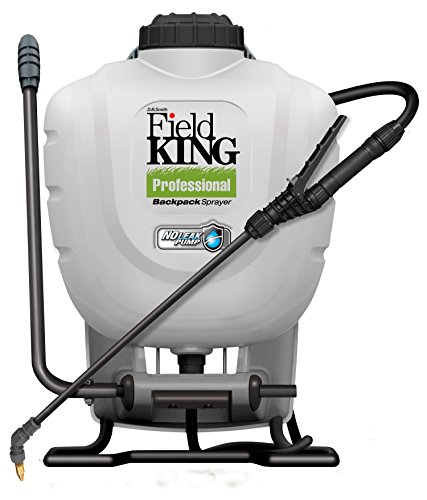
| Field King 190328 Backpack Sprayer | Internal no-leak piston pump, 150 PSI, Viton seals, tool-free service | Mid-range | |
| VAXMAY Battery Powered Backpack Sprayer | Runs on Makita 18V batteries; 100 PSI; 39.3 in telescopic wand | Mid-range | |
| Chapin 60114 Backpack Pump Sprayer | 3-stage filtration; 4 in filling opening; padded waist strap | Budget | |
How to choose a four-gallon backpack sprayer
Battery or manual: the fork in the road
A battery sprayer holds steady pressure without you doing anything, which is transformative on a big job. Even coverage stops depending on how tired your pumping arm is, and an hour of spraying stops being an hour of exercise. The cost is a battery to charge, a motor to eventually fail, and a machine you cannot fix with a seal kit.
A manual pump has no battery to flatten and no electronics to drown. Pump it, spray, pump again. Good ones rebuild with a handful of seals and last decades, which is why they still dominate professional use. The cost is your left arm and slightly uneven pressure as the tank runs down. If your jobs are short, or you spray twice a year, manual is not a compromise. If you are covering acres, the battery pays for itself in the first afternoon.
More pressure is not better spraying
This one is counterintuitive and matters most for herbicide. High pressure atomizes liquid into finer droplets, and fine droplets drift, which means your weedkiller lands on the neighbor’s roses instead of the weeds. For most garden spraying you want lower pressure and a coarse droplet, somewhere in the 20 to 40 PSI range. The 150 PSI a good piston pump can reach is for reaching high branches or blasting a surface clean. Take pressure as headroom you can dial down, and buy an adjustable knob rather than the biggest number.
Internal pumps keep chemicals off your back
The single best safety feature in the category, and the one people notice only after it has failed them. On an external pump, the pump body sits outside the tank, so a worn seal drips concentrate down your spine while you walk. An internal pump sits inside the tank, so a leak leaks into the tank. If you spray anything stronger than seaweed feed, this is worth choosing on purpose.
Seals decide what you can spray
Viton seals resist the solvents and harsh chemistries that swell ordinary rubber, which is why they show up on sprayers meant for wettable powders and strong herbicides. Standard seals are fine for water, fertilizer and mild mixes. The battery sprayers approach this differently, sometimes shipping two wands so that acids and alkalis never touch the parts meant for neutral solutions. Either way, match the machine to the chemistry, and rinse it out afterwards.
Nozzles, filters and clogs
A nozzle set is not padding on the box: a fan nozzle for even lawn coverage, a cone for general work, a jet for distance, and a windproof or foaming head for specific jobs each change what the sprayer is good at. Filtration is the unglamorous companion. Debris in the tank blocks nozzles, and multi-stage filters catch it at the cap, in the line and at the nozzle. A wide filling opening is the third piece: pouring concentrate into a 4-inch mouth spills far less than into a bottleneck.
Carry comfort is a specification
Thirty-three pounds concentrates on two straps. Padded, adjustable straps are the minimum; a waist belt is what moves the load from your shoulders to your hips and is the difference between an hour and three. A translucent tank with gallon markings lets you see what is left without taking it off, which sounds trivial until you have guessed wrong and mixed too much.
OGERY Battery Powered Backpack Sprayer
The best seller here, and it arrives with an idea nobody else had: two wands. A telescopic stainless steel wand handles water and neutral solutions, and a separate plastic wand handles diluted acids and alkalis between pH 4 and 9, so the harsh stuff never touches the steel. The 21V 2.6Ah battery gives about ninety minutes of continuous spraying and recharges in two and a half hours, with automatic cut-off to protect it from over-discharge. Flow runs to 3.1 liters a minute through an adjustable pressure knob, and six nozzles cover spot product, lawns, high branches, rows and breezy days. The tank is 4.2 gallons with gallon markings.
- Pros: Two wands so harsh chemistries never touch the steel one; six nozzles including a genuinely useful windproof head; adjustable pressure from mist to jet; 90 minutes of spraying, 2.5 hour recharge; over-discharge protection; high 3.1 L/min flow; 4.2 gallon translucent tank; thick adjustable straps; one-year warranty.
- Cons: The 2.6Ah battery is modest next to the PetraTools; no waist belt mentioned, so the load stays on your shoulders; a proprietary battery rather than one you may already own.
Best for: Home gardeners and smallholders wanting battery convenience without the professional price.
PetraTools HD4000 Battery Powered Backpack Sprayer
The battery is the product. A 12V 8Ah pack runs six to eight hours and pumps more than 200 gallons on a charge, which is roughly fifty tank refills and, in practice, a full working day without thinking about power. Pressure adjusts from 40 to 90 PSI, six nozzles cover misting through to streams, and the 34.5-inch extendable wand has a squeeze handle with a lock so your hand is not clamped shut all morning. Double-padded straps and a back pad carry the weight, a wide-mouth lid makes filling and cleaning simple, and a screen filter keeps the nozzles clear.
- Pros: 12V 8Ah battery running 6 to 8 hours and 200+ gallons per charge, far beyond anything else here; 40-90 PSI adjustable pressure; six nozzles; 34.5 in extendable wand with a locking squeeze handle; double-padded straps and back pad; wide-mouth lid; screen filter; translucent tank with gallon marker; US-based support.
- Cons: More than twice the price of any other sprayer here; overkill for a suburban garden; heavier for the larger battery.
Best for: Large properties, farms and anyone spraying as part of a working day rather than a weekend chore.
Field King 190328 Backpack Sprayer
The one the professionals reach for, and it has nothing to do with batteries. The pump sits inside the tank, so chemicals cannot drip down your back, which is the reason to buy it over almost anything else. That internal piston delivers up to 150 PSI, enough to reach high into a tree, and Viton seals mean wettable powders and aggressive liquids do not destroy it. The genuinely rare feature is serviceability: the pump comes apart for new seals in minutes with no tools, so this is a sprayer you repair rather than replace. Six nozzles come in the box, and it accepts TeeJet nozzles if you want agricultural precision.
- Pros: Internal no-leak pump keeps chemicals off your back; up to 150 PSI from an internal piston; Viton seals handle wettable powders and harsh liquids; seals replaceable in minutes without tools; lockable brass shut-off with in-line filter; six nozzles including foaming and jet stream; accepts TeeJet nozzles; does the work of both piston and diaphragm designs.
- Cons: Manual pumping, so your arm supplies the pressure; the 21 in wand is the shortest here; no battery convenience for long jobs.
Best for: Anyone spraying real chemicals, and people who would rather rebuild a tool than bin it.
VAXMAY Battery Powered Backpack Sprayer
The clever one: it takes Makita 18V batteries. If your shed already runs on that platform, you have spare packs, a charger and no new ecosystem to feed, and a flat battery means swapping rather than stopping. A 2.6Ah battery and charger come along anyway. The 3800 rpm motor reaches 100 PSI through an adjustable knob, a digital voltage display shows exactly what is left, and discharge protection cuts out below 14V. The telescopic wand extends to 39.3 inches, the longest here, and five nozzles cover the usual jobs. A waist support and thickened cushioning move the load off your shoulders.
- Pros: Runs on Makita 18V batteries, so spares and chargers may already be in your shed; digital voltage display; discharge protection; 100 PSI from a 3800 rpm motor with adjustable knob; longest wand here at 39.3 in; genuine waist support and thick cushioning; sprays about 16 tanks per charge; battery and charger included; one-year warranty.
- Cons: Five nozzles rather than six; the value of the Makita compatibility depends entirely on what you already own; runtime well short of the PetraTools.
Best for: Anyone already on Makita batteries, and jobs needing extra reach or long carrying comfort.
Chapin 60114 Backpack Pump Sprayer
The cheapest way into a real four-gallon backpack, and it spends its budget sensibly. Three-stage filtration catches debris at several points rather than letting it reach the nozzle, which is the difference between spraying and unblocking. The tank opening is four inches across with a filter cap, so filling and cleaning are quick and spills are rare. An adjustable poly cone nozzle shifts from a coarse stream to a gentle shower, covering most garden work with one head. Padded adjustable shoulder straps and a waist strap carry it, the 20-inch poly wand reaches into beds, and it is made in the USA with a one-year limited warranty and a phone line staffed by people.
- Pros: Lowest price here; 3-stage filtration to avoid clogs; wide 4 in opening with filter cap for easy filling and cleaning; adjustable cone nozzle from coarse stream to shower; padded straps plus a waist strap; translucent tank; made in the USA with a one-year warranty and real technical support.
- Cons: Manual pumping; one nozzle rather than a set; no stated Viton seals, so check compatibility before harsh chemistries; 20 in wand is short for high work.
Best for: Homeowners doing seasonal weed, pest and fertilizer work who want a dependable tank, not a machine.
The verdict
Best overall: the OGERY battery powered backpack sprayer. It is the strongest seller here and it removes the pumping arm from the equation at a price close to the manual sprayers. Two wands for different chemistries, six nozzles, adjustable pressure and ninety minutes of runtime cover the realistic span of garden jobs.
Best value: the Chapin 60114. Three-stage filtration, a wide fill opening, a waist strap and a warranty backed by a phone number, for the least money in the group. If you spray a few times a year, nothing else here is necessary.
Best premium: the PetraTools HD4000, for a battery that outlasts the working day and pressure control from 40 to 90 PSI. For chemical work specifically, the Field King 190328 is the more serious tool thanks to its internal pump and Viton seals, and the VAXMAY wins outright if you own Makita batteries.
Frequently asked questions
Battery or manual for a normal garden?
If a job takes you under twenty minutes and happens a few times a year, manual is simpler and there is nothing to go flat. Once you are spraying a long fence line, an orchard or a paddock, a battery changes the experience completely, because steady pressure means even coverage and your arm is not the pump. Cost is no longer the deciding factor: the battery sprayers here start near the manual ones.
What pressure should I actually spray at?
Lower than you think, for most jobs. High pressure makes fine droplets, and fine droplets drift onto plants you did not intend to handle. Coarse droplets at modest pressure land where you aim them. Save the high end for reaching height or cleaning surfaces, and use the adjustable knob rather than taking maximum PSI as a goal.
Can I use weedkiller and fertilizer in the same sprayer?
Strongly inadvisable. Herbicide residue clinging inside a tank will damage whatever you feed next, and rinsing rarely removes all of it. The standard practice is a dedicated sprayer for herbicides and another for everything else. Failing that, label the tank clearly and triple-rinse, accepting some risk.
Why has my sprayer stopped spraying properly?
Nearly always a clog, and nearly always at the nozzle or the filter. Debris gets in when filling, which is why filtration and a filter cap matter. Strip the nozzle, rinse the screen, and check the in-line filter. On a manual pump, a weak spray with good pumping usually means a worn seal, which is a minutes-long job on a serviceable sprayer.
How should I store it over winter?
Empty, rinsed and dry, with the pressure released. Leftover chemical eats seals and freezes. Run clean water through the wand and nozzle until it comes out clear, leave the lid loose so it can breathe, and store batteries somewhere that does not freeze, at partial rather than full charge.
This article may contain affiliate links; see our Affiliate Disclosure.