One grinder here sells you precision grinding control, explains that its knob has seconds marked on it, and promises the exact coarseness for espresso. Read the fourth bullet: it has blades. Its grind size is how long it chops for. The same listing then says it is significantly quieter than traditional blade grinders, which is a blade grinder distinguishing itself from blade grinders, and it is the clearest confession on this page.




At a glance
| Product | Blades or burrs, and how many settings | Price tier | Link |
|---|---|---|---|
| Amazon Basics | Blades. Its own bullet says drip coffee | Budget | |
| Mini Manual Grinder | Conical ceramic burr, 40 settings, 30g | Budget | |
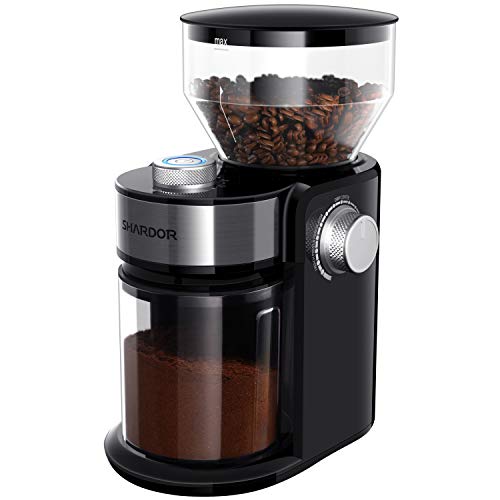
| SHARDOR 70g | Blades, and a timer sold as a grind setting | Budget | |
| SHARDOR Burr 2.0 | A real flat burr. Only 16 settings | Budget | |
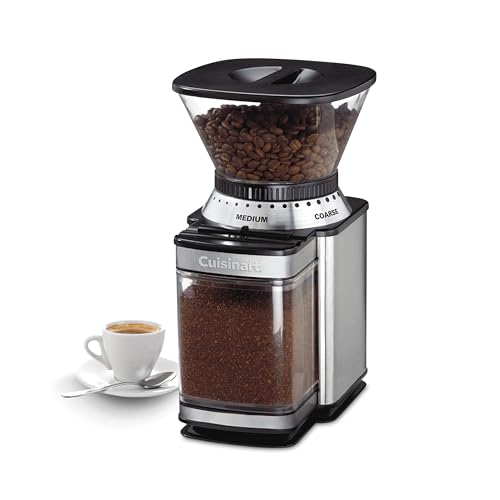
| Cuisinart DBM-8P1 | Flat burr, 18 positions, and it doses in cups | Mid-range | |
| KIDISLE | 51 settings on a 40mm conical burr, for less | Mid-range | |
| SHARDOR Conical 2.0 | Doses in tenths of a second. Nothing else comes close | Premium | |
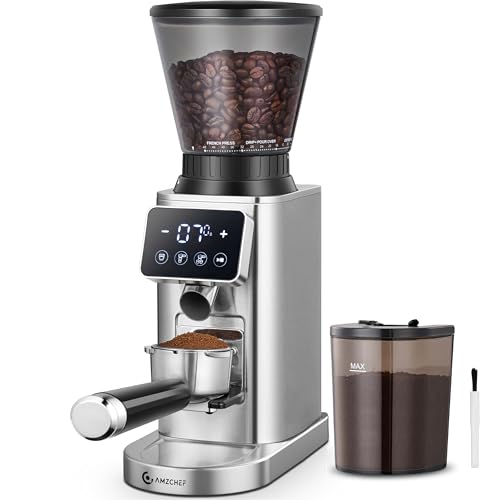
| AMZCHEF | The only published burr speed, and the only portafilter size | Premium | |
How to choose
A blade grinder cannot make espresso
This is not a preference, it is the machine. A blade chops, and chopping produces dust and boulders in the same jar. Espresso forces hot water through a compressed puck under real pressure, and that pressure finds the easiest path: the dust packs solid and blocks, the boulders leave channels the water races through, and what comes out is sour and thin at once. A burr does something different, crushing beans between two shaped surfaces set a fixed distance apart, so every particle is roughly that distance. Three grinders on this page have blades. They will make you perfectly good drip coffee.
When the grind setting is a clock
Watch how the blade grinders describe adjustment, because none of them can lie about it convincingly. One offers a knob with seconds marked on it, coarse to fine, which means coarse is a short chop and fine is a long one. Another says its push-button lets you customize the consistency from coarse to fine, which means the same thing with the timing done by your thumb. Neither has a distance between two surfaces to set, because neither has two surfaces. Grinding longer does not make particles uniform; it makes more dust alongside the boulders you already had.
Espresso is dosed in grams, not cups
A shot is around 18 grams of coffee. Now look at the dials: one grinder here starts at four cups, another at two, and a third counts up to 18 cups. Those are drip carafes, and a grinder whose smallest measure is more coffee than a double shot cannot dose you a double shot. This is why the genuine espresso grinders on this page count in seconds instead, and why the manual one, with a 30 gram capacity, is oddly the best match on the page for what an espresso actually is.
Tenths of a second are not a gimmick
A grinder pushes out roughly two grams a second. So a timer that adjusts in half-second steps moves your dose by about a gram at a time, which on an 18 gram basket is around five per cent, and five per cent is a visibly different shot. One grinder here adjusts in tenths, which is about a fifth of a gram, and that is the difference between hitting your dose and circling it. It is the single most espresso-specific number on this page and only one product has it.
Count the settings, then remember where espresso lives
Eighteen positions sounds generous until you notice they are spread from ultra-fine to extra-coarse, covering French press at one end and Turkish at the other. Espresso occupies a sliver of that range, so eighteen steps might give you two or three inside it, and the gap between two of them can be the gap between a choked machine and a gusher. The grinders here run 16, 18, 40, 48 and 51 settings. For drip, sixteen is plenty. For espresso, the count is the product.
A portafilter cradle is the real espresso badge
Two grinders here hold your portafilter under the spout so the grounds go straight in, and that is what an espresso grinder does; everything else drops into a bin you then tip, losing grounds and static on the way. One of the two names the size it fits, at 50 millimeters, and that is a small basket. Home machines commonly run 51, 54 or 58, so that number is worth checking against your own machine before anything else on this page matters. The other grinder mentions a cradle and never gives a size at all.
Slow burrs, cool coffee
Heat is the enemy of the oils you are grinding for, and burr speed is what generates it. One grinder publishes its speed at 450 rpm and explains that running slow keeps static and heat down. It is the only speed figure on this page. Two others say their burrs minimize heat and give you nothing to check. A manual grinder, incidentally, turns at whatever speed your arm manages, which is slower than any of them.
The first grind is always wrong
Grounds stay behind in the chamber between doses, so the first grind of the day is partly yesterday’s and short of what you asked for. Every grinder on this page does this. Exactly one mentions it, noting that its dosing is precise except the first time, when there will be residue. That is a company telling you about a flaw in a bullet headed precise grinding, and it is worth more than the anti-static claims around it.
Amazon Basics
Under fifteen dollars, and its own bullet tells you what it is for: 30 grams of beans for drip coffee brewing, in ten seconds. Drip. Not espresso. It is a heavy-duty stainless blade in a clear-lidded cup, and for spices, herbs, grains and nuts it is genuinely handy, because for those things chopping is exactly what you want. As an espresso grinder it is the wrong tool, and the listing is not the one claiming otherwise.
Pros:
- The lowest price here by a wide margin
- Its own bullet says drip coffee, plainly
- 30 grams in ten seconds; clear lid to watch progress
- Genuinely good for spices, herbs, grains and nuts
Cons:
- Blades; it chops rather than grinds
- No grind settings of any kind
- Cannot make espresso, and does not claim to
Best for: spices, and drip coffee it admits to.
Mini Manual Grinder
Forty external settings on a conical ceramic burr, for twenty dollars, which is more adjustment than every electric grinder here under sixty. External means the ring is on the outside and you change grind without pulling the thing apart or spilling yesterday’s beans. Its 30 gram capacity is the other quiet advantage: that is one and a half espresso doses, so you grind what you are about to drink instead of measuring out a carafe. Ceramic runs cooler than steel and your arm runs cooler still. It also tells you not to wash it, which is correct and rarely said.
Pros:
- 40 external settings; more than any electric grinder under sixty dollars here
- Conical ceramic burr; runs cool
- 30 gram capacity matches an espresso dose, not a carafe
- Adjusts without disassembly; three parts; 325 grams
Cons:
- You turn the handle, every time
- Calls blades a kind of burr in its own bullet
- 30 grams is a ceiling as well as a match
- No portafilter cradle; no dose timer
Best for: real burrs and real settings, for twenty dollars.
SHARDOR 70g
Its first bullet promises to stop you guessing how long to grind, via a knob with seconds marked from coarse to fine, for the exact coarseness for espresso. Its fourth bullet says the machine has stainless steel blades. Those two facts together explain that its grind setting is a clock, and its third bullet then says it is significantly quieter than traditional blade grinders, which is a blade grinder favorably comparing itself to blade grinders. As a 70 gram spice and drip grinder at 63 decibels with a two-year warranty, it is decent.
Pros:
- 70 grams; the largest blade capacity here
- 63 decibels published; genuinely quiet for the type
- Two-year warranty; spoon and brush included
- Handles spices, herbs, grains and nuts well
Cons:
- Blades, sold with a timer as a grind setting
- Compares itself favorably to blade grinders, which it is
- Claims exact coarseness for espresso
Best for: a quiet spice grinder, sold as something else.
SHARDOR Burr 2.0
A genuine metallic flat burr for forty dollars, which is the cheapest electric burr on this page and a completely different machine from its own brand’s blade grinders sitting nearby. The top burr, hopper and grind chamber all come off, and the removable top burr matters most, because that is where the oily grounds cake and where a sealed grinder slowly dies. Sixteen settings from coarse to ultra-fine is fine for a French press and thin for espresso, and its selector counts from two to fourteen cups rather than in grams.
Pros:
- A real metallic flat burr; the cheapest electric burr here
- Removable top burr, hopper and chamber; the caking part comes out
- Fully automatic; compact; brush included
Cons:
- 16 settings; the fewest on this page
- Doses in cups from two upward, not grams
- No timer, portafilter cradle or burr size published
Best for: the cheapest way into real burrs.
Cuisinart DBM-8P1
Eighteen positions on a flat burr, a removable 8 ounce hopper and chamber, a separate power bar with an internal timer, cord storage and a scoop with a brush. It is a well-made, long-serving drip grinder and its own numbers say so: the selector runs from four cups to eighteen, with a footnote defining a cup as about five ounces. Four cups is more coffee than any espresso shot, so the dial cannot ask for a shot, and eighteen positions spread across the whole world of grinds leaves very few inside the espresso band.
Pros:
- Flat burr with 18 slide-dial positions
- Removable 8 ounce hopper and grind chamber
- Separate power bar with an automatic shut-off timer
- Defines what it means by a cup, in a footnote
Cons:
- Doses from four cups upward; never in grams
- 18 positions across the entire range; few inside espresso
- No burr size, speed, timer or portafilter cradle
Best for: drip coffee, done properly, for years.
KIDISLE
Fifty-one settings on a 40 millimeter stainless conical burr, with a one to sixty second electronic timer and anti-static, which is the same core specification as a grinder on this page costing twenty dollars more. That is a lot of grinder for sixty dollars: the settings count is what puts real steps inside the espresso band, the 40mm burr is the size the serious machines here use, and the timer is how you dose in grams instead of cups. It has no portafilter cradle, and its timer increments are not published, which is the one place its dearer twin pulls ahead.
Pros:
- 51 settings; joint most on this page
- 40mm stainless conical burr; the serious size
- Electronic timer from 1 to 60 seconds; anti-static
- 12.5 ounce locking hopper; twenty dollars under an identical spec
Cons:
- No portafilter cradle
- Timer increments not published
- No burr speed published
Best for: the cheapest grinder here that can hold an espresso setting.
SHARDOR Conical 2.0
A tenth of a second. That is the increment on its timer, and at roughly two grams a second it means you can move your dose by about a fifth of a gram, which is the resolution espresso actually wants and which nothing else here offers. Fifty-one settings on a 40 millimeter stainless conical burr, a portafilter cradle so the grounds go straight where they belong, anti-static so they stay there, and a residue cleaner in the box. It never says which portafilter size the cradle fits.
Pros:
- Timer in 0.1 second steps; five times finer than any rival here
- 51 settings on a 40mm stainless conical burr
- Portafilter cradle; grind straight into the basket
- Anti-static chamber; residue cleaner included
Cons:
- Never states the portafilter size its cradle fits
- No burr speed published
- Joint highest price here
Best for: hitting the same dose twice.
AMZCHEF
It publishes its burr speed at 450 rpm and explains why that is the point: slow burrs make less static and less heat, and heat is what you are trying not to do to the oils. Nothing else here gives a speed. It also names the portafilter size its cradle fits, at 50 millimeters, which is the most useful and least flattering sentence on this page, since plenty of home machines are 54 or 58. And it warns that the first grind carries residue, which is true of every grinder here and admitted by one. A 40mm conical burr, 48 settings, half-second timing and a light-blocking grounds container.
Pros:
- The only published burr speed here, at 450 rpm, with the reason
- The only listing naming its portafilter size
- Warns that the first grind carries residue
- 40mm stainless conical burr; 48 settings; 0.5 second increments
- Light-blocking 100g grounds container; LED touch panel
Cons:
- Its cradle fits 50mm; many machines are larger
- Half-second steps, against a rival’s tenths
- Joint highest price here
Best for: the most published numbers on this page.
The verdict
Three of these have blades and one of them says so in the same breath as promising exact coarseness for espresso. Of the burr grinders, the ones that count in cups were built for a carafe. What is left are the ones that count in seconds, and among those the only real questions are how many settings and how fine the timer.
Best overall: KIDISLE. Fifty-one settings on a 40 millimeter stainless conical burr, with a one to sixty second timer and anti-static, is the same core recipe as the grinders costing twenty dollars more, and it is the cheapest machine on this page with enough steps to actually land inside the espresso band. The settings count is the product here, because espresso lives in a sliver of the range and a sixteen-position dial simply steps over it. You lose the portafilter cradle and you keep the money.
Best value: Mini Manual Grinder. Twenty dollars buys forty external settings and a conical ceramic burr, which is more adjustment than every electric grinder here under sixty and a genuinely better mechanism than three of them at any price. Its 30 gram capacity looks like a limitation and is really a match, because that is a shot and a half and espresso is dosed in grams. You turn the handle. That is the entire catch.
Best premium: SHARDOR Conical 2.0. Buy it for the tenths. Dosing in 0.1 second steps is roughly a fifth of a gram, five times finer than anything else here, and hitting the same dose every morning is the whole of espresso repeatability. Fifty-one settings, a 40mm conical burr, a portafilter cradle and anti-static round it out. Ask the seller which portafilter size that cradle takes before you order, because the only brand on this page that answers that question answered 50 millimeters.
FAQ
Can I use a blade grinder for espresso?
No. A blade chops, producing dust and boulders together; espresso forces water through a puck and the dust blocks while the boulders channel. Three grinders here have blades and one of them promises exact coarseness for espresso anyway.
Why is a timer a bad grind setting?
Because grinding for longer does not make particles uniform, it makes more dust. A burr sets a distance between two surfaces; a blade has no distance to set, which is why its listing offers you seconds instead.
How many grind settings do I need?
More than you would think. Espresso occupies a narrow slice of a range running to French press, so 16 or 18 positions leave two or three inside it. The grinders here offer 16, 18, 40, 48 and 51.
Why do some grinders count in cups?
Because they were designed for drip. A shot is around 18 grams, and dials here start at two cups and four cups, which is more coffee than a double. Espresso grinders count in seconds instead.
Does a portafilter cradle matter?
It saves grounds and static, and it is the real badge of an espresso grinder. Check the size: one listing here says 50 millimeters, and home machines are commonly 51, 54 or 58. The other cradle here names no size at all.
This article may contain affiliate links; see our Affiliate Disclosure.