A flat iron pins your hair between two hot plates; a straightening brush lets you glide from root to tip in one relaxed pass, brushing as it smooths. For anyone chasing a sleek finish on a rushed morning without ironing the same section three times, that difference is the whole appeal. The catch is that these brushes vary a lot in heat control, bristle design, and how gently they treat your strands.


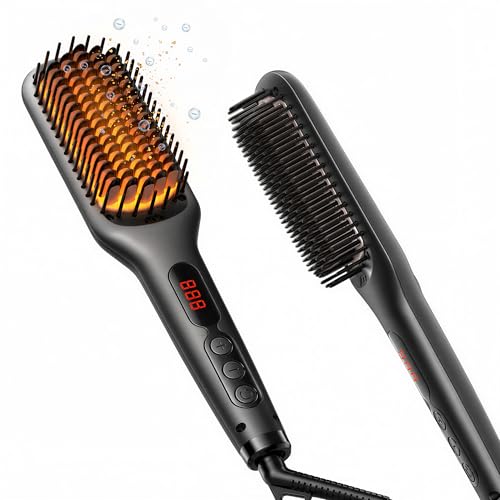


A great straightening brush heats evenly, holds a steady temperature, and uses bristles that grip hair without snagging. The best picks smooth thick or curly hair in a few strokes while staying gentle enough for fine strands. This comparison spans a proven best seller, a heat-precise upgrade, and value options, so there is a match whether you want quick daily de-frizzing or a full sleek blowout look.
At a glance
| Product | Standout features | Price tier | Link |
|---|---|---|---|
| TYMO Ring | Best seller, 5 heat settings, 20-second heat-up, dual voltage | Mid-range | |
| TYMO Ionic Plus | Dense bristles, 16 temps, sensor heat control | Premium | |
| MEGAWISE Pro Ceramic Ionic | Budget friendly, negative ions, anti-scald teeth | Budget | |
| L’ANGE Le Vite | Ceramic bristles, LCD control, double ionic tech | Mid-range | |
| MiroPure Enhanced Ceramic | 16 temps, double ionic generator, temperature lock | Budget | |
How to choose a hair straightening brush
Getting a smooth result without frying your hair comes down to a few features. Here is what actually matters.
Ceramic, tourmaline, and ionic coatings
Ceramic bristle surfaces spread heat evenly, which prevents the hot spots that cause damage. Tourmaline and ionic technology add negative ions that help flatten the cuticle, cutting frizz and boosting shine. You do not need to memorize the chemistry; just know that ceramic plus ions is the combination that leaves hair smoother and less static. Makers advertise ion counts in the millions, and those figures are marketing shorthand rather than a measured standard, so treat them as a rough signal of intent rather than a spec you can compare across brands. What matters in practice is that the heat is even and the surface glides.
How fast it heats, and how steady it stays
Two numbers separate a pleasant tool from a frustrating one. Heat-up time decides whether you wait or start straight away, and the best brushes here are ready in around 20 seconds while others take closer to a minute. More important is heat recovery: as the brush moves through cool hair it loses temperature, and a good one restores it immediately so every stroke behaves the same. Sensor-driven models monitor and correct constantly, which is why they hold a consistent result through a whole head. A brush that sags in temperature makes you go over the same section repeatedly, which is exactly the extra heat exposure you were trying to avoid.
Heat settings for your hair type
Fine or color-treated hair smooths at lower temperatures and burns easily at high ones, so adjustable heat is not a luxury. Thick, coarse, or tightly curled hair needs more heat and often a slower pass. Brushes with more settings, like the 16-level options here, give you finer control to protect delicate hair and still power through coarse hair.
Bristle design and safety
Denser bristles grab more hair per stroke, which speeds up styling and helps on thick or curly textures. Anti-scald tips and cool outer teeth keep the heat away from your scalp and fingers, which matters when you are working near the roots. An auto shut-off after a set idle time is worth having for peace of mind.
Use on dry hair, and go slow
These are dry-hair tools. Using them on wet hair can damage strands and is specifically advised against by several makers. Start with detangled, fully dry hair, then draw a slow, steady stroke from root to tip. One patient pass beats several fast ones, both for the result and for your hair’s health.
What a brush gains, and what it gives up
A straightening brush is not simply an easier flat iron; it produces a different look. Because hair is not clamped between plates, the finish keeps more body and movement, closer to a soft blowout than a poker-straight sheet. Many people prefer that, since flat irons can leave hair looking flat and lifeless at the roots. The trade is that a brush rarely achieves the same glassy, pin-straight result on very coarse or tightly curled hair, and it struggles to get right to the roots or to create curls and flicks at the ends. If you want a natural, smooth, voluminous finish in less time, the brush wins. If you want maximum straightness on stubborn texture, a flat iron still has the edge.
Travel, cords, and everyday practicality
Small details decide whether a tool lives on the counter or in a cupboard. Dual voltage matters if you travel abroad, letting the brush work on other electrical systems with a plug adapter. A 360-degree swivel cord stops the lead twisting as you work around your head, and a longer cord frees you from standing right at the outlet. Weight and balance count too, since you hold the tool at awkward angles for several minutes. Look for controls placed away from your grip, as buttons near the handle are easy to knock mid-stroke and change your heat without noticing.
Getting the smoothest result
Technique matters as much as the tool. Start with clean, completely dry, detangled hair, and always apply a heat protectant before any hot tool touches it: this is the single cheapest way to reduce damage. Choose the lowest temperature that actually works on your hair rather than defaulting to the maximum, and only step up if a pass is not smoothing. Section your hair into manageable pieces and clip the rest out of the way, working from the underneath layers upward, because trying to brush through too much hair at once leaves the middle untouched. Hold the section lightly taut with your free hand and draw the brush slowly from root to tip in one steady stroke, letting the heat do the work instead of pressing hard. Thicker or curlier hair simply wants smaller sections and a slower pace, not more heat. When you finish, let the brush cool on a heat-safe surface, and wipe the plates and bristles clean once cool, since product residue builds up and dulls performance over time.
TYMO Ring
The TYMO Ring is the best seller of the group, and it is the one to beat for straightforward daily use. It heats in about 20 seconds, offers five temperature settings for different textures, and uses 3D brush teeth with even PTC heating to smooth hair in a single pass. The anti-scald exterior and 30-minute auto shut-off make it easy to trust, and dual voltage plus an included travel bag mean it packs for trips. It is the sensible default for a quick, reliable smooth.
Pros
- Proven best seller with a strong track record
- Very fast heat-up and a simple five-setting dial
- 3D teeth straighten effectively in one pass
- Anti-scald design, auto shut-off, and dual voltage for travel
Cons
- Fewer heat steps than the 16-level brushes
- Very thick or coarse hair may want more precision
Best for: anyone who wants a dependable, fuss-free daily straightener.
TYMO Ionic Plus
The Ionic Plus is the upgrade pick for people who fight thick or stubborn curls. Its bristles are roughly twice as dense, so each stroke grabs more hair and reaches the strands a looser brush misses. Sensor-based heat control adjusts by the millisecond across 16 settings, which helps you dial in exactly enough heat without overdoing it. Tourmaline ceramic bristles and a strong ionic output aim for glide and shine. It costs more, but the added grip and precision earn it on demanding hair.
Pros
- Dense bristles excel on thick and curly hair
- 16 settings with responsive sensor heat control
- Tourmaline ceramic bristles glide with less snagging
- Strong ionic output for frizz control and shine
Cons
- Priced at the top of this lineup
- More settings than casual users may need
Best for: thick, coarse, or curly hair that needs grip and fine heat control.
MEGAWISE Pro Ceramic Ionic
The MEGAWISE Pro is the budget entry that still covers the basics well. Negative ion technology tames frizz and static, the heating element warms quickly and spreads evenly, and multiple temperature settings let you match fine or thick hair. Anti-scald outer teeth and a long rotating cord make it comfortable to handle, and it stays light for travel. Remember to use it on fully dry hair only. It is a smart first straightening brush or a low-cost backup.
Pros
- Low price with the essential features intact
- Negative ions reduce frizz and static
- Fast, even heat-up across the brush surface
- Anti-scald teeth and a long swivel cord
Cons
- Dry hair only, so no touch-ups on damp strands
- Simpler controls and build than premium picks
Best for: first-time buyers who want smooth results without spending much.
L’ANGE Le Vite
L’ANGE brings a polished, salon-styled option with the Le Vite. It suits straight, wavy, curly, or tightly coiled hair, heating quickly and evenly with an LCD interface that lets you set a precise temperature. Double negative ion technology helps trap moisture and seal the cuticle for a smooth, healthy-looking finish. A single slow pass from roots to ends does the work. It is a strong middle-ground pick for people who want a refined tool from a beauty-focused brand.
Pros
- Precise LCD temperature control
- Double ionic tech for smooth, sealed cuticles
- Works across a wide range of hair textures
- Dual voltage for travel
Cons
- High top temperature calls for a careful hand on fine hair
- Costs more than the budget options
Best for: people who want a salon-style brush with precise heat.
MiroPure Enhanced Ceramic
The MiroPure packs premium-style features into a value price. It offers 16 temperature settings, so fine, bleached, thick, or curly hair each gets an appropriate heat, and a double ionic generator works to keep strands lustrous and static free. A temperature lock prevents accidental changes mid-style, the anti-scald feature guards against burns, and a 60-minute auto shut-off adds safety. A 360-degree swivel cord keeps it maneuverable. It is a lot of control for the money.
Pros
- 16 heat settings at a budget-friendly price
- Double ionic generator for shine and frizz control
- Temperature lock and auto shut-off for safety
- Swivel cord and anti-scald design for easy handling
Cons
- Takes about a minute to reach temperature
- Build is functional rather than premium
Best for: value seekers who still want fine heat control for all hair types.
The verdict
Best overall: the TYMO Ring. As the best seller it earns the top spot with fast heat-up, simple controls, effective 3D teeth, and travel-ready dual voltage. For most hair on most mornings, it is the easy, reliable choice.
Best value: the MiroPure Enhanced Ceramic, which delivers 16-level heat control and dual ionic output at a budget price, giving fine and coarse hair alike a safe setting.
Best premium: the TYMO Ionic Plus, with its dense bristles and sensor heat control, is the pick for thick or curly hair that wants more grip and precision.
Frequently asked questions
Can I use a straightening brush on wet hair? No. These are dry-hair tools, and using them on wet hair can damage strands. Detangle and fully dry first, then style.
Do straightening brushes damage hair less than flat irons? They tend to be gentler because hair is not clamped between plates, and the ceramic and ionic surfaces spread heat. Damage still depends on temperature and technique, so use the lowest heat that works.
Will one work on very thick or curly hair? Yes, especially models with dense bristles and higher heat like the TYMO Ionic Plus. Work in smaller sections and use slow, steady passes.
How many heat settings do I need? Fine or color-treated hair benefits most from more settings so you can stay at a lower temperature. Coarse hair needs the higher end. More levels simply give more control.
Can I travel abroad with these? Most here offer dual voltage, so they work internationally with the right plug adapter. Confirm the label before you pack it.
Should I use a heat protectant? Yes, every time. A protectant spray or cream is the simplest way to limit heat damage, and it costs far less than repairing dry, brittle ends later.
How long do the results last? Usually until your next wash, though humidity shortens that. Ionic models help by sealing the cuticle and cutting frizz, and many people find a quick touch-up on second-day hair takes only a minute or two.
Can I use one on a wig or extensions? Human hair pieces generally tolerate a straightening brush at a moderate temperature, but synthetic fibers can melt. Check what your piece is made from and start at the lowest setting.
How do I clean a straightening brush? Unplug it and let it cool completely, then wipe the plates and bristles with a slightly damp cloth to lift product residue. Never rinse it under a tap or submerge it.
This article may contain affiliate links; see our Affiliate Disclosure.