The bit skates across the slab, leaves a shiny gray scar, and goes nowhere. Ten minutes later you have a hole a quarter as deep as you need, a hot bit, and a sore wrist – because the drill in your hand was never built to break stone.


Concrete does not care how much torque a drill makes. It yields to impact – thousands of small blows, or a few hundred big ones – and the tools delivering those are built very differently. Working out which kind you need is most of the decision. The five drills below cover that range, from a compact cordless that lives in a tool bag to a corded rotary hammer that takes a foundation wall as a formality.
At a glance
| Product | Standout feature | Price tier | Link |
|---|---|---|---|
| DEWALT DCD806B 20V MAX XR Hammer Drill | Brushless 2-speed power with an anti-rotation safety system | Mid-range | |
| BOSCH 11255VSR Bulldog Xtreme | True SDS-plus rotary hammer, 3 modes, 2.0 ft-lb impact energy | Premium | |
| DEWALT DCD799B ATOMIC Compact | Short 6.49 in. head for tight spaces, 28,050 BPM | Mid-range | |
| Deshuo 1″ SDS-Plus Rotary Hammer | 4 modes and a safety clutch at 7.19 lbs, bits and chisels included | Budget | |
| SKIL HD182001 Corded Hammer Drill | 7.5-amp motor with a heavy-duty keyed chuck, no batteries to manage | Budget | |
How to choose a drill that actually cuts concrete
Hammer drill or rotary hammer – the split that decides everything
These two tools sound alike and work nothing alike. A hammer drill makes its impact by pressing two ridged plates together so they click past each other as the chuck spins. The result is a rapid flutter of tiny taps – tens of thousands per minute – and it works because you lean on it. A rotary hammer drives a piston on a cushion of air, so each blow lands with real energy whether you push hard or not. Fewer blows, vastly harder ones.
The practical line falls around hole size and volume. Anchors up to about 1/4 inch, a handful of holes, ordinary block or brick: a hammer drill is fine and it doubles as your everyday driver. Half-inch holes, poured foundation walls, anything past a dozen holes in a session: a rotary hammer stops being a luxury. It will finish in seconds what makes a hammer drill smoke.
Read impact energy, not just BPM
Marketing loves blows per minute because the number is huge. It is also the least useful spec on the box. A drill quoting 48,000 BPM is not eight times better than one quoting 5,800 – it is a different mechanism landing far weaker hits. On rotary hammers, look instead at impact energy in foot-pounds or joules. The Bosch here states 2.0 ft-lbs; the Deshuo states 2.21 ft-lbs, or 3 joules. Those figures describe how hard each individual blow lands, and they are what fractures aggregate.
SDS-plus versus a keyed or keyless chuck
SDS-plus bits have a slotted shank that drops into the tool and locks itself, with room to slide back and forth. That sliding is the point: the piston strikes the bit directly instead of pounding the whole chuck. Bits change in a second with no key, and nothing works loose under hammering. The trade is that SDS-plus bits are their own family – regular round-shank bits do not fit, and neither do SDS Max. Budget for a set alongside the tool unless, as with the Deshuo, they come in the case.
Clutches and kickback
The single most underrated feature on this page is the thing that stops the drill. Catch rebar or a hard piece of aggregate with a bit at speed and the tool tries to spin instead – hard enough to sprain a wrist or break a finger against a stud. A mechanical safety clutch slips before that happens; DEWALT’s anti-rotation system senses the twist electronically and cuts power, lighting an indicator. Always fit the side handle, whatever you buy. It is the difference between a jolt and an injury.
Cord or battery
Cordless has won most of the jobsite, and for good reason: no extension lead, no outlet hunting, and brushless motors closed most of the power gap. Concrete is where the argument survives. Masonry drilling drains packs quickly, so cordless means owning spare batteries. A corded tool never sags on the tenth hole and never needs a charger – worth real money if the work is a garage floor, a basement wall, or anywhere the cord can simply reach.
Dust is the hazard nobody photographs
Drilling concrete releases crystalline silica, and the fine fraction is the part that damages lungs. It hangs in the air long after the visible cloud settles. A shop vacuum held at the hole, a dust shroud, or a squirt of water all cut exposure sharply. Wear a proper respirator rather than a paper nuisance mask, and eye protection every time.
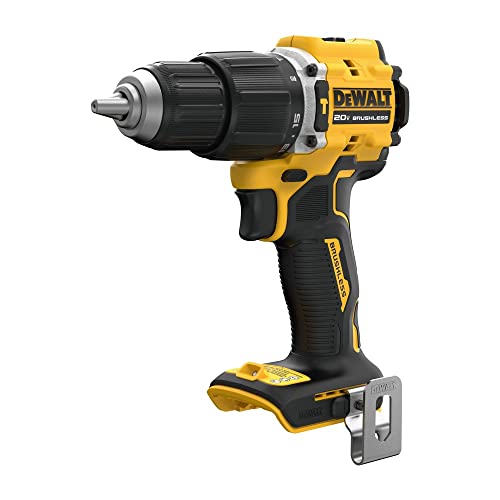
DEWALT DCD806B 20V MAX XR Brushless Hammer Drill
This is the most popular drill in the group by a wide margin, and it is easy to see the logic. DEWALT bills it as the most powerful two-speed hammer drill in the 20V MAX line, up to 109% stronger than the model it replaces, with a claimed 175 holes per charge. What makes it feel different in the hand is the anti-rotation system: the tool senses when it is starting to twist away from you and shuts down, red light on, before your wrist takes the load. The two-speed transmission tops out at 2,000 rpm for masonry and drops to 650 rpm when you need torque and control. Sold as a bare tool, so it assumes you already live in the 20V MAX battery world.
Pros:
- Anti-rotation system shuts the tool down on a bind, with an LED warning
- Brushless two-speed transmission, no-load 0-650 and 0-2,000 rpm
- Up to 175 holes per charge by DEWALT’s rating
- 1/2 in. metal ratcheting chuck grips bits hard
- Three-position 70-lumen work light with auto-shutoff
- Tool Connect chip ready for tracking, chip sold separately
Cons:
- Bare tool – battery and charger cost extra unless you have them
- Still a hammer drill, so large-diameter concrete holes are slow
- Pointless spend if you are not already on the DEWALT platform
Best for: anyone already holding 20V MAX batteries who wants one drill that hangs shelves, drives screws, and handles anchor holes in block without complaint.
BOSCH 11255VSR Bulldog Xtreme SDS-Plus Rotary Hammer
The Bulldog is the tool the other four are measured against when the material is real poured concrete. Its 7.5-amp motor spins to 1,300 rpm and delivers 5,800 blows per minute at 2.0 ft-lbs of impact energy each, and that last number is why it drills a 1/2 in. hole in seconds rather than minutes. Three modes make it more than a drill: rotation only for wood and metal, rotary hammer for masonry, and hammer-only for chiselling, with Vario-lock offering 36 bit positions so a chisel sits at the angle you want instead of the angle it landed in. Bosch builds vibration control into the housing, which matters on a tool you might hold overhead for an hour. It ships corded with an auxiliary handle, depth gauge, and case.
Pros:
- Genuine rotary hammer action, 2.0 ft-lbs impact energy at 5,800 BPM
- Three modes including hammer-only chiselling
- Vario-lock gives 36 chisel positions
- SDS-plus tool-free bit changes with automatic locking and dust protection
- Vibration control and a D-handle for long overhead sessions
- Case, depth gauge, and auxiliary handle included
Cons:
- Priciest tool here
- Corded, so you are tied to a lead
- Heavier and bulkier than a compact drill for everyday jobs
- Needs SDS-plus bits, which are not the ones already in your drawer
Best for: renovation work, foundation and slab anchoring, or anyone who has already lost an afternoon to a hammer drill and refuses to repeat it.
DEWALT DCD799B 20V MAX ATOMIC Compact Hammer Drill
The ATOMIC exists for the holes that are awkward rather than hard. At 6.49 inches of head length it is DEWALT’s shortest 20V MAX hammer drill, which is the difference between reaching between joists and giving up and fetching a right-angle attachment. Power did not get sacrificed to get there: 552 unit watts out, up to 1,650 rpm, and up to 28,050 BPM in hammer mode, with DEWALT claiming up to 14% more power than the version before it. It will drive Tapcons into block and pilot anchors in brick perfectly happily. What it will not do is match the DCD806B on sustained grunt in dense concrete, a fair trade for the size and the lower price.
Pros:
- Shortest 20V MAX hammer drill head at 6.49 in., genuinely useful in tight bays
- Brushless, 552 UWO and up to 28,050 BPM
- Up to 14% more power than the previous ATOMIC by DEWALT’s figures
- 1/2 in. ratcheting chuck with strong bit retention
- Lighter to hold overhead all day
Cons:
- Bare tool again – no battery, no charger
- Single-speed feel compared with the two-speed DCD806B
- No anti-rotation shutdown
- Compact size means less mass to push into a slab
Best for: electricians, cabinet installers, and anyone whose hardest drilling problem is access rather than aggregate.
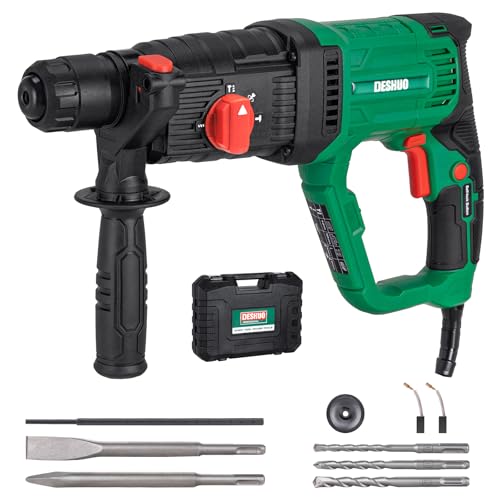
Deshuo 1″ SDS-Plus Lightweight Rotary Hammer
Here is the interesting one. The Deshuo is a proper SDS-plus rotary hammer at a price most hammer drills occupy, and its stated impact energy – 2.21 ft-lbs, or 3 joules – is on paper slightly above the Bosch. Its 9-amp motor runs to 1,100 rpm and 5,300 BPM, it weighs 7.19 lbs, and it offers four modes rather than three: rotation only, rotary hammer, hammer only, and Vario-lock for setting chisel angle. A built-in safety clutch disengages the drive if the bit binds. The case arrives with three drill bits and two chisels, so it is genuinely ready to work rather than ready to shop. Deshuo is not a name with decades behind it, and the 24-month warranty is the reassurance on offer. Note the warning the maker prints first: SDS-plus bits only, nothing else fits.
Pros:
- Rotary hammer performance at a budget price
- 9-amp motor, 2.21 ft-lbs (3 J) impact energy, 5,300 BPM
- Four modes including hammer-only and Vario-lock
- Safety clutch protects your wrist on a bind
- Light at 7.19 lbs, easier overhead than most rotary hammers
- Three bits, two chisels, and a case included; 24-month warranty
Cons:
- Lesser-known brand with no long service history behind it
- Corded only
- SDS-plus exclusively – regular and SDS Max bits will not fit
- Fewer sales than the established names, so less collective feedback
Best for: a homeowner facing one demanding masonry project who wants rotary hammer capability without paying professional money for it.
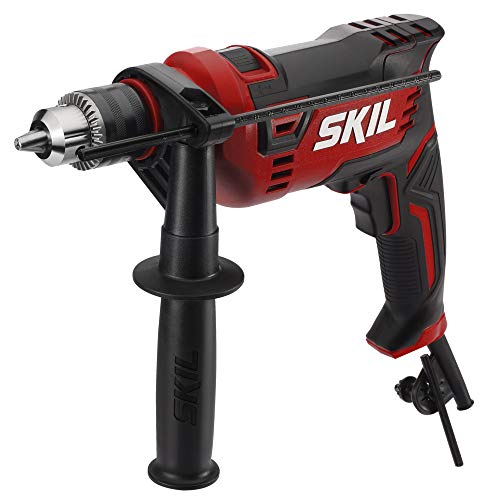
SKIL HD182001 7.5-Amp Corded Hammer Drill
The SKIL is the plain answer to a plain question: what if you just need a hammer drill occasionally and do not want to think about batteries. Its 7.5-amp motor matches the Bosch’s on amperage, though the mechanism is a conventional clutch-plate hammer rather than a piston. The 1/2 in. keyed chuck takes large-diameter bits and holds them without creeping – slower to change than keyless, more secure under vibration. A two-finger variable speed trigger and lock-on button let you settle into a long run of holes without cramping. Plug it in and it makes the same power on hole one hundred as on hole one. For block, brick, mortar, and modest anchors that is plenty.
Pros:
- High-torque 7.5-amp motor, consistent output with no battery to fade
- 1/2 in. heavy-duty keyed chuck accepts large bits securely
- Two-finger variable speed trigger plus lock-on for long sessions
- Side assist handle and soft grip
- Budget price with nothing else to buy
Cons:
- Hammer drill mechanism, so poured concrete is slow going
- Keyed chuck means carrying a key and slower bit swaps
- Corded
- No clutch or anti-rotation protection on a bind
Best for: occasional home projects and light masonry where simplicity and a low price beat cordless convenience.
The verdict
Best Overall – DEWALT DCD806B 20V MAX XR. It is the best seller of this group, and it earns that on breadth: brushless two-speed power, an anti-rotation system no other drill here offers, a strong ratcheting chuck, and enough runtime to make 175 holes on a charge. It handles block and brick well and stays useful every other day of the year as a general drill and driver. If you own 20V MAX batteries, this is the default.
Best Value – Deshuo 1″ SDS-Plus Rotary Hammer. Nothing else on the page delivers rotary hammer impact energy at a budget price, let alone with four modes, a safety clutch, bits, chisels, and a case in the box. The brand is unproven next to Bosch, and that is precisely the trade you are making. For a single big job, it is a good one.
Best Premium – BOSCH 11255VSR Bulldog Xtreme. When concrete is the daily material rather than the occasional obstacle, the Bulldog’s reputation, vibration control, three modes, and 36-position Vario-lock are what you pay for. It is the tool you buy once.
FAQ
Can a regular drill make a hole in concrete?
Sometimes, badly. With a masonry bit and a lot of patience a standard drill may get through soft block or old mortar. In poured concrete it will polish the aggregate, cook the bit, and quit. Rotation alone does not break stone – impact does.
What size hole marks the point where I need a rotary hammer?
Around 1/2 inch in poured concrete is where a hammer drill starts to struggle badly, and volume moves the line further. Ten 1/4 in. anchors in block is hammer drill territory. Thirty 1/2 in. holes in a foundation wall is not, no matter how good the hammer drill is.
Will any of these cut through rebar?
No. Standard carbide masonry and SDS-plus bits are made to crush stone, not shear steel. Hitting rebar means slowing down, stopping, and either moving the hole or switching to a rebar cutter bit made for it. Forcing it destroys the bit and risks a nasty bind – which is exactly when a safety clutch or anti-rotation system earns its keep.
Do SDS-plus bits fit a normal chuck?
No, and the reverse is also true. SDS-plus shanks are slotted so the bit can slide under the piston, so they need an SDS-plus tool. Round-shank bits will not lock into one either. Adapters exist and mostly waste the tool’s advantage. Plan on a small SDS-plus set – the Deshuo saves you that step by including one.
How dangerous is concrete dust really?
Serious enough that occupational rules exist around it. Drilling concrete releases respirable crystalline silica, which causes permanent lung damage over repeated exposure. The fix is cheap: run a shop vacuum at the hole, wear a fitted respirator rather than a dust mask, and keep eye protection on the whole time.
This article may contain affiliate links; see our Affiliate Disclosure.