Stopping to shake a pebble out of your shoe is a minor annoyance the first time and a blister by the fourth. Gaiters exist because the gap around your ankle is the one hole in an otherwise sealed system, and everything on the trail eventually finds it: grit, mud, snowmelt, seeds, ticks, and the odd thorn.

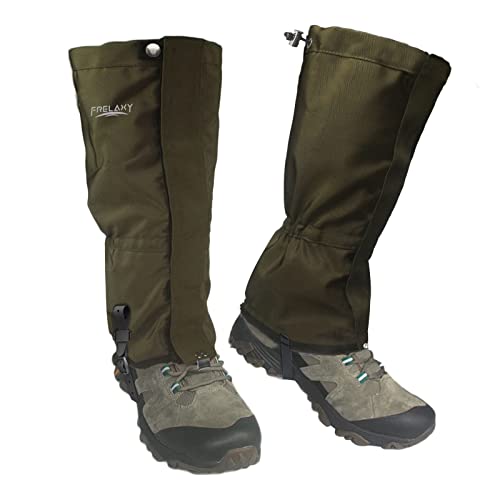


Gaiters divide cleanly into two tools that share a name. Low-cut trail gaiters are a few ounces of stretch fabric that cap the shoe opening and keep debris out, and you forget you are wearing them. High-cut gaiters run to the knee in tough coated fabric, sealing the whole lower leg against snow, water, mud and thorns. Buying the wrong one is the usual mistake: a knee-high gaiter is miserable on a dry summer trail, and an ankle gaiter is useless in shin-deep snow. The picks below cover both, plus the sizing and strap details that decide whether they stay put.
At a glance
| Product | Standout features | Price tier | Link |
|---|---|---|---|
| Pike Trail Adjustable Leg Gaiters | High-cut, waterproof, 360-degree wraparound; three rustproof stainless buckles; wears over or under pants | Mid-range | |
| Frelaxy Waterproof Leg Gaiters | High-cut 900D anti-tear coated Oxford; three-layer rubber instep strap; full-length hook-and-loop opening | Mid-range | |
| Frelaxy Ultralight Trail Gaiters | Low-cut and just 2.29 oz a pair; four-point hold system; stretch Lycra with rubber sole strap | Budget | |
| Altra Trail Gaiter | Low-cut, strapless pull-on design; front metal lace hook; reflective print; breathable stretch fabric | Mid-range | |
| Outdoor Research Rocky Mountain Low Gaiters II | Low-cut; Hypalon instep straps; reinforced lace hooks; abrasion-resistant water-resistant fabric | Premium | |
How to choose hiking gaiters
Low-cut and high-cut are different tools
Low-cut gaiters, sometimes called trail or ankle gaiters, sit just above the shoe and cover the laces. They weigh a couple of ounces, breathe freely, and solve one problem completely: debris. Scree, sand, dust, seeds and small stones stay out, and you stop taking your shoes off every mile. They are not waterproofing, and pretending otherwise leads to disappointment.
High-cut gaiters reach the knee and seal against the calf. They handle deep snow, river crossings, mud, wet undergrowth, thorns and brush, and in tick country they close off the route insects use to climb. The cost is heat and bulk, which is why nobody wears them on a dry August ridge. Many hikers end up owning both, and reach for whichever the day demands.
Read the fabric numbers
Denier, written as 600D or 900D, measures yarn thickness, so a higher number means a heavier, tougher fabric that resists thorns and abrasion. Waterproofing is a separate figure quoted in millimeters of water column: 6000mm is a solid rating for gaiters and covers sustained rain and wet snow. Watch the wording carefully. “Waterproof” and “water resistant” are not the same claim, and low gaiters are usually only the latter, because their job is debris rather than water. Nothing about a gaiter waterproofs the boot underneath it either; water that gets in over the top of your boot still gets in.
The instep strap is what breaks
Everything else on a gaiter outlives the strap that runs under your boot, because that strap is ground between a lugged sole and sharp rock every step. Look for Hypalon or thick layered rubber rather than thin webbing or cord. A metal buckle lets you replace or retension the strap; a sewn-in cord means the gaiter is done when the cord goes. Anyone walking on granite or scree should take the strap material as the single most important spec on the listing.
How it stays put
A gaiter that slides down is worse than none. Four attachment points are the norm on good low gaiters: an adjustable top, a front hook onto the laces, a strap or band under the foot, and an anti-slip element at the heel. Strapless designs trade the under-foot strap for a hook that grips a patch on the shoe heel, which is elegant and frictionless when the shoe supports it and insecure when it does not. High-cut gaiters add a top drawstring to cinch the calf and a full-length hook-and-loop or zip opening so they go on without removing your boots, which matters more than it sounds when weather turns mid-hike.
Sizing and breathability
Size gaiters around your actual boots and trousers, not your leg. Wearing thick winter or ski pants underneath, size up: a gaiter that fits over jeans will bind over insulated layers. Coated Oxford fabrics that stop water do not breathe much, so your calves will sweat on a warm climb, and that is the real trade for staying dry. Stretch Lycra low gaiters breathe fully and dry fast because they were never trying to keep water out at all.
Pike Trail Adjustable Leg Gaiters
The best seller of this group, and a sensible default if you only ever own one pair. These are full-height waterproof gaiters with a 360-degree wraparound and enough adjustment to fit a wide range of legs and boots, and Pike Trail specifically designs them to work worn over or under hiking pants, which is a genuine convenience when conditions change. They are puncture resistant against thorns and bug bites, and three rustproof stainless steel buckles anchor them, with sturdy foot straps holding the fit over the boot. The listing frames them as a lightweight alternative to buying waterproof boots, which is a fair way to think about them: they extend gear you already own rather than replacing it. Hunting, trekking, and fishing all sit within their range.
Pros:
- Full 360-degree wraparound coverage of the lower leg
- Three rustproof stainless steel buckles
- Puncture resistant to thorns and bug bites
- Fits over or under hiking pants
- Broad adjustment range to suit most legs and boots
Cons:
- Too warm for dry summer trails, like all high-cut gaiters
- Costs more than the lightweight trail options
- Overkill if debris rather than water is your problem
Best for: wet, snowy or overgrown ground where the whole lower leg needs sealing.
Frelaxy Waterproof Leg Gaiters
Frelaxy builds these around 900D anti-tear waterproof coated Oxford, a notably heavy fabric for the category, and the brand states they are tested fully waterproof and roughly 50% more durable than most rivals. The instep strap is the part worth noting: three layers of high-abrasion rubber with a metal buckle, aimed straight at the loosening and wear that ends most gaiters. Fit adjusts at three points, with a top drawstring, an elastic band through the middle and lower sections, and a two-inch hook-and-loop opening running the full length so they go on and off without unlacing. Frelaxy backs them with a no-questions lifetime warranty and free exchange sizing without a return, which is unusually generous. Snowshoeing, skiing, hunting and motorcycle use all appear in their brief.
Pros:
- Heavy 900D anti-tear coated Oxford fabric
- Three-layer rubber instep strap with a metal buckle
- Full-length hook-and-loop opening for on and off over boots
- Adjustment at top, middle and lower leg
- Lifetime warranty and free exchange sizing
Cons:
- Coated fabric traps heat on warm climbs
- The waterproof and durability figures are the brand’s own
- Sold by color and size, so check the fit chart
Best for: snow, sustained rain and hard use, where strap failure is the real risk.
Frelaxy Ultralight Trail Gaiters
The same brand at the opposite end of the category, and a useful illustration of what low-cut gaiters are for. At 2.29 ounces a pair, these vanish on your feet. Stretch Lycra wraps the shoelace area and ankle, backed by a three-layer high-abrasion rubber sole strap and reinforced stitching, and a four-point hold system keeps them there: adjustable top drawstring, front shoe hook, bottom strap, and a rear anti-slip belt. That combination is what stops the sliding and re-adjusting that makes cheap trail gaiters infuriating. They work with most trail shoes, hiking boots and sneakers, and they breathe completely, because they are not trying to be waterproof. Rocks, mud, dust, debris, bugs and brush stay out; standing water does not.
Pros:
- Only 2.29 oz a pair, light enough to forget
- Four-point hold system stops slipping without constant adjustment
- Three-layer rubber sole strap on a low-cut gaiter
- Breathable stretch Lycra, comfortable in heat
- Cheapest option here
Cons:
- Debris protection only, not waterproofing
- Ankle height is no use in deep snow
- Lycra offers little defense against thorns
Best for: dry, dusty or rocky trails and trail running, where weight and heat matter most.
Altra Trail Gaiter
Altra takes the strap away entirely. This is a pull-on, strapless gaiter, which means nothing runs under your sole to be ground down by rock, and nothing needs retensioning. Instead it attaches to the shoe with Altra’s GaiterTrap, a fastening built into all Altra trail shoes, with a metal lace hook at the front holding the leading edge. The fabric is highly breathable stretch material with high abrasion resistance, and reflective print adds visibility on dawn and dusk runs. There is an important caveat: the rear attachment relies on the GaiterTrap patch. Altra says the design works with most trail running shoes, but on shoes without that fastening you lose the rear anchor and depend on the pull-on fit alone.
Pros:
- Strapless, so no under-sole strap to wear through
- Locks positively to any Altra trail shoe via GaiterTrap
- Breathable stretch fabric with high abrasion resistance
- Front metal lace hook and reflective print
- Nothing to adjust once it is on
Cons:
- The rear attachment is designed around Altra shoes
- Debris protection only, with no waterproof claim
- Pull-on fit means size selection has to be right
Best for: trail runners in Altra shoes who want gaiters that disappear completely.
Outdoor Research Rocky Mountain Low Gaiters II
This is what a low gaiter looks like when it is built to last rather than to hit a price. Outdoor Research uses Hypalon instep straps, the material that survives being dragged over granite far longer than webbing, and reinforced boot lace hooks that stay hooked through rough terrain. The fabric is abrasion-resistant and breathable while staying water resistant, and a self-fastening front closure means no fiddling on the trail. The updated fit and pattern are made to sit correctly on a range of boot profiles, which is where cheaper low gaiters usually fall down, and they come in sizes from S to XL rather than one-size-fits-most. Note the wording: water resistant, for on-trail use. This is a debris and light-weather gaiter built to a high standard, not a mountaineering shell.
Pros:
- Hypalon instep straps, the most durable material in this group
- Reinforced lace hooks stay attached in rough terrain
- Sized S to XL for a proper fit rather than one-size
- Pattern designed around varied boot profiles
- Self-fastening front closure, quick on and off
Cons:
- Priciest pick here by a distance
- Water resistant, not waterproof
- Low cut, so no help in deep snow
Best for: frequent hikers who wear out cheap gaiters and want one durable pair.
Verdict
Best overall: the Pike Trail Adjustable Leg Gaiters lead this group on sales, and they earn it by covering the widest range of conditions. Full height, waterproof, thorn resistant, three steel buckles, and adjustable enough to fit over or under pants. If you want one pair that handles snow, mud and undergrowth, these are the safe answer.
Best value: the Frelaxy Ultralight Trail Gaiters cost the least and are the pair most likely to be used, because at 2.29 ounces there is no reason to leave them behind. The four-point hold system is the part that matters, and it is rare at this price.
Best premium: the Outdoor Research Rocky Mountain Low Gaiters II are for people who have already worn out a pair. Hypalon straps and reinforced hooks address exactly what fails first, and proper sizing beats one-size-fits-most on boots. For heavy waterproof duty at a lower price, the Frelaxy Waterproof Leg Gaiters bring 900D fabric and a lifetime warranty.
FAQ
Do gaiters keep your feet dry?
They keep water from entering over the top of your boot, which is a real and common way feet get wet in wet grass, snow or shallow crossings. They do nothing for water coming through the boot itself, and they cannot make a non-waterproof shoe waterproof. Pair high-cut gaiters with waterproof boots for the full effect.
Low-cut or high-cut, if I can only buy one?
Choose by what your local trails throw at you. Dry, dusty, rocky or sandy ground means small debris, and low gaiters solve that for a few ounces. Snow, mud, wet brush, thorns or ticks call for high-cut. Someone hiking varied ground year-round genuinely benefits from both, and low gaiters are cheap enough to be a second purchase later.
Will they fit my boots?
Most high-cut gaiters adjust widely and fit almost any boot, but the calf is the limiting dimension, especially over thick trousers. Size up if you wear ski or insulated pants. Low gaiters are more shape-sensitive: they must sit correctly on the boot profile, and one-size versions fit some shoes far better than others. Where sizes S to XL are offered, use them.
How do I stop them sliding down?
Use every attachment point the design gives you. Hook the front onto the laces, tension the under-foot strap so it is snug rather than tight, cinch the top, and seat any rear anti-slip band properly. Sliding is usually a fit or tension problem rather than a defect, though a worn instep strap will let go no matter how well you set it.
How do I clean and store them?
Rinse mud off with water before it dries, let them dry fully before packing, and store them unrolled rather than crushed in a pack all season. Coated fabrics crack if stored damp and folded hard, and hook-and-loop closures clog with grit, which is what makes them stop gripping. Both take a couple of minutes after a hike.
This article may contain affiliate links; see our Affiliate Disclosure.