A helicopter crosses the screen and your apartment does nothing. The dialogue is fine, the explosions are polite, and the whole film sits in a thin band somewhere above your knees. Bass is the part of a soundtrack you feel rather than hear, and getting it into a small room is less about brute size than about picking the right box and putting it in the right corner.



There are two ways to solve this, and the products below split cleanly along that line. Either you buy a complete system where the bass box comes matched and pre-tuned, or you add a standalone powered subwoofer to speakers you already own. The first route is simpler and needs no receiver; the second gives you crossover and phase controls to dial the bass into your specific room. Both work in a small space – they suit different starting points.
At a glance
| Product | Standout feature(s) | Price tier | Link |
|---|---|---|---|
| LG S40TR 4.1 ch Soundbar | Wireless sub and wireless rears; Dolby Audio; no receiver needed | Premium | |
| Rockville RHB70 | Whole 2.1 system in a 4.73-inch-wide cabinet; Bluetooth, USB, SD, FM | Budget | |
| Acoustic Audio AA5170 | True 5.1 with six discrete RCA inputs and optical; powered sub | Mid-range | |
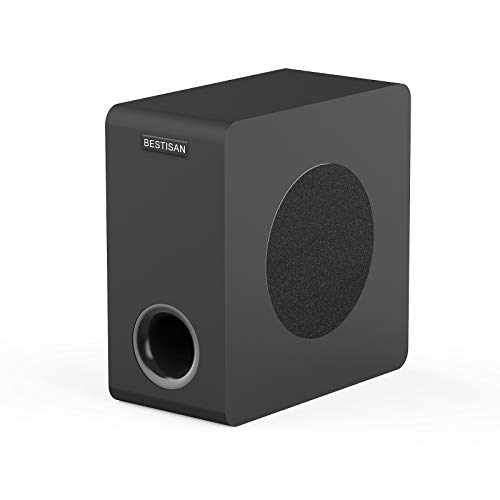
| BESTISAN 6.5″ Powered Subwoofer | 35–200 Hz side-firing sub; speaker-level in and out | Mid-range | |
| Rockville Rock Shaker 6.5 | Adjustable crossover and phase; rated to 20 Hz; Class-D | Mid-range | |
How to choose bass for a small room
First decide: system or add-on sub
If you have a TV and nothing else, a complete system is the plain answer – the LG, the Rockville RHB70 and the Acoustic Audio all include their own amplification, so there is no receiver to buy and nothing to match. If you already own bookshelf speakers or a soundbar and the only thing missing is weight underneath them, a standalone powered sub like the BESTISAN or the Rock Shaker plugs into what you have and leaves the rest alone. Buying a bare subwoofer with no amplifier to feed it is the classic first mistake.
Read the frequency number, ignore the watts
Peak wattage is close to meaningless – it is measured however the marketing department likes. The number that tells you something is the low-frequency limit. The BESTISAN states 35 Hz. The Rock Shaker claims 20 Hz. That range covers the difference between hearing a rumble and feeling it in your chest; most film bass lives between roughly 30 and 80 Hz, so a sub that genuinely reaches the mid-30s covers nearly everything you will notice. Be a little skeptical of very low claims from very small drivers – physics does not care about the box copy – but a stated figure still beats no figure.
Small drivers, small rooms – a fair trade
Every sub here uses a 6.5-inch driver or smaller, and in a bedroom or apartment lounge that is not the compromise it sounds like. A small room pressurizes easily; the walls do work that a big driver has to do in a hall. The cabinet matters as much as the cone – the BESTISAN uses a bass-reflex enclosure with a bottom port and internal bracing to keep the box from resonating along with the music, which is what separates tight bass from a boomy one-note thud.
Which way the driver points
Side-firing designs, like the BESTISAN, throw energy sideways and let you tuck the cabinet into a tight spot. Down-firing designs aim at the floor and use it to couple into the room. Neither is better in the abstract; what matters is that you do not press the firing face flat against a wall or into a corner of furniture. Bass is directionless enough that placement is forgiving, but not that forgiving.
Crossover and phase are the small-room controls
This is the real argument for a standalone sub. A crossover sets where the sub stops and your main speakers start, so the two are not both fighting over the same notes. A phase switch fixes the case where sub and speakers push and pull against each other and cancel out – the reason some setups get quieter when the sub is switched on. The Rock Shaker has both. Complete systems make these decisions for you, which is either convenient or limiting depending on how much you want to fiddle.
Connections decide compatibility
An LFE or RCA input is the standard way to feed a sub from a receiver. Speaker-level inputs matter if your amplifier has no dedicated subwoofer output – the BESTISAN offers high-level in and out, which quietly makes it compatible with old and cheap amplifiers that the others cannot use. The LG sidesteps the whole issue: its sub and rears connect wirelessly, so the only cable is power.
LG S40TR 4.1 ch Home Theater Soundbar
The best seller of this group by a large margin, and the reason is that it removes every hard decision. Four channels, a wireless subwoofer, and wireless rear surround speakers that need no special receiver – you plug things into power and the system finds itself. For a small room that is a real advantage: the sub can live in a corner behind a chair with only a power cable to hide, and the rears go on shelves rather than at the end of cable runs stapled around the baseboard. Dolby Audio handles the decoding, Clear Voice Plus lifts dialogue out of the mix, and Smart Up-Mixer spreads plain stereo across all the speakers. If you own an LG TV, WOW Orchestra plays the TV’s own speakers alongside the bar and one remote runs both.
- Pros: Wireless sub and wireless rears mean almost no cable routing; no receiver required; Dolby Audio; Clear Voice Plus for dialogue; Smart Up-Mixer for stereo sources; single-remote control and WOW Orchestra with LG TVs; comfortably the category best seller.
- Cons: The priciest option here; no crossover or phase adjustment, so bass integration is whatever LG decided; the sub is matched to this system and cannot be repurposed; some features only pay off with an LG TV.
Best for: a small living room that wants real surround and bass without a receiver, a rack, or cables around the room.
Rockville RHB70 Compact Powered Speaker System
An entire 2.1 system – 4-inch subwoofer, two 3-inch satellites and the amplifier – in a cherry wood cabinet measuring 4.73 inches wide by 9.65 high by 10.64 deep. That is desk-sized, and it is the cheapest way into this comparison by a distance. It takes Bluetooth, USB, SD cards up to 32GB, RCA and 3.5mm, plus an FM tuner, so it doubles as the only music source a bedroom needs. Power is 25W RMS, which is the real figure behind the 100W peak on the box. Nobody should expect a 4-inch driver to shake plaster loose, but in a bedroom or a dorm it puts a floor under the sound that a TV cannot manage on its own.
- Pros: Very cheap; genuinely tiny footprint at under 5 inches wide; wood enclosure rather than plastic; Bluetooth plus USB, SD, FM, RCA and AUX; LED display and remote; complete system with nothing else to buy.
- Cons: A 4-inch sub and 25W RMS set a firm ceiling on depth and volume; 2.1 only, so no surround; no crossover or phase control; not a match for a large TV in a big room.
Best for: bedrooms, desks and dorms – small spaces where the alternative is the television’s own speakers.
Acoustic Audio AA5170 5.1 Speaker System
The most system here for the money. A powered subwoofer measuring 12.3 by 6.7 by 13.1 inches does the amplification for five wired satellites – two fronts, a center, and two rears at 6.7 by 4.1 by 4 inches each – giving true discrete 5.1 rather than a soundbar’s simulation of it. Six independent RCA inputs mean a receiver can send each channel its own signal, and there is optical, RCA, AUX, USB and an FM tuner besides. Bluetooth handles phones, and a Pro Surround mode fakes 5.1 out of stereo sources. The system is rated 20 Hz to 20 kHz. Front satellites ship with 15-foot cables and the rears get longer runs, which tells you the real truth about this route: there will be wires.
- Pros: True discrete 5.1 with six independent RCA inputs; powered sub with a compact cabinet; optical and digital inputs; Bluetooth, USB and FM; complete in the box down to the cables and remote; rated to 20 Hz.
- Cons: Five wired satellites mean cable runs around the room; the satellites are small and the 700W figure is peak-style marketing; no crossover or phase control; a dated interface next to the LG.
Best for: anyone who wants real rear channels and does not mind running speaker cable to get them.
BESTISAN 6.5″ Side-Firing Powered Subwoofer
A pure add-on sub, and the most connectable box here. The 6.5-inch side-firing woofer sits in a braced bass-reflex cabinet with a bottom port and is rated 35 to 200 Hz – a specific claim rather than a vague one. What sets it apart is the input list: RCA, 3.5mm AUX, LFE, and crucially high-level speaker inputs and outputs. That last pair means it works with an amplifier that has no subwoofer output at all, including older gear and cheap bookshelf systems, which none of the other subs here can claim. BESTISAN is upfront that it wants a signal at or below 850mV for stable operation, which is unusually candid and worth checking against your source.
- Pros: Stated 35–200 Hz response; braced bass-reflex cabinet with bottom port for tighter bass; RCA, AUX, LFE and high-level speaker in and out; works with amps that lack a sub output; compact side-firing shape tucks away.
- Cons: No crossover or phase control mentioned, so integration is coarser than the Rock Shaker’s; the 850mV signal guidance is a real compatibility caveat; needs speakers and an amp already in place.
Best for: adding bass to existing bookshelf speakers or a soundbar, especially where the amplifier has no dedicated sub output.
Rockville Rock Shaker 6.5
The enthusiast’s pick of the two standalone subs, because it gives you the controls that matter. An adjustable crossover lets you set exactly where the sub hands over to your main speakers, and a phase control fixes the cancellation problem that makes some setups sound thinner with the sub switched on than without it. Those two knobs are how you tune bass to a specific room rather than accepting a factory guess. The 6.5-inch woofer runs on a Class-D amplifier at 100W RMS, rated 20 to 200 Hz, in an 11 by 11.8 by 12.6-inch cabinet with a detachable grill. RCA and speaker-level inputs and outputs cover most receivers and amps.
- Pros: Adjustable crossover and phase – the only sub here with both; rated down to 20 Hz; efficient Class-D amplifier at a real 100W RMS; RCA and speaker-level in and out; compact cabinet with a detachable grill.
- Cons: A 20 Hz claim from a 6.5-inch driver deserves a raised eyebrow; paper cone rather than a stiffer material; needs an existing amp and speakers; the controls only help if you are willing to spend an evening adjusting them.
Best for: tuning bass properly into an awkward small room where the sub has to go wherever it fits.
The verdict
Best overall: LG S40TR. It outsells the rest of this group heavily, and in a small room its wireless subwoofer and wireless rears solve the problem that actually stops people – not the sound, the cables. You get four channels, Dolby Audio and a subwoofer that lands in a corner with nothing but a power lead, and no receiver anywhere. It is the most expensive pick here and it is also the one most people will be happiest with.
Best value: Rockville RHB70. A whole 2.1 system with a wood cabinet under five inches wide, Bluetooth, USB, SD and FM, for less than the cost of a single sub elsewhere in this list. The 4-inch driver and 25W RMS set clear limits, but for a bedroom it transforms what a TV sounds like.
Best premium: Acoustic Audio AA5170 – if premium means the most capability rather than the highest price. It is the only option here with true discrete 5.1 and six independent RCA inputs, its powered sub is rated to 20 Hz, and it includes optical, Bluetooth, USB and FM. It costs less than the LG; you pay for it in cable runs instead.
For anyone who already has speakers, ignore all three and pick a sub: the Rock Shaker 6.5 if you want crossover and phase to dial it in, the BESTISAN if your amplifier lacks a subwoofer output and you need speaker-level inputs.
Frequently asked questions
Is a 6.5-inch subwoofer big enough for a small room?
For a bedroom or an apartment lounge, generally yes. Small rooms pressurize easily, so a modest driver produces more felt bass indoors than the same box would in a large open space. What you give up is headroom at high volume and the very lowest notes. In a big open-plan room, a 6.5-inch sub will run out of breath.
Where should the subwoofer go?
Corners give the most output because the walls reinforce the low frequencies, though they can also make bass boomy and uneven. A common approach is to put the sub in your listening seat, play something bass-heavy, crawl around the floor, and place it where it sounds best. Whatever you do, leave the firing face and any port clear of walls and furniture.
Do I need a receiver?
Not for the LG, the Rockville RHB70 or the Acoustic Audio – all three are powered and connect straight to a TV. The BESTISAN and the Rock Shaker are add-on subs and need something to feed them, though both accept speaker-level inputs, so a plain stereo amplifier without a subwoofer output will still work.
What does the crossover knob actually do?
It sets the frequency above which the sub stops playing, so it does not double up on notes your main speakers already handle. Set it too high and bass sounds like it is coming from the sub’s corner; too low and there is a hole between the sub and the speakers. Small speakers usually want a higher setting than large ones.
Why does my bass sound weaker with the sub turned on?
Usually phase cancellation – the sub and your speakers are pushing air in opposite directions at the same frequencies and partly canceling each other. That is exactly what the Rock Shaker’s phase control is for. Flip it and listen; the correct setting is simply whichever one sounds fuller.
This article may contain affiliate links; see our Affiliate Disclosure.