A helicopter crosses the screen and your soundbar politely mentions it. The same scene through a real subwoofer arrives in your chest, rattles the coffee table, and makes the dog leave the room. That gap is what a sub is for, and closing it is the cheapest big upgrade in home audio.



Subwoofers split into two camps that barely compete with each other. One camp connects wirelessly to a matching soundbar from the same brand and does nothing at all without it. The other takes an RCA or speaker-level cable from any receiver ever made and asks no questions. Knowing which camp you are shopping in settles most of the decision before you compare a single specification, so this guide covers both, from compact budget cubes to premium wireless units.
At a glance
| Product | Standout feature | Price tier | Link |
|---|---|---|---|
| Sonos Sub 4 | Dual force-canceling drivers, ported, WiFi placement | Premium | |
| Bose Bass Module 500 | 10-inch cube, wireless to Bose soundbars, easy to hide | Premium | |
| Rockville Rock Shaker 10 | 10-inch woofer, 600W peak, adjustable crossover and phase | Mid-range | |
| BESTISAN Powered Subwoofer | Side-firing 6.5-inch, RCA/AUX/LFE and speaker-level in | Budget | |
| Rockville Rock Shaker 6.5 | Compact cabinet, 20Hz-200Hz range, phase control | Budget | |
How to choose a home theater subwoofer
Check the ecosystem question first
The Sonos Sub 4 pairs to a Sonos soundbar or speaker. The Bose Bass Module 500 pairs to a Bose Smart or Ultra soundbar. Neither has a line input you can plug a generic receiver into, so if you do not already own the matching bar, they are not candidates at any price. The Rockville and BESTISAN subs are the opposite: they take RCA line inputs, LFE, and high-level speaker inputs, so they attach to essentially any receiver, amplifier, or speaker setup. Answer this question first and half the market disappears from your shortlist.
Driver size is a rough guide, not a ranking
A bigger cone moves more air, and moving air is what low bass is. A 10-inch driver has a real advantage over a 6.5-inch one for the deep rumble under explosions and organ notes. But the cabinet, the port, and the amplifier matter just as much. A well-braced 6.5-inch sub in a properly tuned bass-reflex box can sound tighter and more musical than a floppy 10-inch in a thin cabinet. Size sets the ceiling; engineering decides how close you get to it.
Peak watts versus RMS watts
You will see two power numbers, and only one of them means much. Peak power is a brief maximum the amplifier can hit. RMS is the continuous power it can actually sustain, and it is usually somewhere near half the peak figure or less. When you compare two subs, compare RMS to RMS. A sub advertising 600W peak and 300W RMS is being straight with you; one that quotes only the peak is hoping you will not ask.
Crossover and phase are the controls that matter
The crossover sets the frequency where your sub takes over from your main speakers. Set it too high and you hear the bass coming from a box in the corner instead of from the screen. Set it too low and there is a hole in the middle of the sound. Phase flips the driver’s timing so its output adds to your speakers instead of canceling them, which matters more than people expect when the sub sits across the room. A sub with both controls can be fitted to your room. A sub without them can only be tolerated.
Ported or sealed, and where it goes
A ported cabinet uses a tuned opening to reinforce the lowest notes, so it goes louder and deeper for the same amplifier. A sealed box gives up some depth for tighter, faster stops and starts. Movies tend to favor ports, music sometimes favors sealed. Placement then rewrites everything: corners boost bass hugely, open walls less so, and moving a sub half a meter can change the sound more than upgrading it. Wireless models make that experiment free, which is a genuine part of their value.
Sonos Sub 4
The Sub 4 is the best-selling standalone subwoofer in this group, and it is also the most unusual-looking thing in the room. That hollow sculptural slab hides the reason it works: two drivers face each other inside the cabinet, firing in opposite directions so their reaction forces cancel out. The box does not buzz, rattle, or walk across the floor, because mechanically it is trying to stay still while the air does the moving. A ported enclosure adds depth and output, setup is a power cable and the app, and because it connects over WiFi you can stand it upright beside the TV or lay it flat under the sofa. It exists to complete a Sonos system and nothing else.
Pros
- Dual force-canceling drivers virtually eliminate distortion, buzz, and rattle
- Ported enclosure improves low-frequency output
- Plug-and-play setup with one power cable and the app
- WiFi connection allows flexible placement anywhere in the room
- Stands upright or lies on its side under furniture
- Matte finish and design made to match the rest of a Sonos system
Cons
- Requires a Sonos soundbar or speaker; useless on its own
- No line inputs for a conventional receiver
- The most expensive pick here by a wide margin
Best for: households already running a Sonos soundbar who want the bass to finally match the picture.
Bose Bass Module 500
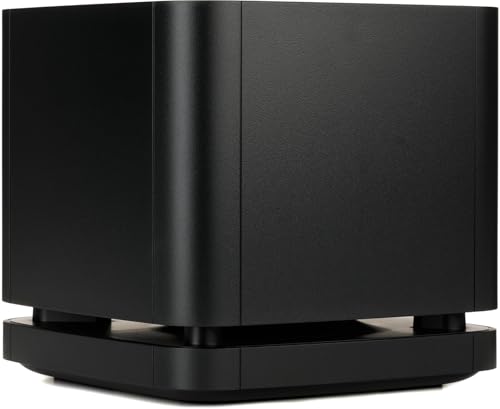
Ten inches on every side. That is the whole pitch, and it is a better pitch than it sounds, because the reason most people never add a subwoofer is that they cannot work out where to put a large black box in a living room they share with other humans. This one is a cube you can slide behind a chair or tuck beside a cabinet, built from premium materials, and it connects wirelessly to a Bose Smart or Ultra soundbar so there is no cable run across the carpet. It will not out-muscle a big ported tower, but it turns a polite soundbar into something you feel, and it does it without a domestic negotiation.
Pros
- Compact 10 by 10 by 10 inch cube fits where larger subs cannot
- Wireless connection to Bose Smart and Ultra soundbars
- Crafted from premium materials
- Setup takes minutes with no cable run
- Genuinely easy to hide in a normal living room
Cons
- Only works with a Bose soundbar; no generic inputs
- A compact cube cannot move the air a 10-inch ported sub can
- No user-adjustable crossover or phase controls
Best for: Bose soundbar owners in rooms where a big box was never going to be allowed.
Rockville Rock Shaker 10
This is the one that plugs into whatever you already own. A 10-inch woofer rated 600W peak and 300W RMS sits in an MDF cabinet with a vinyl finish and a detachable foam grill, driven by a Class-D amplifier matched to the box. More to the point, it gives you volume, crossover, and phase controls on the back, plus RCA line in and out and high-level speaker inputs and outputs. That connection list means it works with an AV receiver, an old stereo amp, a pair of bookshelf speakers, or a soundbar with a sub output. MDF matters too: it is dense and dead, and dense dead cabinets do not sing along with the music.
Pros
- 10-inch woofer, 600W peak and 300W RMS
- Adjustable volume, crossover frequency, and phase
- RCA line inputs and outputs plus high-level speaker inputs and outputs
- Works with virtually any receiver or amplifier
- MDF enclosure with vinyl finish and detachable grill
- Class-D amplifier matched to the woofer and cabinet
Cons
- Wired only, so placement is limited by cable runs
- A full-size box that is harder to hide than a cube
- Setup takes some dial-turning to integrate properly
Best for: anyone with a receiver and a sub output who wants the most air moved for a mid-range spend.
BESTISAN Powered Subwoofer
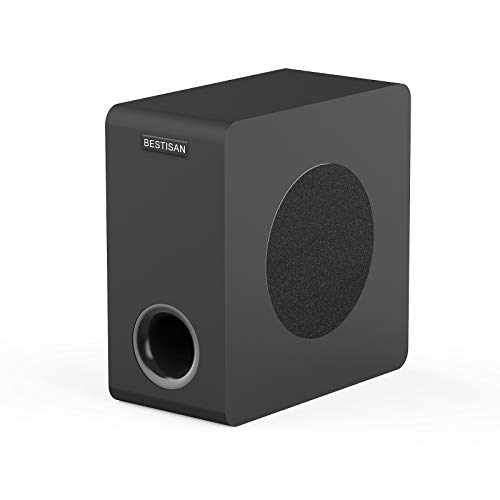
A side-firing 6.5-inch driver in a braced bass-reflex cabinet with a bottom port, quoted at 35Hz to 200Hz, in a black oak finish that reads as furniture rather than equipment. The engineering choices here are the sensible ones for a small box: firing sideways lets the cabinet stay slim, the bottom port loads against the floor, and internal bracing fights the resonance that makes cheap boxes boom. Connectivity is the strong suit, with RCA, 3.5mm AUX, LFE, and high-level speaker inputs and outputs, so it slots into a receiver, a TV, a soundbar, or a bookshelf pair. Note the maker’s own guidance to pair it with sources at or below 850mV output for stable operation.
Pros
- Quoted 35Hz to 200Hz response from a compact enclosure
- Bass-reflex cabinet with bottom port and internal bracing
- RCA, 3.5mm AUX, LFE, and high-level speaker inputs and outputs
- Side-firing driver keeps the cabinet slim
- Black oak finish blends with furniture
- Budget tier with no ecosystem lock-in
Cons
- 6.5-inch driver cannot match a 10-inch for deep output
- Maker recommends sources at 850mV or below, which rules some gear out
- Lowest sales rank among the picks here
Best for: small rooms and apartments where a slim, sensible-looking sub beats a monster.
Rockville Rock Shaker 6.5
The small sibling, and a real one: 200W peak, 100W RMS, a 6.5-inch paper cone with a foam surround and a Y30 magnet, in a cabinet roughly a foot on each side. What makes it interesting at this tier is that it keeps the grown-up controls. Adjustable crossover and phase are here, alongside RCA and speaker-level inputs and outputs, so you can integrate it properly with your speakers rather than just adding a lump of boom in the corner. For a bedroom, a study, a desk setup, or a first sub for someone who is not sure they want one, it does the job at the price of an accessory.
Pros
- Adjustable crossover and phase despite the budget tier
- RCA and speaker-level inputs and outputs for wide compatibility
- Compact 11 by 11.8 by 12.6 inch cabinet
- Quoted 20Hz to 200Hz range
- Class-D amplifier and detachable grill
Cons
- 100W RMS limits how far it fills a large room
- Paper cone and modest magnet are built to a price
- Wired only
Best for: bedrooms, studies, and desks, or a low-risk first subwoofer.
The verdict
Best Overall: Sonos Sub 4. It is the best-selling standalone subwoofer of this group, and the force-canceling dual-driver design solves the problem that ruins cheap subs, namely a cabinet that adds its own noise to the film. Setup is a power cable, placement is free because it is wireless, and it disappears into a room visually. The catch is absolute: no Sonos soundbar, no reason to buy it.
Best Value: Rockville Rock Shaker 10. A 10-inch driver with 300W RMS, a dead MDF cabinet, real crossover and phase controls, and inputs that fit any system you already own. For a mid-range spend it moves more air than anything else here and demands nothing from your brand loyalty.
Best Premium: Bose Bass Module 500. The premium choice for the other ecosystem. It buys you a cube you can genuinely hide, premium materials, and a wireless link to a Bose Smart or Ultra soundbar, which is the difference between owning a subwoofer and endlessly planning to buy one.
FAQ
Can I use the Sonos or Bose subwoofer with my regular AV receiver?
No. Both connect wirelessly to their own brand’s soundbars and have no line input for a receiver. If you are running an AV receiver or a mixed system, the Rockville and BESTISAN subs are the ones that will actually work for you.
What size subwoofer do I need for my room?
Room volume sets the demand. A bedroom or study is well served by a 6.5-inch sub, since the walls are close and bass builds up naturally. A living room with a sofa, an open plan, or high ceilings gives the sound somewhere to escape, and a 10-inch driver with meaningful RMS power stops the bass thinning out at normal volume.
Where should I put the subwoofer?
Corners give the most bass, because two walls and the floor reinforce it, but corners also make the bass boomy and uneven. A common trick is to put the sub in your listening seat, play music with a steady bass line, then crawl around the floor where you might place it and listen for the spot where the bass sounds even. Put the sub where your head liked it.
What should I set the crossover to?
A widely used starting point is around 80Hz, which suits most bookshelf and satellite speakers. If your main speakers are small, raise it so the sub covers more. If they are large floorstanders that already produce real bass, lower it so the two are not fighting over the same notes. Adjust by ear from there.
Do I need a wireless subwoofer?
Only if placement is the problem. Wireless models still need mains power, so you are trading a signal cable for freedom, not for no cables at all. A wired sub with a long RCA run costs less and sounds identical. The real argument for wireless is that it lets you move the sub around and find the good spot without rewiring the room.
This article may contain affiliate links; see our Affiliate Disclosure.