The internet drops and suddenly the lights will not turn on, because a switch in your hallway has been asking a server two thousand miles away for permission. A local controller ends that. It keeps the rules inside the house, so a motion sensor talks to a lamp in milliseconds, your data never leaves the building, and the automations keep running when the router does not.



Local controllers come in two flavors: open platforms like Home Assistant and Hubitat that talk to almost anything, and ecosystem hubs that run one brand’s devices flawlessly but little else. This guide compares strong picks from both camps, so a tinkerer who wants total control, a household that just wants lights that never fail, and someone escaping a pile of separate brand apps can each find the right box. Expect a trade-off between how much a hub can do and how much setup it asks of you.
At a glance
| Product | Standout feature | Price tier | Link |
|---|---|---|---|
| Home Assistant Green | Official Home Assistant hardware, huge integration range | Premium | |
| Lutron Caseta Smart Hub | Rock-solid lighting on its own Clear Connect radio | Mid-range | |
| Aqara Smart Home Hub M3 | Matter bridge, Thread router, PoE, IR blaster | Mid-range | |
| Hubitat Elevation C-8 Pro | Fully local, Z-Wave 800 LR, external antennas | Premium | |
| Zemismart Matter Hub M1 Pro | Local scenes, Thread border router, IR control | Mid-range | |
How to choose a local home automation controller
What “local” actually buys you
Three things, and they compound. Speed comes first: a rule that runs on a box in your closet fires almost instantly, while a cloud round trip adds a noticeable lag between walking into a room and the light coming on. Reliability comes second, since local automations keep working through an internet outage, which matters most for the things you rely on, like locks, thermostats, and security rules. Privacy comes third: your sensor history and routines stay in the house rather than accumulating on someone’s server. The trade-off is that remote access, voice assistants, and some notifications may still route through the cloud, so “local” describes where the rules run, not that the hub is sealed off.
Hubitat and Home Assistant: two philosophies
These are the two names in local automation and they solve the problem differently. Hubitat is an appliance. The radios, the rules engine, and the interface all live in one box you plug in, and it is designed so a beginner can build a schedule in minutes while an advanced user writes intricate rules, with no subscription. Home Assistant is a platform. It integrates with a staggering range of devices and services, and it will do almost anything you can imagine, but it expects more from you in setup and maintenance and rewards curiosity. Choose Hubitat if you want a dependable automation box. Choose Home Assistant if the tinkering is part of the appeal.
Radios decide what you can connect
The protocols a hub speaks set the boundaries of your smart home. Z-Wave is the reliable low-bandwidth workhorse for locks, sensors, and switches, and the newer 800 series adds long-range reach. Zigbee 3.0 is the common mesh standard for bulbs and sensors, cheap and widely supported. Thread is the newer low-power mesh, and Matter is the interoperability layer that lets devices from different brands work together. A hub with all of them built in, like the Hubitat, avoids dongles; a hub with fewer radios, like Home Assistant Green, expects you to add USB sticks for Z-Wave, Zigbee, or Thread. Check what your existing devices use before buying.
Open platform or ecosystem hub
An ecosystem hub runs one brand’s gear beautifully and largely ignores the rest. Lutron’s Caseta hub is the classic example: it does lighting and shades on its own radio with legendary reliability, but it will not run your Zigbee sensors. Aqara’s hubs handle Aqara devices locally and bridge them outward through Matter. Tuya gateways only speak to Tuya devices. None of that is bad, it is just a boundary, and the practical question is whether you want the best possible version of one thing or a controller that unifies everything. Many people run both, using an open hub as the brain and an ecosystem hub for one category it does exceptionally well.
Setup effort, updates, and subscriptions
Be clear with yourself about how much fiddling you enjoy. The friendliest options here boot with the software preinstalled and ask only for power and a network cable. The most capable ones expect you to read documentation, check compatibility lists, and occasionally troubleshoot. Look for platforms with ongoing software updates, since a hub that gains new standards over time saves you buying new hardware later. Finally, check for subscriptions: the picks here run their core automations without a monthly fee, though optional cloud services for remote access exist on some platforms.
Home Assistant Green
The best-selling hub here is the official, and easiest, way into Home Assistant. Built and supported by Nabu Casa, the team behind the software itself, it arrives with Home Assistant already installed, so setup means plugging in the power supply and the included Ethernet cable rather than flashing an SD card and hoping. The hardware suits the job: a quad-core processor, 4GB of RAM, and 32GB of storage in a small fanless case that makes no noise and draws only a couple of watts, so it can sit on a shelf and run forever. The appeal is reach, since Home Assistant replaces a drawer full of brand apps and hubs with one interface, and your home’s data stays on the Green where you can view and export it. Add Z-Wave, Zigbee, or Thread USB sticks to extend it.
Pros
- Official hardware with Home Assistant preinstalled
- Integrates with a huge range of devices and services
- Silent, fanless, and very power efficient
- Your data stays local and exportable
Cons
- No built-in Z-Wave, Zigbee, or Thread radios
- Steeper learning curve than an appliance hub
Best for: anyone who wants one hub for everything and does not mind a little learning.
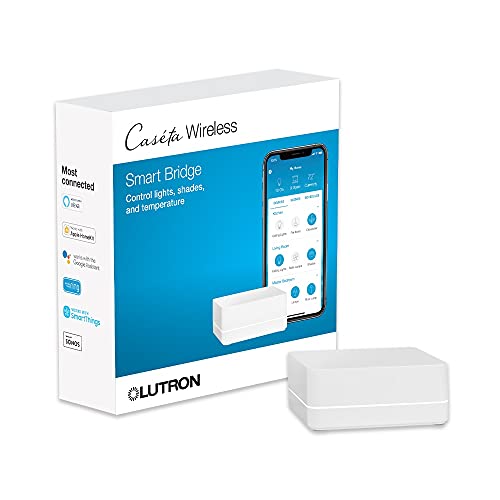
Lutron Caseta Smart Hub
If lighting is the thing that must never fail, Lutron has earned its reputation. The Caseta hub runs Lutron’s own Clear Connect radio, which deliberately avoids competing with your Wi-Fi, and that is a large part of why these dimmers respond instantly and reliably year after year. It supports up to 75 Caseta devices, so it scales through a whole house, and it connects outward to more major platforms than most, including Alexa, Apple HomeKit, Google Assistant, Ring, Serena shades, and Sonos. Setup is genuinely simple: plug it into your router, open the app, follow the steps. The boundary is clear and worth stating plainly: this is a lighting and shade hub for Lutron gear, not a general automation controller, and the dimmers and switches are sold separately.
Pros
- Exceptionally reliable lighting on a dedicated radio
- Does not compete with your Wi-Fi
- Works with Alexa, HomeKit, Google, Ring, and Sonos
- Scales to 75 devices with very easy setup
Cons
- Only runs Lutron Caseta devices
- Not a general-purpose automation controller
Best for: households that want flawless smart lighting and shades above all else.
Aqara Smart Home Hub M3
The M3 is Aqara’s serious hub, and it is built around local control. It acts as an edge hub, taking over from older Aqara hubs and shifting their automations to run locally, and it supports up to 127 Aqara Zigbee devices plus 127 Thread devices while bridging them into Matter ecosystems including Home Assistant. Connectivity is unusually thorough for the price: dual-band Wi-Fi with WPA3, a Power over Ethernet port, and a USB-C port that accepts a power bank as a mini backup supply. A 360-degree IR blaster is the clever part, sending commands and detecting when you use a traditional remote, and it can expose an air conditioner to Matter as a thermostat when paired with a temperature sensor. Privacy is deliberate, with no microphone or camera and 8GB of encrypted local storage. Note it supports Aqara Zigbee devices, not third-party Zigbee.
Pros
- Local edge automations with Matter bridging
- Thread border router plus PoE and USB-C backup
- Smart IR blaster with status feedback
- No mic or camera, encrypted local storage
Cons
- Zigbee support is Aqara devices only
- Best experience stays inside the Aqara app
Best for: Aqara owners who want local control and a bridge into Matter and Home Assistant.
Hubitat Elevation C-8 Pro
This is the local-first controller the category is named after, and it makes no compromises on that promise. Automations run inside your home rather than on remote servers, so lights, locks, thermostats, and security rules keep working through an internet outage, with faster response and better privacy as a bonus. The radio list is the most complete here, covering Matter 1.5, Z-Wave 800 Series with Long Range, Zigbee 3.0, and Bluetooth, plus Ring support, spanning over a thousand devices across a hundred brands with no dongles required. External antennas give it genuinely strong range for larger or device-dense homes. The built-in rules engine scales from a five-minute schedule to intricate custom logic, with no subscription at any point, and regular platform updates keep adding standards without new hardware. The maker is upfront that new users should check the compatible device list first.
Pros
- Fully local automations that survive internet outages
- Matter, Z-Wave 800 LR, Zigbee 3.0, and Bluetooth built in
- External antennas for strong whole-house range
- Powerful rules engine with no subscription
Cons
- Premium price
- Worth checking the compatibility list before buying
Best for: anyone who wants dependable, private, subscription-free automation that never phones home.
Zemismart Matter Hub M1 Pro
The value option here packs a surprising amount of local capability. The M1 Pro unifies Zigbee, Thread, and infrared devices in one gateway, with a Matter bridge and an OpenThread Border Router connecting them to Apple Home, Google Home, SmartThings, and Home Assistant from a single app. Its scenes and rules execute locally, so automations survive an outage, and it supports cross-gateway automations if you run more than one on the network. The genuinely clever bit is resilience: if a gateway fails, adding a new one restores all devices and automations without re-pairing anything. A 360-degree IR blaster with six emitters controls air conditioners and TVs and can expose them through Matter. Connectivity covers dual-band Wi-Fi and Ethernet, though a wired connection is required for first setup, and there is no microphone or camera.
Pros
- Local scenes with Matter bridging at a fair price
- Thread border router plus a strong six-emitter IR blaster
- Automations restore without re-pairing after a failure
- Wi-Fi and Ethernet, no mic or camera
Cons
- Requires a wired connection for initial setup
- Smaller community and support base than the big platforms
Best for: budget-conscious buyers who want Matter, Thread, and local scenes in one box.
The verdict
Best Overall: the Home Assistant Green. As the best-seller it is the most flexible route to local control, with the software preinstalled, an enormous integration range, and silent, efficient hardware. Add a USB radio or two and it genuinely replaces every other hub and app in the house.
Best Value: the Zemismart Matter Hub M1 Pro. Local scene execution, a Thread border router, Matter bridging to every major ecosystem, and a capable IR blaster for a mid-range price is a lot of hub for the outlay.
Best Premium: the Hubitat Elevation C-8 Pro. Every radio you need built in, external antennas for real range, a powerful rules engine, no subscription, and automations that keep running when the internet does not.
Frequently asked questions
What is the difference between Hubitat and Home Assistant? Hubitat is a self-contained appliance with radios and a rules engine built in, aimed at dependable local automation with little fuss. Home Assistant is a flexible platform that integrates with far more devices and services but expects more setup and maintenance from you.
Do local hubs work without the internet? The automations do, which is the point. Rules run on the hub, so lights, locks, and thermostats keep working during an outage. Remote access, voice assistants, and some notifications still need a connection.
Do I need Z-Wave and Zigbee radios? It depends on your devices. Many sensors, locks, and bulbs use one or the other. The Hubitat has them built in; Home Assistant Green expects you to add inexpensive USB sticks for Z-Wave, Zigbee, or Thread.
What does Matter change? Matter is an interoperability layer letting devices from different brands work together, and Thread is the low-power mesh many Matter devices use. A hub acting as a Matter controller and Thread border router can bring mixed-brand gear into one system.
Is there a subscription? The core automations on these hubs run without a monthly fee. Optional paid cloud services exist on some platforms for convenient remote access, but they are not required to run your home locally.
This article may contain affiliate links; see our Affiliate Disclosure.