A newborn’s head weighs roughly a quarter of their body, balanced on a neck that cannot yet hold it. Turn a corner and it lolls sideways; hit a bump and it drops forward. Every caregiver who has twisted around at a red light to check whether a chin has sunk onto a chest knows the specific worry that sells these cushions.

A good insert does three quiet jobs: it fills the gap around a small body so they are not swimming in the seat, it stops the head rolling to the side, and it comes out cleanly when the baby grows. What separates a great one from a landfill purchase is fit, washability, and knowing exactly where it is safe to use. That last point is where most guides stay silent, and it deserves to come first.
At a glance
| Product | Standout feature | Price tier | Link |
|---|---|---|---|
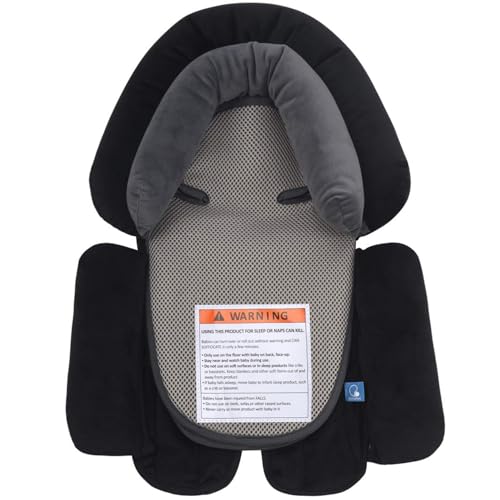
| COOLBEBE Upgraded 3-in-1 Babybody Support | Nested removable layers; mesh side for heat, velour for cold | Budget | |
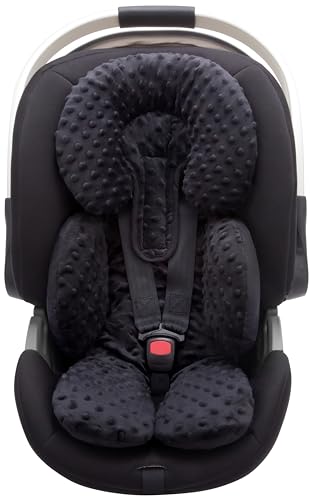
| Pro Goleem Infant Car Seat Insert | Reversible minky and microfiber; holds loft after washing | Mid-range | |
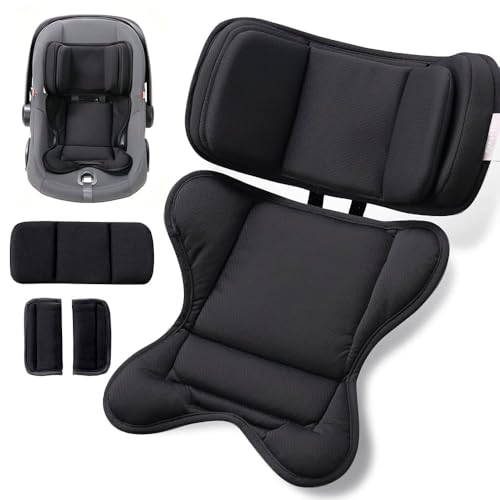
| TinlyFinly Adjustable Infant Insert | Two head-opening widths; silicone anti-slip dots; strap pads | Premium | |
| GFU Baby Car Seat Head Support | Two head supports plus strap covers; 3-point or 5-point harness | Mid-range | |
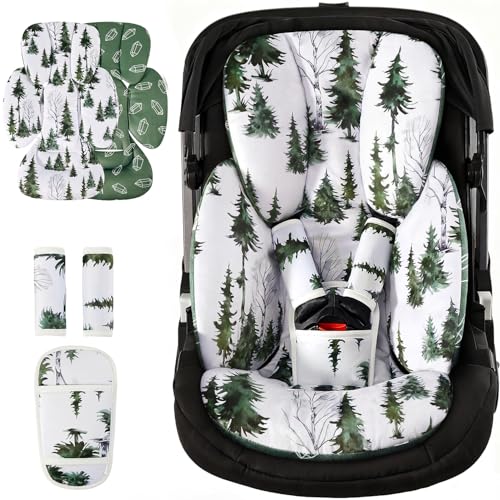
| mamatepe 2-in-1 Reversible Newborn Insert | Preemie-friendly sizing; includes strap and buckle covers | Premium | |
How to choose a newborn head support
Start with your car seat manual, not the cushion
This matters more than any feature in this article. An aftermarket insert is not crash-tested with your particular car seat, because it was not made or approved by the company that built the seat. Most car seat manufacturers say plainly in their manuals that you should only use the padding that came in the box, and many state that adding anything else voids the seat’s approval. Nothing should ever sit between a baby’s back and the seat shell, or between the baby and the harness straps.
So read your manual first. If it prohibits aftermarket inserts, that is the answer for the car, and it is not a close call. Many of the products here are equally at home in a stroller, swing, bouncer or bassinet, where the crash-test question does not apply and a soft insert is simply a comfort item. Buying one for those uses is a perfectly good reason to buy one.
Use the insert your seat came with while it fits
Infant car seats sold for newborn use ship with their own infant insert, tested with that shell and harness. It is the correct choice for the car until your baby outgrows it. Aftermarket cushions are most often bought because the original was lost, stained beyond rescue, or outgrown, and the seat now leaves a gap. That is a real problem, but the safe fix is a replacement part from the seat’s own manufacturer where one exists.
Fit and adjustability
Babies change shape fast. The inserts that stay useful are the ones with a removable inner section or two head-opening sizes, so the same cushion serves a six pound newborn and a ten month old. TinlyFinly builds this in with a narrower upper layer for the first months and a wider lower layer after, and COOLBEBE nests a smaller section inside a larger one. A one-size cushion tends to get a month or two of use before it becomes a nuisance.
Fabric, warmth and airflow
A cushion that is lovely in winter can be miserable in summer. Reversible designs solve this cheaply: a mesh or microfiber side that breathes when it is hot, and a plush velour or minky side for cold months. If your baby runs warm, or you live somewhere that stays warm, take breathability as the deciding feature rather than a bonus.
Washing, and how it survives it
Assume spit-up, and assume it happens on the way somewhere important. Every insert here is machine washable, but they do not all recover equally. Look for listings that specify cool washes and warn against ironing or bleach, and expect plush to need a tumble to regain loft. An insert that mats down after two washes has effectively stopped supporting anything.
Slipping, and the small details that avoid it
A head support that slides is worse than none, because it moves the head instead of steadying it. Silicone grip dots on the underside, webbing and snap fasteners at the back, and strap pads that keep the harness from rubbing are the details that separate a considered design from a shaped pillow.
COOLBEBE Upgraded 3-in-1 Babybody Support
This is the most popular insert in the group, and it gets there by refusing to be a single-season product. The nested design means the whole thing works from birth, then the inner section lifts out to make room as your baby fills the space, with sizing quoted at about 16 by 8.6 inches for the first four months and about 20 by 14 inches from five to ten months. It is reversible, with a sandwich mesh face for hot days and soft velour for cool ones, and the inner layer can be dropped for spring and autumn or kept in for winter. COOLBEBE calls it hypoallergenic and machine washable at cool temperatures, and notes it suits premature babies too. As a stroller, swing and carrier cushion that grows for the better part of a year, it is hard to argue with.
Pros
- Nested removable section covers birth to around 12 months
- Reversible mesh and velour sides for hot and cold weather
- Three thickness configurations across the seasons
- Machine washable at cool temperatures; hypoallergenic materials
- Lowest price here
Cons
- Aftermarket, so not crash-tested with any specific car seat
- Velour side is warm; the mesh side does the real summer work
- No strap pads included
Best for: strollers, swings and carriers where one cushion needs to last the whole first year.
Pro Goleem Infant Car Seat Insert
Pro Goleem’s pitch is texture. One face is microfiber, cool against skin in summer; the other is minky dot, which gives a three-dimensional surface that many babies settle against more readily than flat plush. The insert covers head, neck and body, with removable sections that free up room for bigger infants, and it is rated from birth to around ten kilograms. The listing includes an unusually candid instruction: wash it before first use, because it arrives compressed and only fluffs up properly afterwards. That is a small clarity that tells you the fill is doing real work rather than relying on packaging.
Pros
- Two useful surfaces: cool microfiber and textured minky
- Removable sections adapt as the baby grows
- Machine washable; listing claims no fading, shedding or pilling
- Matching strap covers sold separately in the same color
Cons
- Needs a wash before first use to reach full loft
- Strap covers are a separate purchase
- Aftermarket, so the car seat manual decides whether it belongs in the car
Best for: caregivers who want a soft, tactile insert with a genuine summer side.
TinlyFinly Adjustable Infant Insert
This is the most thought-through design in the group. The head opening has two layers: a narrower upper one shaped for the first three months, and a wider lower one for after, so the cushion tracks a growing skull rather than a growing body. Underneath the head support are silicone dots to stop it wandering, and at the back are webbing and snap fasteners that anchor it to the seat strap. The fill is foam with polyester layered over it, aimed at keeping shape without going hard, and the head support detaches to be used on its own. A pair of shoulder strap pads is in the box. TinlyFinly lists compatibility with a long roster of seat brands and strollers.
Pros
- Two head-opening widths tuned to age, not guesswork
- Silicone anti-slip dots and snap fastening keep it in place
- Head support detaches and works independently
- Shoulder strap pads included
- Foam and polyester fill holds its shape
Cons
- Priciest option here
- Broad brand compatibility claims still need checking against your own seat
- Aftermarket, with the same manual caveat as the rest
Best for: a stroller or travel system where a snug, non-slipping head cradle is the whole point.
GFU Baby Car Seat Head Support
GFU sends more pieces than anyone else: two head supports and two shoulder strap covers, in a pink floral print with a solid pink body support. The two supports can be used together for a very small newborn or separately as the head grows, which is a blunter version of TinlyFinly’s adjustability but works on the same logic. The fabric is soft plush, light and easy on new skin, and the whole set fits three-point or five-point harnesses across most seats, strollers, swings and bouncers. It is machine washable and priced as a gift, which is plainly the market it is aimed at.
Pros
- Two head supports plus two strap covers in one set
- Pieces work together or separately as the baby grows
- Fits three-point and five-point harness layouts
- Soft plush; machine washable
- Presents well as a gift
Cons
- Plush only, with no dedicated breathable side for hot weather
- Floral pink styling will not suit every nursery
- Quoted for roughly 0 to 10 months, a shorter run than some
Best for: a stroller-and-swing setup, or a baby shower gift that gets used rather than shelved.
mamatepe 2-in-1 Reversible Newborn Insert
The mamatepe insert leans hardest into the very small end of the range, sized for preemies and quoted through to a busy twelve month old. It flips between a snug winter face and a breezier summer one, and the package includes the extras that usually cost more later: two padded strap covers and a buckle cover, both aimed at the rubbing that shows up on a baby’s neck and belly after enough car trips. Compatibility is listed across a wide set of major seat, stroller, swing, bouncer and bassinet brands. If your baby arrived early and small, this is the one on the list built with that in mind.
Pros
- Sized from preemie upward, where most inserts start too big
- Reversible winter and summer faces
- Strap covers and a buckle cover included
- Broad stated compatibility across seats, swings and bassinets
- Removable, washable covers
Cons
- Premium tier for a cushion
- Least popular of the group, so fewer buyer reports to lean on
- Aftermarket, with the usual car seat manual caveat
Best for: preemies and small newborns who float in everything else.
Verdict
Best overall: the COOLBEBE Upgraded 3-in-1 Babybody Support. It is the clear favorite here and deserves it: three configurations, two fabric faces, and a size range that spans nearly a year for the least money on the list.
Best value: the Pro Goleem Infant Car Seat Insert. Reversible, durable through washing, and pleasant enough that babies actually settle on it.
Best premium: the TinlyFinly Adjustable Infant Insert. Two head-opening widths, silicone grip, snap anchoring and strap pads make it the most engineered cushion in the group.
For a preemie, the mamatepe insert is the specialist. And whichever you choose, the car seat manual has the final say about the car.
Frequently asked questions
Are aftermarket car seat inserts safe to use in a car?
Only if your car seat’s manufacturer permits them, and most do not. Products that did not come with your seat were not crash-tested in it, and manuals commonly state that adding them voids the seat’s approval. Nothing should sit between the baby and the seat shell or between the baby and the harness. Check the manual before the cushion goes anywhere near the car; in strollers, swings and bouncers, these inserts are simply comfort items and the question does not arise.
My car seat’s original insert is lost. What should I do?
Contact the seat’s manufacturer and ask for a replacement part. Seat makers sell tested spares for exactly this situation, and that part is the only cushion assured to work with your shell and harness. An aftermarket insert is not an equivalent substitute in the car, however similar it looks.
When does a baby stop needing head support?
Most babies gain reliable head control somewhere around four to six months, though it varies. The body-filling job usually ends sooner than the head-steadying job, which is why inserts with a removable inner section stay useful longer. If your baby’s head no longer slumps sideways when they doze off in a stroller, the support has done its work.
Can one insert work in a car seat, a stroller and a swing?
Physically, usually yes, and most listings here claim exactly that. The catch is regulatory rather than physical: the stroller, swing and bouncer uses are unrestricted, while the car use depends on your seat manufacturer’s rules. Buy for the uses you are certain of.
How often should these be washed?
As often as they need it, which with a newborn is often. Wash cool, skip bleach and ironing, and tumble or shake plush back into shape afterwards. A matted, compressed insert has lost the loft that made it supportive, and at these prices replacing it beats persisting with it.
This article may contain affiliate links; see our Affiliate Disclosure.