Easy-on handles exist because rain boots are snug, and rain boots are snug because a boot loose enough for a four-year-old to pull on unaided is a boot that comes off in mud. That is the tension the entire category is built around and almost nobody names. One brand here addresses it with a shaped toe box rather than a handle. One tells you its boots run large enough that you should order a size down. The rest fit handles and hope.



At a glance
| Boot | Material, and what it proves | Price tier | Link |
|---|---|---|---|
| Hbxooxts (cheaper) | Rubber. Light-up soles. Cheapest here | Budget | |
| Hbxooxts (dearer) | The same boot, word for word, for more | Budget | |
| Stelle | Natural rubber. Arch support and a lining | Budget | |
| LONECONE (yellow) | 100% natural rubber. 100-hour test, 6-month warranty | Mid-range | |
| DREAM PAIRS | PVC. Big opening design; odor-free, it says | Mid-range | |
| LONECONE (cranberry) | The same boot again, for more money | Mid-range | |
| Crocs Handle It | EVA foam, unlined. The best seller. Size down | Premium | |
How to choose
Natural rubber, PVC or foam are three different boots
The word rubber does a lot of hiding here. Two brands say 100 percent natural rubber or natural rubber, which stays soft and bendy when it is cold, which is when you wear rain boots. One is PVC, and PVC stiffens as the temperature drops, which is why that listing works hard to tell you its PVC is odor-free. And the best seller is neither: it is ethylene vinyl acetate, the foam that clogs are made of, which is very light, does not absorb water, and is not rubber. Read the material line.
Only one brand offers proof rather than adjectives
Everything here is sturdy, durable and long-lasting. One brand instead publishes a test and a promise: boots tested to withstand over 100 hours of activity without split seams or leaks, assured a full six months without loss of function, and independently certified free of BPA, cadmium, phthalates and lead. That six months is well judged, because it is roughly how long a child stays in one shoe size. Nobody else here offers a test, a warranty period, or an independent chemical certificate.
The boot that runs big tells you so
Buying children’s boots online means guessing, and one brand removes the guess by admitting the answer: it recommends sizing down, giving a worked example. That is a manufacturer telling you its own boots run large, on a page where nobody else mentions sizing at all. It is also the best-selling boot here, which suggests parents value that sentence. Read it as a feature, because a boot that fits is a boot that stays on when the mud sucks.
Handles are not the only way to solve this
Every boot here has handles and one adds something better underneath: a wide toe box for wiggle room without looseness, plus arch support to cut fatigue. That is the real answer to the easy-on problem, because a boot shaped correctly at the toe slides on without needing to be baggy at the ankle. Handles get a child into a snug boot. Shape stops the boot needing to be snug in the first place. One brand thought about the second thing.
Check whether it is lined, especially for bare feet
Children put rain boots on over nothing, constantly, and this is where materials bite. One boot here states plainly that it is unlined. Another makes a point of a soft sweat-absorbent lining and says it works even when barefoot, which is the real acknowledgement of what actually happens. Unlined rubber or foam against a bare foot gets clammy and rubs. If socks are a negotiation in your house, the lining is not a luxury.
Two brands, same trick with the colors
This happens twice on one page. Two listings from one brand carry word-for-word identical bullets, the same sales rank and different prices, separated only by which color you pick. Another brand does exactly the same across its range, with one shade costing more than its siblings for no stated reason. Nothing changes but the picture. Open every color of whatever you settle on before you order, because on this page that is worth a couple of pounds each time.
Hbxooxts (cheaper)
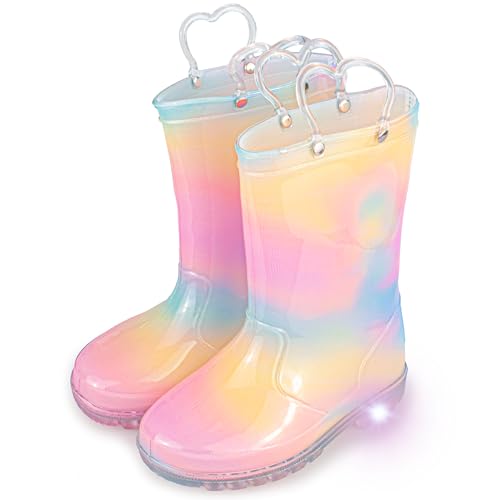
The cheapest boots here and the only ones that light up with every step, which the listing sells as fun and then, more usefully, as visibility. That is a fair point rather than a gimmick: rain boots come out on dark wet evenings, and a child who glows at ankle height is a child drivers see. Handles on both sides for pulling on unaided, fully waterproof rubber, non-slip sole pattern. The listing never mentions how long the lights last or whether the battery can be replaced.
Pros:
- The cheapest boots in this search
- Light-up soles add real visibility on dark wet evenings
- Handles on both sides for independent pulling on
- Non-slip sole pattern; fully waterproof
Cons:
- No battery life stated; the lights may outlast nothing
- No lining, sizing or material detail published
- The same boot is listed again at a higher price
Best for: being seen, cheaply, on a dark walk home.
Hbxooxts (dearer)
The same boot as above, in a different pattern, at a higher price. The bullets are identical word for word: the same light-up feature, the same grip handles on both sides, the same waterproof construction, the same non-slip sole, the same sales rank. Nothing here is different except which picture you are looking at and what you pay. That is the whole entry. If you like this pattern better, this is what that preference costs, and it is worth knowing the number before you decide.
Pros:
- Identical specification to the cheaper listing
- Light-up soles for visibility
- Handles both sides; non-slip sole
- Still among the cheapest boots here
Cons:
- Costs more than the same boot in another pattern
- No battery life, lining or material detail
- No sizing guidance at all
Best for: this pattern specifically, if it is worth the difference.
Stelle
The only boot here that solves the easy-on problem with shape rather than only with handles: a wide toe box giving wiggle room without going loose, which is precisely the trick, plus ergonomic arch support to cut fatigue on a long walk. Rain boots are usually a flat rubber tube, so arch support is genuinely unusual. It is natural rubber, flexible and handled to keep water out, and it carries a soft sweat-absorbent lining that Stelle says works even when your child is barefoot, which they will be.
Pros:
- Wide toe box for room without looseness; the real fix
- Arch support, which almost no rain boot has
- Sweat-absorbent lining, stated to work barefoot
- Natural rubber; five colors with matching linings
Cons:
- No durability test or promise published
- No chemical certification mentioned
- The worst-selling boot on this page
Best for: feet that will be bare inside them, and long walks.
LONECONE (yellow)
The only listing here offering evidence instead of adjectives, and it offers three kinds. The boots are tested to withstand over 100 hours of activity without split seams or leaks. They are assured a full six months without loss of function, which is about how long a child stays in one size. And they are independently certified free of BPA, cadmium, phthalates and lead. The boot itself is 100 percent natural rubber, ultralight, with a flex sole and a non-slip tread, in a soft matte finish.
Pros:
- The only published durability test: 100 hours, no splits or leaks
- A six-month warranty, matched to how fast feet grow
- Independently certified free of BPA, cadmium, phthalates and lead
- 100 percent natural rubber; stays flexible in the cold
Cons:
- No lining mentioned
- No sizing guidance published
- Other colors of the same boot cost more
Best for: proof rather than promises.
DREAM PAIRS
The one that leans hardest into the search term: a big opening design so the boots take seconds to slip on and kick off, which is exactly what a four-year-old needs and exactly what makes a boot want to come off in mud. It is PVC rather than rubber, and DREAM PAIRS knows what you are thinking, describing it as child-safe and odor-free, which is a claim you only make about a material with a reputation. It wipes clean and has a textured outsole.
Pros:
- Big opening; genuinely fast on and off
- Pre-empts the smell question about PVC directly
- Wipes clean in seconds
- Textured outsole for wet surfaces
Cons:
- PVC stiffens in cold, where natural rubber does not
- A big opening is also a boot that pulls off in mud
- No lining, test or certification mentioned
Best for: a child who insists on doing it themselves.
LONECONE (cranberry)
The same boot as the yellow above, in a different color, for more money. Same 100 percent natural rubber, same 100-hour test, same six-month warranty, same independent certification against BPA, cadmium, phthalates and lead, same flex sole, same rank. The bullets differ only in where the full stops fall. LONECONE’s own argument for these is that letting children choose their own colors builds coordination and independence, which is a good argument. It just costs more in this shade than in others.
Pros:
- Same tested, assured, certified boot as the cheaper color
- 100 percent natural rubber with a flex sole
- Easy-on handles designed for children to use alone
- Matte finish that goes with anything
Cons:
- Costs more than the identical boot in other colors
- No lining mentioned
- No sizing guidance
Best for: this color, if your child has chosen it themselves.
Crocs Handle It
The best-selling boot in this search and the most expensive, with oversized handles that are the biggest on the page and the easiest for small hands to grab. It is also the most accurate listing here on the thing that matters when you buy children’s shoes online: Crocs recommends sizing down, and gives you a worked example. Two facts to hold alongside that. The upper and insole are ethylene vinyl acetate, the foam clogs are made from, not rubber. And it is unlined, and says so.
Pros:
- The best seller in this search
- Oversized handles; the easiest here for small hands
- Tells you to size down, with an example
- EVA is very light and does not soak up water
Cons:
- Unlined, by its own listing; clammy on a bare foot
- EVA foam rather than rubber
- The most expensive boots on this page
Best for: small hands and socks, from the boot most people buy.
The verdict
Handles are the answer to a problem created by fit, so read for fit first: one brand tells you to size down, one shapes the toe box so the boot need not be baggy. Then read the material, because natural rubber, PVC and foam behave differently in the cold. Only one listing on this page offers a test or a warranty at all.
Best overall: LONECONE. It is the only brand here that produces evidence: boots tested past 100 hours without split seams or leaks, assured six months without loss of function, and independently certified free of BPA, cadmium, phthalates and lead. That six months is well judged, because it is roughly how long a child stays in one size. 100 percent natural rubber stays soft when it is cold, which is when the boots come out. Check the colors; they are not all one price.
Best value: Hbxooxts. The cheapest boots in the search, with handles on both sides and light-up soles that the listing sells as fun and which are quietly a safety feature: rain boots come out on dark wet evenings, and a child glowing at ankle height is a child drivers can see. Nobody says how long the lights last, so take that as a bonus rather than the reason. Check both patterns, because one costs more for nothing.
Best premium: Crocs Handle It. The best seller here, with the biggest handles on the page and the most useful sentence in the search: Crocs recommends sizing down, and shows you the arithmetic, which removes the guesswork from buying children’s shoes you cannot try on. It is EVA foam rather than rubber, which makes it very light, and it is unlined, so put socks on the child first.
FAQ
Why do rain boots need handles at all?
Because they are snug, and they are snug so they stay on in mud. Handles let a child get into a boot that fits properly. One brand here instead widens the toe box, so the boot slides on without needing to be baggy at the ankle, which is the better answer.
Natural rubber, PVC or EVA?
Natural rubber stays flexible when it is cold, which is when you wear rain boots. PVC stiffens, which is why the PVC listing here works hard on being odor-free and child-safe. EVA is the foam clogs are made from: very light, waterproof, and not rubber.
What size should I order?
Only Crocs will tell you, and it says to size down with a worked example. Nobody else on this page mentions sizing at all. On children’s shoes bought unseen, that one sentence is worth more than most of the features here.
Does the lining matter?
If your child ever goes barefoot in them, yes. One boot here states it is unlined. Another makes a point of a sweat-absorbent lining and says it works even barefoot. Unlined rubber or foam against a bare foot gets clammy and rubs.
Are the light-up ones just a gimmick?
Partly. The lights genuinely add visibility on the dark wet evenings when rain boots get worn, which is a real point. What the listing never says is how long the batteries last or whether they can be replaced, so take the lights as a bonus that may expire.
This article may contain affiliate links; see our Affiliate Disclosure.