One scooter here cites the standards that actually govern children’s toys, naming both the American and the European one. Another cites its manufacturer’s status as a Certified B Corporation, which is a real certification about how a company snacks people and the planet, and which says precisely nothing about whether a two-year-old comes off the thing. Both are printed under a heading about safety. Only one of them is about the scooter.



At a glance
| Scooter | Ages, brake and what is certified | Price tier | Link |
|---|---|---|---|
| Blue Mini | 2+. Rear brake. Four published handlebar heights | Budget | |
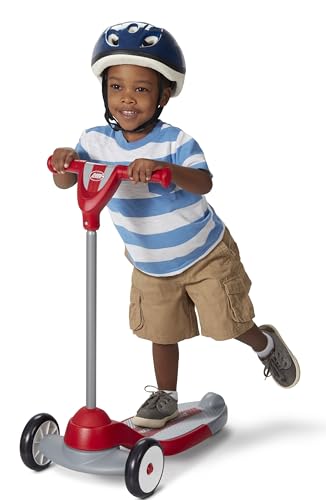
| Radio Flyer My 1st | 2-5. Rear brake and a limited turning radius | Budget | |
| Gotrax KS1 | 2-8, 110lb. The best seller. No brake mentioned | Mid-range | |
| Gotrax KS1 (green) | The same scooter, same price, one more typo | Mid-range | |
| besrey | 3-10, 110lb. The only toy safety standards cited | Premium | |
How to choose
Only one listing names a toy safety standard
besrey states that its scooter is certified to ASTM F963-17 and to EN71, which are the American and European toy safety standards, and that it got there after repeated testing. Nobody else on this page names either. What you get instead is a one-year manufacturer’s assurance, which is a warranty rather than a standard, and a Certified B Corporation badge, which certifies how a company behaves rather than how a scooter behaves. Both are worth having. Neither is a safety test.
Check that the listing mentions a brake
Three scooters here describe a rear foot brake you step on, which on a machine for a two-year-old is not a feature so much as the point. The best-selling scooter in this search does not mention a brake anywhere across its five bullets, which cover glowing wheels, lean-to-steer, a quick-release stem, its bearings and its warranty. That may simply be an omission in the copy. It is still the thing to establish before you buy anything on this page.
Fast bearings and small children
The same best-selling scooter publishes something almost nothing else here does: ABEC-7 bearings, which is a genuine precision rating and a high one for a child’s toy. Higher precision means less friction and a longer roll. Sit that beside the missing brake and think about who is riding it. On a two-year-old’s first scooter, the bearing that keeps rolling after they stop pushing is not obviously the feature you want most, and nobody else on this page quotes one at all.
A limited turning radius is a beginner feature
Most scooters here sell lean-to-steer, where the child leans and the scooter turns, and describe it as building balance and coordination, which it does. Radio Flyer does something different and more conservative: two front wheels, an extra-wide base, and a turning radius deliberately designed to add safety without limiting mobility. In other words it stops a beginner from over-leaning and putting themselves on the pavement. That is the opposite trade from lean-to-steer, and for a nervous two-year-old it is the right one.
The age ranges cannot all be right
The same three-wheel shape is sold here for ages two to five, two to eight, three to ten, and simply two and up. Two of them state a 110 pound limit, which is roughly an eight-year-old, and two publish no limit at all. The real one is the narrow one: a three-wheel beginner scooter is something a child grows out of, usually well before eight, when they want two wheels and to go fast. A range that stretches to ten is a range that has stopped meaning anything.
Motion-powered lights never run out
Two listings here say their LED wheels are motion-activated and need no batteries, with one adding that the lights get brighter the faster the child goes, which is a small piece of magic and also a dynamo. A third simply says its wheels are equipped with powerful LEDs and never says what powers them. That matters, because a battery inside a sealed wheel is a light with an expiry date and no way to change it. Look for the words motion activated.
Blue Mini
The cheapest scooter here and the best-documented listing on the page. It is the only one publishing its handlebar heights, all four of them, at 21.65, 23.62, 25.59 and 27.56 inches, so you can measure your child rather than guess. It is also the only one publishing wheel sizes: 120mm at the front and 80mm at the rear, which is what decides whether it rolls over a paving crack or stops dead in it. Motion-activated LEDs, lean-to-steer, an anti-slip deck and a rear foot brake.
Pros:
- The cheapest scooter here, and the best documented
- All four handlebar heights published to the decimal
- The only wheel diameters published: 120mm front, 80mm rear
- Rear foot brake; motion-activated LEDs with no batteries
Cons:
- No safety standard cited
- No weight limit published
- Ages 2 and up, with no upper bound at all
Best for: knowing the measurements before it arrives.
Radio Flyer My 1st
The most conservative scooter here and the most accurate about its own life: ages two to five, after which your child will want something else, which is true and which nobody else admits. Two front wheels and an extra-wide base give it a genuinely stable platform, and instead of lean-to-steer it limits the turning radius on purpose, so a beginner cannot over-lean their way onto the pavement. There is a rear foot brake and a textured deck. Its only certification is B Corp, which is about the company rather than the scooter.
Pros:
- A deliberately limited turning radius; a real beginner feature
- Two front wheels and an extra-wide base for stability
- Fair 2 to 5 age range, with an upper bound
- Rear foot brake; textured deck; a century-old name
Cons:
- Its only certification is about corporate conduct, not safety
- No weight limit, handlebar height or wheel size published
- No LED wheels, if that is the appeal
Best for: a nervous two-year-old who should not lean too far.
Gotrax KS1
The best-selling scooter in this search and it has the best transport trick: press one red button and the stem pulls out of the base, so the whole thing goes in a boot in seconds and comes back together the same way. Three glowing LED wheels, lean-to-steer, a wide anti-slip deck, ABEC-7 bearings that roll unusually well for a toy, ages 2 to 8 up to 110 pounds, and a one-year manufacturer’s assurance. Across all five bullets it never mentions a brake, and it never says what powers the lights.
Pros:
- The best seller in this search, by a wide margin
- One-button stem removal; in the boot in seconds
- ABEC-7 bearings, a genuine precision rating
- Publishes ages and a 110 pound limit; one-year assurance
Cons:
- No brake mentioned anywhere in the listing
- Fast bearings and no stated brake is a combination to check
- Never says what powers its LEDs
Best for: car boots and glowing wheels, once you have asked about the brake.
Gotrax KS1 (green)
The same scooter in green, at the same price and the same sales rank, with bullets identical to the other listing except for a typo where the word surfaces lost a letter. Same red-button stem, same ABEC-7 bearings, same LED wheels, same 2 to 8 and 110 pounds, same one-year assurance, same silence about a brake. There is genuinely nothing to choose between them but the color, which for once costs nothing, so pick the one your child points at.
Pros:
- Identical to the other color, at the identical price
- One-button stem removal for transport
- ABEC-7 bearings; wide anti-slip deck
- Ages and weight limit published; one-year assurance
Cons:
- No brake mentioned, as with its twin
- No safety standard cited
- Never says what powers the LEDs
Best for: green, at no premium, with the same question to ask.
besrey
The only scooter in this search that names the standards children’s toys are actually held to, ASTM F963-17 and EN71, and says it was tested repeatedly to get there. It also has the most sensitive rear brake description on the page, an extra-wide deck with anti-slip coating, a widened base rated to 110 pounds, and LED wheels that are motion activated with no batteries and glow brighter the faster the child goes. It folds in one step out of the box, and there is a two-year return policy.
Pros:
- The only listing citing ASTM F963-17 and EN71
- Rear brake described; widened base rated to 110 pounds
- Motion-activated LEDs; no batteries, brighter with speed
- Folds in one step; two-year return policy
Cons:
- By far the most expensive scooter here
- Ages 3 to 10 is an implausibly wide range
- No handlebar heights or wheel sizes published
Best for: the only scooter here tested against a toy standard.
The verdict
One listing names the toy safety standards; another offers a certification about corporate conduct under a safety heading. Three describe a brake and the best seller does not mention one. And the age ranges run from two-to-five to three-to-ten for the same shape, which cannot all be right.
Best overall: Radio Flyer My 1st. The most conservative scooter here and the only one real about being outgrown, at two to five. Instead of selling lean-to-steer as far as it will go, it deliberately limits the turning radius so a beginner cannot over-lean onto the pavement, on two front wheels and a wide base, with a rear foot brake. Its only certification is about the company rather than the scooter, which is worth knowing, and everything else about it is aimed squarely at a nervous two-year-old.
Best value: Blue Mini. The cheapest scooter on this page and the one that publishes the most: four handlebar heights to the decimal, so you can measure your child, and both wheel diameters, at 120mm front and 80mm rear, which is what decides whether a paving crack is a bump or a stop. It has the rear brake and motion-activated LEDs that never need a battery. No standard is cited and no weight limit given.
Best premium: besrey. It costs roughly double the others and it is the only scooter in this search tested against the standards that actually govern children’s toys, naming both the American and the European one. It describes its rear brake, publishes its 110 pound limit, folds in a single step, and its LED wheels are motion powered so they never die. Work on the three-to-ten age range as marketing.
FAQ
Which certification actually matters?
ASTM F963 and EN71, the American and European toy safety standards, and one scooter here names both. A one-year manufacturer’s assurance is a warranty. A B Corp certification is about how a company snacks people and the planet. Only one of those three is a safety test.
Do they all have brakes?
Three of these describe a rear foot brake you step on. The best seller does not mention one anywhere across five bullets. That may be an omission in the copy rather than the scooter, and it is the first thing to confirm before buying.
What age is a three-wheel scooter for?
Younger than the listings claim. The same shape is sold here for two to five, two to eight, three to ten, and two and up. The narrow range is the real one: children move to two wheels well before eight.
Is lean-to-steer good for a beginner?
It builds balance, and it lets a child lean as far as they like. One scooter here takes the opposite view and limits the turning radius on purpose, so a beginner cannot over-lean. For a first-ever scooter that trade is worth considering.
Will the light-up wheels stop working?
Not if they are motion powered. Two listings here say their LEDs are motion activated and need no batteries, one adding they brighten with speed. A third never says what powers them, and a battery sealed inside a wheel cannot be replaced.
This article may contain affiliate links; see our Affiliate Disclosure.