A knife meets a tomato skin at a single point and has to break through it. A V-blade meets that same skin at two shallow angles at once and slides in from both sides, which is why a mandoline that struggles with a ripe tomato is almost never sharp enough and almost always the wrong blade shape. Get the geometry right and a bag of potatoes becomes a tray of even chips in about the time it takes to find the peeler.


Plenty of slicers sold as mandolines use a straight blade set across the runway. The five below all use a true V, where two angled edges meet in the middle and draw food into the cut instead of pushing it forward. That shape is the reason a V-blade handles soft produce that makes a straight blade skid. They suit a cook prepping a gratin, someone batching pickles through a weekend, or anyone who has decided that slicing onions by hand is no longer a good use of an evening.
At a glance
| Product | Standout features | Price tier | Link |
|---|---|---|---|
| Gramercy Mandoline Food Slicer | V-shaped stainless blade, compact body, cut-resistant gloves included | Mid-range | |
| OXO Good Grips V-Blade Mandoline | Four thickness settings, straight/wavy/julienne blades, textured runway | Premium | |
| Borner V3 TrendLine Starter Set | German-made V-slicer, insert system, collection tray, storage box | Premium | |
| Cuisinart V-Blade Mandoline | Straight and julienne cuts, thickness adjuster, minimal footprint | Budget | |
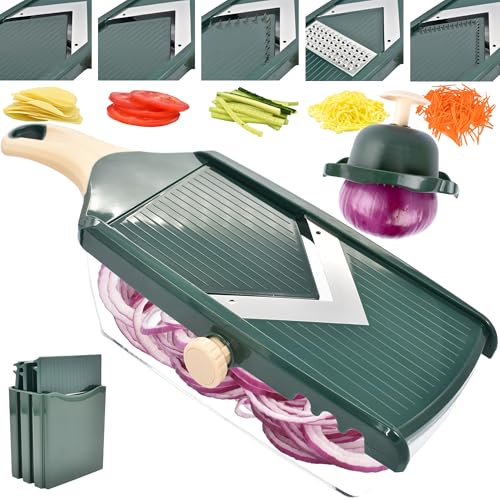
| NACOLUS Adjustable V-Blade Slicer | 420 steel V-blade, five thicknesses, four blades, catch container | Budget | |
How to choose a V-blade mandoline
Why the V shape earns its name
On a straight-blade mandoline the whole width of the food hits the edge simultaneously, so you are pushing against maximum resistance the entire stroke. A V-blade splits that work: the two angled edges engage a little at a time, drawing the food toward the center. NACOLUS describe this as reducing the cutting angle, which is the real mechanical description. The practical result is less force needed, less skidding on curved produce, and clean slices from tomatoes and lemons rather than crushed ones.
Fixed inserts versus a dial
Two design camps split this group. Dial mandolines, like the Gramercy, Cuisinart, and NACOLUS entries, change thickness by turning a knob while the blade stays put. Insert mandolines, which is the Borner approach, have you swap a physical insert to change the cut. Dials are faster and keep your fingers away from loose blades. Inserts give a more rigid cutting bed and are easier to clean thoroughly, but they mean handling sharp parts and finding somewhere to store them, which is exactly why Borner ships a storage box.
Thickness range is where listings differ most
Look at both ends of the range, not the headline number. The OXO offers four settings from 1.5mm to 6mm, which covers crisps through to gratin slices. NACOLUS goes from 1mm to 4.5mm across five steps, better at the thin end and less useful for thick cuts. A wider range is not automatically better; a mandoline that claims a huge span often has vague stops in the middle. Decide what you actually slice. Crisps and gratins live under 3mm; chips and roasting slices want 5mm or more.
The hand guard is the whole safety story
Every serious mandoline injury has the same shape: the last third of the vegetable, no guard, one confident stroke. A good hand guard has prongs that grip the food and sides that ride the rails so your fingers physically cannot reach the blade. NACOLUS spell this out and it is worth repeating. Cut-resistant gloves ship with several of these, and they are a handling aid rather than protection; a mandoline blade will still find an unguarded fingertip. Use the guard, and stop before the food gets too short rather than pushing your luck.
Stability, catch, and cleanup
A mandoline that walks across the counter turns a fine adjustment into a guess. Non-slip feet matter more than they sound. Then decide where the slices land: NACOLUS includes a container that doubles as blade storage, Borner has a collection tray you can serve from, and the OXO and Cuisinart expect you to slice onto a board or into your own bowl. Rinse immediately after use, before starch dries into the blade seat, and use a brush rather than a finger.
Gramercy Mandoline Food Slicer
This is the best seller of the group by a very large margin, and it gets there without a long feature list. A V-shaped stainless steel blade, a compact and light body, dishwasher-safe construction, and a pair of cut-resistant gloves in the box. That is the entire pitch. The compact body is the underrated part: mandolines that live in a cupboard because they are awkward to store get used twice a year, and this one is small enough to keep within reach. Gramercy’s description stays modest, claiming durability and uniform thin slices rather than inventing capabilities, which is a reasonable sign for a product this heavily bought.
Pros
- V-shaped stainless steel blade, the correct geometry for soft produce
- Compact, lightweight body that is easy to hold and store
- Cut-resistant gloves included
- Dishwasher safe
- The clear best seller among true V-blade mandolines here
Cons
- The listing does not state a thickness range in millimeters
- No catch container; slice onto your own board or bowl
- Fewer cut styles than the multi-blade sets here
Best for: everyday slicing where the mandoline needs to be quick to grab, quick to rinse, and quick to put away.
OXO Good Grips V-Blade Mandoline Slicer
The most specific listing here, and the one that tells you exactly what you get: a hardened stainless V-blade with four thickness settings at 1.5mm, 3mm, 4.5mm and 6mm. Named stops rather than a vague dial. It adds straight and wavy blades for crinkle cuts and julienne blades for fries or fine strips, so one tool covers a gratin, a crisp, and a matchstick carrot. Two details lift it above the spec sheet: the textured runway, which stops slices sticking and sliding back into the blade, and the food holder, which grips properly rather than perching on top. OXO’s stated range spans the useful spread from crisp-thin to chip-thick.
Pros
- Four clearly stated thickness settings, from 1.5mm to 6mm
- Straight, wavy, and julienne blades included
- Textured runway keeps food from sticking mid-stroke
- Food holder grips the food and shields fingers
- Hardened stainless V-blade rated for firm and soft produce alike
Cons
- Premium tier, the most expensive way into this group alongside the Borner
- Bulkier to store than the compact dial models
- No catch container included
Best for: the cook who wants one mandoline to handle crisps, crinkle cuts, and julienne without buying a second tool.
Borner V3 TrendLine Mandoline Starter Set
Borner has been making V-slicers in the Eifel region of Germany for over sixty years, and this is the original design rather than an interpretation of it. The set runs to six pieces: the V3 slicer, a safety guard, two inserts at 3.5mm and 7mm, a blade guard insert, a collection tray, and the Multibox that lets the whole thing live flat in a drawer. The insert system means the cutting bed is rigid, with no dial mechanism to drift under load. The collection tray sits under the slicer and doubles as the bowl you mix and serve the salad in. Everything rinses under a running tap.
Pros
- Original German V-slicer design with a long production history
- Rigid insert system rather than a dial that can shift
- Collection tray catches slices and serves as a salad bowl
- Multibox stores the slicer and inserts safely in a drawer
- Safety guard and non-slip feet included
Cons
- Only two slicing thicknesses, at 3.5mm and 7mm
- Changing cuts means handling sharp inserts
- Premium tier, and the slowest of these to reconfigure
Best for: salads and stir-fry prep in volume, where a rigid bed, a catch tray, and safe drawer storage beat having many settings.
Cuisinart V-Blade Mandoline
The shortest listing in this group, and unusually for Amazon, that is not a warning sign. Cuisinart states a stainless V-blade built on the same blade technology as their food processors, two cutting options in straight and julienne, and a thickness adjuster. Nothing more. For a lot of kitchens that is a complete description of what a mandoline needs to do: even slices, matchsticks when you want them, and a V-blade that gets through a tomato without tearing it. The trade-off is that you are buying on the brand’s blade reputation rather than a published thickness range, because the listing does not give the millimeter stops.
Pros
- Stainless V-blade drawing on Cuisinart’s food processor blade design
- Straight and julienne cutting in one tool
- Thickness adjuster for a range of cuts
- Handles softer foods where straight blades skid
- Budget tier from a long-established kitchen brand
Cons
- No thickness range published in the listing
- No gloves, container, or storage included
- Fewer cut styles than the OXO or NACOLUS
Best for: a straightforward first mandoline from a known brand, when straight slices and julienne cover everything you cook.
NACOLUS Adjustable Mandoline Slicer
The most complete package at the budget end. A 420 stainless V-blade, five thicknesses from 1mm to 4.5mm on a dial, and four blades covering slicing, fine grating, a 3mm matchstick julienne and a 6mm shredder. Underneath sits a clear container holding around 23 ounces that catches everything and then stores the blades, which solves the two problems that make people stop using a mandoline: nowhere for the slices to go, and loose blades in a drawer. NACOLUS also give the clearest safety writing of the group, describing a hand guard whose sides ride the rails at both ends with steel prongs inside to hold food still.
Pros
- Five thickness steps from 1mm to 4.5mm, the finest low end here
- Four blades: slicer, fine grater, 3mm julienne, 6mm shredder
- 23-ounce container catches slices and stores the blades
- Hand guard rides the rails with prongs to grip food
- Blades change by dial, without touching the edges
Cons
- Tops out at 4.5mm, so thick chip slices are out of range
- 420 steel is softer than higher-grade stainless and dulls sooner
- The lowest-selling model of this group
Best for: thin work, crisps, fine julienne, and grating, with everything landing in one container.
The verdict
Best overall: Gramercy Mandoline Food Slicer. It outsells every other V-blade mandoline here by an order of magnitude, and the reason is not a feature list. It is a correct V-blade in a compact, dishwasher-safe body with gloves in the box, and it is small enough that it stays in use rather than in a cupboard.
Best value: NACOLUS Adjustable V-Blade Slicer. Four blades, five thicknesses, a catch container, and blade storage at the budget end. You give up steel hardness and thick cuts, and for crisps, salads, and julienne that trade lands well.
Best premium: OXO Good Grips V-Blade Mandoline. The only one that publishes exact stops, with the widest genuinely useful range at 1.5mm to 6mm, plus wavy and julienne blades and a runway that does not let slices stick.
The Borner V3 is the specialist choice: fewer settings, but a rigid bed, a serving tray, and safe drawer storage from the workshop that popularized the V-slicer.
Frequently asked questions
Is a V-blade really better than a straight blade?
For soft and curved produce, yes, and the reason is geometry rather than marketing. A straight blade engages the full width of the food at once, so a tomato skin resists and the food skids. A V-blade’s two angled edges bite progressively and pull food into the center of the cut, which needs less force and slips less. On hard, flat produce like a potato the difference narrows considerably.
How do I use a mandoline without cutting myself?
Use the hand guard from the first slice, not from the moment it starts feeling risky. Keep the food flat against the guard prongs, push in one smooth stroke rather than sawing, and stop while there is still a usable stub left; the last piece is where injuries happen. Cut-resistant gloves help, and several of these makers say plainly that gloves are an aid rather than protection. Never rinse the blade with your hand in the runway.
Can a mandoline slice cheese and meat?
Firm cheese, generally yes, though it will gum the blade and want an immediate wash. Soft cheese, no. Raw meat is not what these are made for; it compresses and drags rather than slicing, and the food safety cleanup is harder than it is worth. Stick to firm vegetables, fruit, and hard cheese.
Can V-blades be sharpened or replaced?
Sharpening a V-blade at home is impractical, because the two angled edges must stay matched or slices come out wedged. Replacement is the usual route, and how easy that is depends on the design: insert systems like the Borner let you simply buy a fresh insert, while a dial model with a fixed blade gives you no such option. Work on a non-replaceable blade as a lifespan limit, and protect it by keeping the mandoline away from other metal and never running it over bones or stones.
Are these dishwasher safe?
Most are, including the Gramercy, and the OXO and several others state top-rack safe. That said, a quick hand rinse right after use does a better job. Starch from potatoes sets like glue once dry, and a dishwasher cycle bakes it into the blade seat where the jets cannot reach. Rinse first with a brush, then put it in the machine if you want to.
This article may contain affiliate links; see our Affiliate Disclosure.