Somewhere in the aisle, a filter promising to trap allergens sits next to one promising reliable airflow, and both are talking about the same slot in your furnace. That tension is real, not marketing. Choke the blower to catch finer dust and you can end up with worse air, a colder house, and a repair bill.


The filters below span MERV 5 to MERV 11, in both the standard 1-inch thickness and a 4-inch deep-pleat design, which is the spread that actually matters for this decision. A higher rating catches more, but only if your blower can still pull air through it. Matching the filter to your system beats chasing the biggest number on the box.
At a glance
| Product | Standout feature(s) | Price tier | Link |
|---|---|---|---|
| Simply MERV 8, 6-Pack | High pleat count and a full year of filters in one box | Budget | |
| Filtrete MERV 11, MPR 1000 | Certified asthma and allergy friendly; catches pet dander | Mid-range | |
| Filtrete MERV 5, MPR 300 | Least restriction; protects the equipment first | Budget | |
| Amazon Basics MERV 8, 6-Pack | Electrostatic media with a wire mesh backbone | Budget | |
| Filtrete MERV 11 Deep Pleat | 4-inch media, MERV 11, changed once a year | Premium | |
How to choose a furnace filter without strangling your system
What MERV actually measures
MERV stands for Minimum Efficiency Reporting Value, and it describes the smallest particles a filter reliably catches. Residential filters run from about MERV 1 to MERV 13. Down at MERV 5 you are catching lint, larger dust, and the debris that would otherwise coat your blower wheel. At MERV 8 you add most household dust, pollen, and mold spores. At MERV 11 you start capturing fine particles in the range where pet dander and smoke live. MERV 13 is the practical ceiling for home equipment and captures finer particles again, though it is also the most restrictive of the residential options. The filters compared here cover MERV 5 through MERV 11.
The tradeoff the box does not explain
Finer filtration means denser media, and denser media resists airflow. Your blower has to pull against that resistance, measured as static pressure. Push it too far and the consequences are not subtle: reduced airflow, longer run times, a heat exchanger running hotter than designed, an evaporator coil that can freeze in cooling season, and a motor working harder than it should. Older systems with PSC blower motors are the most sensitive, because they cannot compensate. A variable-speed ECM motor has more headroom, but it buys that headroom by drawing more power.
Here is the part people miss. A clean MERV 11 filter usually restricts less than a MERV 8 filter that has gone three months without a change. Dirt is the real restriction. Choosing a modest rating and then forgetting about it is worse than choosing a higher rating and staying on schedule.
MPR and FPR are not MERV
Three scales share the same shelf and none of them line up. MERV is the industry standard. MPR is Filtrete’s own scale, focused on the finest particles: MPR 300 corresponds to MERV 5 here, and MPR 1000 to MERV 11. FPR is a retailer’s scale, numbered 1 to 10. When a filter leads with MPR or FPR, find the MERV number before you compare it to anything else. The Simply filter is refreshingly direct about this and states outright that it is comparable to an MPR 600 or an FPR 5 product.
Depth beats density
This is the most useful idea in the whole category. Pressure drop depends on how much media the air must pass through per square foot of face area. A 4-inch deep-pleat filter holds several times the media of a 1-inch filter in the same opening, spread over far more pleat surface. The result is a filter that can hit MERV 11 while restricting airflow less than a 1-inch filter at the same rating, and hold far more dirt before it loads up. That is why the deep-pleat option here is rated for a 12-month change instead of 90 days. The catch is that your system needs a cabinet built for a 4-inch media filter; you cannot put one in a 1-inch slot.
Nominal size versus actual size
A filter sold as 16x25x1 does not measure 16 by 25 by 1. The real dimensions run slightly under so it slides into the slot, and every listing here states its actual size: the Simply is 15.75 by 24.75 by 0.75, the Filtrete 1-inch filters come in at 0.81 thick. Measure the filter currently in your furnace rather than trusting a memory of the label. A filter that is genuinely too small lets unfiltered air slip around the frame, which quietly defeats the whole point.
Buy in the right pack size
A 1-inch filter wants changing every 90 days, so a 6-pack is roughly a year and a half of coverage and usually the lowest cost per filter. A 2-pack costs more per filter but takes less shelf space. Deep-pleat filters change annually, so a 2-pack is already a two-year supply. Whatever you buy, the box on the shelf is the reminder that gets the job done.
Simply 16x25x1 Air Filter, MERV 8, 6-Pack
The runaway best seller of this group, and it lands on the sweet spot of the whole MERV argument. MERV 8 catches dust, mold, pet dander, and pollen, which covers what most households actually need, without the restriction that makes a tired blower struggle. The maker says the higher-than-typical pleat count adds capture surface while keeping airflow up, which is exactly the right lever to pull, and claims 90% of airborne particles trapped. Actual size is 15.75 by 24.75 by 0.75 inches, it is rated for up to 3 months, and the six filters in the box are a year and a half of changes. It is made in the USA with recycled content.
- Pros: MERV 8 balances real capture against low restriction; high pleat count adds surface area; 6-pack is excellent value per filter; states its actual size and its equivalence to MPR 600 and FPR 5 openly; broad compatibility; made in the USA.
- Cons: MERV 8 will not capture the finest particles that a MERV 11 catches; 90-day change interval means six trips to the furnace over the pack; the 90% claim is the manufacturer’s own figure, not an independent one.
Best for: most homes, most systems, and anyone who wants sensible filtration and a year and a half of spares in one box without thinking about it again.
Filtrete 20x25x1 Air Filter, MERV 11, MPR 1000
The step up that most allergy sufferers are looking for. MERV 11 with an MPR of 1000 pulls in microparticles in the 0.3 to 1.0 micron range, which is where pet dander and fine smoke particles sit, and it carries an asthma and allergy friendly certification rather than only a marketing claim. The 3-in-1 electrostatic media is designed to attract particles as well as strain them, so it captures more without becoming a solid wall. Actual size is 19.68 by 24.68 by 0.81 inches, it is a 2-pack, and the change interval is 90 days. A phone app will nag you about that if you want it to.
- Pros: MERV 11 captures dander and fine microparticles a MERV 8 misses; independently certified asthma and allergy friendly; electrostatic media adds capture without maximum density; change reminders through the app; the best-selling filter brand in North America by the maker’s own survey.
- Cons: More restrictive than MERV 8, so an older PSC blower may not love it; a 2-pack is only six months of filters and costs more per filter than a 6-pack; MPR 1000 invites comparison against a scale nobody else uses.
Best for: homes with pets, allergies, or asthma, running reasonably modern equipment with the airflow headroom to handle denser media.
Filtrete 16x25x1 Air Filter, MERV 5, MPR 300, 6-Pack
The least restrictive filter here, and the most plainly named: Basic Dust Defense. MERV 5 with an MPR of 300 removes lint and larger dust and leaves nearly everything else alone. That is not a failing, it is the design. Some systems, particularly older furnaces with modest blowers or setups that were marginal on airflow from the day they were installed, run better with a filter that mostly protects the equipment. Pleated electrostatic media in a 6-pack, actual size 15.69 by 24.69 by 0.81 inches, 90-day changes.
- Pros: Lowest airflow restriction in this comparison; protects the blower and coil from lint and dust; pleated rather than flat fiberglass; 6-pack value; a sensible choice for a system already short on airflow.
- Cons: Minimal air-quality benefit, so it will not help with allergies, dander, or smoke; MERV 5 passes most of what people buy filters hoping to catch; still needs changing every 90 days despite doing less.
Best for: older or airflow-limited systems where equipment protection is the goal, and homes where a higher-MERV filter has previously caused a frozen coil or short cycling.
Amazon Basics 16x20x1 Air Filter, MERV 8, 6-Pack
The same MERV 8 target as the best seller, reached a slightly different way. The synthetic media is electrostatically charged to grab allergens down to around 3 microns, capturing lint, dust, and pollen while keeping restriction moderate. The construction details are the interesting part: a beverage board frame and a wire mesh support behind the pleats. That mesh matters more than it sounds, because it stops the pleats collapsing toward the blower as the filter loads and airflow pushes on it. The 6-pack covers up to 12 months at the 60 to 90 day changes the maker recommends. Actual size is 15.75 by 19.75 by 0.75 inches.
- Pros: Solid MERV 8 filtration at the lowest price per filter here; wire mesh support resists pleat collapse; electrostatic media captures down to about 3 microns; 6-pack; clearly stated actual dimensions.
- Cons: A shorter suggested change interval than some, at 60 to 90 days; MERV 8 leaves fine particles uncaught; a beverage board frame is less rigid than heavier stock if it gets damp.
Best for: households buying filters by the year who want dependable mid-range filtration and the lowest running cost, with no interest in brand-specific rating scales.
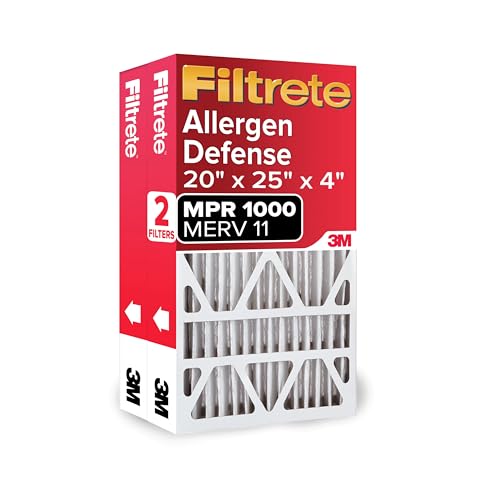
Filtrete 20x25x4 Deep Pleat Air Filter, MERV 11, MPR 1000
The filter that resolves the argument instead of picking a side. Four inches of depth means far more pleat surface than any 1-inch filter can hold, so it delivers MERV 11 capture while spreading the airflow across enough media to keep the pressure drop reasonable. All that media also holds far more dirt, which is why it is rated for 12 months rather than 90 days. The maker says the MPR 1000 rating with MERV 11 captures up to twice the microparticles of MERV alone, and it carries the same asthma and allergy friendly certification. Actual size is 19.88 by 24.63 by 4.31 inches, designed for Honeywell and Space-Gard media cabinets, and it comes as a 2-pack, which is two years of filtration.
- Pros: MERV 11 capture with less restriction than a 1-inch filter at the same rating; enormous dirt-holding capacity; one change a year instead of four; a 2-pack is a two-year supply; certified asthma and allergy friendly.
- Cons: Only works if your system has a 4-inch media cabinet, which most homes do not; highest upfront price in the group; fitment is specific to Honeywell and Space-Gard cabinets, so check yours; a year is a long time to forget a filter exists.
Best for: homes that already have a deep media cabinet, and anyone who wants strong filtration with minimal airflow penalty and a single annual chore.
The verdict
Best Overall: Simply MERV 8, 6-Pack. It outsells everything else here by a wide margin, and the reason holds up. MERV 8 is the rating that serves the most homes without asking questions about your blower motor, the extra pleat count adds capture without adding a wall of resistance, and six filters means the next four changes are already in the cupboard. Filtration you keep up with beats filtration you admire on the box.
Best Value: Amazon Basics MERV 8, 6-Pack. The same rating for less, with a wire mesh support that earns its place as the filter loads. If you change filters on schedule and do not need certified allergy performance, the savings across a year are real.
Best Premium: Filtrete 20x25x4 Deep Pleat MERV 11. If your system has the cabinet for it, this is the only filter here that improves both sides of the tradeoff at once: higher capture, lower restriction, once a year. The requirement is the cabinet, and that is decided by your equipment rather than your budget.
Between the two 1-inch specialists: the Filtrete MERV 11 is the pick for pets and allergies on a system with airflow to spare, and the MERV 5 is the pick when the system is the fragile part and protecting it matters more than polishing the air.
Frequently asked questions
Is a higher MERV rating always better?
No. A higher rating catches finer particles but restricts airflow more, and residential blowers have limits. If your system cannot move enough air through the filter, you can end up with a frozen coil, short cycling, or a strained motor. Match the rating to the equipment, then change it on schedule.
Can a MERV 11 filter damage my furnace?
A clean MERV 11 in a healthy system is generally fine, and a loaded MERV 8 that has not been changed in six months is usually the bigger problem. Where care is needed is with older PSC blowers or systems that were already marginal on airflow. If a higher-rated filter has previously caused freezing or short cycling, that is your answer.
Why is my 16x25x1 filter not actually 16 by 25 by 1?
Filters are sold by nominal size and built slightly smaller so they slide into the slot. Every listing here publishes its actual size for that reason. Always measure the filter you are replacing rather than trusting the printed nominal number alone.
What is the difference between MERV, MPR, and FPR?
MERV is the industry standard scale. MPR is Filtrete’s own rating and emphasizes the finest particles. FPR is a retailer’s scale from 1 to 10. They do not convert cleanly, so compare on MERV whenever a filter publishes it.
How often should I really change a furnace filter?
Every 90 days is the standard guidance for 1-inch filters, and 4-inch deep-pleat filters are typically rated for 12 months. Shorten either interval if you have pets, run the system hard, or live somewhere dusty. Hold the filter up to a light: if it has stopped looking like a filter and started looking like a blanket, it is late.
This article may contain affiliate links; see our Affiliate Disclosure.