The entire point of a multi-zone system is one outdoor unit feeding several rooms: one condenser on your wall, one refrigerant circuit, one pad. Three systems here are sold as multi-zone and say, in their own titles, that they come with two or three outdoor units. That is not a multi-zone system. That is two or three separate mini splits in one box, and the difference is how many condensers end up bolted to your house.


At a glance
| Product | Condensers, and whether the BTU adds up | Price tier | Link |
|---|---|---|---|
| Senville LETO 9K | One zone. In a multi-zone search | Budget | |
| YITAHOME 2 Zone | Two zones, two outdoor units. So, two mini splits | Budget | |
| Hykolity Dual Zone | One condenser, two heads, 18K on 20K. A real one | Budget | |
| COSTWAY 20K Dual | 23 SEER2, pre-charged, line set included | Budget | |
| YITAHOME 3 Zone | Three outdoor units, and 17.5 SEER2 | Mid-range | |
| ROVSUN 3 Zone | 27K of heads on a 28K condenser. The only one under | Mid-range | |
| Albott 3 Zone | 22 SEER2, and 30K of heads on a 28K condenser | Mid-range | |
| DELLA 3 Zone | The only one telling you the square footage | Premium | |
How to choose
Count the outdoor units first
This is the whole decision and it is printed in the titles. A real multi-zone system has one condenser outside and several heads inside, sharing one refrigerant circuit, one electrical feed, one pad and one hole through your wall. Three systems here say two outdoor units or three outdoor units in their own titles. That means two or three condensers on your house, two or three pads, two or three sets of penetrations, and two or three things to service. They are cheaper than the real multi-zone systems on this page, and now you know why.
Why the fake multi-zones exist
Look at the voltage and it clicks. The two-zone system with two outdoor units runs on 115 volts, which is a normal household outlet, and so does one of the two three-zone systems with three outdoor units. A genuine multi-zone condenser cannot; every real one here is 208 to 230 volts and wants an electrician and a dedicated circuit. Splitting one system into several little ones is how you keep each condenser small enough for household power. It is not a swindle. It is a different product, sold under the same words, and it moves the cost from your electrician to your wall.
The BTU never adds up, and that is normal
Add the indoor heads on the real multi-zone systems here. One offers 9K plus 9K plus 12K, which is 30,000, on a condenser rated 28,000. Another offers four 12K heads, which is 48,000, on a condenser rated 38,000. That is a quarter more head capacity than the outdoor unit can supply, and it is deliberate: bedrooms and living rooms rarely call for full output at the same moment, so you oversubscribe. What it means in practice is that on the worst afternoon of the year, with every room calling, nobody gets their full number. No listing here explains that.
One system here is not oversubscribed at all
Three 9,000 BTU heads is 27,000, on a 28,000 BTU condenser. Every head can run flat out simultaneously and the outdoor unit still has headroom, which is the only system on this page where the number on each indoor head is the number you will always get. It is also, unsurprisingly, three equal rooms rather than a big one and two small ones, which is the compromise that buys you the certainty.
Line set length decides which rooms you can reach
The whole promise of multi-zone is heads in rooms that are not next to each other, and the line set is what connects them. Two systems here publish 25 feet. One publishes 16.4 feet, which is about five meters and reaches the room on the other side of the wall and not much further. Two say a kit or a line set is included and never say how long. For a system whose entire purpose is distance, that is the specification to check first, and it is the one most often missing.
SEER2 is the bill, and it varies more than you think
The range here runs from 17.5 to 23, which is a thirty per cent spread in efficiency across systems doing the same job. Note where the low end sits: one brand sells two three-zone systems, both 36,000 BTU, a hundred dollars apart, and the cheaper one is 17.5 while the dearer one is 20. That hundred dollars buys you fourteen per cent better efficiency for the entire life of the machine, which is not a hundred dollars.
BTU describes the machine; square feet describe your house
Every listing here quotes BTU and one quotes an area, at up to 1,350 square feet. That is the number you can actually check, because you know how big your rooms are and you do not know how many British thermal units they need. Sizing properly depends on your ceilings, your insulation, your windows and your climate, and none of that is on this page. One brand at least gave you a starting point.
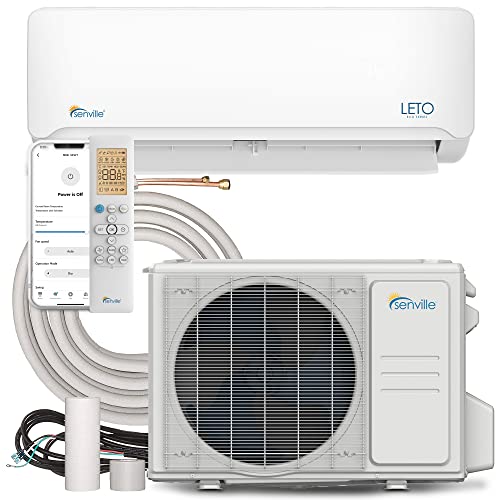
Senville LETO 9K
A single-zone system, in a multi-zone search, at a third of the price of anything else here. One head, one condenser, 9,000 BTU, and it runs on 110 to 120 volts, which means a normal outlet rather than a new circuit. At 21.5 SEER2 it is more efficient than several multi-zone systems on this page costing twice as much, it works with Alexa, and it is a heat pump so it does winter as well. If one room is the actual problem, this is the plain answer and the rest of this page is over-buying.
Pros:
- Runs on 110 to 120V; a normal household circuit
- 21.5 SEER2 beats several multi-zone systems here
- Inverter heat pump; heats as well as cools
- A third of the price of anything else on this page
Cons:
- One zone, listed among multi-zone systems
- 9,000 BTU is one room
- No line set length published
Best for: the one room that is actually the problem.
YITAHOME 2 Zone
Two 12,000 BTU heads and, as its own title says, two outdoor units, which makes it two separate mini splits sold together rather than a multi-zone system. The upside is real and worth understanding: on 115 volts it plugs into household power, each system is independent so a fault in one leaves the other running, and both can run different modes at once because they genuinely are different machines. The downside is two condensers on your wall, two pads and two of everything to service. 20 SEER2.
Pros:
- 115V; no new high-voltage circuit needed
- Genuinely independent modes, because they are separate systems
- A fault in one zone leaves the other running
- The cheapest two-zone package here
Cons:
- Two outdoor units; two pads, two penetrations, two services
- Not a multi-zone system in any technical sense
- 20 SEER2, against 23 elsewhere on this page
Best for: two rooms on household voltage, if the wall can take two boxes.
Hykolity Dual Zone
A genuine multi-zone: one 20,000 BTU condenser feeding two 9,000 BTU heads, each with its own wall controller. Eighteen thousand of heads on twenty thousand of condenser means it is not oversubscribed, so both rooms can call at once and both get their number, which is rare on this page. At 23 SEER2 it is joint most efficient here, it does cooling, heat pump, dehumidifier, fan and turbo, and installation kits are included. It never says how long the line set is.
Pros:
- One condenser, two heads; a real multi-zone system
- 18K of heads on a 20K condenser; not oversubscribed
- 23 SEER2; joint highest on this page
- Independent wall controllers per zone; installation kits included
Cons:
- No line set length published
- 208 to 230V; needs an electrician
- Two zones is the ceiling
Best for: the cheapest real multi-zone here, and the most efficient.
COSTWAY 20K Dual
The other 23 SEER2 system here, at the same price as the Hykolity, with the same shape: 20,000 BTU across two 9,000 BTU zones, pre-charged so the installer is not chasing refrigerant on day one, and a line set in the box. Pre-charged matters more than it sounds, because it turns a two-visit job into a one-visit job. WiFi and heat pump included. Like its twin in price and rating, it never publishes the line set length, which is the thing you most need before booking anyone.
Pros:
- 23 SEER2; joint most efficient here
- Pre-charged condenser; simpler install
- Line set included; WiFi enabled; heat pump
- 18K of heads on 20K; not oversubscribed
Cons:
- No line set length published
- 208 to 230V; needs a dedicated circuit
- Two zones only
Best for: a pre-charged install at the top efficiency here.
YITAHOME 3 Zone
Three 12,000 BTU heads and three outdoor units, which is three mini splits, and it is four hundred dollars cheaper than the true three-zone systems here for exactly that reason. It is also the least efficient thing on this page at 17.5 SEER2, and its own sibling at a hundred dollars more manages 20, on the same 36,000 BTU across the same three zones. The three genuinely separate systems do mean genuinely simultaneous modes, and three condensers on your house is the price.
Pros:
- Cheaper than any true three-zone system here
- Three fully independent systems; different modes at once
- 36,000 BTU across three 12K heads
Cons:
- Three outdoor units; three pads, three sets of penetrations
- 17.5 SEER2; the least efficient on this page
- Its own sibling gives 20 SEER2 for a hundred dollars more
- Not a multi-zone system
Best for: three rooms cheaply, if your wall has room for three condensers.
ROVSUN 3 Zone
Three 9,000 BTU heads on a 28,000 BTU condenser, which is 27,000 of demand on 28,000 of supply, and it is the only system on this page that is not oversubscribed. That means every room gets its full number on the hottest afternoon of the year with all three calling, which is the one day you will remember. It also publishes a 25 foot line set, the longest here, which is what lets those three heads actually be in three different parts of the house. Pre-charged condenser, heat pump, 20 SEER2.
Pros:
- 27K of heads on a 28K condenser; never oversubscribed
- A 25 foot line set; the longest published here
- One condenser; a genuine multi-zone system
- Pre-charged; heat pump; 20 SEER2
Cons:
- Three equal 9K heads; no big room and two small ones
- 20 SEER2, against 22 and 23 elsewhere here
- 208 to 230V; needs a dedicated circuit
Best for: three rooms that all get their full number, always.
Albott 3 Zone
A 28,000 BTU outdoor unit feeding 9K, 9K and 12K, which is 30,000 of heads on 28,000 of condenser, so it is mildly oversubscribed in exactly the way the industry intends: the 12K goes in the living room, the 9Ks go in bedrooms, and they rarely all call at once. At 22 SEER2 it is the most efficient three-zone here. Pre-charged condenser and WiFi. Its 16.4 foot line set is the shortest published on this page, which for a three-zone system is a real constraint on where those heads can live.
Pros:
- 22 SEER2; the most efficient three-zone here
- 9K, 9K and 12K; a living room and two bedrooms
- One condenser; pre-charged; WiFi enabled
Cons:
- A 16.4 foot line set; the shortest published here
- 30K of heads on a 28K condenser
- 208 to 230V
Best for: a big room and two small ones, close together.
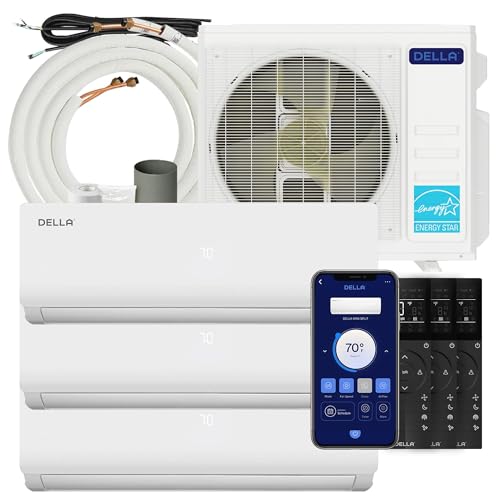
DELLA 3 Zone
The only system on this page that translates its BTU into your house, saying it cools up to 1,350 square feet. Every rival hands you a thermal unit and lets you work it out. It is the same architecture as the Albott, one 28,000 BTU outdoor unit feeding 9K, 9K and 12K, with 16 foot kits, Alexa and WiFi, a pre-charged heat pump and 20 SEER2. It is also the second most expensive thing here, and its efficiency is lower than a three-zone costing seven hundred dollars less.
Pros:
- The only system publishing a square footage: up to 1,350
- One condenser; 9K, 9K and 12K heads
- Pre-charged heat pump; Alexa and WiFi
Cons:
- 20 SEER2, beaten by a three-zone costing far less
- 16 foot kits; nearly the shortest here
- 30K of heads on a 28K condenser
- The second highest price on this page
Best for: the only number that describes your house.
The verdict
Count the outdoor units and half this page reclassifies itself. Then add up the indoor heads against the condenser and you find out what happens on the hottest day. Then look for the line set length, which decides whether the heads can reach the rooms you meant.
Best overall: ROVSUN 3 Zone. One condenser, three heads, and 27,000 BTU of demand on a 28,000 BTU supply, which makes it the only system here that is not oversubscribed. Every other real multi-zone on this page promises more head capacity than its outdoor unit can deliver, and this one does not, so the number on your bedroom head is the number you get on the afternoon it matters. Its 25 foot line set is the longest published here, which is what lets three heads actually live in three different parts of a house.
Best value: Hykolity Dual Zone. The cheapest genuine multi-zone here: one condenser, two heads, two independent wall controllers, and 18,000 BTU of heads on 20,000 of condenser, so both rooms get their full output at once. At 23 SEER2 it is joint most efficient on this page, beating three-zone systems costing more than twice as much. Installation kits are included, though it will not tell you how long the line set is.
Best premium: DELLA 3 Zone. It is the only system here that tells you how big a house it cools, at up to 1,350 square feet, and that is the one number on this page you can hold against your own floor plan. Everything else asks you to convert British thermal units into rooms yourself. One condenser, three heads, pre-charged, Alexa and WiFi. Its efficiency is beaten for less money, and the square footage is what you are paying for.
FAQ
How do I know it is really multi-zone?
Count the outdoor units in the title. A multi-zone has one condenser feeding several heads. Three systems here say two or three outdoor units, which makes them two or three separate mini splits sold together.
Why would anyone sell three outdoor units as one system?
Voltage. Split into three small systems, each runs on 115 volts and a normal circuit. A single condenser that size needs 208 to 230 volts and an electrician. The cost moves from your wiring to your wall.
Why do the BTU numbers not add up?
Because rooms rarely all call at once, so multi-zone systems are deliberately oversubscribed. One here has 48,000 of heads on a 38,000 condenser. On the hottest day with everything running, nobody gets their full number.
What does the line set length change?
Which rooms you can reach. One system here publishes 25 feet and another 16.4, which is about one wall away. Two say a kit is included and never say how long, on products sold for putting heads in different rooms.
How much SEER2 does the price buy?
Less than you would think. The range here runs 17.5 to 23, and one brand’s two identical three-zone systems, a hundred dollars apart, are 17.5 and 20. The cheaper one costs more over its life.
This article may contain affiliate links; see our Affiliate Disclosure.