The nonstick question has changed. It is no longer “does the egg slide” — every pan here passes that test — but what the coating is made of. Ceramic and diamond-infused surfaces now deliver the release traditional PTFE pans promised, without PTFE, PFOA, or PFAS in the formula, and the best of them survive real kitchens for years.






PTFE-free pans divide into ceramic sol-gel coatings (the majority here), granite-style mineral finishes, diamond-reinforced ceramics for durability, and one hybrid that laser-etches stainless steel over the nonstick so utensils never touch it. The best sellers open the list; the buy-once options close it.
| Pan | Standout features | Price | Link |
|---|---|---|---|
| SENSARTE 9.5" Ceramic | Cast aluminum, induction base, no-rivet interior — the best seller | Budget | |
| SENSARTE 8" Ceramic | Same formula in egg-pan size, recycled aluminum body | Budget | |
| CAROTE Granite | Mineral granite finish, all-stove base, famous price | Budget | |
| CAROTE 10" Ceramic | Smooth ceramic, induction-ready, wipe-clean surface | Budget | |
| HexClad 12" Hybrid | Steel hex lattice over ceramic, metal-utensil safe, tri-ply | Premium | |
| SENSARTE with Lid | Ceramic pan plus tempered glass lid, five sizes | Budget | |
| Blue Diamond 10" | Diamond-infused ceramic, oven safe to 600°F, dishwasher OK | Budget | |
| Cuisinart Chef’s Classic 8" | Hard-anodized, PurelyCeramic interior, lifetime warranty | Budget | |
| OXO Enhanced 12" | Diamond-reinforced ceramic, hard-anodized, test-kitchen favorite | Mid-range | |
| ESLITE LIFE Set | Two ceramic pans with lids, die-cast bodies, all stoves | Mid-range | |
How to choose a PTFE-free pan
Coating chemistry, body construction, and your own habits decide how long these pans stay slick. Here is the decoder.
What the acronyms mean, briefly
PTFE is the classic fluoropolymer nonstick; PFOA is a manufacturing chemical phased out years ago; PFAS is the umbrella family both belong to. Ceramic sol-gel coatings — the surfaces on nearly every pan here — achieve their slickness with a silica-based layer instead, with makers declaring them free of PTFE, PFAS, lead, and cadmium. If avoiding the fluoropolymer family is your goal, check for the explicit “PTFE-free” claim, not just “PFOA-free” — every pick in this guide states it.
Ceramic’s real trade-off: heat discipline
Ceramic surfaces release beautifully but lose their slickness faster if routinely overheated or shocked cold under the tap. The habits that double their life: medium heat (ceramic conducts so well you rarely need more), a little oil or butter, no cooking sprays (lecithin builds a gummy film), and wooden or silicone utensils. Work on them this way and the budget pans here run years; abuse them and no coating survives.
Durability engineering: diamonds, anodizing, and steel armor
The upgrades attack ceramic’s weaknesses directly. Diamond infusion (Blue Diamond, OXO) hardens the coating and speeds heat transfer. Hard-anodized bodies (Cuisinart, OXO) resist warping and scratching, and earned OXO’s pan its test-kitchen reputation. HexClad’s hybrid takes the furthest position: a laser-etched stainless hexagon lattice stands proud of the nonstick valleys, so metal spatulas ride on steel — the only pan here genuinely indifferent to utensil choice, with tri-ply construction and full induction support underneath.
Body, base, and your stove
Cast and die-cast aluminum bodies (SENSARTE, CAROTE, ESLITE) heat evenly and stay light; check induction compatibility per pan — most here have magnetic bases, but the Blue Diamond notably does not. Oven ceilings vary widely: 600°F for Blue Diamond, 500°F for Cuisinart, 430°F for OXO — the number matters if your recipes finish under the broiler. Rivet-free interiors (SENSARTE) remove the one spot food loves to weld onto.
Size strategy beats size maximalism
An 8-inch pan does eggs for one or two; 9.5–10 inches is the weeknight all-rounder; 12 inches sears for a family without crowding, which is the actual secret to browning. The two-pan sets (ESLITE) and lidded options (SENSARTE, HexClad) cover braise-and-steam territory a bare skillet cannot.
SENSARTE 9.5" Ceramic Skillet
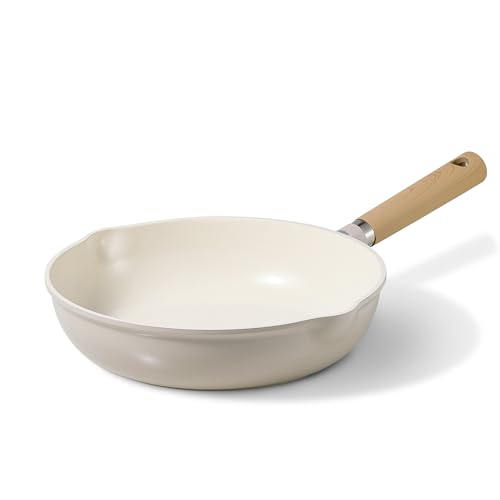
The best-selling PTFE-free pan in this comparison nails the essentials: a natural ceramic coating free of PTFE, PFAS, lead, and cadmium; a heavy cast-aluminum body with an induction-ready base that will not warp or wobble; a stay-cool woodgrain bakelite handle; and a rivet-free interior with nothing for eggs to grab. It is the weeknight workhorse size at an any-kitchen price.
Pros:
- Truly slick ceramic release at a budget price
- Cast aluminum resists warping; induction compatible
- No interior rivets to catch food
- Comfortable cool-touch handle
Cons:
- Ceramic coating rewards gentle heat and utensils
- No lid at this price
Best for: the default daily pan — eggs, pancakes, and everything gentle.
SENSARTE 8" Omelet Pan
The same formula scaled to breakfast: eight inches of the identical ceramic coating on recycled cast aluminum — a production choice SENSARTE says cuts the body’s carbon footprint by 80% — with the induction base, woodgrain handle, and rivet-free interior intact. The size that lives on the stove because it never needs putting away.
Pros:
- Perfect one-to-two-egg and omelet size
- Recycled-aluminum construction
- Same coating and build as the flagship
- Cheapest entry into the lineup
Cons:
- Too small for family cooking
- Same gentle-care rules apply
Best for: the dedicated egg pan every kitchen ends up wanting.
CAROTE Granite Fry Pan
CAROTE’s granite-finish pan is one of the most-bought pieces of cookware anywhere, and the price is the headline: a mineral-speckled nonstick surface, an extended-bottom design that heats fast and evenly, and a magnetized stainless base that works on every stove including induction. Cleanup is a paper-towel wipe. At this cost it is almost a trial subscription to PTFE-free cooking.
Pros:
- Astonishing price for a full-featured pan
- All-stovetop base including induction
- Fast, even heating from the widened bottom
- Massive proven sales record
Cons:
- Coating life matches the price tier — work on it gently
- Lighter body than the cast-aluminum rivals
Best for: trying ceramic-style cooking with pocket change at stake.
CAROTE 10" Ceramic Skillet
CAROTE’s ceramic line steps up the surface: a smooth non-toxic ceramic coating — free of PFOA, PFAS, PTFE, lead, and cadmium — that sauces wipe off in one pass, on a 10-inch induction-compatible body sized for proper weeknight mains. A twelve-month warranty backs it, unusual at the price.
Pros:
- Smooth ceramic surface wipes genuinely clean
- Full no-PTFE/PFAS declaration
- Ten-inch do-everything size
- Warranty coverage at a budget price
Cons:
- Designed for daily cooking, not searing abuse
- No lid included
Best for: the step from granite-budget to smooth ceramic without leaving budget territory.
HexClad 12" Hybrid
HexClad solves ceramic’s utensil problem with armor: a laser-etched hexagonal stainless lattice rises above the TerraBond ceramic valleys, so metal spatulas, whisks, and even the dishwasher touch steel, not coating. Tri-ply construction with an aluminum core sears like stainless while releasing like nonstick, works on induction, goes in the oven, and ships with a tempered glass lid under a lifetime warranty.
Pros:
- Metal-utensil and dishwasher safe — unique here
- Sears properly while still releasing
- Tri-ply build with full induction support
- Lifetime warranty and included lid
Cons:
- Costs eight budget pans
- The steel lattice needs a first-use seasoning and a touch more oil
Best for: cooks who want one 12-inch pan that ends the utensil ceasefire forever.
SENSARTE Ceramic with Lid
The lidded SENSARTE adds the missing piece to the flagship formula: a tempered glass lid that turns the skillet into a braiser for chicken thighs, steamed greens, and rice-adjacent one-pan dinners. Offered from 8 to 12.5 inches, with the same free-of-added-PFAS ceramic, cast-aluminum warp resistance, and rivet-free bowl.
Pros:
- Glass lid unlocks braising and steaming
- Five sizes to match the household
- Same proven coating and body as the best seller
- Modest premium over the lidless pan
Cons:
- Lid knob caps the oven ceiling
- Storage grows a lid’s worth
Best for: one-pan dinners that need ten covered minutes at the end.
Blue Diamond 10"
Blue Diamond hardens its ceramic with actual diamond particles — the maker rates the coating 5x harder and 10x longer-lasting than standard ceramic, with diamonds’ conductivity speeding the heat-up. The forged base resists warping, the pan survives the dishwasher, and the 600°F oven-and-broiler ceiling is the highest in this group. One real caveat: no induction.
Pros:
- Diamond-hardened coating shrugs off daily wear
- 600°F oven and broiler rating — best here
- Dishwasher tolerant
- Budget price for upgraded durability
Cons:
- Not induction compatible
- Riveted handle interior collects a little food
Best for: gas and electric kitchens that finish dishes under the broiler.
Cuisinart Chef’s Classic 8"
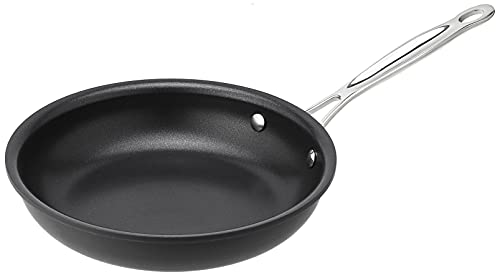
Cuisinart’s entry brings legacy-brand build to the PTFE-free segment: a hard-anodized body that distributes heat evenly and takes decades of use, a PFAS-free PurelyCeramic interior, drip-free pouring lips, a riveted stainless stay-cool handle, 500°F oven safety, and a lifetime warranty — on the cheapest pan of the premium-construction tier.
Pros:
- Hard-anodized durability at a bargain price
- Lifetime warranty from an established brand
- 500°F oven rating
- Pour-friendly sloped sides
Cons:
- Eight inches only in this configuration
- Hand-wash keeps the ceramic happiest
Best for: a buy-once egg pan from a name your kitchen already trusts.
OXO Enhanced 12"
The OXO Enhanced carries a rare credential: Cook’s Illustrated’s top nonstick rating. Diamond-reinforced PFAS-free ceramic rides on a hard-anodized body with excellent conduction and scratch resistance, the stainless handle is shaped to OXO’s usual ergonomic standard, and the 12-inch surface sears family portions without crowding. Oven safe to 430°F, dishwasher tolerated.
Pros:
- Test-kitchen-validated release and durability
- Diamond-reinforced ceramic on hard-anodized aluminum
- Family-scale 12-inch surface
- Even heat across the whole base
Cons:
- 430°F oven ceiling trails Blue Diamond and Cuisinart
- Mid-range price
Best for: the reviewed-and-proven big skillet for serious weeknight cooking.
ESLITE LIFE Two-Pan Set
ESLITE’s set delivers the whole stovetop in one box: two ceramic-coated, SGS-checked pans with lids, die-cast aluminum bodies that borrow cast iron’s evenness without its weight, and magnetized bases for every stove including induction. Thirty years of nonstick manufacturing stand behind a set priced under many single premium pans.
Pros:
- Two sizes plus lids covers most cooking at once
- Die-cast bodies heat evenly, weigh little
- Full stove compatibility
- Strong set value
Cons:
- Lids double the cupboard footprint
- Same ceramic-care rules across both pans
Best for: outfitting a kitchen — or replacing worn PTFE pans wholesale — in one purchase.
Verdict
Best Overall: SENSARTE 9.5" Ceramic. The best seller in the segment earns it: real release, warp-proof cast aluminum, induction support, and a rivet-free bowl at a price that makes replacement painless years from now.
Best Value: CAROTE Granite. A functioning, all-stove, PTFE-free pan for the cost of a sandwich — the lowest-risk way into the category ever sold.
Best Premium: HexClad 12" Hybrid. Steel armor over ceramic ends the gentle-utensil era: sear, scrape, dishwash, repeat, under a lifetime warranty.
FAQ
Is ceramic nonstick actually PTFE-free?
Yes — sol-gel ceramic coatings are silica-based chemistry, not fluoropolymer. Every pan in this guide explicitly declares itself free of PTFE (and PFOA/PFAS as families); that declaration, printed by the maker, is the thing to check on any pan this guide does not cover.
Why did my last ceramic pan stop releasing?
Almost always heat abuse or spray residue. High heat degrades the surface chemistry; cooking sprays bake a gummy lecithin film that mimics a worn coating. Medium heat, a little real oil, and soft utensils routinely double or triple ceramic’s working life.
Can I sear a steak in these?
The HexClad is built for exactly that, and hard-anodized diamonds (OXO, Blue Diamond) tolerate hot searing better than plain ceramic. For the budget ceramics, searing at ripping heat is the fastest way to age the coating — keep a cast-iron or stainless pan for steak nights.
Dishwasher or hand wash?
Blue Diamond and HexClad tolerate the dishwasher by design. Everything else lasts visibly longer hand-washed — which takes seconds on a surface this slick. Never plunge a hot pan into cold water; thermal shock stresses every coating.
How long should a PTFE-free pan last?
Budget ceramics: one to three years of daily use with good habits. Diamond-reinforced and hard-anodized models: several years. The HexClad hybrid is engineered — and warranted — for decades. In every case, the care habits above matter more than the price tag.
This article may contain affiliate links; see our Affiliate Disclosure.