The saute pan is the most useful thing in most kitchens and the least understood. It is not a big frying pan. Straight sides and a lid are the whole point: you can brown something properly, then add liquid and simmer it without half the sauce ending up on the hob. Three quarts is the size where one pan feeds a household.


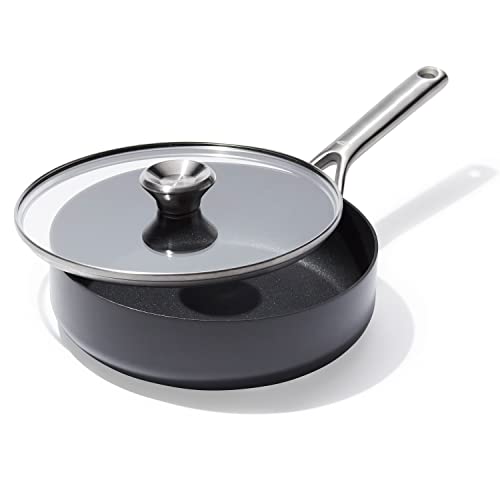
Everything below is a genuine 3-quart pan with a lid, which matters because this category is full of near misses in other sizes. They divide on coating chemistry more than anything else: ceramic without PFAS, hybrid stainless with ceramic, and classic reinforced nonstick. That choice decides how you cook with it and how long it stays slick. Suits one-pan dinners, a couple batch-cooking, or a solo cook who likes leftovers.
At a glance
| Product | Standout feature | Price tier | Link |
|---|---|---|---|
| Calphalon Ceramic Nonstick 3 Qt | PFAS-free ceramic that is safe for metal utensils | Mid-range | |
| Inqibee Hybrid Tri-Ply 3 QT | Stainless tri-ply body with a hybrid ceramic surface; induction ready | Budget | |
| Farberware Forged Induction Ceramic | Forged aluminum with an edge-to-edge steel base against warping | Budget | |
| Rachael Ray Cook + Create 3 Qt | Triple-layer nonstick, tulip profile, nonstick over the rivets | Mid-range | |
| OXO Professional 3QT Jumbo Cooker | Diamond-reinforced ceramic, streamlined rivets, hard-anodized body | Premium | |
How to choose a 3-quart saute pan
Ceramic, PFAS, and what the labels mean
The biggest shift in this category is coating chemistry, and the listings now lead with it. PFAS is the family of compounds behind traditional nonstick; PTFE is the best-known member and PFOA was the processing aid removed years ago. Ceramic coatings are made without any of them, which is why Calphalon, Farberware, and OXO all say PFAS-free plainly, and Farberware goes further with no lead or cadmium either. The real trade is durability: ceramic starts superbly slick and tends to lose it faster than classic nonstick, particularly if overheated. If that matters more than the chemistry, the Rachael Ray’s triple-layer nonstick is the counter-argument.
Hybrid pans are a genuine third option
The newer idea, on the Inqibee here, is a stainless steel structure with nonstick in the recesses: raised steel takes the scraping and the coating in between does the releasing. That is why these tolerate metal utensils and why they last longer than a plain coated pan. They will never be quite as slick as fresh ceramic, and they cost more than a basic pan. As a compromise between a stainless pan you can abuse and a nonstick one you must baby, it is a sensible place to land.
The base decides whether it warps
A saute pan gets ripping hot for a sear then has cold stock poured into it, which is exactly how pans warp. Once the base is convex it spins on a glass hob and pools oil at the edges, and nothing fixes it. So look at construction rather than the coating here. Tri-ply, as on the Inqibee, sandwiches an aluminum core between steel for even heat and stability. Farberware forges its aluminum at extreme pressure and bonds an edge-to-edge steel base specifically to avoid warping. Hard-anodized aluminum, on the Calphalon and OXO, is aluminum hardened at the surface, and heats fast and evenly.
Induction, and checking before you buy
Aluminum does not work on induction without a steel base bonded to it, so this is the one specification to verify rather than assume. The Inqibee, Farberware, and OXO all state induction compatibility explicitly, and Farberware’s edge-to-edge steel base is doing double duty here. If your hob is gas or electric, ignore this entirely and choose on the coating.
Handles and rivets
Long stainless steel handles stay cool because steel conducts heat poorly along a thin bar, which is why both Calphalon and LOLYKITCH make a point of it. Look at the rivets too, since that is where food lodges and where scrubbing wears the coating first. Rachael Ray coats the rivets in nonstick, and OXO streamlines them to eliminate food traps. It is a small thing that becomes the reason you stop liking a pan.
Oven safe, and to what temperature
Half the appeal of a saute pan is starting on the hob and finishing in the oven. The temperatures differ and they are worth knowing: Calphalon’s hard-anodized line goes to 450 degrees F, older Simply Calphalon pans only to 400 degrees F. Check the lid separately, since a tempered glass lid usually has a lower limit than the pan. Dishwasher safe is claimed widely and is worth ignoring: nearly every maker here, including Calphalon, recommends hand washing to preserve the finish.
Calphalon Ceramic Nonstick 3 Quart Saute Pan
The most popular true 3-quart pan here, and it resolves the usual ceramic complaint. Ceramic coatings are normally the ones you must never touch with metal, which rules out half the tools in your drawer. This one has a scratch-resistant interior that Calphalon states is metal utensil safe, so a steel fish slice under a piece of chicken is not a crisis. It is made without PFAS, and Quick Cleaning Technology is Calphalon’s name for a surface that wipes down in seconds rather than needing a soak. The handles are long cast stainless steel that stay cool on the hob. It is dishwasher safe, though Calphalon themselves recommend hand washing to keep the finish, which tells you what they expect.
Pros
- Metal utensil safe, which is rare for a ceramic coating
- Made without PFAS
- Wipes clean in seconds; no soaking
- Long cast stainless handles that stay cool
- Well-established cookware brand
Cons
- Hand washing recommended despite the dishwasher-safe claim
- Induction compatibility is not stated; check if that is your hob
Best for: the default pick, especially if you want PFAS-free without giving up metal tools.
Inqibee 3 QT Hybrid Tri-Ply Saute Pan
The most interesting construction here for the money. It is a tri-ply stainless steel pan, so an aluminum core sits between steel layers giving even heat and a body that resists warping, and then a hybrid ceramic coating goes on top for release and scratch resistance. That combination is what lets it be genuinely oven safe and induction compatible while still behaving like a nonstick pan, and it means a hard sear followed by deglazing does not worry it. At ten inches and three quarts it doubles as a brasier, which is exactly what the straight sides and depth are for: braising, frying, searing, then simmering. This is the pan on this list that a stainless steel cook would be least unhappy with.
Pros
- Tri-ply stainless: even heat and real warp resistance
- Hybrid ceramic coating resists scratches better than plain ceramic
- Oven safe and induction compatible, both stated
- Deep enough to braise, not just saute
- Cheapest route here to tri-ply construction
Cons
- Hybrid surfaces are never as slick as fresh ceramic
- Least known brand of the five
Best for: anyone who wants a pan that survives real heat and induction, and does not want to baby it.
Farberware Forged Induction Ceramic Saute Pan
The cheapest pan here and the one with the most convincing story about not warping. The body is aluminum forged at extreme pressures rather than stamped from sheet, which makes it denser and stiffer, and Farberware bonds an edge-to-edge steel base across the bottom, which both makes it induction compatible and holds the pan flat through the thermal shock that ruins cheaper pans. The forged body distributes heat better and faster than ordinary aluminum. The ceramic surface is made without PFAS, PFOA, PTFE, lead, or cadmium, which is the most complete list of exclusions in this group. A tempered glass lid lets you watch a simmer without lifting it.
Pros
- Lowest price here by a clear margin
- Edge-to-edge steel base: induction ready and warp resistant
- Forged aluminum heats faster and more evenly than stamped
- Free of PFAS, PFOA, PTFE, lead, and cadmium
- Tempered glass lid
Cons
- Ceramic coatings lose their slickness faster than classic nonstick
- No claim of metal utensil safety; use wood or silicone
Best for: an induction hob on a budget, and anyone who wants the cleanest coating chemistry for the least money.
Rachael Ray Cook + Create 3 Quart Saute Pan
The pan for people who want nonstick that stays nonstick. Rather than ceramic, it uses a triple-layer coating built for scratch resistance and durability, which is the plain answer if longevity matters more to you than the coating chemistry. The shape deserves attention too: a tulip profile flares the walls to give a bigger, wider cooking surface than a straight-sided pan of the same capacity, which means more room to brown things in a single layer instead of steaming them in a crowd. That is the difference between a good one-pan meal and a gray one. The thicker gauge construction feels solid rather than tinny, and the nonstick continues over the interior rivets so there is nothing for food to catch on.
Pros
- Triple-layer nonstick built for scratch resistance and longevity
- Tulip profile gives a wider cooking surface for real browning
- Nonstick over the rivets: no food traps inside
- Thicker gauge than budget pans; feels substantial
Cons
- Not marketed as PFAS-free, unlike the ceramic picks
- No stated induction compatibility
Best for: one-pan meals where browning space matters, and cooks who want the coating to last.
OXO Professional 3QT Jumbo Cooker
The premium option, and it attacks ceramic’s one real weakness directly. Its ceramic nonstick is reinforced with diamonds, which is a hardness play: the point is a surface that keeps releasing food after the season when a plain ceramic pan has started to grip. It is free of PFAS, PFOA, lead, and cadmium. The hard-anodized aluminum body heats quickly and evenly, and a heavy-duty induction base is built in and optimized for every hob rather than added as an afterthought. The detail that reveals the price is the rivets: streamlined to eliminate food traps entirely, so the interior is seamless and snag-free. That is what you are paying for, along with a build meant to still be good in several years.
Pros
- Diamond-reinforced ceramic directly targets ceramic’s durability problem
- Free of PFAS, PFOA, lead, and cadmium
- Heavy-duty induction base built for all hobs
- Streamlined rivets leave a seamless interior
- Hard-anodized body for fast, even heat
Cons
- Several times the price of the Farberware
- Even reinforced ceramic is not permanent
Best for: anyone who cooks daily, wants PFAS-free, and is tired of replacing pans every couple of years.
The verdict
Best Overall: Calphalon Ceramic Nonstick 3 Quart Saute Pan. The most popular genuine 3-quart pan here, and the one that removes ceramic’s most annoying restriction by being safe with metal utensils. PFAS-free, wipes clean in seconds, cool stainless handles, sensible money. If you are not on induction, start here.
Best Value: Farberware Forged Induction Ceramic Saute Pan. The cheapest pan on the list and it is not the flimsiest, which is unusual. The forged body and edge-to-edge steel base are real engineering against warping, it works on induction, and its coating excludes more compounds than anything else here.
Best Premium: OXO Professional 3QT Jumbo Cooker. Diamond-reinforced ceramic and seamless rivets aimed squarely at the two things that make people bin a nonstick pan. Worth it if you cook every day.
Two real alternatives. If you sear hard and deglaze often, the Inqibee’s tri-ply hybrid will outlast any coated pan here. And if you would rather have nonstick that stays slick than a particular coating chemistry, take the Rachael Ray for its triple-layer surface and its wider browning area.
Frequently asked questions
What is a saute pan actually for?
Straight sides and a lid. That combination lets you brown food over high heat without it escaping the pan, then add liquid and simmer with the lid on, which a sloped frying pan does badly. It is the pan for one-pan dinners, braises, risotto, shallow frying, and anything that starts dry and ends saucy. Three quarts feeds a household from one pan.
Is ceramic nonstick better than regular nonstick?
Better on chemistry, worse on lifespan, generally. Ceramic is made without PFAS, which is why every ceramic pan here says so, and it starts extremely slick. The trade is that it usually loses its release faster, especially if run too hot. Classic nonstick like the Rachael Ray’s triple layer tends to last longer. Pick whichever trade you actually care about.
Will these work on an induction hob?
Check individually rather than assuming, since aluminum alone will not work. The Inqibee, Farberware, and OXO state induction compatibility explicitly. Farberware’s edge-to-edge steel base and OXO’s heavy-duty induction base are what make it possible. On gas or electric this does not matter and you can choose purely on coating.
Can I use metal utensils?
On the Calphalon, yes, which is unusual for ceramic and a real reason to choose it. The hybrid Inqibee is designed for it too, since raised steel takes the contact. On the others, use wood, silicone, or nylon; a metal edge is the fastest way to end a nonstick pan’s life.
Are they really dishwasher safe?
Technically, and you should still hand wash. Calphalon claims dishwasher safe and recommends hand washing to maintain the finish in the same listing, which is the whole answer. Dishwasher detergent is abrasive and alkaline, and it takes the shine off coatings faster than anything you would do at the sink. These pans wipe clean in seconds anyway.
This article may contain affiliate links; see our Affiliate Disclosure.