The mouse is the one tool your hand never lets go of. Eight hours a day, thousands of clicks, and most people are still dragging around whatever plastic lump came free in a box – then wondering why their wrist aches by Thursday.


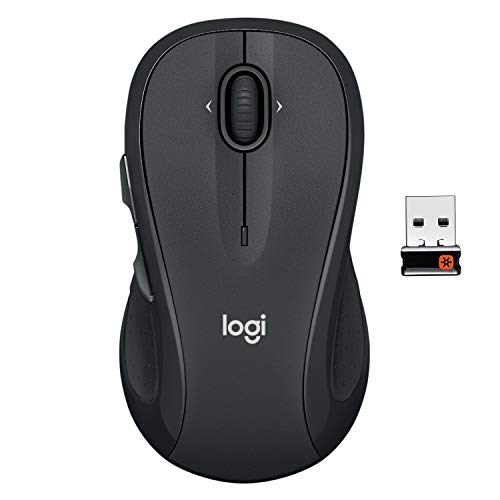


A great office mouse gets three things right: a shape your hand can rest on without clenching, a click that does not announce itself to the whole room, and a battery you forget about. Everything else – extra buttons, adjustable sensitivity, multi-device pairing – is useful, but it is decoration on top of those three. The five below cover a shared desk, a home office, a hot desk, and a laptop bag equally well.
| Product | Standout feature | Price tier | Link |
|---|---|---|---|
| Logitech G305 Lightspeed | 250 hours on one AA, 3.4 oz, nano receiver stows inside | Mid-range | |
| Logitech M330 Silent | SilentTouch cuts over 90% of click noise, 18-month battery | Budget | |
| Logitech M510 | 7 buttons, side-to-side scroll, 24-month battery life | Mid-range | |
| TECKNET Bluetooth & 2.4G | Three paired devices, rechargeable, side scroll wheel | Mid-range | |
| Logitech M185 | Ambidextrous shape, 12-month battery, plug-and-play | Budget | |
How to choose a wireless mouse for desk work
Grip and hand size decide comfort, not the spec sheet
Most wrist complaints trace back to a mouse that is too small, which forces the fingers to curl and the wrist to hover. A full-size shape like the M510 fills the palm and lets the hand rest its weight on the shell. A compact shape like the M185 or G305 asks the fingertips to do more work, which is fine for short bursts and travel but tiring across a long day. If the hand is on the larger side, or the mouse sees six-plus hours of use, size up. If the desk is shared or the mouse lives in a bag, compact wins.
Handedness matters too, and it is easy to get wrong. Contoured mice with a thumb rest and side buttons are shaped for right hands only. The M185 is ambidextrous and works either way. A left-handed reader looking at the M510 or M330 should know both are right-hand shapes before ordering.
Click noise is a real specification
Open-plan desks, shared studies, late-night work next to a sleeping household, video calls with a sensitive microphone – a loud click stops being a small thing. Silent switches use a dampened mechanism that changes the sound rather than the feel; the M330 and the TECKNET both use this approach. The tactile bump is softer than a standard switch, which some people love and a few miss. Standard clicks, like the G305’s, are crisp and satisfying and carry across a room.
Receiver, Bluetooth, or both
A 2.4 GHz nano receiver is the simplest thing that works: plug it in, the mouse moves, no pairing menu, no driver. The catch is that it occupies a USB-A port, and thin laptops are short on those. Bluetooth frees the port and pairs to tablets and USB-C-only machines, but it depends on the host’s Bluetooth stack and can be slow to reconnect from sleep.
Two useful middle grounds appear in this group. Logitech’s Unifying receiver, on the M510, pairs a compatible keyboard and mouse to one dongle instead of two. The TECKNET carries both radios and holds three device pairings at once, so a work laptop, a personal machine, and a tablet share one mouse with a button press.
Batteries: replaceable or rechargeable
AA-powered mice run astonishingly long. The M185 is rated around a year, the M330 around 18 months, the M510 around two years, and the G305 quotes 250 hours of continuous use with an endurance mode that stretches it to roughly nine months. When one dies, a spare cell fixes it in seconds. Rechargeable mice like the TECKNET skip the battery-buying entirely – about 1.5 to 2 hours on the cable for roughly three months of typical use – at the cost of remembering to charge it. Neither approach is wrong; pick the failure mode that annoys you less.
Buttons and sensitivity, plainly
Back and forward thumb buttons are the genuinely useful extras: browsing, file managers, and document review all speed up. Programmability is a smaller win unless there is a repetitive task to bind. Adjustable DPI matters more than it sounds on high-resolution and multi-monitor setups, where a 1000 DPI mouse means dragging across the mat to cross the desktop. A mouse that steps up to 1600 DPI or beyond covers wide screens with a flick.
Logitech G305 Lightspeed – the best seller that quietly excels at desk work
This is a gaming mouse, and it is worth saying so plainly rather than pretending otherwise. It is also the strongest-selling mouse in this group by a wide margin, and the reasons it sells translate to office use almost perfectly. It weighs 3.4 oz, so it never feels like it is fighting the hand. The HERO sensor tracks at up to 12,000 DPI, which means one small motion crosses an ultrawide monitor. The 1 ms report rate is overkill for spreadsheets, but a cursor that never stutters is pleasant anywhere. The receiver stows inside the shell for travel, and one AA runs it for 250 hours of continuous use – switch on endurance mode in Logitech’s software and that figure stretches toward nine months of ordinary work.
The trade-offs are real. The clicks are standard, crisp, and audible – this is not the mouse for a silent library or a sleeping baby’s room. The shape is compact and symmetrical rather than a full palm rest, so very large hands may find it small over a long day. And the software is aimed at gamers, which is either a bonus or one more thing to ignore.
- Pros: Exceptional battery life on a single AA; extremely light at 3.4 oz; high-DPI sensor suits large and multi-monitor setups; six programmable buttons; receiver stores inside for travel; on-board memory keeps settings across machines.
- Cons: Clicks are loud by design; compact shape is not a palm-filling ergonomic form; gaming-oriented software; no Bluetooth, so a USB-A port is required.
Best for: Anyone on a wide or multi-monitor desk who wants long battery life and a light, fast cursor, and does not need silent clicks.
Logitech M330 Silent – the one for shared rooms
Logitech rates SilentTouch as removing over 90% of the clicking sound, and the practical effect is that the mouse stops being audible to anyone but the person using it. That is the whole pitch, and it is a good one. Around it sits a sensible right-handed shape with contoured plastic grips, an 18-month battery on the included AA, auto-sleep, and a plain USB-A receiver that works on Windows, macOS, ChromeOS, and Linux with nothing to install. Tracking is standard optical at a fixed sensitivity – fine on most surfaces, unremarkable on a very wide screen.
What it does not have is worth knowing: no adjustable DPI, no side scroll, and a right-hand-only contour. It is a focused tool rather than a feature list, and the focus is on being quiet and comfortable for a long stretch.
- Pros: Over 90% of click noise removed; 18-month battery life with auto-sleep; comfortable contoured grips for long sessions; broad OS support with no software needed; budget tier.
- Cons: Right-handed shape only; fixed sensitivity feels slow on very large displays; no Bluetooth; softer click feel takes a day to get used to.
Best for: Open-plan desks, shared studies, night work, and calls where a sensitive microphone picks up every click.
Logitech M510 – the full-size palm rest
The M510 is the one in this group built to hold a hand up rather than sit under fingertips. It has a broad palm area, soft rubber side grips, and gently curved flanks, which is exactly the recipe for keeping a wrist relaxed across a working day. Seven buttons include back and forward, and the scroll wheel tilts side to side for horizontal movement through wide spreadsheets and timelines – with zoom available through Logitech’s SetPoint or Control Center software. Battery life is the headline number: roughly two years, helped by an on/off switch, smart sleep, and an indicator light.
Its Unifying receiver is an underrated convenience. One dongle can carry a compatible Logitech keyboard and this mouse together, which frees a port and removes a thing to lose. Clicks are standard volume, and the shape is unambiguously right-handed.
- Pros: Roughly 24-month battery life; broad ergonomic shape with rubber grips suits long sessions and larger hands; seven buttons with back/forward; tilt wheel for horizontal scrolling; Unifying receiver shares one dongle with a compatible keyboard.
- Cons: Right-handed only; clicks are not silenced; side-scroll and zoom need Logitech software; 1000 DPI tracking is modest for very high-resolution screens.
Best for: Long desk days, larger hands, and spreadsheet work that benefits from horizontal scrolling.
TECKNET Bluetooth and 2.4G – one mouse, three machines
Anyone who juggles a work laptop, a personal machine, and a tablet knows the shuffle of unplugging a dongle and moving it across the desk. This mouse ends it. It holds two Bluetooth 5.3/5.0 pairings plus a 2.4 GHz receiver connection, and a single button rotates between all three. The receiver stores in the base for the times a machine has no usable Bluetooth. It is rechargeable – roughly 1.5 to 2 hours on the cable for about three months at two hours of daily use – and the clicks are quiet, so it suits shared spaces as well as the M330 does.
The details are thoughtful for the tier: a metal scroll wheel, a side wheel for horizontal scrolling, and six DPI steps from 800 up to 4800 with an LED that blinks out the current setting. Two real caveats from the maker’s own notes: the buttons are not programmable, and the side scroll wheel does not work on macOS. On Windows, Chrome OS, and Linux it works as advertised.
- Pros: Switches between three paired devices at a button press; both Bluetooth and 2.4 GHz built in; rechargeable with about three months per charge; quiet clicks; six DPI steps to 4800; side scroll wheel; metal wheel feels solid.
- Cons: No button programming at all; side scroll unsupported on macOS; a flat charge means a cable, not a spare AA; ergonomic shape favors right hands.
Best for: Desks with more than one computer, or anyone who would rather charge a mouse than buy batteries.
Logitech M185 – the sensible spare that becomes the main mouse
The M185 is the mouse to buy when the job is simply “stop using the touchpad”. It is ambidextrous, so it suits either hand and any shared desk. The nano receiver plugs in and it works in seconds, on Windows, macOS, or a laptop of any age. Battery life runs to about a year on the included AA thanks to a smart sleep mode, and the wireless range is roughly 33 feet, which is more than any desk needs but handy for a mouse used with a TV-connected machine. Logitech also notes the plastics include certified post-consumer recycled content.
It is compact, and that is the main limit – small to medium hands and tight workspaces are its stated home. Tracking is 1000 DPI with no adjustment, and there are no thumb buttons. For the price it is hard to fault, and it is the natural spare to keep in a bag or a drawer.
- Pros: Ambidextrous, so left and right hands both fit; about 12 months per AA; plug-and-play with no software; wide compatibility across old and new machines; genuinely portable; includes recycled plastic content.
- Cons: Small for large hands over a full day; no back/forward buttons; fixed 1000 DPI; standard click noise.
Best for: Laptop users, left-handers, shared desks, and anyone who wants a reliable mouse without thinking about it.
The verdict
Best Overall – Logitech G305 Lightspeed. It is the clear best seller here, and the qualities that earned that are the same ones that make a good desk mouse: a battery measured in months, a light body, a sensor that crosses a big screen without effort, and buttons that can be put to work. The only reason to skip it is noise. If the room needs silence, the choice changes.
Best Value – Logitech M185. Budget tier, ambidextrous, a year on one battery, and it works on anything with a USB-A port. Nothing else in this group asks less and delivers more of the basics.
Best Premium – Logitech M510. Nothing in this group is truly premium-priced, and the M510 is the closest to a premium desk experience: the broadest, most supportive shape, seven buttons, a tilt wheel, and a battery rated around two years. For a hand that spends the whole day on a mouse, it is the most comfortable option here.
Two picks for specific needs. If quiet matters most and the budget is tight, the M330 Silent is the direct answer. If one hand has to drive three machines, the TECKNET does that and charges over a cable.
FAQ
Is a gaming mouse a bad idea for office work?
Not at all. Gaming mice tend to have better sensors, lighter bodies, and longer battery life than budget office mice, and those help anywhere. The two things to check are click noise, which is usually higher, and shape, since some gaming mice are built for a specific grip. The G305 is a mainstream shape and works well on a desk.
Does a silent mouse feel different to click?
Yes, slightly. The switch is dampened, so the click is softer and less sharp rather than mushy. Most people stop noticing within a day. If a firm, defined click is something you enjoy, a silent mouse will feel muted at first.
Bluetooth or a USB receiver – which is more reliable?
A 2.4 GHz receiver is generally the more dependable of the two: it wakes instantly, needs no pairing, and does not care about the host’s Bluetooth stack. Bluetooth’s advantage is that it saves a USB-A port and works with tablets and port-limited laptops. A mouse with both, like the TECKNET, avoids the choice.
How much DPI is actually needed for office work?
On a single 1080p screen, 1000 DPI is fine. On a 4K display, an ultrawide, or a two- or three-monitor setup, 1000 DPI means a lot of dragging, and something in the 1600 to 3000 range feels far better. Higher settings than that are available on the G305 and TECKNET but are rarely needed away from gaming.
Will these work with a Mac?
All five do. Logitech lists macOS support across the M185, M330, M510, and G305, and the TECKNET works on macOS too – with the one exception that its side scroll wheel is not supported there. Extra button features on the M510 need Logitech’s Control Center software on macOS.
This article may contain affiliate links; see our Affiliate Disclosure.