Somewhere below the flagship shelf, the arithmetic changes. Nobody is spending a fortune here, so every pair has made a choice about what to sacrifice, and the interesting question is which sacrifice you will not notice. Some of these headphones cut the wireless radio and spend it all on drivers. Others spend it on noise canceling and long battery life. Both are defensible, and only one of them suits your commute.




A worthwhile budget headphone is one that is clear about its job. The best-selling pair in this group has no wireless and no noise canceling at all, and it outsells everything else here by a wide margin, which tells you something about what people actually want. The five below cover the studio wired route, the long-battery wireless route, and three different attempts at cheap active noise canceling.
At a glance
| Product | Standout features | Price tier | Link |
|---|---|---|---|
| OneOdio Pro-10 | 50mm drivers, wired only, swivel cups, quarter-inch adapter built in | Budget | |
| Soundcore Q20i | Hybrid ANC, 40 hours with ANC on, app EQ, multipoint pairing | Mid-range | |
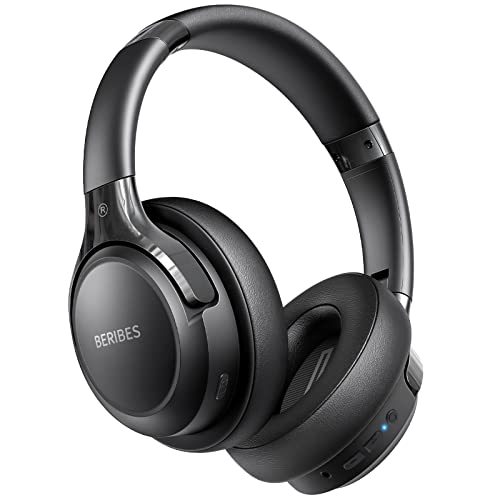
| BERIBES Bluetooth Headphones | 65 hours of playtime, 6 EQ modes, very light, folds flat | Budget | |
| bmani Hybrid ANC Headphones | 45dB hybrid ANC, 120 hours, charge display, six call mics | Premium | |
| MMWOWARTS Hybrid ANC Headphones | Hybrid ANC, 120 hours quoted, memory foam cups | Budget | |
How to choose budget over-ear headphones
Wired or wireless, and what the cable buys you
At this end of the market the cable is not a compromise, it is a budget decision. A wired headphone spends nothing on radios, batteries, chips, or noise-canceling microphones, so more of the cost goes into drivers and padding. That is why the OneOdio, with no battery at all, is the strongest seller in this comparison. It also never needs charging, never drops a connection, and adds no latency, which matters if you play an instrument or edit video.
Wireless buys freedom and, usually, active noise canceling. It costs you charging, pairing, and the certainty that in some years the battery will be the thing that kills the headphone. Both routes are legitimate. The question is whether you want to walk around, not which is objectively better.
What noise canceling actually does
This deserves plain language, because the marketing numbers do not supply it. Active noise canceling works by generating a sound wave that opposes incoming noise, and it is very good at steady low-frequency drone: aircraft cabins, train rumble, air conditioning, road noise. It is much weaker against sudden or high-pitched sound, which is why an office conversation two desks away still reaches you. Claims like “blocks 95% of noise” describe the easy case, not the whole picture.
Hybrid ANC, which the Soundcore, bmani, and MMWOWARTS all use, means microphones sit both inside and outside the cup, so the system hears both the noise arriving and what leaked through. It works better than a single-microphone design. The figures quoted here, up to 45dB on the bmani and around 90% on the Soundcore, are measured under conditions the maker chose, so take them as ranking hints rather than promises.
Passive isolation matters too, and it is free. A cup that seals properly around the ear blocks a fair amount before any electronics are involved. A leaky seal undoes expensive ANC, which is why fit is not a comfort issue alone.
Reading battery numbers plainly
A quoted 120 hours and a quoted 40 hours are not measured the same way. Longer figures usually assume noise canceling switched off and a moderate volume, while the shorter figure often assumes ANC running. The Soundcore is unusually clear about this, quoting 40 hours with ANC on and 60 without. The MMWOWARTS quotes 120 hours as a headline and 60 hours in standard mode at moderate volume, which is the more useful figure.
Fast charging is the number that actually changes a bad morning. Five minutes for four extra hours, as on the Soundcore, or ten minutes for three hours on the bmani, is the difference between leaving with music and leaving without.
Drivers, bass, and the EQ escape hatch
Driver size gets top billing and explains less than the box implies. A 50mm driver, as in the OneOdio, can move more air than a 40mm one, but tuning matters more than diameter. What genuinely helps at this price is an EQ you can adjust. The Soundcore app offers 22 presets plus manual control, and the BERIBES has six EQ modes on the headphone itself. Being able to pull down the bass on a pair tuned for thump is worth more than any driver spec.
Comfort, weight, and the two-hour test
Any headphone is comfortable for ten minutes. The problems arrive at hour two, as heat, clamp pressure on the jaw, or a headband pressing one spot on the skull. Memory foam, as on the bmani and MMWOWARTS, spreads pressure better than plain foam. Low weight helps: the BERIBES is around 0.38lb, which is genuinely light for a full-size pair. If you wear glasses, clamp force is the specification you care about most and the one nobody publishes.
Calls
Call quality is where budget headphones most often disappoint, because the microphone is far from your mouth and hears the whole room. Multiple microphones with noise suppression, like the six on the bmani, help isolate your voice from background noise. If calls are the main use, this is worth prioritizing over sound quality.
OneOdio Pro-10 Wired Over-Ear Headphones
By a distance the best-selling pair in this comparison, and it wins by refusing to play the feature game. No Bluetooth, no ANC, no battery, no app. What the money buys instead is 50mm drivers with neodymium magnets, cups that swivel a full 90 degrees for single-ear monitoring, and a jack arrangement that handles both a phone and a mixer or amplifier without hunting for an adapter. The shared audio port is a small delight: plug a second pair straight into the first and two people listen without a splitter. It is a studio and DJ tool that happens to be affordable enough for everyday use.
Pros
- Large 50mm drivers, with the whole budget spent on sound rather than radios
- Never needs charging, no pairing, no latency
- Works with both a 3.5mm jack and a quarter-inch amp or mixer input
- Cups swivel 90 degrees for single-ear monitoring
- Daisy-chain port lets a second pair share the audio
- Good passive isolation from the padded cups
Cons
- Wired only, so no walking around untethered
- No active noise canceling, only passive isolation
- Tuned with a bass lift, which is not to everyone’s taste
- No inline microphone for calls
Best for: desk listening, recording, DJing, or anyone who would rather have drivers than features.
Soundcore by Anker Q20i
The most complete wireless pair here and the second-strongest seller. Four microphones, two inside and two outside each cup, drive hybrid noise canceling that Soundcore rates at roughly 90% reduction on trains and in offices. Battery runs 40 hours with ANC on or 60 without, and five minutes on charge returns four hours. The app is what lifts it above the pack: 22 EQ presets or manual adjustment, three listening modes, and the ability to actually fix the tuning if the bass is too much. Multipoint pairing keeps it connected to a laptop and a phone at once and switches automatically when a call arrives.
Pros
- Hybrid ANC with four microphones, the most convincing implementation here
- Real battery quotes: 40 hours with ANC, 60 without
- Five-minute charge gives four hours
- App EQ with 22 presets or full manual control
- Connects to two devices at once and switches automatically
- Transparency mode for announcements and traffic
- Backed by an established brand
Cons
- Mid-range tier, the second-priciest here
- Bass-forward out of the box, so the app is close to mandatory
- Bluetooth 5.0 rather than a newer version
Best for: commuting, open-plan offices, and anyone who wants noise canceling that genuinely earns its name.
BERIBES Bluetooth Over-Ear Headphones
The lightest pair here at roughly 0.38lb, with a 500mAh battery that BERIBES rates at more than 65 hours of play and over 950 hours of standby. It folds, it carries a 3.5mm cable for when the battery does finally die, and six EQ modes let you move between balanced, bass-heavy, and treble-forward without an app. Bluetooth 6.0 pairs in a second or two and holds two devices at once. Be clear about what it is not: there is no active noise canceling here, only the passive seal of the cups. At the lowest price tier in the comparison, that is a fair trade.
Pros
- 65 hours of playtime, plus a very long standby
- Lightest pair here, which shows on long sessions
- Six EQ modes selectable on the headphone, no app needed
- Folds flat and includes a 3.5mm cable as backup
- Bluetooth 6.0, fast pairing, two devices at once
- Lowest price tier in this group
Cons
- No active noise canceling at all, despite the wireless design
- Light build feels less substantial than the metal-and-foam alternatives
- Passive isolation only, so aircraft drone comes through
Best for: long wireless listening on a tight budget, where cutting engine noise is not the point.
bmani Hybrid ANC Headphones
The most ambitious specification here, and the only pair at the premium tier. A four-layer hybrid ANC system rated up to 45dB, 120 hours of quoted playback, a display that shows the charge level rather than making you guess, and six microphones with environmental noise canceling for calls. Ten minutes on charge returns about three hours. Memory foam under velvet-soft protein leather is the right approach for long wear. The caution is proportionate to the claims: a 45dB rating and 95% blocking in 0.02 seconds are manufacturer figures measured on their terms, and this brand has nothing like the track record of Anker behind it.
Pros
- Highest ANC rating quoted here, up to 45dB, in a four-layer hybrid design
- 120 hours of quoted playback, the longest in the group
- Display shows exact remaining charge
- Six microphones with noise suppression for calls
- Memory foam cups built for long sessions
- Bluetooth 6.0, plus an AUX input as backup
- Transparency mode and spatial audio
Cons
- Premium tier, roughly five times the cheapest pair here
- Headline ANC and battery claims are the maker’s own, with no independent check
- Less established brand, so support is an unknown
Best for: frequent flyers and heavy call users who want the strongest noise canceling in this bracket and will pay for it.
MMWOWARTS Hybrid ANC Headphones
Active noise canceling at the budget tier, which not long ago was a contradiction. Dual-microphone hybrid ANC covers the full 20Hz to 20kHz range and is rated at up to 95% reduction, playback is quoted at 120 hours headline or 60 hours in standard mode at moderate volume, and a five-minute charge buys four hours. Memory foam cups and an adjustable headband handle the comfort side. It costs about the same as the wired OneOdio, which frames the decision neatly: the same money buys drivers or buys features, and this pair chose features.
Pros
- Hybrid ANC at the budget tier
- 60 hours in standard mode, with a 120-hour headline figure
- Five-minute charge returns four hours
- Memory foam cups for long wear
- Bluetooth 6.0 with auto-connect and low latency
- Wind resistance and clarity processing on the call microphone
Cons
- Two microphones for ANC rather than four, so weaker than the Soundcore
- Headline battery figure needs the asterisk the maker supplies
- No app, so the tuning is what it is
- Little brand history to lean on
Best for: a first pair of noise canceling headphones, or a spare pair you would not mourn if they were lost.
The verdict
Best overall: OneOdio Pro-10. It is the runaway best seller here, and that is a verdict in itself. Buyers keep choosing 50mm drivers, a cable that never needs charging, and a quarter-inch jack over a feature list. If you listen at a desk, record anything, or simply want the most sound for the money, nothing else here competes.
Best value: BERIBES Bluetooth Headphones. The lowest price tier, 65 hours of wireless play, six EQ modes, and a weight you stop noticing. Accept that it has no active noise canceling and it is the easiest recommendation in the group.
Best premium: bmani Hybrid ANC. The strongest noise canceling specification and the longest battery, plus a charge display and six call microphones. Its claims are unverified, so buy it for the feature set rather than the numbers.
One caveat on the headline. If active noise canceling is your actual reason for shopping, the Soundcore Q20i is the pair to buy: four-microphone hybrid ANC, real battery figures, a proper app, and a company with a real support record. It is the best noise canceler here in every sense except the raw decibel claim.
Frequently asked questions
Is cheap active noise canceling worth having?
For steady low-frequency noise, yes. Engine drone, train rumble, and air conditioning all drop noticeably even on inexpensive hybrid systems. For voices and sudden sounds, the difference between cheap and expensive ANC is large, and budget pairs will not silence an open-plan office.
Why does a wired pair outsell wireless ones?
Because none of the money goes into radios, batteries, or noise-canceling chips. At a fixed budget, cutting those puts more into drivers and padding. A wired pair also never needs charging, never drops out, and adds no delay, which matters for recording, gaming, and video editing.
Are the quoted battery hours real?
They are usually real under the conditions the maker picked, which typically means noise canceling off and moderate volume. The useful comparison is like for like: the Soundcore quotes 40 hours with ANC on and 60 without, so a 120-hour headline elsewhere is measuring something different. Look for the figure with ANC engaged.
Do bigger drivers mean better sound?
Not reliably. A 50mm driver can move more air than a 40mm one, but tuning, cup design, and the seal around your ear matter more. A well-tuned smaller driver beats a badly tuned large one. Adjustable EQ is more useful than driver size at this price.
Which of these is best for calls?
The bmani, on specification, with six microphones and environmental noise canceling to separate your voice from the room. The Soundcore is the safer all-rounder. The wired OneOdio has no microphone at all, so it is not a call headphone.
This article may contain affiliate links; see our Affiliate Disclosure.