Shoot a sweeping vista by hand and the software fights you: ghosted edges, bent horizons, seams that will not blend. A panoramic tripod head fixes the physics. It rotates the camera around the right point and in even, repeatable steps, so every frame overlaps cleanly and your stitching program does its job in seconds instead of an hour of retouching. For wide landscapes, real-estate tours, and full 360-degree scenes, it is the difference between a struggle and a click.



A great panoramic head rotates smoothly, marks even angle stops you can repeat, levels true, and holds your camera and lens without sag. The types differ a lot, from a simple panning base to a multi-row gimbal or a motorized head. The five below suit a landscape shooter chasing seamless vistas, a real-estate photographer making 360 tours, a traveler who packs light, and a videographer wanting smooth motorized pans.
At a glance
| Product | Standout feature | Price tier | Link |
|---|---|---|---|
| K&F Concept Panoramic Gimbal Head | Multi-row capable, 44lb load, calibrated scales | Premium | |
| NEEWER 360 Panoramic Ball Head | Versatile pano ball head with independent pan | Mid-range | |
| Ytvariw Panoramic Panning Base | Click-stop 360 scale for even, repeatable rows | Budget | |
| SmallRig 3034 Panoramic Ball Head | Low-profile, compact, trusted brand | Mid-range | |
| Soonpho M4 Motorized Head | Remote-controlled powered 360 rotation | Premium | |
How to choose a panoramic head
The right head depends on how ambitious your panoramas are, from a simple horizontal sweep to a full spherical scene. A few concepts make the choice clear.
Why a panoramic head at all
The enemy of a clean panorama is parallax, the way foreground and background shift against each other when the camera pivots off-center. A panoramic head lets you rotate the camera around its lens’s no-parallax point, so that shift disappears and frames line up for effortless stitching. Even shots blend better when each frame overlaps the last by a consistent amount, which even angle stops make easy. That is the whole job: rotate around the right point, in even steps, on a level base.
Single-row, multi-row, or motorized
Match the type to your goal. A panning base or panoramic ball head handles a single horizontal row, perfect for wide landscape sweeps and most 360 scenes. A multi-row gimbal or nodal head adds vertical tilt so you can shoot rows above and below the horizon and assemble a full spherical panorama, the tool for virtual tours and immersive scenes. A motorized head rotates under power on a timer or remote, ideal for video pans and hands-free time-lapse panoramas. Buy for the most demanding panorama you actually plan to shoot.
Click stops and calibrated scales
Repeatability is what saves you at the computer. A base with detent click stops or a calibrated degree scale lets you rotate the exact same amount every frame, ensuring even overlap and complete coverage with no gaps. Look for marked degree increments, common bases click every 15 degrees for 24 stops around the circle, and independent pan control so you can rotate horizontally without disturbing your framing.
Leveling and load capacity
A tilted base bends the horizon and multiplies stitching errors, so leveling matters. Bubble levels, ideally on more than one axis, help you set the base true, and for demanding work a dedicated leveling base under the head lets you fine-tune level without adjusting the tripod legs. Capacity matters too: add up your camera and heaviest lens, then pick a head rated well above that so it locks solid and never creeps mid-sequence.
Mounts, build, and portability
Compatibility keeps setup fast. Arca-Swiss quick-release plates are the common standard, and the usual screw sizes are a 1/4-inch stud to the camera and a 3/8-inch thread to the tripod, so check your gear matches or that an adapter is included. Aluminum-alloy construction balances strength and weight, and smooth, well-sealed movement keeps rotation even. Finally, weigh portability against capacity: a compact low-profile head travels light, while a big gimbal trades bulk for the ability to carry heavy rigs through multi-row work.
Getting the most from the head
The gear only pays off with a few good habits behind the camera. Lock your exposure and white balance to manual so every frame matches, rather than letting the camera re-meter and leave a patchwork of brightness across the sweep. Overlap each frame with the last by roughly a third, which gives the stitching software plenty to work with, and shoot in a raw format for the most latitude when you blend and tone the final image. Focus manually so it does not hunt between frames, and if there is close foreground, take the extra minute to set the no-parallax point precisely, since that is exactly where a panoramic head earns its keep. Level the base carefully before the first frame, and the whole sequence falls into place.
K&F Concept Panoramic Gimbal Head
This is the pick for serious, multi-row panoramas. A gimbal-style design rotates 360 degrees both horizontally and on a vertical arm, so you can shoot full rows above and below the horizon for spherical scenes, and a horizontally adjustable lens platform lets you set the center of gravity, and the no-parallax point, for any camera and lens. Calibrated scales make every position repeatable, so overlap stays even across a big sequence. Built from 6061 aluminum alloy, it carries a hefty 44-pound load, easily handling long lenses and heavy bodies, and refined sealed grease keeps its movement smooth. For ambitious panoramic work, it is the most capable option here.
Pros:
- Multi-row capable for full spherical panoramas
- Adjustable platform to set the no-parallax point
- Very high 44-pound load capacity
- Calibrated scales for repeatable positioning
Cons:
- Larger and heavier than a simple base
- More setup than a single-row shooter needs
Best for: multi-row and spherical panoramas with heavier gear.
NEEWER 360 Panoramic Ball Head
The NEEWER is the versatile all-rounder, a metal ball head with a dedicated panning base. Three knobs let you set the ball for framing, then pan a full 360 degrees independently for a level horizontal sweep, with an index scale for precise, even steps. Both horizontal and vertical bubble levels help you set up true, and fine-tuning damping guards against a sudden lens drop while you adjust. It carries up to 17.6 pounds, plenty for most mirrorless and DSLR kits, mounts via a 1/4-inch Arca-type quick-release plate, and threads onto tripods with a 3/8-inch base. For a photographer who wants one head for everyday shooting and single-row panoramas, it is a practical, affordable choice.
Pros:
- Independent 360 pan with index scale
- Doubles as an everyday ball head
- Horizontal and vertical bubble levels
- Damping avoids sudden lens drop
Cons:
- Single-row only, no vertical tilt rows
- No adjustable nodal rail for parallax
Best for: an all-purpose head that also handles single-row panoramas.
Ytvariw Panoramic Panning Base
The Ytvariw is the budget specialist that does one thing very well: even, repeatable rotation. A dedicated panning base with a 0-to-360-degree scale clicks in 15-degree stops, 24 around the circle, so you can rotate the exact same amount every frame for consistent overlap and full coverage. It carries a strong 22-pound load, adds a bubble level for a true setup, and uses standard screws, a 3/8-inch base thread and a 1/4-inch camera screw, plus Arca-Swiss plate compatibility, so it slots between your tripod and existing head. Compact and inexpensive, it is the simplest way to turn any setup into a precise single-row panorama rig.
Pros:
- Click-stop 360 scale for even rows
- Strong 22-pound load capacity
- Arca-Swiss compatible, standard screws
- Compact and very affordable
Cons:
- Panning only, add your own head for tilt
- Single-row panoramas rather than spherical
Best for: precise single-row panoramas on a budget.
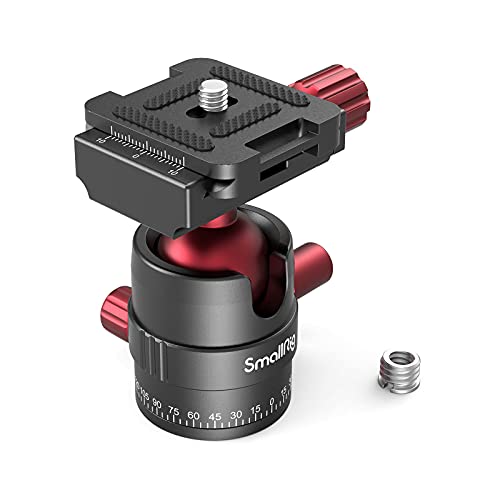
SmallRig 3034 Panoramic Ball Head
From a brand trusted by videographers, the SmallRig is the compact travel pick. A precise 360-degree panning dial with accurate calibration and an independent pan knob makes single-row panoramas easy, while the ball itself switches quickly between horizontal and vertical framing. Its low-profile design places the locking knob on the side rather than the base, lowering the center of gravity for a stronger lock and better stability, a smart touch for a small head. It carries up to 11 pounds, uses a removable Arca-Swiss quick-release plate with a 3/8-inch base, and is built from durable aluminum alloy. For a photographer who packs light but wants quality and reliable panning, it hits a sweet spot.
Pros:
- Calibrated 360 pan dial, independent knob
- Low-profile design for extra stability
- Compact and travel-friendly
- Trusted brand, Arca-Swiss plate
Cons:
- Lower load rating than the larger heads
- Single-row rather than multi-row
Best for: travel and lightweight kits wanting quality single-row panning.
Soonpho M4 Motorized Head
The Soonpho takes a different path: it rotates under power. A remote control drives 360-degree horizontal and 35-degree vertical movement across eight speeds, so you can capture smooth motorized pans for video, hands-free time-lapse panoramas, and automated 360 sweeps without touching the camera. The 2.4GHz remote reaches beyond 20 meters with strong anti-interference, a built-in rechargeable battery with a level display keeps it running, and a 1/4-inch quick-shoe plate mounts smartphones, cameras, and camcorders up to about a kilogram. It suits lighter setups and content creators more than heavy DSLR rigs, and note that it pans or tilts, not both at once. For motion and automation, it is the standout.
Pros:
- Powered 360 rotation by remote
- Eight speeds for smooth video pans
- Great for hands-free time-lapse panoramas
- Rechargeable with a battery display
Cons:
- Light load limit, not for heavy rigs
- Pans or tilts, not simultaneously
Best for: motorized video pans and automated 360 with light gear.
The verdict
Best Overall: the K&F Concept Panoramic Gimbal Head is the most capable pick. Its multi-row design, adjustable no-parallax platform, calibrated scales, and huge load capacity let you shoot everything from a wide sweep to a full spherical panorama with heavy gear, making it the tool that grows with your ambitions.
Best Value: the Ytvariw Panoramic Panning Base delivers exactly what single-row panoramas need, click-stop even rotation and a strong load rating, for a rock-bottom price, and it slots into any existing setup.
Best Premium: the Soonpho M4 Motorized Head is the one for motion, driving powered pans and hands-free 360 sequences no manual head can match. For an everyday head that also pans, the NEEWER is versatile, and the SmallRig is the compact, stable travel choice.
Frequently asked questions
Do I really need a panoramic head, or can I just pan on a ball head? You can pan on a ball head with a panning base, and for single-row landscape sweeps that works well. What a dedicated panoramic setup adds is rotation around the lens’s no-parallax point and even, repeatable angle stops, which remove ghosting and make stitching far easier, especially with close foregrounds or multi-row spherical scenes.
What is the no-parallax point? It is the spot along the lens where rotating the camera does not shift the foreground against the background. Rotating around it keeps every frame aligned so the software stitches them seamlessly. Multi-row and nodal heads have an adjustable platform or rail to set it, which is why they produce the cleanest panoramas, particularly with nearby objects in the frame.
What is the difference between single-row and multi-row panoramas? A single-row panorama is one horizontal sweep, ideal for landscapes and many 360 scenes, and a panning base or panoramic ball head handles it. A multi-row panorama also tilts up and down to capture rows above and below the horizon, which you assemble into a full spherical image, the job of a gimbal or nodal head.
Why do click stops and levels matter so much? Click stops let you rotate the exact same amount each frame, ensuring consistent overlap and complete coverage with no gaps to fix later. Levels keep the base true so the horizon stays straight; a tilted base curves the horizon and multiplies stitching errors. Together they turn a fiddly process into a repeatable, reliable one.
How much load capacity do I need? Add up your camera body and your heaviest lens, then choose a head rated comfortably above that total so it locks solid and never creeps during a sequence. Lighter mirrorless kits are happy on compact heads, while long telephotos and pro bodies want a higher-capacity gimbal or ball head for stability.
This article may contain affiliate links; see our Affiliate Disclosure.