One recorder here advertises 11,500 hours of storage and 1536kbps stereo quality. Those two numbers are in the same listing, and they cannot both describe the same recording. Do the arithmetic the listing invites: at 1536kbps, its 160GB holds about 230 hours. To reach 11,500 you have to drop to roughly 32kbps, which is worse than a phone call. The headline capacity and the headline quality are advertising opposite ends of the same dial.





At a glance
| Product | The number that matters | Price tier | Link |
|---|---|---|---|
| 8GB Voice Recorder | Publishes hours at four bitrates. Nobody else does | Budget | |
| Tonfarb 64GB | Puts the caveat in brackets: 48 hours at 32kbps | Budget | |
| EVISTR L357 | Sells seven gain levels. The pricier ones removed gain | Budget | |
| 160GB Recorder | 160GB is 32 plus a 128 card. It calls the 32 RAM | Budget | |
| Sony ICD-PX370 | Three bullets. The battery figure states its conditions | Mid-range | |
| Xvive XV1-R | 130dB SPL, 32-bit float, and it records before you press it | Mid-range | |
| TASCAM DR-05XP | 32-bit float, 125dB SPL, 17.5 hours on two AAs | Mid-range | |
| Zoom F3 | Every spec is in the title. The bullets name buyers | Premium | |
How to choose
Hours and quality are the same dial
Every huge hour figure on this page is measured at the worst setting the device offers. The arithmetic is fixed and you can do it yourself: 1536kbps works out to about 690MB per hour, so 64GB holds roughly 90 hours of it and 160GB holds about 230. Any listing promising thousands of hours has quietly switched to around 32kbps to get there, which is a fiftieth of the data and sounds like it. Two brands here are straight about this. One publishes a full table of hours at four different bitrates. Another simply puts the conditions in brackets after its battery claim. The rest print the big number and the good number side by side and hope you do not multiply.
1536kbps is not a feature
Six listings here shout it. Here is what it is: 48,000 samples a second, 16 bits each, two channels. Multiply those together and you get exactly 1,536,000 bits per second. It is the plain arithmetic of an ordinary stereo WAV file, the same as a CD and a fraction better. It is the floor of digital audio, not the ceiling, and the three serious recorders on this page never mention it once. They talk about 32-bit float, 96kHz and maximum sound pressure instead. When a spec appears only on the cheap products, that is information.
32-bit float means you stop setting levels
This is the feature that separates the two halves of this page, and it is worth understanding. On a normal recorder you set a gain level first: too low and your recording is thin and hissy, too high and a sudden loud moment clips into distortion you can never repair. Setting it right, in advance, for a sound that has not happened yet, is the entire skill. A 32-bit float recorder has so much headroom that it captures the quiet and the sudden bang in one file and you simply pull the level where you want it afterwards. Nothing clips. Notice, then, that one budget listing sells seven levels of adjustable gain as a headline feature. It is selling you the chore that the expensive ones deleted.
Maximum SPL is the spec for anything loud
If you are recording a band, a motorbike or a toddler, the question is how loud a sound the microphone can take before it gives up. Three products here answer: two at 125 decibels, one at 130. Every dictaphone on this page is silent on it, including one sold explicitly for musicians, podcasters and filmmakers. A microphone with no published maximum is a microphone nobody wants you to test at a gig.
Read what the capacity is made of
One listing here is admirably transparent by accident. It advertises 160GB and then explains, in brackets, that this is 32GB plus a 128GB memory card. So the recorder has 32GB and the box has a card in it. Another does the same thing to reach 136GB, which is 8 plus 128. The card is a nice inclusion and it is not a specification of the device. The same listing also describes its built-in 32GB as RAM, which is a different thing entirely from storage, and tells you how carefully that page was written.
Password protection is a menu lock
Four recorders here offer password protection for sensitive interviews. The same listings also say the device works as a plain USB storage drive. Both cannot give you much security at once: a password on the device’s own menu does not encrypt anything, and none of these listings claims the recordings themselves are encrypted. Plugged into a computer, the files are files. Take it as a lock on the screen, not on the audio.
Pre-record is the feature that saves takes
One recorder here keeps a rolling buffer and writes the seconds from before you pressed the button. Anyone who has recorded anything unrepeatable knows exactly why that matters, because the good bit always starts a moment before you are ready. It is on precisely one product on this page, and it is not the most expensive one.
8GB Voice Recorder
The cheapest thing here and the only listing on the page that refuses to play the hours game. Instead of one headline figure it prints the whole table: 140 hours at 128kbps, 280 at 64, 560 at 32. Run the numbers and the low-bitrate figures land almost exactly where the arithmetic says they should, which means somebody actually calculated them rather than picking a number that looked big. Three-button operation, voice activation with a threshold you set, A-B repeat, variable speed, timestamped filenames, 20 hours of recording per charge.
Pros:
- Publishes hours at four separate bitrates; the only one here
- Its low-bitrate figures survive the arithmetic
- Three buttons; timestamped filenames; A-B repeat
- The lowest price on this page by a distance
Cons:
- 8GB, and no card slot mentioned; 199 file limit
- 20 hours of recording; the shortest here
- Micro USB, where rivals have moved to USB-C
- No maximum SPL, no sample rate published
Best for: the only listing that shows you the trade-off.
Tonfarb 64GB
It claims 4,600 hours and 48 hours of battery, and then does something almost nobody here does: it puts the conditions in brackets, telling you the battery figure is MP3 at 32kbps. That single bracket is the difference between a specification and a slogan, and it lets you work out that the hours figure lives at the same setting. A 1.44-inch screen, voice activation with a settable threshold, scheduled recording, file segmentation, bookmarking, and it doubles as a USB drive and MP3 player.
Pros:
- States the bitrate behind its battery claim, in brackets
- 1.44-inch screen; scheduled recording; file segmentation
- Internal and external recording; bookmarking; A-B loop
- 64GB card included; works as a USB drive
Cons:
- 4,600 hours is the same 32kbps figure, unbracketed
- Every bullet closes with a list of search terms
- 600mAh; the smallest battery here
- No maximum SPL published
Best for: a budget recorder that admits its own conditions.
EVISTR L357
The best-organized dictaphone here. It publishes its exact dimensions, names its battery at 500mAh, quotes three hours to charge for 32 of recording, and names its files by the second they started so you can find anything later. Two buttons, one to record and one to save. Seven levels of gain and seven levels of voice-activation sensitivity give you more control than any rival at this price, and its manual even has a page number for troubleshooting disk errors. Just note what those gain levels are for: the recorders three times the price have removed the setting entirely.
Pros:
- Publishes dimensions, battery capacity and charge time
- Files named by exact start time, to the second
- Seven gain levels and seven voice-activation levels
- Two-button operation; Type-C; WAV or MP3
Cons:
- Sells adjustable gain, which better recorders eliminate
- 4,660 hours is a 32kbps figure
- No maximum SPL or sample rate published
Best for: the tidiest listing among the cheap recorders.
160GB Recorder
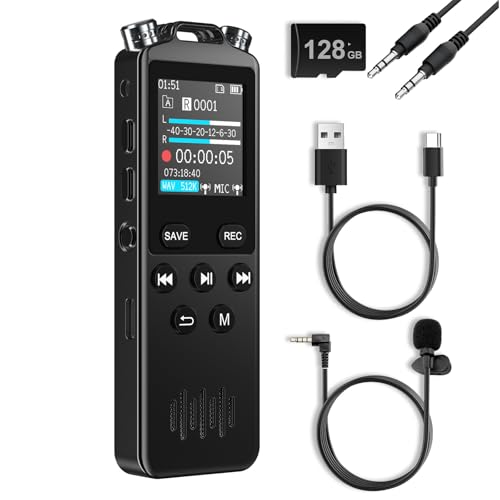
Sold for musicians, podcasters, filmmakers and content creators, with no sample rate, no maximum SPL, no input jack and no mention of what it does when something gets loud. Its 160GB is disclosed in brackets as 32GB plus a 128GB card, and it calls that 32GB “RAM”, which is a different component doing a different job. The 11,500 hours it promises would need roughly 32kbps, in a listing whose first bullet sells 1536kbps. What is genuinely here: zinc alloy and acrylic, dual mics, four recording modes, and a 1100mAh battery, the largest on this page.
Pros:
- 1100mAh; the largest battery among the dictaphones
- Zinc alloy and acrylic body; dual microphones
- Four recording modes; scheduled and segment recording
- Discloses that its 160GB includes a 128GB card
Cons:
- 11,500 hours and 1536kbps cannot both describe one file
- Calls its built-in storage RAM
- Sold for filmmakers with no SPL, sample rate or input
Best for: battery life, if you ignore the rest of the page.
Sony ICD-PX370
Three bullets. Records MP3, 57 hours of battery, USB plug built into the body so there is no cable to lose. That is the entire listing, and the battery figure carries its conditions right there in brackets. On a page where rivals need five paragraphs of keywords to say less, brevity reads as confidence. The catch is that brevity also means no capacity, no bitrate options, no SPL and no noise reduction claims, and its own title calls it mono while the battery bullet quotes a stereo figure.
Pros:
- 57 hours of battery, with the conditions stated
- USB plug built in; no cable required
- Three bullets, no keyword padding, no unverifiable claims
Cons:
- Titled mono; quotes a stereo bitrate in its battery bullet
- No storage capacity, SPL or format options published
- Dearer than every dictaphone here, for fewer features
Best for: a listing with nothing in it to decode.
Xvive XV1-R
It costs less than the cheapest TASCAM and out-specifies it. 32-bit float and 24-bit integer up to 96kHz, so no levels to set and nothing to clip. A 130 decibel maximum, the highest figure published anywhere on this page. Pre-recording, so it catches the moment before you pressed the button, which is the only feature here that recovers a take you would otherwise have lost. An onboard limiter, noise gate and low-cut filter. A threaded tripod mount and a slate tone for syncing to video. And it runs on two AA batteries for 12 hours, so it never dies somewhere without a charger.
Pros:
- 32-bit float and 24-bit up to 96kHz; no gain to set
- 130dB maximum SPL; the highest published here
- Pre-record buffer catches what happened before you hit record
- Limiter, noise gate and low-cut on board; tripod thread and slate tone
- Runs on two AA batteries; also a USB-C audio interface
Cons:
- 12 hours per set of batteries; the shortest of the serious recorders
- Cards to 128GB only
- A 1/8-inch input, not XLR; no phantom power for pro mics
Best for: nearly everything the big recorders do, at a third of the price.
TASCAM DR-05XP
The safest recommendation on this page and the most boring, which in recording is a compliment. 32-bit float, 24-bit and 16-bit at 96, 48 or 44.1kHz, omnidirectional condenser mics rated to 125 decibels, and 17.5 hours on two alkaline AAs. It is also a 2-in 2-out USB-C interface, so the same box records in a field and plugs into a laptop for a podcast. TASCAM tells you plainly that the card and batteries are not included, which is a small courtesy nobody else extends.
Pros:
- 32-bit float at up to 96kHz; nothing to clip
- 125dB maximum SPL, published
- 17.5 hours on two AA alkalines you can buy anywhere
- Doubles as a 2-in 2-out USB-C audio interface
- Says outright that the card and batteries are extra
Cons:
- Omnidirectional mics pick up the whole room, wanted or not
- No XLR input; no phantom power
- 125dB where a cheaper rival publishes 130
Best for: the dependable middle, with no surprises.
Zoom F3
Dual analog-to-digital converters per channel is the real reason this costs what it does: two converters run at different levels simultaneously and the recorder combines them, which is how it captures a whisper and a slammed door in the same file with nothing to set. Two locking XLR inputs mean the cable cannot fall out when the recorder is taped under a table. Note where the specs live, though: they are all in the title. Every one of its five bullets opens by naming a type of buyer, and between them they contain no measurements at all.
Pros:
- Dual AD converters per channel with 32-bit float
- Two locking XLR/TRS inputs; cables cannot pull out
- Ultra-low-noise preamps for quiet dialogue
- Standalone or USB workflows; wireless control
Cons:
- All five bullets name a buyer type; none names a number
- No maximum SPL, sample rate or battery life in the bullets
- Three times the price of a recorder publishing more
- No built-in microphones; you supply them
Best for: the job with no second take.
The verdict
This page is two categories wearing one name. Below sixty dollars you get dictaphones selling storage measured at their worst setting alongside a bitrate that is simply what a WAV file is. Above ninety you get recorders that deleted the hardest part of recording and publish how loud a sound they survive.
Best overall: Xvive XV1-R. It undercuts every serious recorder here and beats them on the numbers that matter: 32-bit float so there is no level to set and nothing to clip, and a 130 decibel maximum, the highest published on this page. It adds the one feature that actually rescues a lost take, a pre-record buffer that keeps the seconds before you pressed the button. A limiter, a gate, a low-cut, a tripod thread and a slate tone are all things you would otherwise buy separately, and it runs on two AAs from any petrol station.
Best value: 8GB Voice Recorder. It is the cheapest thing here and the only listing that takes you as someone who can read a table. Four bitrates, four hour-counts, and the low ones land where the arithmetic says they should. Every rival on this page picked the biggest number the maths allowed and printed it alone. This one shows you the whole curve and lets you choose your point on it, which is exactly the decision the category is built on hiding.
Best premium: Zoom F3. Dual converters per channel and locking XLRs are what you buy when the recording cannot be repeated and the recorder is taped somewhere you cannot reach. It is genuinely the most capable box here. Just know its listing sells you five kinds of person rather than one measurement, and that the specifications you are paying for appear only in the title.
FAQ
Can a recorder really hold 11,500 hours?
Only at about 32kbps, which is worse than a phone call. At the 1536kbps those same listings advertise, 160GB holds roughly 230 hours. The two figures describe opposite ends of one dial.
Is 1536kbps good?
It is ordinary. It is 48kHz, 16-bit, two channels multiplied together: a plain stereo WAV file. It is the floor of digital audio, which is why the three serious recorders here never mention it and talk about 32-bit float instead.
What does 32-bit float actually do?
It removes the gain setting. There is enough headroom to capture a whisper and a bang in one file with nothing clipping, and you set the level afterwards. One budget listing here sells seven gain levels as a feature, which is the chore the expensive recorders deleted.
Why does maximum SPL matter?
It is how loud a sound the mic survives before distorting. Three products publish it, at 125 and 130 decibels. Every dictaphone here omits it, including one sold for musicians and filmmakers.
Does password protection secure my recordings?
It locks the device’s menu. The same listings say the recorder mounts as an ordinary USB drive, and none of them claims the audio files themselves are encrypted. Plugged into a computer, they are just files.
This article may contain affiliate links; see our Affiliate Disclosure.