Nothing wastes good trim like a corner that is not actually 90 degrees. Old houses almost never are, and guessing the angle turns a clean crown molding joint into a gappy mess. An angle finder measures the real corner and hands you the exact number to set on the saw.




An angle finder or miter saw protractor measures the true angle of a corner or workpiece and translates it into the setting your saw needs, ending the trial-and-error that ruins molding and framing. This guide compares five tools across two styles, digital angle finders with precise readouts and manual protractors that transfer angles directly to the saw. It suits trim carpenters, deck and framing builders, and DIYers chasing tight joints in rooms where no corner is ever square.
| Product | Standout | Price tier | Link |
|---|---|---|---|
| Tirpheety Digital Angle Finder | Best-selling, budget digital, large LCD | Budget | |
| Klein Tools 935DAF | 3-in-1 digital, miter calc, bright display | Premium | |
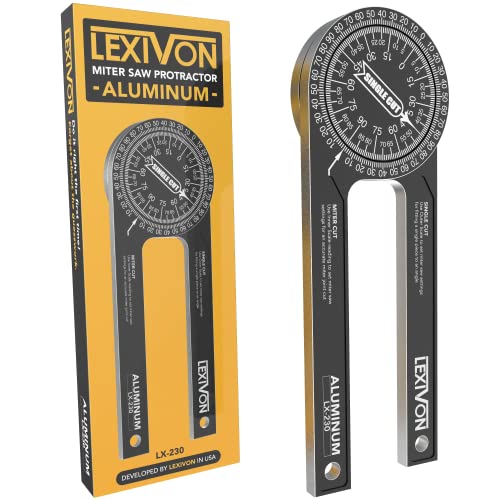
| LEXIVON Aluminum Miter Protractor | Direct-transfer scales, machined aluminum | Budget | |
| Saker Miter Saw Protractor | Lightweight aluminum, direct angle read | Budget | |
| S&F Digital Angle Finder | Miter and bevel calc, with case | Mid-range | |
How to choose an angle finder or miter protractor
These tools solve the same problem two different ways. Understanding the styles makes the choice clear.
Digital angle finder or manual protractor?
The core choice is between a digital angle finder and a manual miter saw protractor. A digital angle finder has an electronic screen that displays a precise measured angle, often to a tenth of a degree, and many can calculate the miter and bevel settings for you. A manual miter saw protractor is a mechanical tool with two arms and laser-engraved scales; you open it against a corner and read the exact saw angle directly off the scale, with no battery involved. Digital tools offer precision and helpful calculations; manual protractors are simple, rugged, and never run out of power. Both do the job well, so pick the workflow that suits you.
Accuracy and readout
Precision is the whole point, so check how accurate a tool is. Better digital angle finders quote accuracy around a couple of tenths of a degree with fine resolution, which matters for tight joints in trim and molding where small errors compound. A large, clear LCD or a bright, backlit display makes readings easy in dim job-site conditions. Manual protractors rely on cleanly engraved, easy-to-read scales for their accuracy. For fine finish carpentry, favor a tool with proven accuracy and a display or scale you can read quickly and confidently, since a misread number leads straight to a wasted cut.
Miter and bevel calculation
The most useful feature for saw work is a tool that does the math for you. Measuring a corner is only half the job; you then need the miter angle, and for crown molding the bevel angle too, to set on the saw. Manual miter protractors are cleverly engraved with two scales that transfer your measured corner directly to a single-cut or miter setting. Digital finders with a built-in miter and bevel calculator take a corner reading and display the saw settings outright. Either way, a tool that converts the raw angle into saw settings saves time and avoids the arithmetic errors that produce gappy joints.
Build quality and durability
These tools live in toolboxes and take knocks, so construction counts. Machined, anodized aluminum protractors are rugged, rust-resistant, and hold their calibration, while quality digital finders use durable housings and machined ruler edges for reliable measurement. A smooth, precise pivot, whether a Teflon O-ring in a manual protractor or a solid hinge in a digital one, ensures consistent readings. A protective case helps a digital tool survive the job site. Since an angle tool is only useful if it stays accurate, favor solid materials and a mechanism that will not loosen or drift over time.
Versatility and extras
Consider what else the tool can do. Many measure inside and outside angles, and some also read lengths, doubling as a ruler for layout work. A full 0 to 360-degree range handles every corner you will meet, and the ability to measure relative or supplementary angles adds flexibility for odd joints. For manual protractors, a size around seven inches balances reach and portability. Think about whether you want a single-purpose miter helper or a more versatile measuring tool, and weigh extras like a carrying case, batteries included, or units that switch between measurement systems.
Tirpheety Digital Angle Finder: the best-selling budget tool
The top seller here proves a good digital angle finder need not be expensive. This third-generation tool measures inside and outside angles as well as lengths across a full 0 to 360-degree range, making it a versatile helper for miter setup and general layout alike. A large, easy-to-read LCD shows the measured angle quickly, which speeds up work and reduces misreads, and the enhanced ABS construction with finely finished edges is built to last in a toolbox. Its modern, minimalist design is a nice touch, but the real appeal is capable digital precision at a rock-bottom price. For a DIYer or carpenter who wants a straightforward, affordable digital angle finder that covers the essentials, it is an easy, popular choice.
Pros
- Very affordable best-seller
- Measures angles and lengths
- Large, easy-to-read LCD
- Full 0 to 360-degree range
- Durable ABS construction
Cons
- No premium miter-calculation extras
- Plastic rather than metal body
- Basic feature set
Best for: budget-minded DIYers who want a capable, simple digital angle finder.
Klein Tools 935DAF: the trusted precision digital finder
From a brand carpenters and electricians trust, the Klein 935DAF is a refined 3-in-1 digital angle finder that measures inside and outside angles, reads lengths, and calculates miter saw cut angles with precision. That built-in miter calculation is its standout, letting you take a corner reading and get the perfect blade angle for tight miter joints every time, no mental math required. Machined ruler edges deliver reliable accuracy of about plus or minus 0.2 degrees, and a bright white LED display stays easy to read in any lighting, a genuine advantage in dim rooms and on busy job sites. Durable and dependable, it is the premium pick for finish carpenters and pros who want accurate readings and saw-ready calculations from a tool built to last.
Pros
- Trusted brand, durable build
- 3-in-1 angle, length, and miter calc
- About plus or minus 0.2-degree accuracy
- Bright LED display for any lighting
- Machined ruler edges
Cons
- Priciest here
- More tool than casual users need
- Relies on battery power
Best for: finish carpenters and pros who want precise readings and miter calculations.
LEXIVON Aluminum Miter Saw Protractor: the direct-transfer classic
The LEXIVON is a manual miter saw protractor that takes the guesswork out of angled cuts with no battery in sight. Crafted from CNC-machined anodized aluminum with precise, laser-engraved scales, it opens against inside or outside corners, and an internal Teflon O-ring mechanism swivels smoothly for a precise, repeatable read. Its two scales transfer your measured work angle directly to the miter saw for accurate miter and single cuts, so you simply read the number and set the saw. Rugged and rust-proof, it is ideal for crown molding, trim work, plumbing layout, and a variety of carpentry tasks. For anyone who prefers a simple, durable, always-ready tool that converts real corners into saw settings, it is an affordable and reliable workhorse.
Pros
- No batteries, always ready
- Machined anodized aluminum build
- Direct-transfer miter scales
- Smooth Teflon O-ring pivot
- Great for crown molding and trim
Cons
- Reading a scale, not a digital display
- Requires learning the two scales
- Less precise than fine digital readouts
Best for: trim carpenters who want a rugged, battery-free direct-transfer protractor.
Saker Miter Saw Protractor: the lightweight budget protractor
Saker offers a manual miter saw protractor that delivers the same direct-read convenience in a light, affordable package. Precision laser-engraved scales let you read the miter saw angle directly off the tool, making it well suited to crown molding, baseboards, and trim, and an O-shaped body design swivels smoothly to give a precise read on inside and outside corners. Made from lightweight aluminum alloy with strong corrosion and wear resistance, it holds up to job-site use while being easy to carry from room to room. Simple enough for a first-time trim project yet accurate enough for regular work, it is a budget-friendly manual protractor that helps beginners and pros alike cut clean angles without batteries or math.
Pros
- Affordable and lightweight
- Direct-read engraved scales
- Smooth O-body pivot
- Corrosion-resistant aluminum
- Battery-free simplicity
Cons
- Scale reading rather than digital
- Basic compared with digital tools
- Takes practice to master the scales
Best for: beginners and value seekers wanting a simple, battery-free miter protractor.
S&F Digital Angle Finder: the miter-and-bevel calculator
The S&F digital angle finder blends precision with saw-ready calculation and adds job-site practicality. It delivers a high-precision digital readout with about plus or minus 0.2-degree accuracy and 0.1-degree resolution to reduce guesswork and improve cut accuracy, and a built-in miter button calculates both miter and bevel settings, which is exactly what crown molding demands. It measures inside, outside, supplementary, and relative angles across a full 0 to 360-degree range, so it handles any corner or joint you meet. Each unit is individually tested and serialized for reliability, and it ships with a protective case for safe transport. For a mid-priced tool that reads precisely and does the miter and bevel math for you, it is a strong, well-equipped choice.
Pros
- Precise 0.1-degree resolution readout
- Built-in miter and bevel calculation
- Measures every angle type, 0 to 360
- Individually tested for reliability
- Includes a protective case
Cons
- Costs more than basic finders
- Relies on battery power
- More features to learn than a plain protractor
Best for: carpenters who want digital precision plus automatic miter and bevel math.
The verdict
All five turn a real-world corner into an accurate saw setting. The best one depends on whether you prefer digital precision or a rugged, battery-free protractor, and your budget.
Best Overall: Tirpheety Digital Angle Finder – the best-selling digital finder that measures angles and lengths on a clear display at a rock-bottom price, covering the essentials for most users.
Best Value: LEXIVON Aluminum Miter Protractor – a rugged machined-aluminum protractor that transfers corners straight to the saw with no batteries, at a friendly price.
Best Premium: Klein Tools 935DAF – a trusted, precise 3-in-1 digital finder that calculates miter angles and reads clearly in any light for finish-carpentry accuracy.
Frequently asked questions
Do I need a digital angle finder or a manual protractor?
Both accurately turn a corner into a saw setting, so it comes down to preference. A digital angle finder gives a precise numeric readout and often calculates miter and bevel settings for you, ideal if you like exact numbers and automatic math. A manual miter protractor transfers the angle directly to the saw with engraved scales, is rugged, and never needs batteries. If you value precision and calculations, go digital; if you want simple, always-ready reliability, a manual protractor is excellent.
How does an angle finder help with crown molding?
Crown molding meets in corners that are rarely a perfect 90 degrees, and cutting it requires both a miter and a bevel angle. An angle finder measures the true corner, and a tool with miter and bevel calculation, or a miter protractor’s transfer scales, converts that reading into the exact settings to dial into your saw. This removes the guesswork and complex math that make crown molding notoriously tricky, helping you achieve tight, gap-free joints on the first cut.
How accurate do these tools need to be?
For finish work like trim and molding, accuracy matters because small errors add up across a joint and leave visible gaps. Quality digital finders quote accuracy around plus or minus 0.2 degrees with fine resolution, which is plenty for clean joints, and good manual protractors rely on precisely engraved scales. For rough framing, a little less precision is fine. Match the tool to the work: invest in accuracy for visible finish carpentry, where a misread of even a degree can show.
Can these measure inside and outside corners?
Yes, all of these measure both inside and outside angles, which is essential because rooms have both, such as inside corners where walls meet and outside corners around a bump-out. Digital finders read either directly on the display, and manual miter protractors are designed to sit against inside or outside corners and give the corresponding saw setting. A full 0 to 360-degree range on many tools ensures you can handle any corner or joint angle you encounter.
Do manual protractors need calibration or batteries?
Manual miter protractors need no batteries at all, which is a key advantage on long job-site days, and quality machined-aluminum models hold their accuracy well without routine calibration, though you should keep the pivot clean and avoid dropping them. Digital angle finders do rely on batteries and can sometimes be zeroed against a known flat surface to stay accurate. If you dislike depending on batteries, a rugged manual protractor is the more carefree choice.
This article may contain affiliate links; see our Affiliate Disclosure.