Two listings in this search disagree about brush shape, and they disagree completely. One says its brush is flat so it stays stable and does not tip over. The other says a flat brush pushes dirt back into the groove, which is why its own brush is curved. They are describing the same job with opposite conclusions, on the same page, and one of them is right.


At a glance
| Product | Is it a machine? | Price tier | Link |
|---|---|---|---|
| iSonic Solution | No. It is two bottles of fluid | Budget | |
| EVEO 4-in-1 Kit | No. Brushes and fluid. Its brush is flat | Budget | |
| Boundless Audio 5-in-1 | No. But its brush is curved, and it explains why | Budget | |
| Big Fudge Spinner | Manual. You turn it. 500 albums of fluid | Mid-range | |
| Spin-Clean Deluxe | Manual. 6300 records of materials | Mid-range | |
| VEVOR Ultrasonic | Yes. 40kHz, 8 records, and a dial that goes to 80 degrees C | Mid-range | |
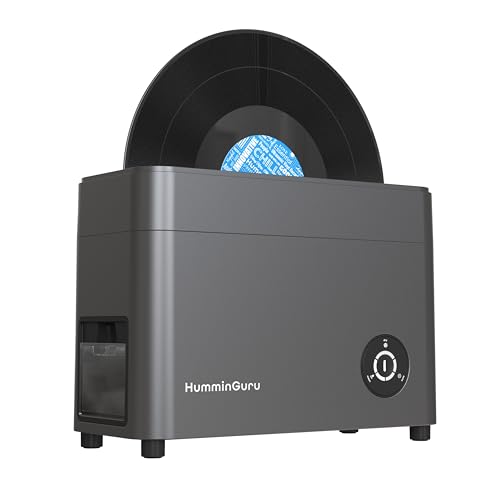
| HumminGuru Ultrasonic | Yes. 40kHz, one record, dried and playable | Premium | |
How to choose
Two of these ten have a motor
The search says machine. Two results plug in. Three are basins you turn by hand, which their own listings describe as operating without power. Four are a brush, a bottle and a pouch. And one is not a cleaning device at all but two bottles of concentrate, which dilute at ten milliliters to seven liters of water. They are mostly all useful things. Most of them are not machines.
The groove is the whole problem
The dirt that makes a record crackle is not the dust on top. It is down in the groove, in a channel narrower than the bristles of anything you can wipe across it, and that single fact organizes this entire page. Wiping cleans the flat land between the grooves. Spinning through fluid with brushes on both sides drives cleaner deeper. Ultrasonic cavitation makes microscopic bubbles collapse inside the groove itself, where nothing physical will fit. Three price tiers, three depths.
Flat or curved, and both listings cannot be right
One kit here sells its brush being flat as the feature: it stays stable and will not tip over and scratch anything. Another says a curved brush lifts debris out, and that a flat one pushes it back in. That is not a matter of taste, it is a claim about what happens to the dirt, and only one of them can be describing your record accurately. The curved brush’s argument is the one with a mechanism attached.
Alcohol is the thing these fluids are defined by not having
Four products here advertise their solution as alcohol-free, and when several rivals independently make a point of excluding the same ingredient, that ingredient is a known risk rather than a marketing detail. It matters most at the older end of a collection: the washers here that handle 78s are among the alcohol-free ones, and 78s are made of shellac rather than vinyl. If you are buying fluid separately, this is the label to read.
Ultrasonic is 40kHz whoever sells it
Both powered machines here run at 40kHz, and the gap between them is enormous. One takes eight records at a time in a six liter tank and gives you a rack to air-dry them on. The other takes one record, uses 350ml of distilled water it says you can reuse, and dries it automatically so you can play it straight away. The frequency is identical. What you are choosing is batch versus finish, and how much distilled water you fancy buying.
Read the temperature dial on the cheap ultrasonic
One ultrasonic machine here offers a wash temperature adjustable from 0 to 80 degrees C, calls itself a commercial sonic cleaner, and comes in a 304 stainless tank with a 30 minute timer. Those are the specifications of a general-purpose parts and jewelry bath with a record rack dropped into it. Heat is what warps vinyl, and 80 degrees C is a great deal of heat to have on a dial with nothing in the listing telling you not to use it.
Count the records, not the bottles
Fluid is the running cost here and two listings do the arithmetic for you. One manual washer says its kit covers up to 500 albums with 50 per wash cycle. Another says its deluxe kit carries enough materials for up to 6300 records. That is more than twelve times the coverage for less than double the price, and it is the sort of number that decides a purchase far more than a brush description does.
iSonic Solution
Two bottles of concentrate, and no machine anywhere. It is here because it is what you put in one: a capful of ten milliliters into two gallons of water, which from an eight ounce bottle is a very great deal of cleaning solution. It leaves no streaks and the listing specifies no sulfuric acid, no phosphorus and no ammonia, which is an unusual set of reassurances and tells you something about what else is out there. It is made to pair with ultrasonic tanks.
Pros:
- Extremely concentrated; 10ml makes over seven liters
- Names three things it does not contain
- Residue-free; leaves no streaks
- Two bottles at the lowest price here
Cons:
- It is fluid, not a machine
- Useless unless you own an ultrasonic tank
- Written for one brand’s cleaners
Best for: refilling an ultrasonic tank you already own.
EVEO 4-in-1 Kit
The cheapest thing here you can actually clean with: a velvet record brush, cleaning fluid, a nylon duster for cleaning the brush itself, and a stylus gel that lifts dust off the needle without you touching it, in a black case. The stylus gel is the genuinely good idea, because the needle is the most delicate part of the whole system and the hardest thing to clean safely. Its brush is flat, which the listing presents as a stability feature, and which a rival listing on this page argues pushes dirt back into the groove.
Pros:
- Stylus gel cleans the needle with no contact
- Nylon duster for cleaning the velvet brush itself
- Four pieces in a case, at the lowest kit price
- Fluid included; nothing else to buy
Cons:
- Flat brush, which a rival here says pushes dirt in
- Surface cleaning only; nothing reaches the groove
- Does not say whether its fluid is alcohol-free
Best for: the stylus, more than the records.
Boundless Audio 5-in-1
The only kit here that explains why its brush is shaped the way it is: curved, so that rotating it lifts debris out of the groove, rather than flat, which the listing says pushes it back in. That is a mechanism rather than an adjective, and it is the difference between marketing and thinking. Five pieces: the velvet brush, 60ml of alcohol-free solution, a carbon fiber stylus brush, a nylon brush for cleaning the velvet, and a snap-close pouch that will not leak fluid into your bag.
Pros:
- Curved brush, with the reason published
- Alcohol-free solution, stated in milliliters
- Carbon fiber stylus brush plus a nylon brush for the velvet
- Snap-close pouch; fluid stays put
Cons:
- Surface and upper groove only; no deep clean
- Only 2oz of fluid in the box
- No machine; this is maintenance, not restoration
Best for: between-play upkeep, done properly.
Big Fudge Spinner
The cheapest way into a proper wet wash: a spinner basin with brushes and rollers, washer fluid, an all-purpose cloth and a microfiber cloth. You stand the record in the bath and turn it, and both sides get brushed at once while your hands stay out of the way. The adjustable roller system takes several record sizes. Its own numbers are the reason to look further: up to 50 records per wash cycle, and enough fluid for 500 albums, where a rival kit here claims more than twelve times that coverage.
Pros:
- A real wet wash at the lowest price here
- Adjustable rollers take several record sizes
- Both sides brushed at once; hands stay dry
- Two cloths and fluid included
Cons:
- Fluid covers 500 albums against 6300 elsewhere
- Its “versatile and scratch-free” bullet is printed twice
- Does not say whether the fluid is alcohol-free
Best for: trying a wet wash without committing.
Spin-Clean Deluxe
Enough materials for 6300 records, which is a whole collection cleaned several times over and more than twelve times what the other manual washer here offers. Both sides go through the brushes at once, it needs no power and makes no noise, the fluid is alcohol-free concentrate at 4oz plus an extra 32oz, and it washes 33s, 45s and 78s, which matters because 78s are shellac and fussy about what touches them. Made in the USA with a limited lifetime warranty, which nothing else on this page comes near.
Pros:
- Materials for up to 6300 records
- Limited lifetime warranty; the only one here
- Handles 78s as well as 33s and 45s
- Alcohol-free concentrate; no power, no noise
Cons:
- Manual; you are the motor
- No ultrasonic action into the groove
- Two typos in its own bullets
Best for: cleaning a whole collection, once and properly.
VEVOR Ultrasonic
Real 40kHz ultrasonic cleaning at a quarter of what the other ultrasonic machine costs, and it does eight records at once against that machine’s one, in a six liter 304 stainless tank driven by three 60W transducers. For a large collection that batch size is transformative. The reasons to think hard: the dial runs to 80 degrees C and heat is what warps vinyl, the listing calls itself a commercial sonic cleaner with a 30 minute timer, which reads like a general parts bath with a record rack in it, and drying is a rack and patience.
Pros:
- Eight records per cycle; genuine batch cleaning
- 40kHz and 180W across three transducers
- 304 stainless tank with a dust lid
- A quarter the price of the other ultrasonic machine
Cons:
- Temperature dial goes to 80 degrees C, unremarked
- Six liter tank; a lot of water per fill
- Air-dry on a rack; no drying function
Best for: batches, with the temperature left alone.
HumminGuru Ultrasonic
The finished version of the idea. Duo 40kHz transducers do the cavitation, then it dries the record automatically, so it comes out ready to play rather than ready to wait. It uses 350ml of distilled water, reusable, which is a fraction of what a big tank swallows and matters because distilled water is a thing you buy. It is 13.5 by 6 by 11 inches, sized to live on a record shelf, quiet, filtered, with the power cord stored inside under the lid and a year’s warranty.
Pros:
- Cleans and dries; playable immediately
- Only 350ml of distilled water, and reusable
- Fits on a record shelf; cord stores inside
- Filters included; one-year warranty
Cons:
- One record at a time
- By far the highest price here
- Same 40kHz as a machine costing a quarter as much
Best for: cleaning the record you are about to play.
The verdict
Two results here plug in, three are basins you turn by hand, four are brushes in a pouch and one is a bottle of concentrate. Underneath the labeling there is a real ladder: wiping cleans the surface, a wet wash drives fluid down the groove, and ultrasonic cavitation reaches inside it where no bristle fits. Pick the depth, then the price.
Best overall: Spin-Clean Deluxe. Materials for up to 6300 records, which is a collection cleaned several times over and more than twelve times what the other manual washer offers for less than double the money. Both sides brush at once, it needs no power, the fluid is alcohol-free concentrate, and it washes 78s as well as modern records. Made in the USA with a limited lifetime warranty, which nothing else on this page approaches.
Best value: Boundless Audio 5-in-1. The only kit here that tells you why its brush is curved: rotating a curve lifts debris out of the groove, where a flat brush can push it back in, and a rival listing on this page sells flat as a feature. Five pieces including alcohol-free fluid, a carbon fiber stylus brush and a nylon brush for cleaning the velvet. This is upkeep between plays rather than restoration, and it is the thoughtful version of it.
Best premium: HumminGuru Ultrasonic. 40kHz cavitation is the only thing on this page that reaches the bottom of the groove, and this is the version that finishes the job: it dries the record too, so it goes from dirty to playable without a rack and an evening. 350ml of distilled water, reused, against a six liter tank. It costs four times the other ultrasonic machine and it does one record at a time, and it is the one you will actually use.
FAQ
Are these actually machines?
Two of the ten are. Three are basins you turn by hand, and their listings say plainly that they need no power. Four are a brush and a bottle. One is two bottles of concentrate with no device at all.
Should the brush be flat or curved?
Two listings here take opposite positions. One says flat keeps the brush stable. The other says a curved brush lifts debris out while a flat one pushes it back into the groove. The curved argument comes with a mechanism; the flat one is about the brush not tipping over.
Why does ultrasonic cost so much more?
Because it does something no brush can: microscopic bubbles collapse inside the groove, which is narrower than any bristle. Both machines here run at the same 40kHz, and the four-fold price gap buys automatic drying and a fraction of the water, not more cleaning power.
Why is every fluid alcohol-free?
Because alcohol is the known risk, which is why four rivals independently make a point of excluding it. It matters most for 78s, which are shellac rather than vinyl, and the washers here that handle 78s are among the alcohol-free ones.
Does the ultrasonic temperature setting matter?
One machine here has a dial running to 80 degrees C and says nothing about it. Heat is what warps records. That specification, with a stainless tank and a 30 minute timer, reads like a general-purpose parts cleaner with a record rack fitted.
This article may contain affiliate links; see our Affiliate Disclosure.