There is a specific kind of despair reserved for the end of a long driveway, three hours after you cleared it, when the plow has been past and left a wall of compacted gray ice across the bottom. A single-stage machine will climb that wall and stall. A two-stage will eat it.


A two-stage blower separates the job into two parts: an auger chews the snow loose and feeds it to a separate impeller that fires it away. That division is why these machines handle depth, ice, and gravel that stop lighter throwers dead. What then separates them is clearing width, how they get traction, and how much the machine does for you at six in the morning in the dark. The picks below suit a long suburban driveway, a rural approach, an uneven gravel yard, or a genuinely brutal snow belt.
At a glance
| Product | Standout features | Price tier | Link |
|---|---|---|---|
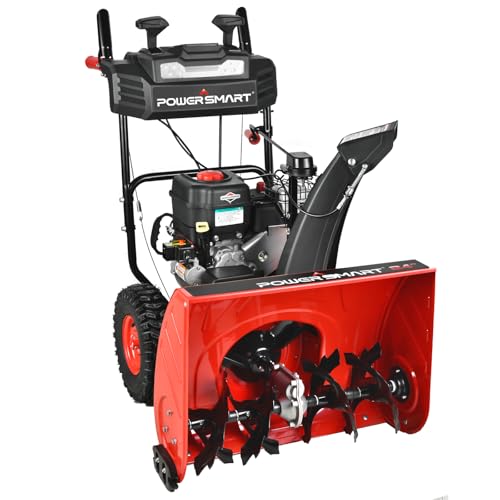
| PowerSmart 26 in Two-Stage | Best seller; 208cc Briggs & Stratton; handle warmer; 2700 lbs/min | Mid-range | |
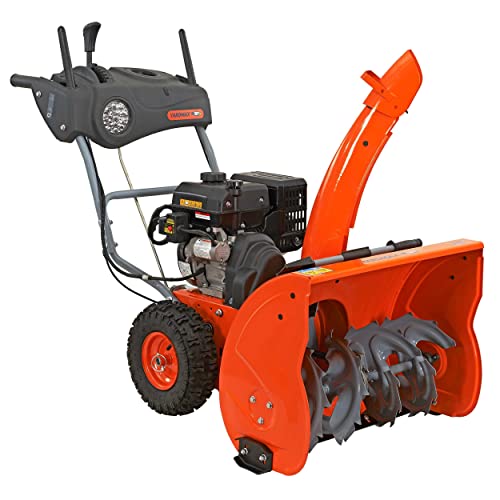
| YARDMAX YB6770 26 in | Serrated augers; aluminum gear case; heated grips; headlight | Mid-range | |
| PowerSmart 24 in Two-Stage | Lowest price; 212cc engine; 6 forward/2 reverse; LED lights | Budget | |
| Honda HSS1332 Track Drive | 31.9 in width; rubber tracks; hydrostatic drive; 56 ft throw | Premium | |
How to choose a gas two-stage snow blower
Why two stages, and when one is enough
A single-stage machine uses one rubber auger that both collects snow and throws it, which means the auger must touch the ground. That works on a flat paved drive under a moderate fall, and it is lighter and cheaper. A two-stage machine keeps its steel auger off the surface, adjustable on skid shoes, and hands the snow to a high-speed impeller that does the throwing. The consequences are the ones that matter in a hard winter: it clears gravel without firing stones, it handles depth measured in feet rather than inches, and it does not stall in the wet gray mass at the end of the drive. If your snow is occasional and light, a single-stage is genuinely the smarter buy. If you are reading this in a snow belt, it is not.
Clearing width against the length of your driveway
Width sets how many passes you walk, and the arithmetic is unforgiving on a long drive. These run 24 inches on the smaller PowerSmart, 26 on the larger PowerSmart and the YARDMAX, and 31.9 on the Honda. Going from 24 to 32 inches removes about a quarter of the passes on the same driveway, which on a hundred-foot approach is a meaningful number of trips in the cold. The counterweight is maneuverability and storage: a 32 inch machine is heavy, wide in a garage, and awkward around a car. Intake height matters just as much and gets ignored. The PowerSmart 26 takes 20 inches, the Honda 21.7. That is the depth of drift the machine can swallow without you having to skim it in layers.
Engine, throughput, and throwing distance
Engine displacement is the headline, but throughput is the real number. The PowerSmart 26 runs a 208cc Briggs and Stratton 950 snow series engine and moves 2700 pounds per minute, rated for 1 to 12 inches of snow. The Honda’s commercial-grade GX390 pushes 2750 pounds per minute. Both PowerSmart and YARDMAX also offer 212cc engines. Throwing distance decides whether you clear the drive once or clear it twice: 45 feet from the PowerSmart’s steel impeller, up to 56 feet from the Honda. On a wide driveway a short throw drops snow back onto ground you just did, and you end up chasing your own pile down the drive.
Wheels or tracks, and the ground you actually have
This is the fork that separates the Honda from everything else here. Wheeled machines with aggressive snow tires, the 13 inch tires on both PowerSmarts, are lighter, cheaper, turn easily, and are fine on a flat paved drive. Tracks, on the Honda, are pliable low-temperature rubber with gripping cleats, and they change what is possible: inclines, rough or uneven ground, and hard-packed ice where wheels simply spin. If your driveway has a slope or the surface is uneven, tracks are not a luxury feature, they are the reason the machine moves at all. The Honda pairs them with a hydrostatic transmission, so you push a lever forward or back and it goes that way at that speed, with no gear shifting.
The features that matter at six in the morning
These are not luxuries in January. Electric start ends the ritual of yanking a cold recoil, and every pick has it; the YARDMAX and the Honda keep a recoil as backup, which is the right design when a battery is cold. Handle warmers or heated grips, on the PowerSmart 26 and the YARDMAX, are the single most appreciated feature on any snow blower, because bare-metal handlebars pull the heat out of gloves. Lights matter because snow gets cleared before dawn and after dusk: LEDs on the 24 inch PowerSmart, a dashboard headlight on the YARDMAX. Chute control is the other one: the PowerSmart 26 turns its chute through 180 degrees one-handed, freeing your other hand for the drive lever.
The parts that wear, and the parts that break
Two details separate a machine that lasts a decade from one that does not. The gear case is the first: YARDMAX specifies a heavy-duty aluminum case with alloy steel gears running in synthetic gear oil, which is a real answer to the hardest-working component. The auger is the second. Serrated steel augers, on the YARDMAX, slice packed ice rather than push it, and the PowerSmart uses all-steel augers and a steel impeller. Skid shoes are the consumable, adjustable on both PowerSmarts to set auger height and protect the surface, and the Honda goes further with a thumb-operated auger height control lever you can change on the move.
PowerSmart 26 in Two-Stage Snow Blower
The best seller of this group, and the specification reads like someone worked out what a long driveway needs and stopped there. A 208cc Briggs and Stratton 950 snow series engine moves 2700 pounds of snow a minute, rated for 1 to 12 inches. The clearing width is 26 inches with a 20 inch intake height, so drifts go in whole rather than in layers. Everything in the snow’s path is steel: housing, frame, deflector, chute, auger, and the high-speed impeller that throws 45 feet. It is self-propelled with variable speed forward and reverse, rides on 13 inch snow terrain tires, and adds the things you notice in the cold: electric start, a handle warmer, one-handed operation, a one-hand 180 degree chute control, and adjustable steel skid shoes to keep the auger off your surface.
Pros:
- Best-selling two-stage blower in this comparison
- 208cc Briggs and Stratton engine; 2700 lbs/min throughput
- 26 in clearing width with a tall 20 in intake
- All-steel auger, impeller, housing, chute and deflector
- Handle warmer, electric start, one-handed operation
- One-hand 180 degree chute control; adjustable skid shoes
- Throws snow up to 45 feet
Cons:
- Rated to 12 inches of snow; deeper drifts need patience
- Wheeled, so slopes and ice can beat it
- Variable speed rather than defined gears
Best for: a long paved driveway in a serious winter, where a handle warmer and a tall intake earn their money every week.
YARDMAX YB6770 26 in Snow Blower
The YARDMAX is the one built by people who thought about ice specifically. Its augers are serrated steel, designed to slice hard-packed snow rather than shove it, and the housing sides are axe-shaped to chop through what a flat housing would ride over. Underneath, the heavy-duty aluminum gear case runs alloy steel gears in synthetic oil, which is the component that decides whether a blower sees ten winters. A 212cc engine drives six forward and two reverse speeds for fine control, and the high-speed impeller with an elongated chute is engineered to throw further with minimal blowback. Push-button electric start has recoil backup. The dashboard is the giveaway that this was designed by a user: headlight, speed control in reach, heated hand grips, and a cup holder.
Pros:
- Serrated steel augers cut packed ice
- Axe-shaped housing chops through heavy drifts
- Heavy-duty aluminum gear case, alloy steel gears, synthetic oil
- Six forward and two reverse speeds
- Electric start with recoil backup
- Heated hand grips and a dashboard headlight
- Elongated chute designed to minimize blowback
Cons:
- No throwing distance or throughput figure published
- Wheeled drive, so steep or icy ground still limits it
- 26 in width means more passes than the Honda
Best for: hard-packed, icy snow and plow ridges, and anyone who values the drivetrain lasting over headline numbers.
PowerSmart 24 in Two-Stage Snow Blower
The cheapest genuine two-stage machine here, and it gives up width rather than capability. The 24 inch clearing system is driven by a 212cc engine, actually a slightly larger displacement than the best seller’s, and the six forward and two reverse speeds let you crawl through wet snow or stride through a dusting. It rolls on the same 13 inch snow tires for traction on slippery ground, and the skid shoes adjust for paved or gravel surfaces, which is the setting that stops a two-stage machine firing your driveway at your car. Built-in LED lights cover the early-morning and after-dark reality of the job. The trade is passes: two extra inches per pass sounds trivial until the driveway is long.
Pros:
- Lowest price of these two-stage machines
- 212cc engine, larger than the 208cc picks
- Six forward and two reverse speeds
- 13 in snow tires for traction
- Skid shoes adjust for paved or gravel surfaces
- Built-in LED lights
Cons:
- Narrowest clearing width here at 24 inches
- No handle warmer
- No published throughput or throwing distance
Best for: a shorter drive or a tighter budget, where two-stage capability matters more than clearing the width fast.
Honda HSS1332 Track Drive Snow Blower
A different class of machine, at several times the price. The HSS1332 runs a commercial-grade GX390 OHV engine, clears 31.9 inches wide by 21.7 inches high, moves up to 2750 pounds a minute, and throws as far as 56 feet, which on a wide drive means the snow lands somewhere it will not have to be moved again. The defining feature is the dual rubber track drive: pliable low-temperature tracks with gripping cleats that hold on inclines, rough ground, and ice where wheels spin uselessly. The hydrostatic transmission means no shifting, just a lever forward or back at the speed you want, and a thumb lever adjusts auger housing height as the surface changes. It arrives needing no assembly and carries a three-year residential warranty.
Pros:
- Widest clearing at 31.9 in with a 21.7 in intake height
- Rubber tracks grip inclines, ice and rough ground
- Commercial-grade Honda GX390 engine
- 2750 lbs/min and up to 56 ft throwing distance
- Hydrostatic drive: no shifting, infinite speed control
- Thumb-operated auger height control
- Three-year residential warranty; no assembly required
Cons:
- Costs several times any other pick here
- Heavy and wide; demands real garage space
- Tracks are slower to turn than wheels on flat pavement
Best for: sloped, uneven, or gravel driveways, long rural approaches, and snow belts where the machine runs weekly for years.
The verdict
Best Overall: PowerSmart 26 in Two-Stage Snow Blower. The best seller here, and the balance is right. A Briggs and Stratton engine moving 2700 pounds a minute, 26 inches wide with a tall 20 inch intake, steel through the whole snow path, a 45 foot throw, and the two things you appreciate at dawn: electric start and a handle warmer. It costs a fraction of the Honda and clears a long driveway without drama.
Best Value: PowerSmart 24 in Two-Stage Snow Blower. The cheapest way to get genuine two-stage capability, with a 212cc engine, eight speeds, proper snow tires, adjustable skid shoes, and LED lights. You walk two more passes per driveway and save real money doing it.
Best Premium: Honda HSS1332 Track Drive. If the ground slopes or the winter is genuinely severe, the tracks and the hydrostatic drive are not indulgences, they are the difference between clearing the drive and standing on it while the wheels spin. Nearly 32 inches wide, a 56 foot throw, and a three-year warranty.
One more worth naming: the YARDMAX YB6770 is the pick for ice specifically, with serrated augers, an axe-shaped housing, and the only properly specified gear case in the group. Heated grips and a headlight are the sort of detail you notice all winter.
Frequently asked questions
Is a two-stage blower really worth it over a single-stage?
If your snow is heavy, deep, or wet, yes, and it is not close. A single-stage auger touches the ground and does the throwing itself, so it bogs down in depth and cannot be used on gravel without launching stones. A two-stage keeps a steel auger above the surface on adjustable skid shoes and lets a separate impeller do the throwing, which is why it clears plow ridges and gravel. For a short flat drive and a few inches of light snow, a single-stage is lighter, cheaper, and enough.
How wide a machine do I need?
Match it to driveway length, not to ego. On a short drive, 24 inches is fine and easier to store and turn. On a long approach, every extra inch removes passes: going from 24 to nearly 32 inches cuts roughly a quarter of your trips up and down. Also check intake height, which is the depth it swallows in one go, between 20 and 21.7 inches on these picks.
Do I need tracks instead of wheels?
Only if your ground demands it, and then absolutely. Wheels with 13 inch snow tires are fine on flat pavement and are lighter and cheaper. Rubber tracks with cleats, as on the Honda, grip on inclines, uneven or rough ground, and hard ice where wheels just spin. If your driveway slopes, tracks are the feature to buy.
Why does throwing distance matter?
Because snow you cannot throw clear is snow you will move twice. On a wide driveway, a short throw drops the snow back onto ground you just cleared, or onto the next pass. These machines throw 45 feet and up to 56 feet respectively, which is the difference between building a bank at the edge of your property and pushing a pile down the drive ahead of you.
Is electric start worth having on a gas machine?
Yes, and every pick here includes it. A cold recoil start on a stiff engine, in gloves, in the dark, is the reason snow blowers sit unused. The better designs, like the YARDMAX and the Honda, keep a recoil as a backup, which matters because cold weather is exactly when batteries and starters are least willing.
This article may contain affiliate links; see our Affiliate Disclosure.