One listing in this search promises a lifetime warranty. The same listing, four bullets later, offers a 180-day warranty in its heading and a 90-day warranty in the sentence underneath it. Lifetime, 180 days and 90 days, one product, one page. It also spends a bullet describing a training guide for resistance bands, which are not gloves. That is the standard of evidence in a category where the best-selling product never mentions padding at all.


At a glance
| Glove | Padding, palm and wrist | Price tier | Link |
|---|---|---|---|
| ATERCEL Aqua | Padding quoted as 4x common sponge. Cheapest here | Budget | |
| HOZMOZ | 6mm published. Silicone palm. V-cut at the tear point | Budget | |
| MhIL | Wrist wraps. Lifetime, 180-day and 90-day warranty | Budget | |
| ATERCEL Black | The best seller. The only sizing chart. No padding stated | Budget | |
| ihuan | Built-in wrist wraps. Silicon-printed neoprene palm | Mid-range | |
| FREETOO | Full-finger. No wrist support, deliberately. Touchscreen | Premium | |
| Harbinger 3.0 | The only genuine leather palm. Moderately padded | Premium | |
How to choose
One glove publishes a padding thickness
Padding is why you buy these, and exactly one listing here puts a millimeter figure on it: a single-piece 6mm pad running from palm to fingertips. Everyone else offers adjectives. One says its sponge is four times denser than common sponge, which is a ratio against a baseline nobody defines. The best-selling glove in this entire search does not mention padding at all across five bullets, talking instead about grip, breathability and ergonomics. That may be fine for cycling. It is a strange silence on a weight lifting glove.
Two brands give opposite advice about wrist wraps
This is the genuine disagreement on the page and both sides are reasonable. ihuan builds wrist wraps in and recommends them specifically for snatches, cleans and front squats. FREETOO leaves wrist support out on purpose and says so, explaining that it suits people who need high wrist flexibility. Those two lifts are the same lifts. Front squats and cleans need your wrist to bend right back, and a wrap that stops that is a wrap fighting the movement. Decide whether you want support or range, because you cannot have both.
Fit is the whole product, and one brand shows its chart
A loose lifting glove bunches under the bar and gives you the blister it was bought to avoid. So the sizing chart is the specification, and only ATERCEL prints one: five sizes with hand measurements from 6.3 inches up to 9.6. One rival tells you to measure yourself against its sizing chart and then does not provide it. Get a tape measure around your palm before you order anything on this page, because none of the padding numbers matter if the glove moves.
Gloves tear in one place and one listing names it
The web between thumb and index finger is where the bar sits and where gloves die. HOZMOZ is the only brand here that says so, describing a V-shaped cut at that junction specifically to address the tearing issue. That is a company naming its category’s known failure and engineering for it, which is worth more than any grip claim. Everyone else promises durability and double stitching without ever mentioning where the stitching gives up first.
Leather or microfiber changes how they age
Almost everything here is microfiber, synthetic leather or silicon-printed neoprene, and one glove uses genuine leather on the palm with leather reinforcement at the high-contact points. That is the old answer and it is still a real one: leather molds to your hand over months and gets better, where synthetics stay exactly as they arrived until they wear through. Leather costs more and needs drying out. Notice also that the leather glove calls itself moderately padded, which on this page is practically a confession.
Full-finger or fingerless is a feel decision
Nearly all of these are fingerless, and one is not. Full fingers cover the pads where calluses form and let you use a phone between sets, which the listing points out. Fingerless leaves your fingertips on the bar, which is how most lifters want to feel a heavy pull, and lets sweat out. Neither is better. If you have ever put a glove on and immediately felt disconnected from the bar, buy fingerless. If your fingers are the part that hurts, buy the other one.
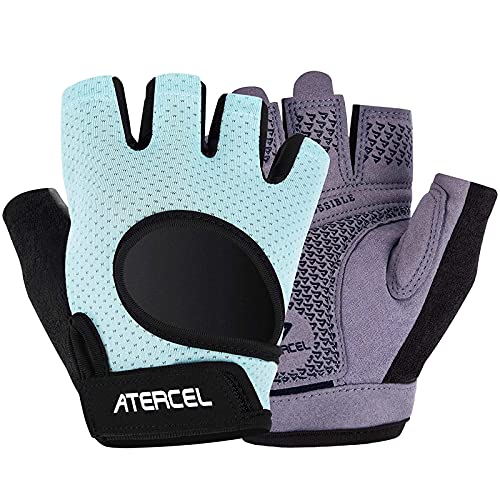
ATERCEL Aqua
The cheapest gloves in this search and, unlike their better-selling black stablemate, they at least talk about padding: a high density sponge ATERCEL says is four times denser than common sponge, in a full palm design. The trouble is the comparison, because common sponge is not a thing anyone measures. What is real here is the full palm coverage, the breathable back, the towelling panel for wiping sweat, and the fact they are aimed at beginners and daily training alike. One bullet is printed twice, word for word.
Pros:
- The cheapest gloves in this search
- Full palm design, unlike the better-selling sibling
- Breathable back and a towelling panel for sweat
- Anti-slip palm; light enough for cycling too
Cons:
- Four times common sponge is a ratio against nothing
- No thickness figure published
- One bullet is duplicated word for word
Best for: a first pair, for almost nothing.
HOZMOZ
The only glove on this page that tells you how thick its padding is: a single 6mm pad running from palm to fingertips, so there is no seam across the part that meets the bar. It is also the only one that names where gloves fail, cutting a V at the thumb and index junction specifically to stop the tearing. Add full-palm anti-slip silicone over tough microfiber, an open back in breathable mesh, quick-release fingertips for getting them off, and a cotton towel panel.
Pros:
- The only published padding thickness here, at 6mm
- One-piece pad; no seam where the bar sits
- V-cut at the thumb junction, aimed at the known tear point
- Full-palm silicone over microfiber; quick-release fingertips
Cons:
- No wrist support at all
- No sizing chart published
- 6mm is thick; you will feel less of the bar
Best for: the most padding, from the listing that measured it.
MhIL
Wrist wraps, silicone grip, pull loops on the fingers, a thumb towel and a mesh back, at a budget price, and the features list is genuinely well thought out. The warranties are another matter. One bullet promises a lifetime warranty. Another is headed with a 180-day warranty and then offers a 90-day one in its own body. A third bullet describes a training guide for resistance bands. When a listing cannot agree with itself about how long it stands behind the product, that is the specification you are actually reading.
Pros:
- Wrist wraps at a budget price
- Pull loops on the fingers and a thumb towel
- Hand washable; double stitched
- Ergonomic palm shaping for grip
Cons:
- Claims lifetime, 180-day and 90-day warranties on one page
- One bullet is about resistance bands, not gloves
- Says to use a sizing chart it does not provide
Best for: wrist wraps cheaply, if you ignore the warranty entirely.
ATERCEL Black
The best-selling glove in this search by an enormous margin, ranked inside the top hundred where nothing else here comes close, and it costs very little. It earns that with the thing nobody else offers: a real sizing chart, five sizes with hand measurements from 6.3 to 9.6 inches, which is the specification gloves actually live or die on. Pull loops for removal, a towelling panel for sweat, soft mesh inside. It is lightweight, breathable and stretchy, and across five bullets it never once mentions padding.
Pros:
- The best seller here, by a very wide margin
- The only published sizing chart, across five sizes
- Pull loop system and a towelling sweat panel
- Very cheap; light enough for cycling
Cons:
- Never mentions padding, on a weight lifting glove
- No wrist support
- Sold under several near-identical listings
Best for: getting the fit right, which is most of the battle.
ihuan
Built-in wrist wraps that tighten with Velcro to whatever tension you want, on a silicon-printed neoprene palm that ihuan says resists water, oils, heat and ageing. The back is ultralight microfiber for breathing. Its case for the wraps is specific: snatches, cleans and jerks, front squats and other lifts requiring wrist protection. Read that beside the full-finger glove on this page, which leaves wrist support out precisely so your wrists can move on those lifts, and then decide which of them describes your training.
Pros:
- Built-in wrist wraps, adjustable to your own tension
- Neoprene palm; resists water, oil and ageing
- Foam pad to buffer the bar; ultralight microfiber back
- Names the specific lifts it is for
Cons:
- Its wrist advice directly contradicts a rival on the same lifts
- No padding thickness published
- No sizing chart
Best for: wrist support, if support is what you have decided you want.
FREETOO
The only full-finger glove here, so it covers the finger pads where calluses actually form, and it works on a touchscreen so you are not peeling gloves off to change a song. The palm is microfiber synthetic leather with a foam pad and silicone particles. The bullet worth reading is the last one, where FREETOO states that these gloves have no wrist support, on purpose, for people who need wrist flexibility and want to wear a watch. Stating an absence as a design decision is rare.
Pros:
- The only full-finger glove here; covers the finger pads
- Touchscreen friendly; no peeling them off between sets
- States the lack of wrist support as a deliberate choice
- Publishes its fabric blend precisely
Cons:
- Full fingers mean less feel on the bar
- No padding thickness published
- Among the most expensive gloves here
Best for: wrist flexibility and finger coverage, chosen deliberately.
Harbinger 3.0
The only genuine leather palm on this page, with leather reinforcement at the high-contact points and double stitching, which is the construction that lets a glove mold to your hand over months instead of simply wearing out. PU texturing on the upper palm for grip, four-way stretch lycra on the back so it moves with your skin, an adjustable wrist closure and finger pull tabs. And it describes itself as moderately padded, which on a page of maximum and thickest and most effective is refreshing.
Pros:
- The only genuine leather palm here; it improves with use
- Leather reinforcement at the high-contact points
- Four-way stretch lycra back; it moves with your hand
- Says moderately padded rather than overclaiming
Cons:
- The most expensive gloves on this page
- Leather needs drying out; synthetics do not
- No padding thickness or sizing chart published
Best for: gloves that get better rather than merely older.
The verdict
One glove publishes a padding thickness, one publishes a sizing chart, and the best seller does neither while never mentioning padding at all. Two brands give opposite advice on wrist wraps for the same lifts. Measure your hand first, because a glove that moves under the bar causes the blister it was sold to avoid.
Best overall: HOZMOZ. The only glove here that measured its own padding, at 6mm in a single piece from palm to fingertips with no seam where the bar lands, and the only one that names where gloves actually tear and cuts a V at the thumb junction to stop it. Full-palm silicone over microfiber, mesh back, quick-release fingertips. It is a company describing engineering rather than adjectives.
Best value: ATERCEL Black. The runaway best seller in this search, ranked far ahead of anything else on the page, for pocket money, and it is the only listing that gives you the number that decides everything: a five-size chart running from 6.3 to 9.6 inches of hand. Get a tape measure out before ordering. Be clear-eyed that across five bullets it never mentions padding, which for heavy work is a real gap.
Best premium: Harbinger 3.0. Genuine leather on the palm with leather reinforcement where the wear happens and double stitching holding it together, which is the construction that molds to your hand over months rather than staying exactly as it arrived until it splits. Four-way stretch lycra on the back. And it calls itself moderately padded, which on this page counts as candour.
FAQ
How much padding do I need?
Only one glove here will tell you what it has: 6mm from palm to fingertips. One quotes four times common sponge, which measures nothing. The best seller never mentions padding. More padding means less feel on the bar, so thicker is not automatically better.
Do I want wrist wraps?
Two brands here disagree about the same lifts. One builds wraps in and recommends them for cleans and front squats. The other leaves them out deliberately for people needing wrist flexibility, which is exactly what those lifts demand. Decide between support and range.
What size should I buy?
Measure your hand. ATERCEL is the only brand publishing a chart, running five sizes from 6.3 to 9.6 inches. One rival tells you to consult its sizing chart and then never gives one. A loose glove bunches and blisters you.
Full-finger or fingerless?
Fingerless keeps your fingertips on the bar, which most lifters want, and lets sweat out. The one full-finger glove here covers the pads where calluses form and works on a touchscreen. If your fingers are what hurt, that is the one.
Is leather worth the extra?
If you lift often. Leather molds to your hand over months and gets better; microfiber and neoprene stay as they arrived until they wear through. The leather glove here reinforces the high-contact points too. It also needs drying out, which synthetics do not.
This article may contain affiliate links; see our Affiliate Disclosure.