Half a ton of wet topsoil, a mountain of gravel, or a pile of split firewood that has to cross the whole yard before dark. That is the moment a cheap wheelbarrow either earns its keep or buckles at the axle. The carts below are built for the loads that make a standard garden barrow groan.




Heavy hauling rewards a different set of traits than light weeding: a stronger frame, tires that will not fold under weight, and a way to dump without lifting. The picks here suit anyone shifting real tonnage, whether you are a homeowner regrading a bed, a small-farm hand moving feed, a weekend landscaper clearing debris, or a builder ferrying block and bags of mix. What they share is a construction that takes a full load as normal, not as an emergency. Below is a quick comparison, then a guide to the features that decide which cart survives the season rather than the first hard weekend.
| Model | Standout features | Price | Link |
|---|---|---|---|
| Gorilla Carts 4 Cu Ft Dump Cart | 600 lb capacity, quick-release dump bed, pneumatic tires | Mid-range | |
| BILT HARD 4 Cu Ft No-Flat | 600 lb capacity, 10" no-flat tires, 180° rotating handle | Mid-range | |
| CAMMOO 4 Cu Ft No-Flat | 600 lb capacity, virgin-PP bed, 270° rotating handle | Budget | |
| VIVOHOME 4 Cu Ft Dump Wagon | 660 lb capacity, ATV/tractor tow handle, pneumatic tires | Mid-range | |
| True Temper 6 Cu Ft Steel | 6 cu ft steel tray, pneumatic tire, classic single-wheel balance | Premium | |
How to choose a wheelbarrow for heavy loads
The word “wheelbarrow” now covers two very different tools, and heavy hauling pushes you toward one of them. A classic single-wheel barrow tips and pours in one motion and threads narrow gate gaps, but all the weight rides on your arms and wrists. A dual-wheel dump cart carries the load on its own axle, so your job is mostly steering. For repeated heavy trips, the cart usually wins on comfort. Keep the traditional barrow if you mix concrete, work tight beds, or need to pour precisely.
Rated capacity versus real capacity
Capacity numbers describe what the frame can bear, not what the tray can hold. A 4 cubic foot tub rated to 600 pounds will hit that weight limit long before it fills with gravel or wet soil, since dense material is heavy for its volume. Match the rating to your worst load, not your average one. The dump carts here carry 600 to 660 pounds, comfortably above a full tub of mulch or firewood, which gives you margin on the days that matter.
Tires: pneumatic versus no-flat
Air-filled pneumatic tires cushion the ride and roll easily over ruts, but they puncture and slowly deflate, and a flat under a full load is a miserable surprise. No-flat solid tires never go down and never need a pump, at the cost of a slightly firmer ride. If your cart lives outside and hauls thorny debris or scrap, no-flat tires remove a recurring headache. If you value the softest roll over rough ground, pneumatic tires still lead.
Dumping mechanism
A quick-release dump bed is the single feature that spares your back. Instead of hoisting the whole load, you trip a latch and the tray tilts, pouring everything where you want it. On heavy days this turns a strenuous lift into a nudge. Every dump cart below offers it; the classic barrow relies on your own tip, which is fine for lighter tips but tiring at full weight.
Frame, bed material, and steering
Poly beds shrug off rust and never dent, which suits soil, fertilizer, and anything corrosive. Steel trays take sharp, heavy debris and rough product better but can rust where the coating chips. Look for a reinforced steel frame under the tub, since that is what actually carries the tonnage. A handle that rotates lets you make tight turns and reposition without wrestling the whole cart, a real help in a crowded yard. Diagonal bracing on the rear supports, where a cart offers it, forms a triangle that resists the flex and sag that eventually loosens a lesser frame.
Balance, comfort, and storage
Two wheels spread the load and keep a cart level when you pause, so nothing tips while you shovel; one wheel demands more balance but turns on a dime. A padded grip and a handle set at a natural height save your hands and lower back across a day of trips. Think about storage too, since a heavy cart is bulky. Trays that tip upright, or handles that fold or convert, reclaim garage and shed space between jobs. None of this shows up in a spec sheet, but all of it decides whether the cart stays in service or gets parked in a corner.
Gorilla Carts 4 Cu Ft Poly Garden Dump Cart
The most-purchased cart in this group backs its popularity with a sensible design. The 4 cubic foot poly tub rides on a reinforced steel frame rated to 600 pounds, and the patented quick-release lets you dump a full load with one pull. Pneumatic tires soak up bumps across grass and gravel, and the 36-by-20-inch bed swallows bagged soil, firewood, and yard debris without fuss. The steel frame is designed to shorten assembly and improve maneuverability, so it comes together faster than many flat-packed carts and turns predictably once loaded. It is the safe default: proven, balanced, and forgiving of hard use, which is exactly what you want when the cart is the only thing standing between you and a dozen more trips.
Pros
- 600 lb capacity on a rust-proof poly bed
- One-pull quick-release dumping
- Cushioned pneumatic tires for rough ground
- Widely used, so assembly help and reviews are easy to find
Cons
- Pneumatic tires can eventually go flat
- Pull-behind design needs room to turn
Best for: anyone who wants one dependable cart for soil, mulch, and general heavy yard work.
BILT HARD 4 Cu Ft No-Flat Dump Cart
This cart matches the class leader on capacity and bed size but trades pneumatic tires for 10-inch no-flat solids, so it never needs a pump and never strands you with a flat mid-job. The 180-degree rotating handle makes tight turns and dumping easier, and the heavy steel frame under the rust-proof poly bed keeps 600 pounds moving smoothly. For a yard full of thorns, screws, and scrap that would puncture a normal tire, this is the pragmatic choice, and it typically costs a little less than the best seller. The manufacturer backs it with a one-year warranty and direct support, a reassuring extra on a tool that lives a hard outdoor life. If you have ever knelt in the mud patching a tube on a loaded barrow, the appeal of never doing that again is obvious.
Pros
- No-flat tires eliminate punctures and pumping
- 600 lb capacity, 36.5-by-20-inch bed
- 180° rotating handle for tight steering
- One-year manufacturer warranty
Cons
- Solid tires ride slightly firmer than air-filled
- Assembly takes some patience
Best for: buyers who never want to deal with a flat, especially on debris-heavy sites.
CAMMOO 4 Cu Ft No-Flat Garden Dump Cart
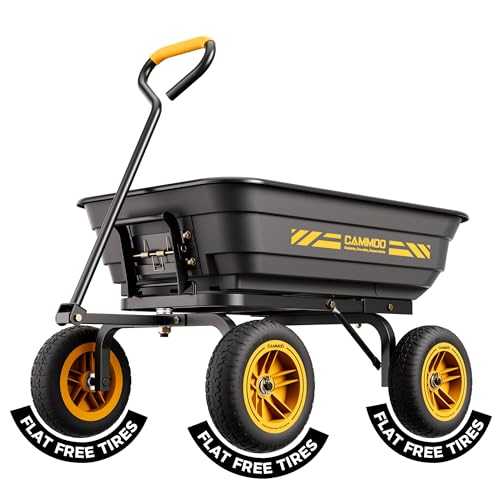
The budget pick here does not skimp where it counts. It carries the same 600-pound rating, rides on 10-inch no-flat tires with dual steel bearings, and uses a 100 percent virgin polypropylene bed rather than recycled plastic, which resists cracking under heavy loads. The handle rotates 270 degrees side to side and 180 degrees up and down, and an EVA-padded grip eases long sessions. One plain note: the bed has structural ridges for strength, so loose items will not sit perfectly flat. For most soil, mulch, and firewood duty that is a non-issue, and the value is hard to beat.
Pros
- Lowest price of the group
- 600 lb capacity, no-flat tires with steel bearings
- Highly maneuverable 270° padded handle
- Virgin-PP bed resists cracking
Cons
- Ridged bed floor is not perfectly flat
- Slightly smaller interior than some rivals
Best for: value hunters who still want a genuine 600 lb, no-flat cart.
VIVOHOME 4 Cu Ft Convertible Dump Wagon
When the loads get big enough that walking every trip stops making sense, this wagon adapts. Its 2-in-1 handle rotates to switch between pulling by hand and towing behind an ATV, lawn tractor, or riding mower for long hauls across acreage. It also posts the highest rating in the group at 660 pounds, with a reinforced poly tray, thickened base and sidewalls, and 10-inch pneumatic tires with deep tread for stable travel on slopes and uneven ground. A built-in damping mechanism keeps the handle from swinging suddenly when you turn, and a 240-degree U-turn radius lets it pivot tightly despite the size. The kit even bundles the wrenches and screwdriver you need, with parts labeled by step, so assembly is less of a puzzle than the parts count suggests. On a big property, being able to hitch it behind a mower and haul several loads in one pass changes the math on how long a chore takes.
Pros
- Highest capacity here at 660 lb
- Converts between hand-pull and tow-behind
- 90° quick-dump for effortless unloading
- Deep-tread pneumatic tires for slopes
Cons
- Pneumatic tires need occasional pressure checks
- Larger footprint to store
Best for: larger properties where towing behind a mower or ATV saves real time.
True Temper 6 Cu Ft Steel Wheelbarrow
Some jobs still want a real single-wheel barrow, and this is the classic done in steel. The 6 cubic foot alloy-steel tray is the largest tub here and stands up to sharp, heavy material that would scuff a poly bed, while sturdy steel handles give a confident grip for lifting and pouring. A single pneumatic tire keeps it nimble in tight beds and lets you pour precisely, which matters when you are mixing concrete or feeding a narrow trench. It asks more of your arms than a dump cart, but nothing beats it for control and raw tray volume. Because a single wheel sits directly under the front of the load, a well-balanced barrow feels lighter in the hands than the raw weight suggests, and it fits through gates and along paths that would stop a wide two-wheel cart. Work on the steel with a wipe-down after wet, muddy work and it will outlast several plastic tubs.
Pros
- Largest tray at 6 cu ft
- Tough steel tub for sharp, heavy debris
- Precise single-wheel pour and tight turning
- Simple, long-lived construction
Cons
- Load rides on your arms, not an axle
- Steel can rust where the coating chips
Best for: concrete work, tight beds, and anyone who prefers a traditional barrow.
The verdict
Best Overall: the Gorilla Carts 4 Cu Ft Dump Cart. It is the most-bought option for good reason, pairing a genuine 600-pound rating with easy quick-release dumping and a forgiving ride, so it handles the widest range of heavy jobs without drama.
Best Value: the CAMMOO 4 Cu Ft No-Flat cart. It delivers the same 600-pound capacity and puncture-proof tires as pricier rivals at the lowest price in the group, and the virgin-PP bed holds up under real loads.
Best Premium: the True Temper 6 Cu Ft Steel wheelbarrow. If you want the largest tray, the toughest tub, and the pouring control only a single-wheel barrow gives, it is worth the step up.
FAQ
How much weight can these carts actually carry? The dump carts here are rated from 600 to 660 pounds, and the steel barrow holds 6 cubic feet of material. Dense loads like wet soil or gravel reach the weight limit before the tub is full, so take the rating as your ceiling.
Are no-flat tires better than pneumatic ones? They are better for hassle: no punctures, no pump, no flats under load. Pneumatic tires give a softer ride over rough ground, so the choice comes down to whether you prize convenience or cushioning.
Is a dump cart easier on your back than a wheelbarrow? Generally yes. A cart carries the load on its own wheels and dumps with a latch, while a single-wheel barrow puts the weight on your arms and requires you to tip it manually.
Do these need much assembly? Most arrive flat-packed and take some time to bolt together, particularly the frame and wheels. Following the labeled steps and tightening every bolt fully avoids wobble later.
Can I leave one outside? Poly-bed carts resist rust and tolerate the weather well. A steel-tray barrow lasts longest under cover, since exposed steel can rust where the coating is scratched.
One wheel, two wheels, or four? A single-wheel barrow gives the tightest turning and the most precise pour, which suits concrete and narrow beds. Two large wheels add stability and let a dump cart carry the weight for you, the better pick for repeated heavy trips. Four-wheel wagons stay dead level and tow well, but they need the most room to turn.
This article may contain affiliate links; see our Affiliate Disclosure.