Hold a candle near an old sash window on a cold night and watch the flame lean. That draft is money leaving the building, and the fix costs less than a takeaway: a sheet of clear plastic, a roll of double-sided tape, and twenty minutes with a hair dryer. Done properly it disappears – you look straight through it and forget it is there until the room stops feeling cold near the glass.



All of these kits do the same job by the same method: tape a clear film around the window frame, shrink it drum-tight with heat, and trap a layer of still air against the glass. What separates them is film thickness, how much area you get, and whether the kit is cut for standard windows or for a patio door. Renters get the most out of this, but anyone with single glazing, a drafty frame, or a cold room over a garage is in the same boat.
At a glance
| Product | Standout feature | Price tier | Link |
|---|---|---|---|
| Duck MAX Strength Window Insulation Kit | Film twice standard thickness; puncture resistant | Premium | |
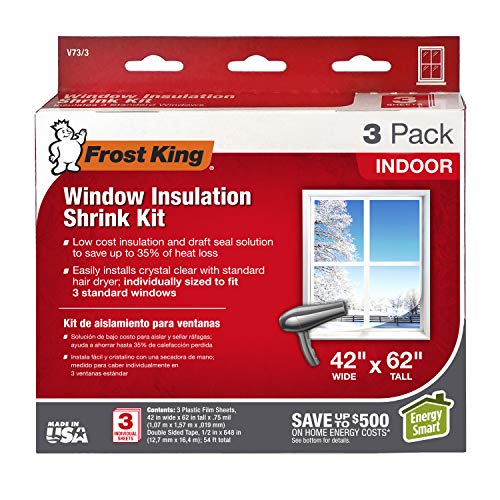
| Frost King V73/3H Shrink Window Kit | Three pre-cut 42 by 62 inch sheets at the lowest price here | Budget | |
| Frost King V76H Shrink Window Kit | One 84 by 110 inch sheet for patio doors and tall windows | Budget | |
| Duck Brand Window Insulation Kit | Covers up to ten windows from two rolls; cuts to size | Mid-range | |
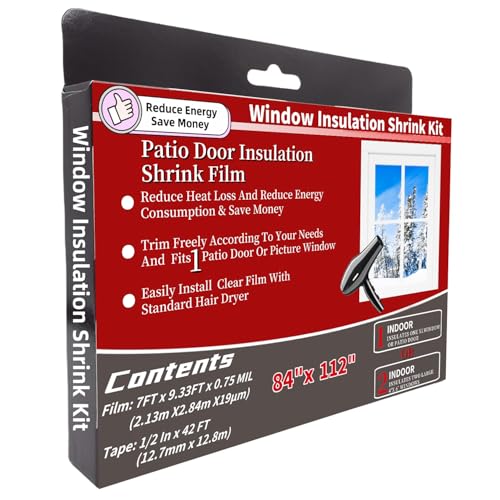
| FonsBleaudy Patio Door Shrink Film Kit | 84 by 112 inch patio sheet at a budget price | Budget | |
How to choose a window insulation film kit
The plastic is not the insulator
This surprises people. A sheet of film a fraction of a millimeter thick has almost no insulating value by itself. What does the work is the pocket of still air trapped between the film and the glass. Air is a poor conductor of heat as long as it cannot circulate, which is the same principle behind double glazing and a puffer jacket. That is also why a loose, flapping sheet does very little and a drum-tight one does a lot: tightness is what stops the air moving.
Buy by area, not by the window count on the box
“Fits up to 5 windows” assumes a standard 3 by 5 foot window. Your windows are probably not that. The number that matters is the film dimension: a 62 by 210 inch roll is about 90 square feet of film, which you cut to whatever shapes you actually have. Measure your frames, add a couple of inches on each side for the tape line, and add up the area. Buying one size larger is cheap insurance against a mis-cut.
The tape is where kits fail, and where the surface matters
The film almost never fails. The double-sided tape does, and it fails for a predictable reason: it needs a clean, dry, sealed surface. Duck is specific about this – painted, finished or varnished wood, vinyl, and aluminum are fine, while plaster, drywall, and bare or unvarnished wood are not. Tape on a dusty frame or raw timber lets go within weeks. Wipe the frame down, let it dry properly, and press the tape firmly along its whole length before you even open the film.
Hair dryer, not heat gun
Every kit here specifies a hair dryer, and that is not caution for its own sake. A heat gun runs hot enough to melt film into holes and scorch a painted frame. A hair dryer on high, held a few inches back and moved constantly, shrinks the sheet gradually so wrinkles pull out evenly. Work from the middle outward toward the corners. If a wrinkle refuses to go, more heat in one spot is the wrong answer – keep moving and it usually resolves.
Thickness matters if life happens near the window
Standard shrink film is thin enough that a cat’s claw, a chair back, or a curious toddler will put a hole in it, and a holed sheet stops sealing. Heavy-duty film – Duck’s MAX Strength line is roughly twice standard thickness and puncture resistant – costs more per window and survives a household. In a quiet spare room, standard film is fine. In a lounge with pets, the thicker film usually outlasts two seasons of the cheap stuff.
Patio doors are a different purchase
A standard kit is around 62 inches wide, and a patio door is roughly 80 inches tall. The maths does not work, and taping two sheets together leaves a seam that leaks and looks bad. Patio kits run 84 inches on the short dimension for exactly this reason. If you have a sliding door or a tall picture window, buy the XL sheet rather than trying to make a window kit stretch.
Duck MAX Strength Window Insulation Kit – the popular one, and the tough one
This is the best-selling kit in the group and the only one built around a genuinely different film. MAX Strength is roughly twice the thickness of a standard window kit and is described as puncture resistant, which turns a seasonal consumable into something that survives a room people live in. The kit is a single 62 by 210 inch roll with an 84-foot roll of half-inch tape, enough for up to five standard windows, and there is no measuring involved: tape, roll the film on, then cut to size. It goes on clear, stays transparent, and peels off at the end of the season.
Pros
- Twice the thickness of standard film; puncture resistant
- Roll-on then cut, so no pre-measuring
- Generous 84 feet of tape included
- Crystal clear once shrunk; barely visible
- Removes cleanly when the cold weather ends
Cons
- Highest cost per window of the standard-size kits
- Covers five windows, half what the standard Duck roll does
- Not suitable for plaster, drywall, or bare wood frames
Best for: rooms in daily use, especially with pets or children near the glass.
Frost King V73/3H Shrink Window Kit – the cheapest way to test the idea
Three indoor sheets at 42 by 62 inches, for roughly the price of a coffee. If you are not sure whether film will make a difference in your place, this is how you find out without committing. The 42 by 62 inch size suits an ordinary bedroom or bathroom window without much trimming, and pre-cut sheets are less fiddly than a long roll for a first attempt. It is basic – the listing says little beyond the size and model – but Frost King has been a fixture in this category for a very long time, and the format has not needed reinventing.
Pros
- Cheapest kit here by a wide margin
- Three sheets, so a small flat is covered in one purchase
- Pre-cut sheets are simpler than a roll for beginners
- 42 by 62 inches suits common bedroom windows
- Low-risk way to try the approach
Cons
- Standard-thickness film; punctures easily
- Listing gives almost no detail on tape or coverage
- Sheet size caps what it will fit
Best for: a couple of drafty bedroom windows, or a first trial before committing.
Frost King V76H Shrink Window Kit – patio-sized, priced like a window kit
One clear sheet, 84 by 110 inches. That 84-inch dimension is the whole point: it clears the height of a standard patio door in a single piece, so there is no seam down the middle of your view and no join to leak through. A sliding door is often the largest single hole in a home’s thermal envelope, which makes this one of the highest-impact purchases here. It is also, notably, cheaper than most standard multi-window kits, which makes the usual reluctance to seal the big door hard to justify.
Pros
- Covers a full patio door in one seamless sheet
- Cheaper than most standard window kits
- 84 by 110 inches also suits tall picture windows
- Targets the biggest single heat loss in many homes
- Clear film keeps the light and the view
Cons
- Standard thickness on a surface people walk past constantly
- Sealing a door means not using it until spring
- Minimal information on the listing
Best for: a sliding patio door you can live without opening through the cold months.
Duck Brand Window Insulation Kit – the whole-house roll
Two 62 by 210 inch rolls and two 83-foot rolls of tape, enough for ten standard windows – this is the kit for doing the entire house in one afternoon rather than picking off the worst room. It is standard-thickness film rather than the MAX line, which is the trade you make for roughly half the cost per window. The roll format means no measuring: tape the frame, unroll across it, cut to fit. Same clear finish once shrunk, same clean removal at the end of the season.
Pros
- Ten windows from one purchase; best coverage here
- Around half the cost per window of the MAX film
- Two generous 83-foot tape rolls included
- Roll-and-cut needs no advance measuring
- Clear, transparent finish that removes easily
Cons
- Standard thickness; more vulnerable to punctures
- Highest total price here, though not per window
- Same frame surface restrictions as all taped kits
Best for: sealing every window in a house or flat in one go.
FonsBleaudy Patio Door Shrink Film Kit – the budget XL sheet
An 84 by 112 inch sheet with 42 feet of half-inch double-sided tape, sized for one XL window or patio door, or two standard 4 by 6 foot windows if you would rather split it. It undercuts most of the field while covering the largest opening in the room, and the film stays crystal clear so the sheet does not cost you daylight – worth something in a season when daylight is scarce. The listing also notes dust protection, which is a real if unglamorous benefit of sealing a frame you are not going to open.
Pros
- Full patio door coverage at a budget price
- 84 by 112 inches, slightly larger than the Frost King XL sheet
- Can be split into two standard 4 by 6 foot windows
- Clear film that does not block sunlight
- Seals out dust as well as drafts
Cons
- 42 feet of tape is the least here; tight for the sheet size
- Standard-thickness film
- Least established brand in this comparison
Best for: a patio door on a tight budget, or one large window split two ways.
The verdict
Best Overall – Duck MAX Strength Window Insulation Kit. The best-selling kit here, and the thickness is a real difference rather than a label. Film at twice standard gauge survives pets, furniture and daily life, which matters because a punctured sheet has stopped insulating entirely. Roll-on application, plenty of tape, clean removal.
Best Value – Frost King V73/3H Shrink Window Kit. Three windows for pocket change. It is basic, standard-thickness film with a sparse listing, and it is still the cheapest genuine reduction in heat loss available for a drafty room. If it works for you, buy the bigger kit next time.
Best Premium – Duck Brand Window Insulation Kit. Not premium in film, premium in scope: ten windows, two rolls, and enough tape to finish the job. For anyone sealing a whole home rather than one room, it is the most economical route per window in this comparison.
FAQ
Does window film actually reduce heating bills?
It reduces heat loss through the window, which is where a large share of it goes in a single-glazed room. The saving depends entirely on how bad the window was to begin with: a drafty single-glazed sash in a cold climate is transformed, while a modern double-glazed unit has much less to gain. Nobody can quote you a number without knowing your windows and your weather.
Can I still open the window afterwards?
No. The film seals the frame shut for the season, which is why it suits windows you do not use in winter and not a bathroom that needs venting. Plan which windows you can afford to close before you buy, and leave at least one openable window per room for airflow.
Will the tape damage my paintwork?
Usually not on sound, fully set paint or varnish, which is exactly what these kits specify. The risk rises on fresh paint, flaking finishes, plaster, and bare wood – Duck explicitly advises against those surfaces. Pull the tape off slowly at a shallow angle, and warming it gently with a hair dryer first helps it release cleanly.
Does the film stop condensation on the glass?
It usually reduces condensation on the room side, because warm moist air no longer reaches the cold pane. You may see some moisture form between the film and the glass instead, which is normal and generally clears. Persistent water in that gap means the seal is leaking somewhere, most often at a tape corner.
Can I reuse a kit next season?
The film, realistically no – it stretches during shrinking and rarely goes back on well, and the tape is single-use regardless. Take these as a seasonal consumable. That is the argument for the thicker film if you use a room heavily: it is far more likely to make it through the whole season intact.
This article may contain affiliate links; see our Affiliate Disclosure.