Several chargers on this page advertise 50 pounds of suction power, which is an impressive number and a strange one to lead with on a vent mount, because a vent mount does not use suction. They are three-in-one units that clip to a vent or stick to a windshield, and the suction figure describes the other job. If the vent is where you want it, the number to look for is what the clip does, and almost nobody talks about that.


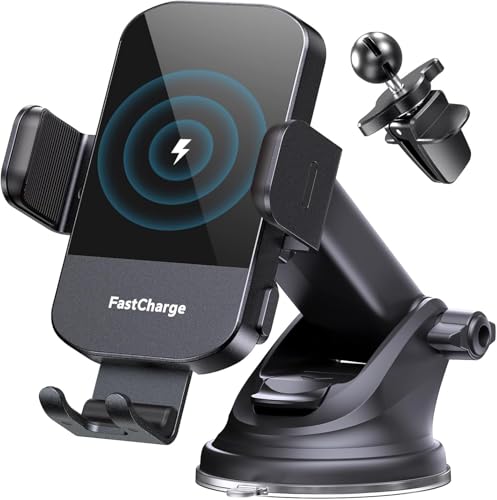

Wireless charging in a car is a slightly odd idea when you think about it: you are converting electricity to a magnetic field and back again, losing some as heat, in a hot box, on a bumpy road. Everything good about these chargers is an answer to one of those three problems.
At a glance
| Charger | Standout feature | Price tier | Link |
|---|---|---|---|
| MOYAC | Cheapest here; Qi2 certified, three mounts | Budget | |
| Guceful | An enlarged coil; more room to miss by | Budget | |
| MOKPR | Hollow silicone against the vent blade | Budget | |
| JOYROOM | Anti-shake clip; fits 99% of vent types | Budget | |
| JOYMASS | Tri-section snap onto the vent | Budget | |
| CHGeek | Best seller; detects metal and warns you | Mid-range | |
| LISEN Qi2.2 | 25W certified, with a fan to keep it there | Premium | |
How to choose a vent-mount wireless charger
The clip is the part that fails, and one brand talks about it
Everything here charges. What separates them on a bad road is whether the phone is still where you left it. JOYROOM is the only brand naming the problem, with an anti-shake vent clip it says fits 99% of vertical and horizontal vents, and that second half matters as much as the first: vent blades come in both orientations and a clip designed for one slips off the other. MOKPR’s answer is innovative hollow silicone against the blade, which grips without crushing. JOYMASS uses a tri-section snap. Everyone else describes the charging and hopes.
Heat is why fast charging is not fast
Wireless charging wastes energy as heat by design, and a phone that gets hot slows its own charging down to protect itself. So a 25 watt charger in a sunlit car can easily deliver less over twenty minutes than a 15 watt one that stays cool. LISEN is the only unit here that takes this as an engineering problem rather than a marketing one, fitting a cooling fan with temperature control specifically so the phone does not throttle. It also makes the real argument: the point of the fan is maintaining the speed you paid for.
Qi2 and Qi2.2 are real certifications
Most of this page says 15W Qi and leaves it there. Two brands name a certified standard: MOYAC states Qi2 certified 15W, and LISEN states official Qi2.2 certification at 25W. Those are specific versions of an actual standard with actual testing behind them, not a brand’s description of its own chip. On a page where everyone else has an upgraded chip or an advanced chip, a certification version number is the only claim somebody outside the company has checked.
Foreign object detection is a safety feature, not a gimmick
Put a coin, a key or a card between a wireless charger and a phone and the field heats the metal instead of the battery. CHGeek is the only charger here that addresses it: foreign object detection with an LED alarm, so it stops and tells you rather than quietly warming a coin against your phone. That is worth having in a car, where loose change lives in exactly the places phones get put down. It is also the kind of feature that only appears once you read past the wattage.
Check your case thickness
Wireless charging works across a gap and the gap has a limit, so a thick case is the reason a charger you bought does nothing. Two brands publish the figure and they are not the same: CHGeek says up to 6mm, MOYAC says up to 4mm. That is a real difference, and a rugged case with a card holder can exceed both. Where a listing says case friendly without a number, it is describing an intention. Measure your case before you blame the charger.
Alignment is what auto-clamping is really for
The arms are the visible feature and the sensor is the useful one. MOKPR describes auto-precise alignment: place the phone and the mount positions itself so the coils line up, which matters because a misaligned coil charges slowly or not at all while looking exactly like a working one. Guceful takes the other route with an enlarged charging coil, giving you more area to be sloppy within. Both solve the same problem, and both are more useful than the wattage printed above them.
MOYAC
The cheapest charger here and, unusually for the price, it names a real certification: Qi2 certified 15W fast charging, which is a version of an actual standard rather than a description of an in-house chip. It offers three mounting options, windshield, vent and dash, so it fits whatever your car allows rather than what the designer assumed. A gentle-lock hook mechanism holds the phone, it rotates 360 degrees, and MOYAC publishes the case limit at 4mm, which is fair and is thinner than a lot of rugged cases.
Pros:
- Cheapest charger here
- Qi2 certified; a real standard, not an in-house claim
- Three mounting options: windshield, vent and dash
- Publishes its case limit at 4mm; 360 degree rotation
Cons:
- 4mm case clearance; a rugged case will not work
- Nothing said about the vent clip specifically
- Sells poorly against the established names
Best for: a certified Qi2 charger for the least money.
Guceful
The cheap one with a genuinely useful idea: an enlarged charging coil. Wireless charging needs the phone’s coil over the charger’s, and a bigger coil gives you a bigger target, which means a phone dropped in slightly off-center still charges rather than sitting there pretending to. Around it, the arms and foot auto-open when power connects and close on the phone, and advanced sensors handle precise alignment on top. An upgraded chip identifies the device. It is the second cheapest thing here and it fixes the failure people actually blame on the phone.
Pros:
- Enlarged charging coil; a bigger target to hit
- Automatic precision alignment on top of that
- Arms and foot auto-open on power; auto-clamp on placement
- Very cheap
Cons:
- No certification named; upgraded chip is not a standard
- No case thickness published
- Nothing said about the vent clip
Best for: dropping the phone in roughly and having it charge anyway.
MOKPR
The second best-selling charger here, and it addresses both halves of the job. On charging, a built-in sensor handles auto-precise alignment, so you place the phone and the mount finds the coil rather than leaving you to. On mounting, MOKPR describes a strong vent clip with innovative hollow silicone, which is a specific answer to a specific problem: the silicone grips the blade without crushing it, and a crushed vent blade never quite closes again. It steps through 15W, 10W and 7.5W depending on the phone, and the arms and foot open automatically on power.
Pros:
- The second best-selling charger here
- Hollow silicone grips the vent blade without crushing it
- Sensor-based auto-precise alignment
- Steps through 15W, 10W and 7.5W to suit the phone
Cons:
- No certification named
- No case thickness published
- Sold alongside a similar MOKPR three-in-one at a higher price
Best for: a vent clip that will not wreck the blade it grips.
JOYROOM
The only charger here that takes the mount as the product. Its vent clip is described as anti-shake and upgraded for wider compatibility, fitting 99% of vertical and horizontal vents, and that second detail is the one to notice: vent blades run both ways depending on the car, and a clip made for one orientation slides off the other. On a road with potholes, the phone staying put is the whole feature. Premium soft rubber lines both clamping arms so nothing slips or scratches, and the auto-clamp locks with one tap once powered.
Pros:
- The only anti-shake vent clip named on this page
- Fits 99% of vertical and horizontal vents
- Soft rubber lining on both arms; no slipping or scratching
- One-handed auto-clamp
Cons:
- No certification named
- No case thickness published
- Vent only; no windshield or dash option
Best for: bad roads, and vents the other chargers slide off.
JOYMASS
A straightforward 15W vent charger with a tri-section snap design, which is JOYMASS’s answer to vents of different depths: three points of contact rather than one pinch, spreading the grip so the mount does not rock. Anti-slip rubber pads, a stable support shelf under the phone and scratch-free arms mean nothing is fighting your handset. The auto-clamping does what it says: put the phone in, the arms take it. It publishes no certification and no case limit, and it costs very little for a competent version of the standard arrangement.
Pros:
- Tri-section snap spreads the grip across the vent
- Support shelf under the phone as well as arms
- Anti-slip pads and scratch-free arms
- Cheap for a competent vent charger
Cons:
- No certification named; no case thickness given
- Nothing said about alignment or coil size
- Sells poorly
Best for: a plain vent charger that grips in three places.
CHGeek
The best-selling charger here and the only one with a feature worth having for reasons other than speed: foreign object detection with an LED alarm. Put a coin or a key between the pad and the phone and a wireless charger will heat the metal; this one notices and tells you. In a car, where loose change lives in every cupholder and door pocket, that is a real scenario rather than a hypothetical. It also publishes the case limit at 6mm, the most generous on this page, so a proper case still works, and the angle adjusts freely. Intelligent identification handles the rest.
Pros:
- The best-selling charger here
- Foreign object detection with an LED alarm; nobody else has it
- 6mm case clearance, the most generous published here
- 15W Qi with intelligent device identification
Cons:
- No Qi2 or Qi2.2 certification named
- Nothing said about the vent clip specifically
- Costs more than most of this page
Best for: a car full of loose change, and a case worth keeping.
LISEN Qi2.2
The only charger here that understands why fast wireless charging usually is not. It is officially Qi2.2 certified at 25W, which is the highest and the only version-numbered certification on this page, and it pairs that with a cooling fan and temperature control, because a hot phone throttles its own charging to protect itself. LISEN makes the argument plainly: the fan exists to maintain the speed rather than to be a feature. It is MagSafe compatible, so it magnets on rather than clamping, and it comes with a 95W adapter that can actually feed 25 watts.
Pros:
- Officially Qi2.2 certified at 25W; the only version-numbered claim here
- Cooling fan with temperature control; stops the phone throttling
- Real about why the fan matters
- MagSafe magnetic attachment; 95W adapter included
Cons:
- The most expensive charger here by half again
- MagSafe means an iPhone or a magnetic case
- A fan is another thing to make noise and collect dust
Best for: actually getting the fast charge you paid for.
The verdict
The wattage on the front is the least interesting number here. What decides whether this works is the clip on a rough road, the gap your case leaves, and whether the phone gets hot enough to throttle itself.
Best overall: CHGeek. The best seller here, and the reason to pick it is a feature nobody else offers: foreign object detection with an LED alarm, so a coin between the pad and your phone gets flagged rather than quietly heated. Cars are full of loose change. It also publishes the most generous case clearance on this page at 6mm, which means the case you already own probably works, and the angle adjusts freely.
Best value: MOYAC. The cheapest thing here and it still names a real standard: Qi2 certified 15W, where most of this page offers an upgraded chip and a hope. Three mounting options mean it fits whatever your car allows rather than one arrangement, and it rotates fully. It publishes its case limit at 4mm, which is fair and is thinner than a rugged case, so measure first.
Best premium: LISEN Qi2.2. The only charger that solves the reason fast wireless charging disappoints. It is officially Qi2.2 certified at 25W, the only version-numbered certification on this page, and the cooling fan exists to stop your phone throttling itself back down, which LISEN says outright rather than dressing up. The 95W adapter is included, because 25 watts needs feeding. MagSafe, so bring a magnetic phone.
FAQ
Why do vent chargers advertise suction power?
Because several are three-in-one units that also stick to a windshield or a dash, and the 50 pound figure describes that job rather than the vent clip. If the vent is where you want the phone, look at what the clip does instead. JOYROOM is the only brand naming an anti-shake clip and vent orientation.
Will it fit my car’s vents?
Depends on the blade. Vents run vertical in some cars and horizontal in others, and a clip made for one slips off the other. JOYROOM claims 99% of both. MOKPR uses hollow silicone that grips without crushing the blade, which matters because a crushed blade never closes properly again.
Is 25W actually faster than 15W?
Only if the phone stays cool. Wireless charging wastes energy as heat, and a hot phone throttles its own charging, so a 25 watt charger in a sunny car can deliver less than a cool 15 watt one. LISEN fits a fan specifically to stop that, and says so.
Will it charge through my case?
Up to a point, and the point is published twice on this page. CHGeek says 6mm, MOYAC says 4mm, and a rugged case with a card holder can exceed both. Where a listing says case friendly with no number, measure your case before blaming the charger.
What is foreign object detection?
The charger noticing metal between the pad and the phone, which the field would otherwise heat. CHGeek is the only unit here with it, complete with an LED alarm. In a car full of loose change and keys, that is a scenario rather than a hypothetical.
This article may contain affiliate links; see our Affiliate Disclosure.