A triangle sounds like the obvious shape for a corner and it is a strange shape for a desk. The wide edge sits against the wall where you cannot reach it, and the point aims at your chest where there is no room for anything. Knowing that before you order changes which of these you want.


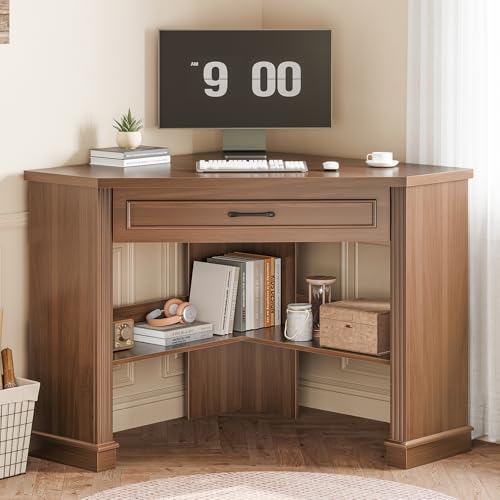

What a corner desk is really solving is not floor area, it is the fact that the corner of a room is already dead space. Nothing else goes there. So the question is not how small the desk is, it is how much usable surface you get out of a place that was doing nothing, and whether it brings power with it, because corners never have a reachable socket.
At a glance
| Desk | Standout feature | Price tier | Link |
|---|---|---|---|
| VECELO Corner Shelf Desk | Cheapest here; steel frame with a cabinet | Budget | |
| Tangkula | Publishes a 200 lb top rating; cable holes | Budget | |
| Armocity | Two outlets and three USB ports built in | Mid-range | |
| VECELO Charging Desk | Power plus a keyboard tray | Mid-range | |
| SEDETA 44.5 inch | By far the largest work surface here | Mid-range | |
| SEDETA with Hutch | Drawers, hutch, USB-C and a monitor stand | Premium | |
How to choose a corner desk
Read the dimensions, then imagine the triangle
Armocity publishes 26.8 by 26.8 inches, and that is a helpful number precisely because it sounds bigger than it works. A 90-degree triangle with two 26.8 inch sides has its full depth only where the walls meet, and tapers to nothing at the corners. In practice you get a usable band across the middle. That is genuinely enough for a laptop and a mug, and it is not enough for a monitor, a keyboard and a notebook side by side. SEDETA’s 31.5 by 44.5 inch model is the outlier here and the only one with a real desk’s worth of surface.
Corners have no sockets, which is why the power matters
Think about where you are putting this. The corner of a bedroom is the furthest point from anything, usually behind the bed, and running an extension across the floor is how the whole plan falls apart. Three desks here solve it at source: Armocity builds in two AC outlets and three USB ports, VECELO’s charging model has two outlets and two USB, and SEDETA’s hutch model adds USB-C alongside two outlets and a USB-A. That is the single most useful feature in this category and it is why the plain desks feel cheaper than they are.
Check the height, because most will not tell you
Armocity publishes 29.6 inches, which is standard desk height and means an ordinary chair works. Nobody else here gives you a figure at all, on a product you are meant to sit at for hours. If the desk is a vanity height or a dining height, your elbows will know within a week. Where a brand skips this, it is worth asking why.
Weight capacity is the real durability number
Only Tangkula publishes one: 200 pounds on the desktop, with lower figures on each shelf, on premium engineered wood. That is far more than a desk needs and it is a real answer, which is more than the others manage. Elsewhere you get sturdy construction and high-quality materials, which are adjectives. If you plan to put a heavy monitor and a printer on this, the brand that quotes a number is the one that measured it.
Storage or surface, because you will not get both
A corner desk is small by definition, so every drawer and shelf is taken out of the space you had. SEDETA’s hutch model piles on a bookshelf, acrylic cabinet doors, a drawer and a monitor stand, which is genuinely a lot of organization and leaves less bare desk. The VECELO shelf model goes furthest the other way and is really a corner cabinet with a work surface on top. Decide whether the problem is nowhere to put things or nowhere to work.
A keyboard tray buys back the depth
The clever move on a shallow desk is to move the keyboard off it. VECELO’s charging model is the only one here with a tray, which slides the keyboard under the surface and gives you back the few inches a triangle steals. On a desk this size that is the difference between a monitor at a sensible distance and a monitor in your face.
VECELO Corner Shelf Desk
The cheapest thing here and the most accurate about what a corner is for: this is really a corner cabinet with a usable top, in a black metal frame with MDF panels and a ventilated door. It works as a storage shelf, a small bookcase or an organizer, and you can put a laptop on it. The industrial look suits a dorm or a rented flat, and it occupies almost no floor while taking a surprising amount of clutter out of the room. As a desk you sit at all day it is not really trying, and it does not pretend to be.
Pros:
- Cheapest option here by a wide margin
- Steel frame with MDF; a ventilated cabinet door
- Works as a bookcase or organizer as well as a surface
- Tiny floor footprint in a corner nothing else uses
Cons:
- More a corner cabinet than a desk
- No power, no dimensions and no height published
- Barely sells
Best for: reclaiming a corner for storage, with a laptop perch on top.
Tangkula
The only desk here that tells you what it will hold: 200 pounds on the top, with each shelf rated separately, in premium engineered wood. That is a real number where everyone else offers adjectives. The 90-degree design fits tight into a wall corner, the top takes a laptop, notebooks and a lamp, and there are cable management holes so the wires drop through rather than draping over the front edge. Tangkula also aims it at makeup as much as work, which is fair: at this size it suits a vanity as well as a desk.
Pros:
- Publishes a 200 lb desktop rating; the only one that does
- Cable management holes built into the top
- Premium engineered wood with shelf storage
- Genuine 90-degree fit into a wall corner
Cons:
- No power built in
- No dimensions or height published
- Sells modestly
Best for: a corner desk or vanity that you know will hold what you put on it.
Armocity
The best-specified small desk here, and the only one that answers both questions this category raises. It publishes its full size, 26.8 by 26.8 by 29.6 inches, so you know exactly what surface you get and that it is standard desk height rather than a vanity. And it builds in a power strip with two AC outlets and three USB ports, which is what makes a bedroom corner usable at all without an extension lead across the carpet. A triangular under-desk shelf holds the overflow, and assembly is labeled and quick.
Pros:
- Publishes full dimensions including a standard 29.6 inch height
- Two AC outlets and three USB ports built in
- Under-desk triangular shelf for overflow
- Labeled parts and clear instructions; quick assembly
Cons:
- 26.8 inches is a small triangle; laptop and mug, not a workstation
- No weight capacity published
- Sells modestly, like everything in this category
Best for: a bedroom corner with no socket and a laptop to charge.
VECELO Charging Desk
The one that thinks about depth. A keyboard tray slides the keyboard underneath the top, which on a triangle is the single most useful thing you can do, because it hands back the few inches the shape steals and lets a monitor sit at a sensible distance instead of under your nose. Around that is a 90-degree corner design in engineered wood on a metal frame, with a built-in charging station carrying two AC outlets and two USB ports. It doubles as a vanity, which at this size is a fair description rather than a compromise.
Pros:
- The only keyboard tray here; buys back the depth a triangle steals
- Two AC outlets and two USB ports built in
- Engineered wood on a metal frame
- 90-degree design that genuinely fits a wall corner
Cons:
- No dimensions, height or weight capacity published
- The least-selling desk on this page
- Fewer USB ports than the Armocity
Best for: a monitor on a small triangle, with the keyboard out of the way.
SEDETA 44.5 inch
The one that is actually a desk. At 31.5 inches deep by 44.5 wide it is roughly double the working surface of the small triangles, which changes what is possible: a monitor and a keyboard and a notebook, rather than choosing two. It keeps the triangular corner geometry so it still fits where a rectangular desk would not, and it adds drawers and storage shelves for the things that would otherwise cover the top. The styling is deliberately plain so it fits most rooms. It is the plain answer if you actually work at this rather than occasionally sitting at it.
Pros:
- By far the largest surface here at 31.5 by 44.5 inches
- Room for a monitor, keyboard and notebook together
- Drawers and shelves included
- Still uses the corner geometry that a rectangle cannot
Cons:
- No built-in power
- No height or weight capacity published
- Big enough that it stops being a small-space solution
Best for: a corner and a real job, rather than a corner and a laptop.
SEDETA with Hutch
Everything, in 31.5 inches square. A bookshelf and two acrylic cabinet doors sit above, a large drawer below, and the power station is the most complete here: two outlets, a USB-A and a USB-C, which is the only Type-C port on this page and the one modern laptops actually want. An ergonomic monitor stand lifts the screen off a surface that does not have inches to spare, and dual LED strips light the desk itself rather than the room. It is the most expensive thing here and the only one that arrives as a finished workstation.
Pros:
- The only USB-C port here, alongside two outlets and a USB-A
- Hutch, bookshelf, cabinet doors and a large drawer
- Monitor stand included; lifts the screen off a small top
- Dual LED strips light the work surface
Cons:
- Most expensive desk here by a wide margin
- All that storage eats into a 31.5 inch square
- No height or weight capacity published
Best for: one corner that has to be the whole office.
The verdict
Best overall: Armocity. It is the only small desk here that answers the two questions that matter. It publishes its size and its height, 26.8 by 26.8 by 29.6 inches, so you know you are getting a standard desk you can sit at rather than a vanity. And it builds in two outlets and three USB ports, which is what makes a bedroom corner usable without an extension lead running across the floor. It is a small triangle, so bring a laptop, not a workstation.
Best value: VECELO Corner Shelf Desk. The cheapest thing on this page, and the most accurate: a steel-framed corner cabinet with a ventilated door and a usable top. It clears clutter out of a room and gives you somewhere to put a laptop, in a corner that was doing nothing. It is not a desk you sit at for eight hours, it publishes no dimensions, and for the money it is doing something genuinely useful.
Best premium: SEDETA with Hutch. The only desk here that arrives as a whole office: a hutch, a bookshelf, cabinet doors, a drawer, a monitor stand, LED strips, and the only USB-C port on this page. In 31.5 inches square, that is a lot of organization and correspondingly less bare surface. If the corner has to be the entire workspace, this is the one built for that.
FAQ
Is a triangle really a good desk shape?
It is a good use of a corner, which is not quite the same thing. The full depth exists only where the walls meet and it tapers away toward you, so a 26.8 inch triangle gives a usable band rather than 26.8 inches of desk. That is fine for a laptop and a mug. For a monitor, a keyboard and a notebook, look at SEDETA’s 44.5 inch model.
Why does built-in power matter so much?
Because corners have no sockets. The corner of a bedroom is the furthest point from anything, and an extension lead across the carpet undoes the tidiness you bought the desk for. Armocity gives you two outlets and three USB; SEDETA’s hutch model adds USB-C, which is what a modern laptop wants.
What height are these?
Only Armocity says: 29.6 inches, which is standard desk height for an ordinary chair. Nobody else publishes a figure, on furniture meant to be sat at for hours. Several of these double as vanities, and vanity height is not desk height, so the silence is worth noticing.
How much weight will they hold?
Tangkula is the only brand willing to say: 200 pounds on the top, with separate figures for the shelves. Everyone else offers sturdy construction and high-quality materials. If a heavy monitor and a printer are going on this, buy from the one that measured it.
How do I get more usable space out of one?
Move the keyboard off the top. VECELO’s charging model is the only desk here with a keyboard tray, and on a shallow triangle that hands back the inches the shape takes away, which is the difference between a monitor at arm’s length and a monitor in your face.
This article may contain affiliate links; see our Affiliate Disclosure.