The bar leaves a receipt. Drag it up your shins for a few heavy sets and you find the bill that night in the shower, a stripe of missing skin that lights up under hot water. The fix is not to push the bar away from your legs, because that is the one thing assured to cost you the lift.



Shin protection splits into two camps that solve the problem differently. Neoprene guards strap on, pad heavily, and come off between exercises. Lifting socks weave a tough panel into the shin and stay on all session. Both keep skin on your legs; they differ in how much they put between the bar and the bone, which is exactly what decides whether they help your pull or quietly sabotage it. The five below are ordered by how many lifters buy them.
At a glance
| Product | Standout features | Price tier | Link |
|---|---|---|---|
| TAVIEW Shin Guards Best Overall |
5mm neoprene, three straps, 12 in long, fits 13 to 20 in calves | Mid-range | |
| THEFITGUY Shin Guards Best Premium |
Dense 5mm neoprene, on and off over shoes, sold as a pair | Premium | |
| Pure Athlete Lifting Socks Best Value |
Anti-abrasion shin panel, silicone grip sole, left and right specific | Budget | |
| Trend Changer Shin Guards | 5 to 7mm padding, triple straps, fits 13 to 20 in calves | Mid-range | |
| BOORE Deadlift Compression Socks | 15 to 20mmHg graduated compression, knee high, cuffed top | Mid-range | |
How to choose deadlift shin protection
Guards and socks solve different problems
A neoprene guard is armor. Five millimeters of closed cell foam absorbs a knurled bar dropping down your shin, and it is the only thing on this list that will genuinely take a rope climb or a missed box jump without complaint. A lifting sock is abrasion resistance rather than armor: a tough panel woven into the shin that the bar slides across instead of grabbing. If your problem is skin, a sock is enough. If your problem is bruised bone from rope climbs and cleans, you want foam.
Thickness is a trade, not a virtue
Here is the part the product photos never mention. A deadlift is strongest when the bar tracks in a straight vertical line close to your body, because every centimeter it drifts forward lengthens the lever your lower back has to fight. Strap 5mm of neoprene to each shin and the bar now rides 5mm further out. On a warm-up that is nothing. On a heavy single it is a real, if small, tax. Thicker padding buys more protection and pays for it in bar path, which is why plenty of lifters wear guards for rope climbs and switch to socks for maximal pulls.
Measure your calf before you order
Most guards are sold as one size with adjustable straps, but the range varies more than you would expect. Two here fit calves from 13 to 20 inches; another stops at 18. Measure the widest part of your calf with a tape before ordering, because a guard at the top of its range gapes and slides, and one at the bottom cuts in. Socks are sized in the ordinary way, and since the shin panel has to sit over your shin rather than beside it, the size chart matters more than usual.
How fast can you take them off
This decides more than it sounds like it does. Guards with hook and loop straps go on and off in seconds without unlacing your shoes, so you can wear them for deadlifts and strip them for squats. That is the whole design intent, and it works. A sock is a commitment: you put it on at the start and it stays for the session, shin panel and all. For a lifter who deadlifts once a week among other work, guards suit the rhythm better. For someone who lifts in socks anyway, the sock is already there.
Grip, heat, and the small stuff
Lifting without shoes is common for deadlifts, and a sock with silicone nodules on the sole stops your foot skating on a rubber platform. Neoprene, meanwhile, is a wetsuit material and does exactly what a wetsuit does: it holds heat. That is welcome in a cold garage gym and unwelcome in July. Graduated compression is a separate feature again, useful for long sessions and recovery, and it has nothing to do with protecting skin.
TAVIEW Weightlifting Deadlift Shin Guards
These outsell everything else in the category, and the reason is that they get the boring things right. Five millimeters of neoprene covers 12 inches of shin, three hook and loop straps clamp it down, and the whole thing goes on in a few seconds without touching your shoes. The strap range fits calves from 13 to 20 inches, which is generous enough to cover most legs and to survive being worn over leggings or training pants rather than bare skin. That layering flexibility is the quiet feature: you can wear them under socks, over tights, or straight on the skin, and the straps still hold.
- Pros: 5mm neoprene handles bar drag, rope climbs, and box jumps; 12 inches of coverage; three straps hold position without sliding; fits calves from 13 to 20 inches; on and off in seconds with shoes on; wearable over skin, socks, or tights.
- Cons: Neoprene traps heat and gets clammy in a warm gym; one size means the extremes of the range fit worst; the padding adds thickness to the bar path on maximal pulls.
Best for: mixed training where the bar, the rope, and the box all take a turn at your shins, and you want to strap up for one exercise and strip off for the next.
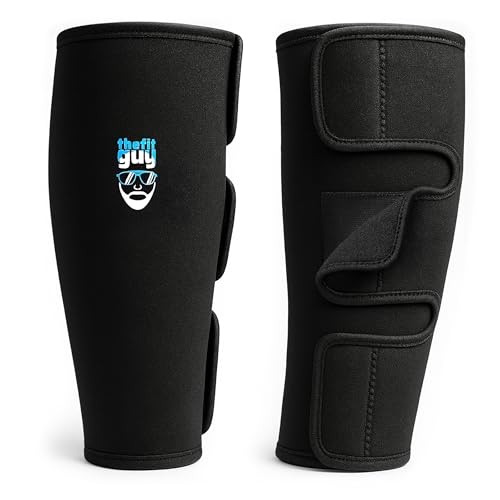
THEFITGUY Deadlift Shin Guards
THEFITGUY makes the same argument as the TAVIEW with a firmer material. The neoprene is 5mm and specifically dense, which is the distinction that matters in foam: dense foam resists compressing all the way through under a sharp edge, so a knurled bar meets resistance rather than bottoming out onto bone. The guards are built around cleans and snatches as much as deadlifts, where the bar comes down fast and the impact is a strike rather than a scrape. They cover 11.8 inches, come as a pair, and go on and off with your shoes on.
- Pros: Dense 5mm neoprene resists bottoming out under a sharp bar; aimed at cleans and snatches where impact is sudden; quick on and off over shoes; wearable over skin, socks, pants, or tights; sold as a pair.
- Cons: The narrowest calf range here at 13 to 18 inches, so larger calves should measure first; the priciest option on this list; slightly shorter coverage than the TAVIEW; same heat issue as all neoprene.
Best for: lifters who catch a falling bar as often as they drag one up, and anyone with average calves who wants the firmest foam here.
Pure Athlete Lifting Socks
This is the sock that behaves most like a purpose-built tool. The shin panel is stacked anti-abrasion yarn that the maker rates at many times the strength of ordinary cotton, and it sits where the bar actually travels rather than being a vague nod at durability. The sole carries silicone gripping nodules, which matters if you pull without shoes on a slick platform. The socks are cut left and right specific, so the panel lands on the shin rather than rotating around the leg, and the heel, sole, and toe are cushioned with a seamless toe seam. It costs the least here and adds nothing to the bar path.
- Pros: Cheapest option and no added thickness against the bar; stacked anti-abrasion shin panel where it counts; silicone grip nodules for lifting without shoes; left and right specific fit keeps the panel in place; cushioned heel and sole with a seamless toe; moisture wicking and anti-odor.
- Cons: Fabric resists scraping but does not absorb impact, so rope climbs will still bruise; sized rather than adjustable, so check the chart; on for the whole session, with no stripping off between exercises.
Best for: barbell lifters whose problem is skin rather than bone, especially anyone chasing a heavy pull who does not want padding between the bar and their leg.
Trend Changer Weightlifting Shin Guards
If the other guards are 5mm, these go to 7, and that extra couple of millimeters is the entire pitch. The padding runs 5 to 7mm of neoprene aimed squarely at repeated impact: rope friction that burns, box jump misses that crack, and the barbell contact of a long session where the twentieth rep hurts more than the first. Three reinforced hook and loop straps let you dial the compression rather than accept it, and the wraparound design fits calves from 13 to 20 inches on either leg. They come as a pair with a 30-day return window.
- Pros: The thickest padding here at 5 to 7mm; three reinforced straps for precise compression; wide 13 to 20 inch calf range; either leg, no left and right to sort out; wearable over skin or clothing; pair included.
- Cons: The thickest option is also the bulkiest and the hottest; extra padding pushes the bar furthest from your shin, so it is the least suited to maximal pulls; a 30-day warranty is short.
Best for: rope climbs, box jumps, and high-rep conditioning work where the shins take repeated hits and a few millimeters of bar path do not matter.
BOORE Deadlift Compression Socks
The BOORE is the sock that wants a second job. It carries real graduated compression at 15 to 20mmHg, the range used for running and recovery rather than decoration, and it runs longer than average, reaching to or over the knee so the shin panel covers the whole path a bar takes. Extra yarn thickness goes directly over the shin to stop the skin peel that comes from repeated drag, and a cuffed top keeps it from creeping down mid-set. Extra sole thickness targets blistering. It is built for obstacle racing as much as the platform, which is why it wants to be worn on a run home too.
- Pros: Genuine 15 to 20mmHg graduated compression for long sessions and recovery; knee-high length covers the full bar path; added shin thickness against drag; cuffed top resists sliding down; thicker sole to fight blisters; doubles for running and obstacle racing.
- Cons: Real compression feels restrictive if you are not used to it; the shin protection is yarn rather than padding, so no impact absorption; sized in broad bands, so the fit is coarser than a lettered chart.
Best for: people whose training crosses lifting, running, and obstacle courses in the same week, and who want compression benefits alongside shin cover.
The verdict
Best Overall: the TAVIEW Deadlift Shin Guards. They sell better than anything else here and the spec explains it: 5mm of neoprene, 12 inches of coverage, a 13 to 20 inch strap range, and a design you can strap on for one exercise and pull off for the next. For most lifters that combination is the practical answer.
Best Value: the Pure Athlete Lifting Socks. The cheapest option and the one that adds nothing between the bar and your leg. If skin is your only complaint and heavy pulls are the goal, the anti-abrasion panel and grip sole do the job for less.
Best Premium: the THEFITGUY Deadlift Shin Guards. Dense neoprene resists bottoming out under a sharp bar better than softer foam, which is what you want when the bar arrives fast. Measure your calf first, since the range stops at 18 inches. For maximum padding on rope climbs, the Trend Changer goes thicker still.
FAQ
Do shin guards really affect the deadlift?
Slightly, and it is worth understanding rather than worrying about. A strong pull keeps the bar tracking close to the body, so anything strapped to your shin moves the bar that same distance forward. Five millimeters will not ruin a lift, and for most people the confidence of not shredding their skin is worth more than the millimeters. If you are chasing a genuine maximum, that is the session to wear a sock instead.
Why not just wear long socks?
Ordinary socks lose. Cotton has no abrasion resistance worth the name, so the knurling tears through, and then you have shredded socks and shredded shins. The socks here weave a dedicated panel of tough yarn over the shin specifically to survive that contact. It is the panel you are buying, not the length.
Can I wear guards over my leggings?
Yes, and most are designed for it. All three guards here can be worn on bare skin, over socks, or over training pants and tights, and the straps still hold. Wearing them over a layer also solves the sweat problem, since the fabric takes the moisture instead of your skin.
How do I stop them sliding down mid-set?
For guards, it is the straps: tighten the top strap most, since it carries the weight, and snug the rest. For socks, look for a cuffed top, which is what keeps the BOORE from creeping. Sliding usually means the size is wrong rather than the product, so measure your calf at its widest point and compare it to the stated range.
Will they help with shin splints?
Not directly. Shin splints come from load on the bone and surrounding tissue, usually from running, not from bar contact. Graduated compression, like the 15 to 20mmHg in the BOORE, may help with the ache and with recovery, but it is not medical care. Padding protects skin and blunts impact; it does not address why the bone hurts.
This article may contain affiliate links; see our Affiliate Disclosure.