Half the bowls sold as chawan have a pouring spout, and a spout tells you something the listing does not. A chawan is the bowl you whisk in and then drink from; that is the entire idea. Put a spout on it and you have made a mixing jug, which is a perfectly good object and a different one. Both are here. Knowing which you want settles most of this page.




One more thing to clear up before the bowls. Ceramic and glazed are not two options: glaze is a coating fired onto ceramic, so every bowl here is both. What actually separates these is size, whether it was made in Japan by hand, and whether it has that spout.
At a glance
| Bowl | Standout feature | Price tier | Link |
|---|---|---|---|
| BlendWell | Best seller here; dishwasher safe | Budget | |
| CAMATET | Biggest spouted bowl; publishes its size | Budget | |
| HIBINO | Crystal glaze, formed in the kiln | Budget | |
| Happy Sales | Hand-painted sakura; made in Japan | Budget | |
| WELL ORIGIN | Mino ware; real about what is not included | Mid-range | |
| Product of Gifu Japan | Largest bowl here; handmade in Japan | Mid-range | |
| TAKEMI | Bowl, whisk and scoop together | Premium | |
How to choose a matcha bowl
Spout or no spout is the real question
A traditional chawan has no spout because you drink from it. You whisk, you turn the bowl, you drink, and the bowl is part of the ritual rather than a step on the way to a mug. BlendWell, CAMATET and HIBINO all add a spout, which makes pouring into a cup clean and tidy and makes the bowl a piece of equipment instead of the vessel. Neither is wrong. But if you are buying a chawan because you want the practice rather than the drink, a spout quietly removes the thing you were buying.
Width decides whether the whisk works
A bamboo whisk needs room to move sideways, and a bowl that is too narrow forces you to stir rather than whisk, which is how you end up with lumps and no foam. Look for the diameter, not the volume. CAMATET publishes 13cm, which is generous and traditional. The Gifu bowl gives 12cm across and 7.5cm deep. Happy Sales is 3.75 inches, under 10cm, which is small for the job. Where a listing describes a compact size and no measurement, that is worth a second thought.
Made in Japan means something specific here
Four bowls on this page say it plainly. WELL ORIGIN and TAKEMI are both Mino ware, a pottery tradition from Gifu prefecture, made in Japan. Happy Sales is handcrafted and hand painted in Japan. The Gifu bowl is made by artisans there. The rest describe high-quality ceramic fired at high temperature, which says nothing about where or by whom. That is not a fault in a mixing bowl. It is the whole point of a chawan.
Handmade means each one is different
Worth setting expectations. WELL ORIGIN explains that its glaze changes expression depending on where the piece sat in the kiln, and the Gifu bowl is described as unique from piece to piece. That means the bowl that arrives will not exactly match the photograph, and on a handmade bowl that is the feature rather than the flaw. If a precise color match matters to you, the molded bowls are the predictable ones.
Dishwasher safe, and what it costs you
BlendWell says dishwasher safe outright, and for a bowl used every morning that is a real convenience. None of the handmade Japanese bowls claim it, which is the ordinary trade: hand-glazed pottery with an unglazed foot is not built for a dishwasher’s heat and detergent. Decide plainly how you will actually work on it. A beautiful bowl washed badly does not stay beautiful.
Check what is in the box
You need three things to make matcha: the bowl, a bamboo whisk, and ideally a scoop. WELL ORIGIN deserves credit for stating in its very first line that the whisk, scoop and matcha are not included, which spares an unpleasant surprise. TAKEMI includes the whisk and the scoop with the bowl. Most of the rest are the bowl alone. Price them as a set, not as a bowl, or the cheap one stops being cheap.
BlendWell
The best seller here by a wide margin, and clear about what it is doing: a wide ceramic interior to whisk in, a built-in spout to pour cleanly into a cup, and a smooth surface that helps the matcha come together evenly. It is dishwasher safe, which none of the handmade bowls here offer, and it is compact enough to live in a drawer rather than on display. It is a well-judged tool for making a drink every morning. It is not a tea ceremony bowl, and the spout is the giveaway.
Pros:
- Comfortably the best-selling bowl here
- Dishwasher safe; built for daily use
- Spout pours into a mug without mess
- Wide interior with a stable feel while whisking
Cons:
- The spout means it is a mixing bowl, not a chawan
- No dimensions published anywhere
- No origin stated; no whisk included
Best for: a daily matcha habit where the mug is the destination.
CAMATET
The spouted bowl that tells you its size, and the size is the reason to buy it. At 13cm across it is as wide as a traditional chawan, which means a bamboo whisk has the room it needs to actually whisk rather than stir, and it holds 500ml, so there is depth for the water without a splash. High-fired ceramic gives it durability, the spout pours cleanly, and the shape is a smooth continuous line meant to be looked at. Among the mixing-bowl group it is the one that gets the important dimension right and prints it.
Pros:
- 13cm wide; genuine room for a bamboo whisk
- Publishes both diameter and capacity
- Holds 500ml; deep enough not to splash
- High-fired ceramic with a clean pouring spout
Cons:
- Spouted, so not a bowl for drinking from
- No origin stated
- Sells modestly against BlendWell
Best for: whisking properly, then pouring into a cup.
HIBINO
The prettiest of the spouted bowls, and the glaze is a real thing rather than a pattern printed on. A crystal-style glaze forms during firing, so the depth and the variation across the surface are made by the kiln, which means no two come out quite alike. Handcrafted ceramic, sized for comfortable whisking and serving, with a smooth spout for controlled pouring. It sits between the plain mixing bowls and the traditional chawan: more interesting to look at than the former, more practical than the latter, and committed to neither.
Pros:
- Crystal glaze formed in the kiln; genuine variation
- Handcrafted ceramic with a smooth pouring spout
- Sized for both whisking and serving
- Cheaper than the made-in-Japan bowls
Cons:
- No dimensions published; “practical size” is not a measurement
- Spouted, so not a drinking bowl
- Sells poorly
Best for: a mixing bowl you would rather leave on the shelf than in a drawer.
Happy Sales
The cheapest bowl here that is genuinely made in Japan, handcrafted from fine clay and hand painted with a pink sakura design. It is a real chawan with no spout, meant to be whisked in and drunk from, and it publishes its dimensions, which most of this page does not: 3.75 inches across and 2.5 inches tall. Read that first number carefully, because at under 10cm wide it is the smallest bowl here and a bamboo whisk will feel cramped in it. As an object it is lovely and it gifts well. As a working bowl it asks you to whisk in a small space.
Pros:
- Genuinely handcrafted and hand painted in Japan
- Cheapest made-in-Japan bowl here
- A real chawan; no spout
- Publishes its dimensions
Cons:
- 3.75 inches across; the smallest here and tight for a whisk
- No whisk or scoop included
- Sells poorly
Best for: a gift, or a small bowl you already know you can whisk in.
WELL ORIGIN
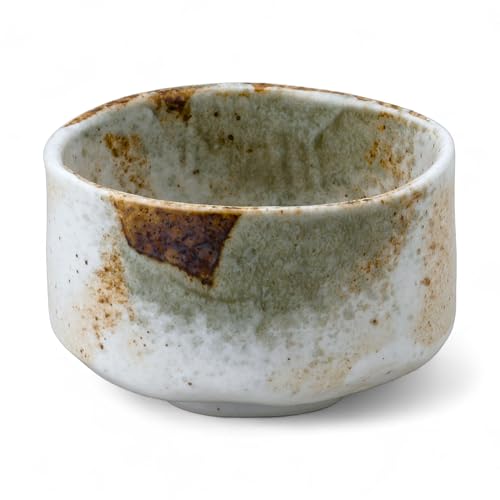
Mino ware, made in Japan, and the most straightforward listing on the page. Its first line is not a boast but a warning: the whisk, scoop and matcha are not included. That single sentence saves more disappointment than any feature here. The bowl itself is traditional pottery for the tea ceremony, finished with glazes that take on a different expression depending on where the piece sat in the kiln, so each one is genuinely its own. WELL ORIGIN also points out it works for soup, rice or dessert, which is an unusually plain way of saying a good bowl is a good bowl.
Pros:
- Mino ware, made in Japan; a real tea ceremony bowl
- Says plainly that whisk and scoop are not included
- Kiln-dependent glaze; every piece differs
- Works as an everyday bowl too
Cons:
- No dimensions published
- Bowl only; budget for a whisk on top
- Sells poorly
Best for: a real chawan when you already own the whisk.
Product of Gifu Japan
The best-judged bowl here on the numbers that matter. It is 12cm across and 7.5cm deep, holding 620ml, which is the largest capacity on this page and the shape a chasen actually wants: wide enough to whisk across, deep enough that the water stays in. It is handmade by artisans in Japan, so each piece is unique, and the navy glaze is scattered with soft white speckles. A real chawan, no spout, meant for drinking from. It publishes its dimensions where most of its rivals talk about a perfect size and leave it there.
Pros:
- 12cm wide and 7.5cm deep; the right shape for a whisk
- 620ml, the largest capacity here
- Handmade in Japan; each piece unique
- A true chawan with published dimensions
Cons:
- No whisk or scoop included
- Handmade means the color will vary from the photo
- Sells modestly
Best for: whisking properly in a bowl you drink from.
TAKEMI
The only complete answer here. A Mino ware chawan made in Japan arrives with the bamboo whisk and the bamboo scoop, which means one order and nothing missing, and that changes the price comparison entirely once you notice everything else is a bowl on its own. The glaze is hand applied with a wabi-sabi finish, and the foot is deliberately left unglazed to show the white clay underneath, which is a traditional detail rather than an oversight. Each bowl is patterned differently. It costs about twice the other made-in-Japan bowls and it is not really competing with them.
Pros:
- Bowl, bamboo whisk and bamboo scoop together
- Mino ware, made in Japan; hand-glazed
- Unglazed foot showing the natural clay
- Every bowl uniquely patterned
Cons:
- Most expensive item here by a wide margin
- No dimensions published
- Sells very little
Best for: starting from nothing, properly, in one order.
The verdict
BlendWell outsells everything else here several times over, and that tells you what most people are really buying: a tidy way to make a morning drink. If that is you, buy it and skip the rest. If you want the bowl itself to be part of it, the spout is the line, and these are the picks on the far side of it.
Best overall: Product of Gifu Japan. The only bowl here that gets both halves right. It is a real chawan with no spout, handmade in Japan, and it publishes the numbers that decide whether whisking works: 12cm across, 7.5cm deep, 620ml, the largest here. That is a bamboo whisk’s shape, wide enough to move and deep enough to stay in. Budget for a whisk; it is the bowl alone.
Best value: BlendWell. The best seller, and it earns it by being a real tool. Wide inside to whisk, a spout to pour into a mug, dishwasher safe for a habit you keep, and small enough to live in a drawer. It publishes no size and states no origin, and for a bowl that exists to get matcha into a cup every morning, neither is the point.
Best premium: TAKEMI. The only listing here that is a complete answer. A Mino ware bowl made in Japan, plus the bamboo whisk and scoop, so nothing else is needed. Compare it against a bowl plus a whisk bought separately and it stops looking as expensive as it first does. Hand-glazed, unglazed foot, no two the same.
FAQ
Is a bowl with a spout still a chawan?
Not really. A chawan is whisked in and drunk from, and the spout means you are pouring it somewhere else, which makes it a mixing bowl. BlendWell, CAMATET and HIBINO have spouts; Happy Sales, WELL ORIGIN, the Gifu bowl and TAKEMI do not. Both are useful. Just buy the one you meant to.
What size should a matcha bowl be?
Wide enough for the whisk to move sideways, which is what makes foam instead of lumps. Around 12 to 13cm across is traditional: the Gifu bowl is 12cm, CAMATET is 13cm. Happy Sales is 3.75 inches, under 10cm, and will feel tight. Volume matters less than diameter.
What is the difference between ceramic and glazed?
None, as a choice. Glaze is a glassy coating fired onto ceramic, so every bowl here is glazed ceramic. What actually differs is how the glaze was applied: HIBINO’s crystal glaze and WELL ORIGIN’s kiln-dependent finish form during firing, so each piece varies.
Do I get a whisk with the bowl?
Only with TAKEMI, which includes the bamboo whisk and scoop. WELL ORIGIN says in its first line that they are not included, which is worth the credit. Everything else is the bowl alone. Price the set, not the bowl.
Can I put it in the dishwasher?
BlendWell says yes. None of the handmade Japanese bowls claim it, and hand-glazed pottery with an unglazed foot is not made for that heat and detergent. If it will realistically go in the machine, buy the bowl that was built for it.
This article may contain affiliate links; see our Affiliate Disclosure.