The difference between gritty green sludge and a bowl of matcha with a fine, standing foam is about ninety seconds of technique and roughly four pieces of bamboo and ceramic. Neither is expensive. What trips people up is buying a beautiful bowl, no sifter, and a whisk that splays apart in two weeks because nothing was there to dry it on.
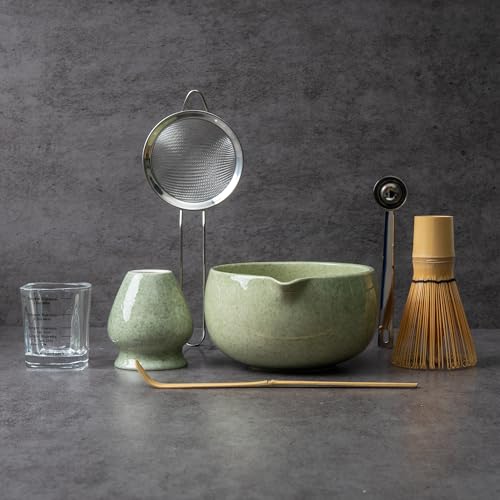


A complete kit means four working parts and one that quietly protects your investment: a bowl wide enough to whisk in, a bamboo chasen, a chashaku scoop, a sifter to break up clumps, and a holder that keeps the whisk in shape between uses. The sets below range from a tools-only kit for someone who already owns a bowl, to seven-piece boxes with a cloth and a scoop rest. All of them are tool sets – the tea itself is bought separately.
At a glance
| Product | Standout feature | Price tier | Link |
|---|---|---|---|
| YIBO Matcha Whisk Set With Bowl | Seven pieces including a measuring cup and 5 ml scoop | Mid-range | |
| Jade Leaf Matcha Traditional Starter Set | Tools plus a full-color handbook; no bowl included | Budget | |
| JUL WIND Matcha Whisk Set | Roughly 100-prong whisk and an 18 oz spouted bowl | Budget | |
| TEANAGOO 7 Pcs Matcha Whisk Set | Kiln-transformation bowl, cotton chakin, lead-free test reports | Premium | |
| Buucup 5 Pcs Matcha Set | Jade-green glazed 17 oz chawan; five essentials, nothing spare | Mid-range | |
How to choose a matcha starter kit
The sifter is not optional, whatever you have been told
Matcha is ground finer than flour, and fine powder clumps as it sits. Whisking alone will not break those clumps; it will suspend them, and you will find them at the bottom of the bowl. Pushing the powder through a small stainless sifter before adding water takes ten seconds and is the single step that separates a smooth bowl from a lumpy one. Every set here includes one, which is a good sign of a kit assembled by someone who actually makes matcha.
Prong count, and what it really changes
A chasen is cut from one piece of bamboo into fine tines. The kits here run from about 72 to 76 prongs up to around 100. More prongs move more air, so they build a finer, denser foam with less effort – the reason the hundred-prong style is the traditional choice for thin tea. The trade is fragility: finer tines are thinner tines, and they are the first thing to snap. For a beginner, a 72 to 76 prong whisk is more forgiving; if the foam is the point, go higher.
Spouted bowl or traditional chawan
A traditional chawan is a bowl you drink from, and the ceremony ends with it at your lips. A spouted bowl is a modern adaptation that pours cleanly into a glass, which is what most people actually want if matcha lattes are the destination. Four of the five sets here use a spout. It is a genuine improvement for lattes and a small departure from tradition – worth knowing which one you are buying, because the spout is not something you can add later.
Bowl size matters more than it looks
The bowls here run around 17 to 18 oz, which sounds enormous for a drink you make two ounces of. The volume is not for the tea; it is for the whisking. A wide, deep bowl gives the chasen room to move in a brisk W motion without slopping water over the rim. A narrow mug is exactly why home matcha goes wrong. If a set quotes a small bowl, it is a cup pretending to be a chawan.
The whisk holder is the part that pays for itself
A wet chasen dries with its tines curling inward and eventually splaying. A holder – a small ceramic dome the whisk sits on – keeps the tines spread in their original arc while air moves through them. It costs almost nothing and roughly doubles the working life of the whisk. Four of these five sets include one. Never put a chasen in a dishwasher, never leave it soaking, and rinse in warm water with no soap.
What is in the box, counted plainly
Piece counts are marketing arithmetic. A “seven-piece” set may count a scoop rest and a cloth alongside the bowl and whisk. Read the contents list rather than the number: bowl, chasen, chashaku, sifter, holder. Anything beyond those five is nice, not necessary. And none of these kits include matcha powder, so budget for the tea as a separate purchase – the tools last for years, the tea does not.
YIBO Matcha Whisk Set With Bowl – the most complete kit here
This is the most popular set in the group, and the contents list explains it. Alongside the expected bowl, whisk, ceramic holder, sifter and chashaku, YIBO adds a 5 ml measuring scoop and a measuring cup – the two things that turn a ritual into a repeatable recipe. Once you know your bowl is two grams to sixty milliliters, you stop guessing and start getting the same result twice. The bowl uses a thickened spout for clean pouring, a lead-free glaze, and a mottled green finish, and the bamboo is handmade.
Pros
- Seven pieces with everything essential accounted for
- Measuring scoop and cup make results repeatable
- Thickened spout designed against drips
- Lead-free, stain-resistant glaze
- Ceramic whisk holder included
Cons
- Prong count is not stated on the listing
- Bowl volume is not published
- Mid-range price for a first experiment
Best for: a first kit that leaves nothing to buy afterwards.
Jade Leaf Matcha Traditional Starter Set – tools only, and that is the point
Read the contents carefully: a bamboo chasen, a chashaku, a stainless sifter, and a printed preparation handbook. There is no bowl and no whisk holder. That is not an oversight – it is a set for someone who already owns a bowl they like, or who intends to whisk in something they have. If you have a wide cereal bowl and no tools, this is the cheapest legitimate route into whisked matcha. If you have no bowl and expected one, this is the wrong box. Jade Leaf is a well-established matcha brand, and the full-color handbook is genuinely aimed at first-timers.
Pros
- The three tools that matter, from a known matcha specialist
- Printed step-by-step handbook for beginners
- Lowest cost route in if you already have a bowl
- Elegant packaging that suits gifting
- Nothing redundant in the box
Cons
- No bowl included, despite “starter set” framing
- No whisk holder, so chasen life will be shorter
- No cloth or scoop rest
Best for: anyone who owns a suitable bowl and just needs proper tools and instructions.
JUL WIND Matcha Whisk Set – the fine-foam whisk at the low price
Six pieces at the lowest price here, and the whisk is the reason to look: roughly 100 hand-cut prongs, the fine-tined style that builds a proper crema-like foam rather than a few large bubbles. The bowl is a substantial 18 oz chawan with a spout, glazed inside with a dense finish that resists tea staining – a real consideration, since matcha stains porous ceramic quickly. The design borrows from folding-fan and wave motifs, and the set includes a tea towel, a bamboo scoop, a stainless sifter, and a whisk holder.
Pros
- Roughly 100 prongs for finer foam than most kits here
- Generous 18 oz bowl with a pouring spout
- Stain-resistant dense interior glaze
- Whisk holder and tea towel included
- Cheapest complete set with a bowl
Cons
- Fine prongs are more fragile in inexperienced hands
- Six pieces rather than seven; no scoop rest
- Pink colorway will not suit every kitchen
Best for: beginners who want the traditional fine-tined whisk without paying for it.
TEANAGOO 7 Pcs Matcha Whisk Set – the ceremony version
This is the only set here that includes a chakin, the cotton cloth used to wipe the bowl as part of the ceremony rather than as an afterthought – a sign the kit is aimed at the practice, not only the drink. The 510 ml spouted bowl is finished with a kiln-transformation glaze, where the firing produces color variation no two bowls share exactly. The whisk carries about 100 fine tines with a vegetable-oil finish for durability, and TEANAGOO states lead-free and mercury-free test reports for the ceramic. Seven pieces include a ceramic whisk holder and a separate ceramic scoop stand.
Pros
- Includes a cotton chakin for the full ceremony sequence
- Roughly 100 fine tines with a protective oil finish
- Kiln-transformation glaze makes each bowl individual
- Stated lead-free and mercury-free test reports
- Both a whisk holder and a scoop stand in ceramic
Cons
- The most expensive set here
- Kiln variation means your bowl will differ from the photo
- The extra pieces are ceremonial rather than functional
Best for: approaching matcha as a practice, or gifting to someone who will.
Buucup 5 Pcs Matcha Set – five pieces, no padding
Five pieces, and they are exactly the five that matter: a 500 ml spouted chawan, a bamboo chasen, a chashaku, a stainless sifter, and a whisk holder. Nothing ceremonial, nothing to store in a drawer unused. The emerald-green glazed bowl is the visual draw, finished with a smooth lead-free interior that rinses clean. The whisk runs around 76 tines, which is the sturdier end of the range and a sensible choice if the kit is going to be used daily by someone still learning the wrist motion.
Pros
- Exactly the five essential tools, no filler
- Large 500 ml spouted bowl with room to whisk properly
- 76-tine whisk is durable and beginner-tolerant
- Non-toxic lead-free glazed interior, easy to clean
- Whisk holder included to protect the chasen
Cons
- No cloth, scoop rest, or measuring tools
- Fewer tines means a coarser foam than the 100-prong sets
- Costs more than fuller kits here
Best for: daily matcha with the essentials and nothing to dust around.
The verdict
Best Overall – YIBO Matcha Whisk Set With Bowl. The best-selling set here, and the only one that includes measuring tools. That sounds minor until you have made three bowls in a row that tasted different for no reason you could name. Bowl, whisk, holder, sifter, scoop, plus a way to measure – it closes the loop for a beginner.
Best Value – JUL WIND Matcha Whisk Set. The cheapest complete kit with a bowl, and it does not economize where it counts: a roughly 100-prong whisk, a full 18 oz spouted chawan, a stain-resistant glaze, and a holder to keep the chasen alive. Very little reason to spend more.
Best Premium – TEANAGOO 7 Pcs Matcha Whisk Set. The chakin, the scoop stand, the fine-tined whisk and the kiln-transformation bowl make this the set for the ritual rather than the caffeine. Published lead-free and mercury-free testing adds a reassurance the others do not state.
FAQ
Do these kits include matcha powder?
No. Every set here is tools and ceramics only, so the tea is a separate purchase. That is normal, and arguably better: the tools last for years while powder is best used within weeks of opening, so tying them together would only mean stale tea.
Can I just use a milk frother instead of a bamboo whisk?
You can, and it makes a perfectly drinkable bowl. A frother whips air in aggressively and produces large bubbles that collapse quickly; a chasen’s fine tines suspend the powder and build a denser, longer-lasting foam. The bigger difference is the sifting step – skip that and neither tool will save you from clumps.
How do I look after a bamboo whisk?
Rinse in warm water immediately after use, with no soap and no soaking. Shake the water off gently and stand it on the holder to dry, which keeps the tines in their spread shape. Kept this way a chasen lasts many months of daily use. Losing an occasional tine is normal and not a defect.
Is a spouted bowl worth it, or should I get a traditional one?
If you drink matcha straight from the bowl, a traditional chawan is the authentic experience and pours nowhere. If you make lattes, the spout saves a mess every single time. Most people making matcha at home end up pouring it into something, which is why four of these five sets have a spout.
What water temperature should I use?
Below boiling. Water straight off a rolling boil scorches matcha and turns it bitter, which is the most common reason people conclude they dislike it. Let the kettle sit a minute or two, or use the cooler setting if you have one. The tools in these kits cannot fix water that is too hot.
This article may contain affiliate links; see our Affiliate Disclosure.