A thin laptop is a marvel until a game stutters or a render crawls, and its soldered-in graphics have nowhere to go. An eGPU enclosure hands that laptop a full desktop graphics card over a single cable, turning an ultrabook into a gaming rig at the desk and a featherweight on the road.


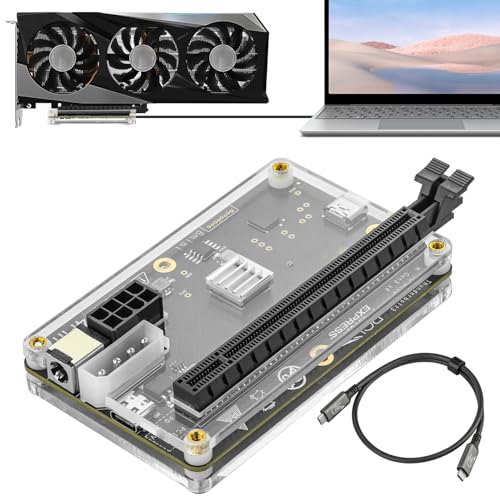
A Thunderbolt eGPU enclosure holds a desktop graphics card and connects it to a laptop through one Thunderbolt or USB4 cable, adding serious graphics power that thin machines simply cannot fit inside. This guide compares five enclosures, from affordable open docks to complete plug-and-play boxes, so gamers, creators, and anyone with a light Thunderbolt laptop can boost performance without buying a whole desktop. Understanding bandwidth, power, and card fit is what separates a smart purchase from a frustrating one.
| Product | Standout | Price tier | Link |
|---|---|---|---|
| GODLIY eGPU Dock | Best-selling, 40Gbps TB4/USB4, 85W charging | Mid-range | |
| ORARA Mini eGPU Dock | Compact open dock, daisy chain, 85W PD | Mid-range | |
| OwlTree eGPU Dock | Lowest price, flexible power inputs | Budget | |
| Razer Core X V2 | Complete enclosure, four-slot GPU, high bandwidth | Premium | |
| Sonnet Breakaway Box 850 | Built-in 850W PSU, triple-wide cards | Premium | |
How to choose a Thunderbolt eGPU enclosure
eGPU enclosures split into two very different kinds of product, and confusing them leads to disappointment. Start here.
Open dock or complete enclosure?
This is the decision that shapes everything else. An open dock is an exposed board that accepts a graphics card but usually needs you to supply your own external power supply and offers little enclosure or cooling, in exchange for a low price and a compact footprint. A complete enclosure is a finished box with a built-in power supply, a fan, and a proper slot, so you drop in a card, connect one cable, and go. Open docks reward tinkerers who already own a spare power supply and want to save money; complete enclosures suit anyone who wants a clean, reliable, plug-and-play result without sourcing parts.
Bandwidth: Thunderbolt 4, USB4, and Thunderbolt 5
The connection is the real bottleneck of any eGPU, so understand it. Thunderbolt 4 and USB4 provide 40Gbps of bandwidth, of which a portion is available to the graphics card, meaningfully less than the internal slot in a desktop. That is fine for a large performance jump over integrated graphics, but a top-tier card will not reach its full desktop potential over this link. The newer Thunderbolt 5 standard roughly doubles bandwidth to around 80Gbps, easing that bottleneck considerably and letting powerful cards stretch their legs. A few enclosures here use the older, cheaper controllers with even lower throughput, so match the link to your ambitions.
Power: for the card and for the laptop
Two separate power needs matter. First, the graphics card itself draws significant wattage, so the enclosure or your external supply must deliver enough, and a built-in power supply sized generously, such as several hundred watts, removes the guesswork and supports hungrier cards. Second, many enclosures deliver power back to the laptop over the same Thunderbolt cable, often up to around 85 watts, charging and running the machine so you need only one cable on the desk. Check both figures: the card’s power requirement against what the box provides, and the charging wattage against what your laptop needs.
Graphics card size and compatibility
Not every card fits every box, and this trips up buyers constantly. Complete enclosures typically state how many slots wide a card they accept, with the roomiest handling large triple- or four-slot desktop cards, while compact open docks may only fit smaller cards or leave a big card hanging unsupported. Confirm the physical length, width, and slot count of your intended card against the enclosure’s stated limits. Also verify driver support for your specific card and operating system, since eGPU setups generally suit Windows and Linux laptops with a Thunderbolt or USB4 port rather than every machine.
Ports, cooling, and everyday use
The extras decide how pleasant the enclosure is to live with. Some models add extra USB ports or a daisy-chain Thunderbolt port, turning the box into a dock that also connects peripherals and displays from one cable. Adequate cooling, whether a built-in fan or an open airflow design, keeps a hard-working card from throttling. Consider size and noise if the enclosure sits on your desk, and cable length for tidy placement. A confirmed Thunderbolt 4, Thunderbolt 5, or USB4 port on your laptop is required, so double-check your machine before buying any of these.
GODLIY eGPU Dock: the best-selling value option
The top seller here is a compact, affordable open dock built around the officially certified JHL7440 controller, delivering the full 40Gbps of a Thunderbolt 4, Thunderbolt 3, or USB4 connection for workstation-grade capability well beyond integrated graphics. It plays nicely with a wide range of Thunderbolt and USB4 laptops, mini PCs, and gaming rigs, and its TB4 port also pushes up to 85 watts back to charge your laptop over the same cable. A USB-A port and a daisy-chain port let it double as a modest dock for peripherals. The catch, typical of open docks, is that you supply your own power supply and there is no full enclosure, so it favors tinkerers. For a low-cost route to external graphics from a proven best-seller, it is a sensible pick.
Pros
- Affordable best-seller
- Full 40Gbps TB4/USB4 bandwidth
- Certified JHL7440 controller
- 85W laptop charging over one cable
- Extra USB-A and daisy-chain ports
Cons
- Requires your own power supply
- Open dock without full enclosure
- Limited support for the largest cards
Best for: value seekers comfortable supplying a power supply for external graphics.
ORARA Mini eGPU Dock: the compact open dock
ORARA’s mini dock covers similar ground to the best-seller in an even more space-conscious form. It, too, uses the certified JHL7440 controller to break past older bandwidth limits over a Thunderbolt 4, Thunderbolt 3, or USB4 connection, and its daisy-chain port supports strong performance and additional devices. Flexibility with power is a highlight: it works with ATX, SFX, FLEX, and DC 12V power supplies, so you can pair it with whatever you have on hand, and it delivers up to 85 watts of PD charging to the laptop. As with any open dock, you provide the power supply and forgo a full case. For a tidy, adaptable, budget-conscious external graphics setup, it is a flexible choice for those who like to build their own configuration.
Pros
- Compact open-dock design
- Certified JHL7440 controller
- Works with many power supply types
- Daisy chain for extra devices
- Up to 85W laptop charging
Cons
- Power supply not included
- No enclosure or built-in cooling
- Smaller cards fit best
Best for: builders who want a small, power-supply-flexible open dock.
OwlTree eGPU Dock: the lowest-cost entry
The OwlTree is the budget doorway into eGPUs, and it is honest about what it is. Built around the older JHL6340 controller, it delivers around 22Gbps rather than the full 40Gbps of newer Thunderbolt docks, which is a real cap on high-end cards but still a large step up from integrated graphics for many uses. It accepts any NVIDIA or AMD card with available official drivers, works with most Windows and Linux laptops and even some handhelds with a Thunderbolt port, and includes the Thunderbolt cable. Four flexible power input options, from a CPU connector to PD or a DC barrel, let you power it however suits your parts. For the lowest possible cost of entry, or a modest card, it gets the job done with clear-eyed limits.
Pros
- Lowest price here
- Includes the Thunderbolt cable
- Four flexible power input options
- Broad card and laptop compatibility
- Simple entry into eGPUs
Cons
- Lower ~22Gbps bandwidth
- Older controller limits top cards
- Open dock, supply your own power
Best for: the tightest budgets or modest cards where entry cost matters most.
Razer Core X V2: the complete high-bandwidth enclosure
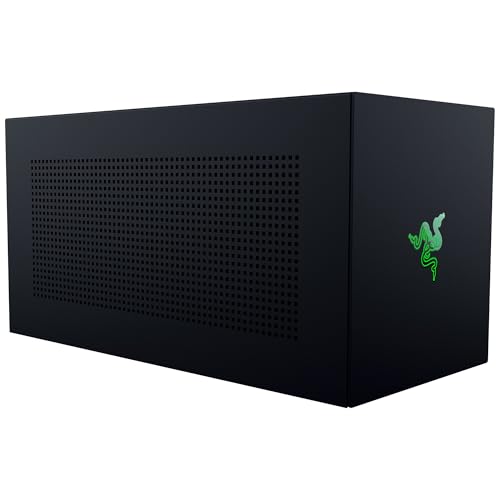
The Razer Core X V2 is a proper, finished enclosure aimed at people who want performance and simplicity together. It fits large PCIe desktop graphics cards up to four slots wide, giving a compatible laptop a substantial power boost, and it embraces next-generation Thunderbolt 5 for up to 80Gbps of bandwidth, roughly double the older Thunderbolt 4 ceiling, which meaningfully eases the eGPU bottleneck for powerful cards. It stays broadly compatible, working with Thunderbolt 4 and Thunderbolt 5 laptops and even USB4 gaming handhelds, and setup is as simple as connecting the included cable to add a graphics boost when you want it. As a clean, high-bandwidth, well-supported box from a known brand, it is the premium pick for serious gamers and creators.
Pros
- Complete plug-and-play enclosure
- Fits four-slot desktop cards
- Thunderbolt 5 up to 80Gbps
- Works with TB4, TB5, and USB4
- Simple single-cable setup
Cons
- Premium price
- Larger desktop footprint
- Full benefit needs a TB5 laptop
Best for: gamers and creators wanting a clean, high-bandwidth, big-card enclosure.
Sonnet Breakaway Box 850: the professional powerhouse
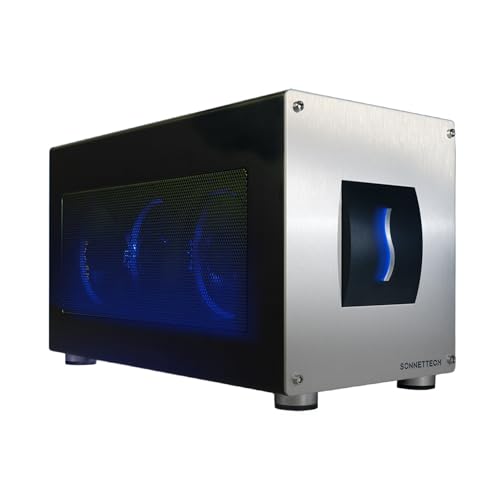
Sonnet’s Breakaway Box 850 is the enclosure for people who put no ceiling on the card inside. It pairs Thunderbolt 5 bandwidth of up to 80Gbps with a generous built-in 850-watt power supply, enough to feed today’s and tomorrow’s power-hungry graphics cards without a second thought, and it accepts triple-wide cards across current NVIDIA and AMD lineups. A large, variable-speed, temperature-controlled fan keeps everything cool under sustained load. This is squarely a professional tool, transforming a Thunderbolt 5 laptop into a near-desktop workstation that accelerates editing, rendering, color grading, animation, visual effects, and demanding AI workloads. It is the most expensive option here, but for maximum, reliable power with no power-supply worries, nothing else on the list matches its headroom.
Pros
- Large built-in 850W power supply
- Thunderbolt 5 up to 80Gbps
- Fits triple-wide desktop cards
- Strong temperature-controlled cooling
- Built for demanding pro workloads
Cons
- Highest price here
- Large and heavy
- Overkill for casual gaming
Best for: professionals who want maximum power and headroom with no power worries.
The verdict
These split between affordable open docks and complete enclosures. The best one depends on your budget, your card, and whether you want to tinker or just plug in.
Best Overall: GODLIY eGPU Dock – the best-selling dock that delivers full 40Gbps bandwidth and 85W charging at a low price, the value route to external graphics for the willing tinkerer.
Best Value: OwlTree eGPU Dock – the lowest cost of entry with a bundled cable and flexible power, a clear-eyed budget path to a big step up from integrated graphics.
Best Premium: Sonnet Breakaway Box 850 – a built-in 850W supply, Thunderbolt 5 bandwidth, and triple-wide card support for professionals who want maximum, worry-free power.
Frequently asked questions
Will an eGPU make my thin laptop as fast as a desktop?
It will dramatically improve graphics performance over a laptop’s integrated chip, but it usually will not match an identical card in a desktop. The Thunderbolt or USB4 connection provides less bandwidth than an internal slot, which caps how much of a powerful card’s potential comes through. Thunderbolt 5 enclosures narrow that gap considerably. For most gamers and creators, the boost is still large and very worthwhile, just not quite full desktop speed.
Do I need to buy a power supply separately?
It depends on the type. Open docks are typically sold without a power supply, so you provide your own to power the graphics card, which is why they cost less. Complete enclosures like the premium options here include a built-in power supply sized for demanding cards, so you only add the card. If you do not already own a suitable power supply and want simplicity, a complete enclosure with a built-in unit is the easier route.
Which laptops work with these enclosures?
You need a laptop with a Thunderbolt 4, Thunderbolt 5, or USB4 port, which covers many modern Windows and Linux ultrabooks and some gaming handhelds. Check your specific machine’s port before buying, since a regular USB-C port without Thunderbolt or USB4 will not work. Also confirm driver support for your chosen graphics card and operating system, as eGPU support is strongest on Windows and Linux.
How big a graphics card can I install?
That is set by the enclosure. Complete boxes state a maximum card size, with the roomiest accepting large triple- or four-slot desktop cards, while compact open docks suit smaller cards. Always compare your intended card’s length, width, and slot count against the enclosure’s limits before buying. Fitting a big card into a box that cannot support it, physically or in power terms, is a common and avoidable mistake.
Is Thunderbolt 5 worth waiting or paying for?
If you plan to run a powerful graphics card, yes, it can be. Thunderbolt 5 roughly doubles the bandwidth of Thunderbolt 4 to around 80Gbps, which eases the main eGPU bottleneck and lets a strong card deliver more of its performance. The catch is that you also need a laptop with a Thunderbolt 5 port to gain the full benefit; on a Thunderbolt 4 machine, these newer enclosures still work but at the lower bandwidth. Match the enclosure to your laptop and your card ambitions.
This article may contain affiliate links; see our Affiliate Disclosure.