A doorway pull-up bar tells you its limits the first time you hang a weight belt off your hips and it creaks. Bolt a bar into structural timber or masonry instead and the equation flips: the bar stops being the weak link, and the only thing left to fail is your grip.
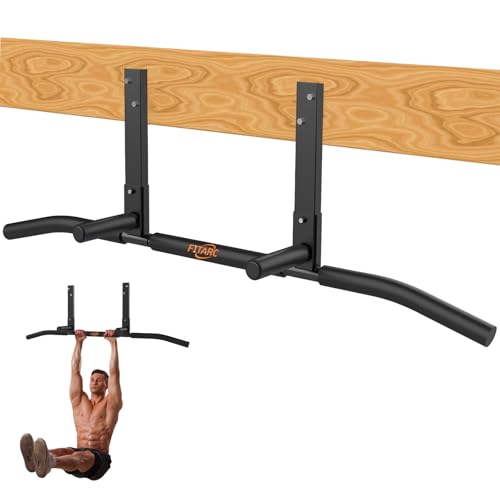


Once a bar is bolted to structure, three things decide whether it takes weighted work: the stated load rating, the clearance that lets you hang and swing without clipping a wall, and whether your building actually gives you the studs or joists the bracket needs. The five here cover both wall brackets and ceiling or joist mounts, at every price, and they suit a first strict pull-up as readily as a belt loaded with plates.
At a glance
| Product | Standout feature | Price tier | Link |
|---|---|---|---|
| Fitarc Joist Mount Pull Up Bar | 42-inch wide ceiling mount, thick weight-bearing tube, foam grips | Mid-range | |
| Fitarc Heavy Duty Wall Mount Pull Up Bar | Two neutral grips, band carabiners, spans two stud bays | Mid-range | |
| Yes4All Multifunctional Pull Up Bar | 300 lb rating, multi-grip foam positions, all hardware included | Budget | |
| Jusgym Wall Mounted Pull Up Bar | 500 lb rating, depth adjusts 19 or 27 inches, 1.27-inch steel bar | Premium | |
| SELEWARE Ceiling Mounted Pull Up Bar | 400 lb rating, four heights, five grips including ball finger grips | Premium | |
How to choose a mounted pull-up bar
Your building decides before you do
This is the step people skip and regret. A wall bracket needs solid wood studs or masonry behind it, and the bracket has a fixed bolt spacing that must land on them: the Fitarc wall bar, for instance, wants stud spacing of 32 to 36 inches, meaning it spans two bays at standard 16-inch centers. A ceiling or joist mount needs joists at 16 or 24-inch centers and enough headroom that your chin clears the bar. Drywall alone holds nothing. Before comparing anything below, find a stud finder and learn what your wall is made of, because that single fact eliminates half this list for most rooms.
Load rating, and why bodyweight plus plates is not the number
A 300 lb rating does not mean a 250 lb person can safely add 50 lb. Pull-ups are dynamic: dropping into a dead hang or kipping spikes the instantaneous load well past your static weight, and the anchors carry that spike, not the average. For weighted work the sane approach is a rating with real headroom over your loaded bodyweight. Among these, the Jusgym states 500 lb and the SELEWARE states 400 lb; the Yes4All states 300 lb, which is generous for bodyweight training but tight once plates come out.
Clearance is what makes a bar usable
Wall-mounted bars sit a fixed distance off the wall, and that gap is the difference between full range of motion and barked knuckles. Around 19 inches is enough for a strict pull-up. Muscle-ups, kipping, ring work or anything where your body travels want more, which is why the Jusgym offers a 27-inch setting. Ceiling mounts sidestep the problem entirely by putting you in open space, and they leave the wall free for other equipment.
Grips, width and knurl
Wide, narrow, neutral and angled grips all load your back differently, and a bar with several lets one purchase cover more training than a single straight tube. Foam is comfortable and kind to bare hands; it also compresses and eventually tears, and it is less secure than bare knurled steel once chalk and sweat enter the picture. Neutral (parallel) grips deserve special mention: they are the friendliest hand position for cranky elbows and shoulders, and they are the reason the Fitarc wall bar earns its place.
Accessory anchors
Rings or carabiners welded to the frame turn a pull-up bar into an anchor point for resistance bands, suspension trainers, gymnastic rings or a punch bag. It costs nothing extra at purchase and quietly doubles what the bar is for. Three of the five here include them.
Fitarc Joist Mount Pull Up Bar
The best-selling bar of this group is a ceiling mount, and that says something about how people actually solve this problem: hang it from a joist and you get open space in every direction instead of a wall in your face. It measures 42 inches wide, which is enough for a genuinely wide grip rather than a token one, and it is built around a thick weight-bearing tube with electrostatically sprayed paint that resists chipping where hardware rubs. The handles use high-density foam that stays grippy when wet. Fitarc is explicit that it mounts to a secure, solid joist and nothing else, and it ships with instructions plus installation videos.
Pros
- The most popular bar here, and by a wide margin
- Ceiling mount gives full range of motion with no wall to clip
- 42 inches wide, room for a true wide grip
- Thick load-bearing tube with chip-resistant coating
- Non-slip high-density foam handles
- Written instructions plus installation videos
Cons
- No published weight rating, which matters if you plan on heavy belted work
- Needs a solid joist and adequate headroom; no substitutions
- Fixed height once mounted
Best for: a garage or basement with exposed or locatable joists, and anyone who wants space to swing.
Fitarc Heavy Duty Wall Mount Pull Up Bar
The same maker’s answer for rooms with no usable ceiling. It is steel throughout with multiply-tested welds and a rust-proof black powder coat that holds up even if the wall happens to be outdoors. The feature worth buying it for is the pair of neutral grips: most wall bars in this price bracket give you a straight tube and nothing else, and parallel grips are both the most shoulder-friendly pull-up position and the easiest place to start if strict overhand reps are still out of reach. Carabiners on the frame take resistance bands or suspension straps. Installation is specific: stud spacing from 32 to 36 inches, mounted into solid wood studs.
Pros
- Two neutral grips as well as the standard positions
- Tested welds and heavy-duty steel construction
- Rust-proof powder coat, usable outdoors
- Carabiners built in for bands and suspension work
- Compact footprint for a small room
Cons
- Weight rating is not published
- Requires 32 to 36-inch stud spacing, which not every wall offers
- Wall clearance is fixed and modest
Best for: a spare room or garage wall, especially if elbows and shoulders prefer neutral grips.
Yes4All Multifunctional Pull Up Bar
The cheapest bar here is also the third best-seller, and it is the one that publishes a straight answer on load: 300 lb. Heavy-gauge steel, black powder coat against rust, multiple foam-padded grip positions, and every piece of mounting hardware in the box. It also carries a one-year warranty and a 30-day return window, which is worth more than it sounds on a product you are about to drill into your house. For bodyweight training, dead hangs, and building up to strict reps, it does the whole job for the least money.
Pros
- Lowest price of the group
- Published 300 lb capacity, no guesswork
- Multiple foam-padded grip positions
- Heavy-gauge steel with anti-corrosion powder coat
- All mounting hardware included
- One-year warranty and 30-day returns
Cons
- 300 lb leaves little headroom for heavy weighted reps
- No accessory rings or carabiners
- Modest wall clearance
Best for: bodyweight training on a budget, and a first mounted bar to replace a doorway one.
Jusgym Wall Mounted Pull Up Bar
If the heading of this article describes your actual plan, this is the bar built for it. The rating is 500 lb, the highest here, on a reinforced steel frame with industrial-grade bolts and a 1.27-inch thick bar, and it mounts to solid concrete or wooden wall. The genuinely clever part is adjustable depth: 19 inches keeps it tight to the wall for standard pull-ups in a narrow room, and 27 inches pushes it out far enough for muscle-ups and anything where your legs travel. It spans 51 inches, dual steel rings take gymnastic rings or bands, and it carries a one-year limited warranty with replacement parts.
Pros
- 500 lb rating, real headroom for belted and weighted work
- Depth adjusts between 19 and 27 inches for muscle-ups or tight rooms
- 1.27-inch thick steel bar, reinforced frame, industrial bolts
- 51 inches wide with dual steel accessory rings
- Mounts to concrete or solid wood
- One-year warranty with parts replacement
Cons
- Among the pricier options here
- The 27-inch depth needs a room that can spare it
- A 51-inch span demands a suitable stretch of solid wall
Best for: weighted pull-ups, muscle-ups, and heavier lifters who want the rating to stop being the question.
SELEWARE Ceiling Mounted Pull Up Bar
The most adjustable bar in the group, and the one that solves the ceiling-mount headroom trap. Safety hand screws set the drop to any of four heights, so a low basement ceiling and a tall user can coexist, and the mounting base fits joists at 12 or 24-inch spacing with screws for wood and concrete both. It is rated 400 lb on heavy-duty steel with an electrophoretic coating. Five grip positions include a ball finger grip, which is a niche inclusion that is not niche at all if you climb: hanging from spheres builds grip in a way a foam tube never will. Two rings take straps and bands, and it comes with a 30-day satisfaction promise.
Pros
- Four adjustable heights, a real fix for low ceilings
- 400 lb rating with advanced welding and protective coating
- Five grips, including ball finger grips for climbing and grip work
- Fits 12 or 24-inch joist spacing, hardware for wood and concrete
- Two accessory rings for straps and bands
- 30-day satisfaction promise
Cons
- The priciest pick here
- At 24 inches it is the narrowest bar of the five
- Ceiling mounting is a harder overhead job than a wall bracket
Best for: low or awkward ceilings, shared-height households, and climbers who want finger training built in.
The verdict
Best overall: Fitarc Joist Mount Pull Up Bar. It is the best-selling bar of this group, and the design reasoning holds up: 42 inches of width, a thick load-bearing tube, comfortable grips, and a ceiling mount that gives you clear air instead of a wall. If you have a joist to hang it from, it is the most bar for the money here. Its companion, the Fitarc wall mount, is the pick when the ceiling is not an option and neutral grips appeal.
Best value: Yes4All Multifunctional Pull Up Bar. The least expensive bar here publishes its 300 lb rating, includes the hardware, backs itself with a warranty, and is the third best-seller of the group. For bodyweight training it is all the bar most people need.
Best premium: Jusgym Wall Mounted Pull Up Bar. For heavy or weighted pull-ups specifically, the 500 lb rating and the 27-inch depth setting are the two specs that matter, and no other bar here offers both. The SELEWARE ceiling mount takes the same money in a different direction, trading width for four-way height adjustment and grip training.
FAQ
Can I mount a pull-up bar into drywall or plaster?
No. Drywall anchors are rated for pictures and shelves, not for a person’s whole bodyweight arriving suddenly. Every bar here bolts into solid wood studs, joists, concrete or brick. If you cannot locate structure behind the wall, a free-standing rack is the safer purchase.
Wall mount or ceiling mount?
Ceiling mounts give unrestricted range of motion, keep your wall free, and suit kipping or ring work, but they need joists and enough headroom above your head at the top of a rep. Wall mounts are easier to install and work in rooms with high or inaccessible ceilings, at the cost of a fixed clearance from the wall behind you.
What weight rating do I need for weighted pull-ups?
Take your bodyweight, add the heaviest belt load you realistically expect, then leave meaningful headroom on top for the dynamic spike of dropping into a hang. If that sum is anywhere near a bar’s rating, choose the next one up. This is the reason the 500 lb Jusgym exists.
How much clearance do I need behind the bar?
About 19 inches lets you do strict pull-ups without your knees or feet meeting the wall. If you intend to kip, do muscle-ups, or hang rings, you want closer to 27 to 30 inches, or a ceiling mount that removes the wall from the equation.
Can I hang rings, bands or a punch bag from these?
From the ones with built-in rings or carabiners, yes: the Fitarc wall mount, the Jusgym and the SELEWARE all provide anchor points and say so. Remember that a swinging bag or a band under tension applies force in directions a pull-up does not, so respect the bar’s rating with a wide margin.
This article may contain affiliate links; see our Affiliate Disclosure.