Buy a standing desk, use it standing for three weeks, then quietly discover that your old office chair leaves you typing at chin height. A drafting chair is the missing half of that purchase: a normal ergonomic chair on a taller gas cylinder, with a ring for your feet so your legs do not dangle.


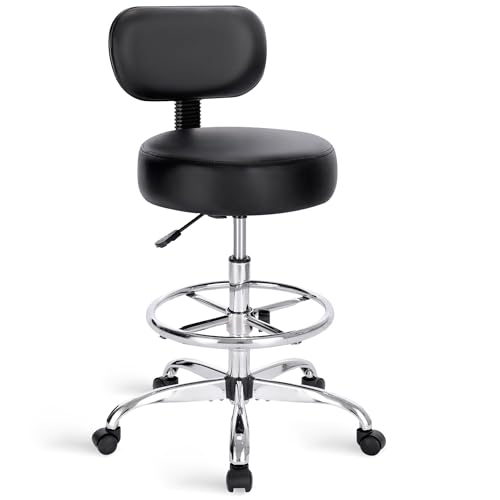


The good ones get three things right: a gas lift with enough travel to reach your desk, a footrest ring you can actually reposition as you change height, and a base wide enough that sitting tall never feels precarious. The chairs below cover standing desks, drafting tables, kitchen counters, lab benches and salon stations, whether you want full back support or a compact stool that tucks away.
At a glance
| Product | Standout feature | Price tier | Link |
|---|---|---|---|
| Primy Drafting Chair | Adjustable lumbar support, flip-up arms, mesh back, 3 in cushion | Premium | |
| Brick Attic Drafting Chair with Backrest | 300 lb base, detachable backrest, 7.87 in footrest travel | Mid-range | |
| SUPERJARE Drafting Chair with Back | 23.6-32.2 in seat range, 4 in cushion, 300 lb capacity | Mid-range | |
| Sweetcrispy Tall Drafting Desk Chair | Lumbar support doubles as a storage basket; mesh back | Budget | |
| Synorla Ergonomic Drafting Chair | 9 in of height travel, 3D mesh back, adjustable lumbar | Premium | |
How to choose a drafting chair
Seat height is the whole decision
Start with a tape measure, not a product page. Measure from the floor to the underside of your desk or bench, then subtract roughly ten to twelve inches for thigh clearance and the thickness of the seat. That is your target seat height. A counter at 36 inches wants a seat somewhere near 24 to 26 inches; a bar-height bench at 42 inches wants closer to 30. Then check the chair’s published seat range covers your number with room either side, because you want to sit inside the range rather than at its very top.
This is worth laboring because the category is loosely policed. Plenty of chairs sold as “drafting chairs for standing desks” have seat ranges topping out around 21 inches, which is an ordinary office chair with a footrest bolted on. If a listing quotes an overall height rather than a seat height, or quotes no height at all, take that as a warning rather than an oversight.
The footrest ring is not a garnish
Sit at counter height with your feet hanging and the whole weight of your legs pulls on the underside of your thighs. Within an hour that becomes numbness. The ring takes that load, and its adjustability matters as much as its presence: a fixed ring at the wrong height for your legs is nearly as bad as none. Look for a ring with several inches of travel, ideally seven or eight, so you can tune it once and forget it.
Backrest, detachable back, or none
Three shapes exist here. A full ergonomic back with lumbar support suits long focused sessions at a desk. A detachable backrest lets the same chair be a task chair in the morning and a compact backless stool at a bench in the afternoon. Armless designs pull in closer to a drafting table and slide right under a counter when you are done. None of these is better; they answer different rooms. What you should avoid is a token back that meets your spine in the wrong place, which is why an adjustable lumbar section is worth paying for if you sit for hours.
Stability rises in importance with height
A tall chair puts your center of gravity well above a five-star base, and leaning back to reach a shelf is how people discover the limit. Base diameter and material do the work: a wide chrome or steel base in the twenty-three-inch range resists tipping far better than a narrow plastic one. Weight capacity is a proxy for the same thing. Ratings here run from 250 to 350 pounds, and the higher numbers usually signal a thicker base plate and a better gas cylinder rather than an invitation.
Mesh or PU leather
Mesh breathes, which matters if you sit for long stretches or the room gets warm, and it is the more forgiving choice in summer. PU leather wipes clean in a second, which is why it dominates salons, labs, clinics and kitchens where something will eventually be spilled on it. For a home office, mesh backs with a padded seat tend to be the comfortable middle. Cushion thickness of three or four inches over high-density foam is the practical floor for all-day use.
Gas cylinder class and casters
The gas lift is the part that fails first on a cheap chair, usually by sinking slowly while you work. A cylinder described by class, or tested to a recognized standard, is a small sign that somebody checked. Casters are the other quiet detail: nylon dual-wheel casters roll quietly on hard floors without scarring them, and if your chair lives on carpet, larger wheels are worth seeking out.
Primy Drafting Chair with Flip-up Armrests
The best seller here by a wide margin, and the most complete chair of the group. It is the only one combining an adjustable lumbar support, a breathable mesh back, a three-inch high-density seat cushion with a waterfall front edge, flip-up armrests that fold ninety degrees out of the way, and an adjustable footrest ring. The five-claw base spreads load and keeps the roll quiet. In practice it behaves like a proper ergonomic office chair that happens to reach counter height, which is exactly what most standing-desk owners are looking for.
- Pros: Adjustable lumbar support, rare at this size; breathable mesh back for long sessions; 3 in high-density cushion with pressure-relieving edge; armrests flip up 90 degrees to tuck under a desk; adjustable footrest ring; stable five-claw base; one-year warranty.
- Cons: Premium tier; the listing does not publish a seat height range, so measure your desk and confirm before buying; mesh back is harder to wipe clean than leather.
Best for: Standing desks and home offices where the chair carries a full working day.
Brick Attic Drafting Chair with Backrest
This is the one that publishes its numbers, and they are good ones. A 23.6-inch five-star base on a 2mm-thick plate carries up to 300 pounds and makes tipping a non-issue. The footrest ring moves through 7.87 inches, the widest useful range here, so tall and short legs both get supported. The PU leather backrest curves to the spine and lifts off completely when you want a bare stool, and the memory foam under the 15.8-inch cushion is a step above the usual sponge. Silent rollers finish it.
- Pros: Wide 23.6 in base with a 2mm plate rated to 300 lbs; footrest ring adjusts through 7.87 in; backrest detaches for a compact stool; memory foam cushion; PU leather wipes clean; silent casters; suits offices, spas, labs, salons and kitchens alike.
- Cons: Quoted 33.86 to 41.75 in figures are overall height, not seat height, so measure carefully; PU leather runs warm on long summer sessions; no armrests at all.
Best for: Salons, clinics, labs and workshops where the chair must be wiped down and occasionally lose its back.
SUPERJARE Drafting Chair with Back
The clearest seat-height story in the group: 23.6 to 32.2 inches, an 8.6-inch stroke on a hydraulic gas lift, which covers everything from a tall desk to a bar-height bench without guesswork. The seat is the thickest here at four inches of high-density foam under waterproof, oil-resistant PU leather, which is a specific answer to tattoo studios, clinics and kitchens. The backrest detaches and the circular metal footrest adjusts, so it converts to a backless stool in seconds. A reinforced chrome base and five dual-wheel nylon casters carry 300 pounds without wobble, and assembly is tool-free in about five to ten minutes.
- Pros: Published 23.6-32.2 in seat range covers counters through bar height; 4 in high-density cushion, the thickest here; waterproof and oil-resistant PU leather; backrest detaches for a stool; reinforced chrome base to 300 lbs; quiet dual-wheel casters; tool-free assembly.
- Cons: No lumbar adjustment, just a shaped back; PU leather rather than mesh; no armrests.
Best for: Anyone who needs a specific, confirmed height range, and professionals who will spill things on the seat.
Sweetcrispy Tall Drafting Desk Chair
The budget pick, and the one with the idea nobody else had: the lumbar support doubles as a storage basket, so files and notebooks live in the small of the chair’s back rather than on your desk. Beyond the party trick it is a sensible chair. Seat height runs 23.43 to 29.33 inches, the footrest ring adjusts through eight inches, the back follows the spine’s curve, and the mesh keeps air moving. The upgraded higher-density foam has a waterfall edge to spare your thighs, and the gas cylinder is class 3, tested to hold 250 pounds.
- Pros: Lowest price here; published 23.43-29.33 in seat range suits most standing desks; 8 in footrest adjustment; flip-up arm; breathable mesh back; lumbar support doubles as storage; class 3 gas cylinder, independently tested; waterfall cushion edge.
- Cons: 250 lb capacity is the lowest of the group; the range stops short of true bar height; lumbar is fixed in position rather than adjustable.
Best for: A first drafting chair for a home standing desk, on a budget, without giving up the essentials.
Synorla Ergonomic Drafting Chair
Nine inches of height travel is the headline, and the chair is built around genuinely long sessions. The 3D mesh back is wear-resistant and moves air, the adjustable lumbar section can be set to meet your own lower back rather than an average one, and three inches of high-density foam sit under you. Flip-up armrests and a repositionable footrest ring handle the rest of the fit. A pentagon base and metal frame keep it planted, quiet PU casters protect floors, and the maker states it suits people from roughly 5 foot 3 to 6 foot 2, with an overall height of 46.5 to 51 inches and a 19.5 by 20.5 inch seat.
- Pros: 9 in of seat travel, the largest stroke here; adjustable lumbar support; 3D breathable, wear-resistant mesh back; flip-up armrests; repositionable footrest; pentagon metal base; quiet floor-safe PU casters; publishes seat dimensions and a user height range.
- Cons: Premium tier; the listing gives overall height rather than an explicit seat height range; mesh is harder to wipe than leather in a messy workspace.
Best for: Designers, architects and engineers who move between a drafting table and a standard desk through the day.
The verdict
Best overall: the Primy drafting chair. It is the strongest seller of the group and the only one pairing adjustable lumbar support with a mesh back, a thick contoured cushion, flip-up arms and an adjustable ring. That combination is what makes a tall chair survivable for eight hours rather than two.
Best value: the Sweetcrispy tall drafting desk chair. It costs the least and still publishes its seat range, adjusts the footrest through eight inches, breathes through a mesh back, and uses a tested class 3 cylinder. If you are under the 250-pound rating and your desk sits inside its range, the savings buy nothing you would miss.
Best premium: the Synorla for its nine inches of travel and adjustable lumbar. For a confirmed height range instead, the SUPERJARE is the safest measurement bet, and the Brick Attic has the widest, most stable base.
Frequently asked questions
What seat height do I need for my desk?
Measure floor to the underside of the desktop and subtract about ten to twelve inches. A 36-inch counter lands near 24 to 26 inches of seat height; a 42-inch bar-height surface lands near 30. Aim for the middle of a chair’s range rather than the top, so you have adjustment left in both directions.
Is a drafting chair just a bar stool with wheels?
No, though the height overlaps. A bar stool is fixed and built for short sits. A drafting chair adds a gas lift, a swivel, casters, a shaped and usually adjustable back, and a footrest ring positioned for someone working rather than resting. The ring in particular is what makes hours at counter height bearable.
Will the chair tip if I lean back?
A wide five-star base makes it unlikely within normal use, and the models here run to 300 or 350 pounds of rated capacity on steel or chrome bases. The risk rises when you push off a desk to roll backwards, or lean back and sideways at once to reach something. Tall chairs reward keeping your feet on the ring.
Can I use a drafting chair at a normal desk?
Yes, if its range goes low enough. Chairs with a wide stroke, such as the nine-inch Synorla or the SUPERJARE starting at 23.6 inches, drop close to ordinary desk height. Check the bottom of the range as carefully as the top, and remember the footrest ring will sit unused down there.
How long does assembly take?
Between five and twenty-five minutes depending on the model. The SUPERJARE is tool-free in five to ten; others take longer with a supplied hex key. The gas cylinder normally drops into the base under its own weight, and the seat presses on. It is a one-person job with a bit of floor space.
This article may contain affiliate links; see our Affiliate Disclosure.