The floor looks clean. The grout does not. Those gray lines running between every tile are the reason a freshly mopped bathroom still reads as dirty, and no amount of pushing a flat mop over them will change it, because a flat pad never touches the bottom of a recessed line.




Grout sits below the tile surface. That single fact decides everything about which tool works: a wide spinning pad rides across the tops of the tiles and skims the line, while a narrow tapered brush drops into it and scrubs the sides. Everything below is judged on whether it can reach the bottom of a grout line, keep turning once you lean on it, and let you do it standing up rather than on your knees.
At a glance
| Tool | Standout feature | Price tier | Link |
|---|---|---|---|
| YKYI Electric Spin Scrubber | Eight heads including a pointed grout brush | Budget | |
| VigorDay Electric Spin Scrubber | Handle stretches to 54 inches, battery readout | Budget | |
| SetSail Grout Brush | V-shaped head that straddles the line; no motor | Budget | |
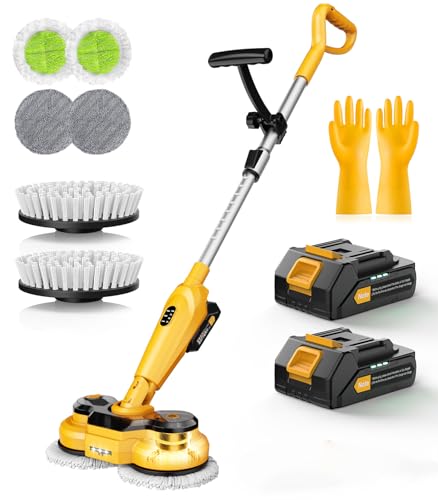
| qimedo Electric Mop M3 Pro | Mop and scrubber in one, with a water tank | Premium | |
| HOTO Wand Spin Scrubber | Twelve magnetic heads, fully submersible | Budget | |
| Qimedo Spin Scrubber Q2 Pro | Three speeds to 1,500 RPM, two batteries | Mid-range | |
How to choose a cordless scrubber for grout
The head shape matters more than the motor
This is the whole game. Grout lines are recessed channels, so a large flat disc spins across the tile and only grazes the top edge of the dirt. What reaches the bottom is a narrow brush: a pointed cone that follows the line, or a V-shaped head that straddles it and works both walls at once. Every electric pick here ships a bundle of heads for exactly this reason, and the pointed one is the only one that will do the job you bought the tool for. Count the heads, but look at their shapes first.
RPM is the number makers argue about, and it is not the one that matters
The spread here is wide. HOTO runs 170 or 250 RPM. YKYI offers 380 and 480. The qimedo Q2 Pro claims 800, 1,000 and 1,500 RPM, and its own copy takes a swing at rivals for managing only 380. Handle all of it carefully: those are unloaded figures, measured with the brush spinning in free air. The moment you press a head into a grout line, what keeps it turning is torque, not top speed. HOTO makes that argument explicitly and builds for torque at a low RPM instead. A slower head that keeps turning under pressure beats a fast one that bogs down.
Reach decides whether you finish the room
Grout cleaning fails because people give up, and people give up because they are on their knees. Handle length is the fix, and the numbers are real: the SetSail pole runs to 51 inches, the qimedo models to 50, VigorDay to 54, and YKYI covers 12 to 43.3 inches. The short end matters too. A handle that collapses to around a foot turns the same tool into a tub and shower scrubber, which is where most of these get used between floor jobs.
Water rating, because this happens wet
Every electric pick here is rated IPX7, which means sealed against immersion rather than just splashes. HOTO goes furthest and states the whole body can sit in three feet of water for half an hour. That sounds excessive until you are scrubbing a shower floor with the head under an inch of soapy water and the tool is the only thing between you and a live battery.
Runtime, and what the figure is measured at
Quoted runtimes cluster around 100 minutes for the budget scrubbers, and HOTO quotes 210 minutes at its low speed and 180 at its high one, which is the plain way to publish it. Note that qimedo’s 120 minutes for the Q2 Pro is quoted at the middle speed, not the 1,500 RPM headline. Nobody publishes runtime at maximum, because it would be short. Two batteries in the box, as both qimedo units ship, is worth more than a big number on one.
A scrubber is not a mop
Most of these tools scrub dry-ish, and you bring the water and the cleaner. The qimedo M3 Pro is the exception: it carries a 300 ml removable tank and sprays as it goes, so it washes and scrubs in one pass. If you want the grout scrubbed and the floor mopped in one trip, that is the only pick here that does both. If you already own a mop, you do not need it to.
YKYI Electric Spin Scrubber
The best seller of this group, and it earns it on head variety rather than raw power. Eight interchangeable heads run from a large flat brush for open floor to a pointed brush for grout lines and a corner brush for curved tub edges, which covers the awkward geometry of a real bathroom. Two speeds, 380 and 480 RPM, off a 2,600 mAh battery YKYI rates at roughly 100 minutes from a three to four hour charge. The stainless handle detaches and telescopes from 12 to 43.3 inches, so it works kneeling at a tub or standing at a floor.
Pros:
- Eight heads including a pointed grout brush and a corner brush
- Handle collapses to 12 inches for tub and sink work
- Around 100 minutes quoted runtime with USB-C charging
- IPX7 rated, with five LED charge indicators
Cons:
- Shortest maximum reach here at 43.3 inches
- 480 RPM is mid-pack on paper
- No water tank, so you wet the floor yourself
Best for: a bathroom with tile, a tub and awkward corners, all on one battery.
VigorDay Electric Spin Scrubber
The reach specialist. Its telescopic handle runs from 12 to 54 inches, the longest span in this group, which means the same tool covers a ceiling corner, a deep bathtub and the gap behind a toilet without you changing position. Seven heads cover tub, toilet, tile, stove top and crevices. Two speeds, 350 RPM for wood and delicate surfaces and 420 for grout and shower grime, run off a 3,000 mAh battery quoted at up to 100 minutes, and a digital display shows what is left rather than making you guess.
Pros:
- Longest reach here, 12 to 54 inches
- Battery readout instead of a guess
- Lower 350 RPM speed aimed at surfaces that scratch
- Largest battery of the budget scrubbers at 3,000 mAh
Cons:
- 420 RPM top speed is the lowest of the spin scrubbers
- Seven heads, one fewer than YKYI
- No water tank
Best for: high ceilings, deep tubs and anyone who would rather not bend.
SetSail Grout Brush
Read this one clearly: there is no motor and no battery. It is a stiff-bristled brush on a pole, and it is here because its head is the correct shape for the job in a way most powered heads are not. The V-shaped head straddles a grout line and works both walls at once, the bristles are stiff enough to resist bending into uselessness, and the three-section metal pole adjusts from 26.5 to 51 inches so you scrub standing up. The head swivels 180 degrees for angles. It costs a fraction of everything else here and asks for your shoulder instead of a charge.
Pros:
- V-shaped head purpose-built to straddle a grout line
- Adjusts from 26.5 to 51 inches, so no kneeling
- 180 degree swivel head for corners and angles
- Costs a small fraction of the powered tools; nothing to charge or break
Cons:
- Entirely manual, so the effort is yours
- One head shape, no versatility beyond lines and crevices
- Hard work on a large floor
Best for: a small tiled area, or testing whether powered is worth it at all.
qimedo Electric Mop M3 Pro
The only tool here that mops and scrubs on the same trip. A 300 ml removable tank feeds a pump that sprays water ahead of the heads, so you wash and scrub in one pass rather than wetting the floor first. Three speeds, 400, 600 and 800 RPM, run off a 6,000 mAh battery, and two batteries ship in the box. The heads counter-rotate, which cancels the pull that makes single-head machines wander. A 50 inch telescopic pole, a head that tilts 90 degrees, an LED lamp for dark corners, and a display showing charge and mode. qimedo says the handle design cuts the felt weight by 40 percent, which is their figure, not a measured one.
Pros:
- Sprays and scrubs in one pass; removable 300 ml tank
- Counter-rotating heads track straight instead of pulling
- Two 6,000 mAh batteries included
- LED head lamp and a charge and mode display
Cons:
- The most expensive pick here by a wide margin
- Mop heads are wide, so you still swap to a narrow brush for lines
- More machine than a small bathroom needs
Best for: a large tiled floor you want washed and scrubbed in one go.
HOTO Wand Spin Scrubber
The one that argues for torque over headline speed, and the argument is sound. It runs at 170 RPM for delicate surfaces or 250 for hard work, far below the rest, and builds for the grunt that keeps a brush turning when you lean on it. Twelve heads swap magnetically instead of screwing on, which matters when your hands are wet and soapy. The 2,000 mAh battery is quoted at 210 minutes on low and 180 on high, the longest here. It is fully submersible to three feet for thirty minutes, and the body sits at a 33.5 degree angle to spare your wrist. HOTO says it won a Good Housekeeping cleaning award and carries the seal.
Pros:
- Longest quoted runtime here, and plainly split by speed
- Twelve magnetic heads, swappable with wet hands
- Fully submersible, not just splash-proof
- Built for torque rather than an RPM headline
Cons:
- 250 RPM will read as underpowered next to rivals
- A short wand, so floor work means kneeling
- No extension pole in the box
Best for: showers, tubs and tight crevices where you are close in anyway.
Qimedo Spin Scrubber Q2 Pro
The power play. Three modes at 800, 1,000 and 1,500 RPM, which is several times what the budget scrubbers turn, off a removable 21 V battery, with a second one in the box so one charges while the other works. Eight brushes, four bristle and four cloth, and the head is sealed IPX7 so you can drop the whole thing in a tub of water. The 50 inch pole and a counter-rotating head keep it stable and standing-height. The runtime figure deserves a careful read: 120 minutes is quoted at the middle speed, not at 1,500 RPM.
Pros:
- Three speeds up to 1,500 RPM, the fastest here
- Two batteries, so no waiting mid-job
- Eight brushes, bristle and cloth
- 50 inch pole and a counter-rotating, sealed head
Cons:
- Runtime is quoted at mid speed, not the headline speed
- Costs roughly double the budget scrubbers
- High RPM does not help if the head stalls under pressure
Best for: big tiled areas where you want speed and a spare battery.
The verdict
Best overall: YKYI Electric Spin Scrubber. The best seller here, and the reason holds up: eight heads covering flat floor, grout lines and curved corners, on a handle that goes from 12 to 43.3 inches so the same tool does the tub and the floor. Around 100 minutes of runtime is enough for any bathroom. It wins nothing on the spec sheet and everything on having the right brush for each part of the job.
Best value: SetSail Grout Brush. No motor, no battery, a tenth of the price, and a head shaped correctly for the one job in the title. If your tiled area is a bathroom floor rather than an open plan kitchen, this does it, and the V-head reaches into a line better than most powered discs. You supply the effort. That is the entire trade.
Best premium: qimedo Electric Mop M3 Pro. It is the only pick that sprays, washes and scrubs in one pass, with two big batteries, counter-rotating heads that track straight and a lamp for the dark corners. On a large tiled floor it replaces two tools and two trips. On a small bathroom it is far more machine than the room deserves.
FAQ
Why does my mop leave the grout dirty?
Because grout sits below the tile. A flat pad spans the gap and touches only the top edge of the line, so it wipes the tile and skims the dirt. Reaching the bottom of a recessed channel takes a narrow, stiff brush, which is why every powered tool here ships a pointed head.
Does a higher RPM scrub better?
Not on its own. Those figures are measured with the brush spinning in open air. Press it into grout and what matters is torque, the grunt that keeps it turning under load. HOTO deliberately runs at 250 RPM and builds for torque instead. A slower head that does not bog down beats a fast one that stalls.
Can I use these in the shower while it is wet?
Yes. Every powered pick here is IPX7 rated, meaning sealed against immersion rather than splashes. HOTO states its whole body survives three feet of water for half an hour. Check the rating covers the body and not just the head, as some seal only the brush end.
Do I still need a cleaning product?
Usually. Only the qimedo M3 Pro carries water, and none of these dispense a cleaner. For set-in grout stains the makers suggest soaking the line for a few minutes before you scrub, which lets the chemistry do the work the bristles would otherwise fight for.
Is a scrubber or a mop the right tool?
Different jobs. A scrubber attacks lines and corners with small stiff heads. A mop washes an open floor. Only the M3 Pro tries both, and even it wants a narrow brush swapped in for the lines. If you already own a mop, buy a scrubber and keep them separate.
This article may contain affiliate links; see our Affiliate Disclosure.