Hit record once, look back later, and discover you caught the whole moment from every angle at the same time, the jump and the landing, your face and the view, the room and the doorway you walked through. That is the trick a 360 camera pulls off: it films everything around it, then lets you choose the shot afterward, including the impossible third-person view where the selfie stick simply vanishes.





The phrase “360 camera” covers more than one tool. Most of this lineup is built for immersive capture, dual-lens action cameras that stitch a full sphere for reframed video, virtual tours, and that signature drone-like selfie shot. A few are room cameras instead: 360-degree conference webcams that show everyone around a table, and a pan-and-tilt security camera that sweeps a room. Whether you are filming a ski run, documenting a property, vlogging hands-free, or covering a meeting, the picks below lead with the proven best sellers so the most-bought models come first.
| 360 camera | Standout features | Price | Link |
|---|---|---|---|
| Insta360 X5 | 8K30 360 video, dual 1/1.28″ sensors, triple AI chip low light, replaceable lenses | Premium | |
| Insta360 X5 Essentials Bundle | X5 camera plus extras, waterproof to 49ft, 208-min battery, 20-min fast charge | Premium | |
| DJI Osmo 360 | 1-inch 360 imaging, native 8K30, 105GB built-in storage, 120MP 360 photo | Mid-range | |
| Insta360 X3 | 5.7K 360 Active HDR, 4K single-lens mode, 2.29″ touchscreen, FlowState stabilization | Mid-range | |
| Insta360 X4 Air | Ultralight 165g, 8K30 360 video, replaceable lenses, Active HDR, AI editing | Mid-range | |
| AKASO 360 | 5.7K 360 video, dual 1/2″ 48MP sensors, 72MP 360 photo, AI subject tracking | Budget | |
| Insta360 X4 Standard Bundle | 8K or 5.7K60 360, 4K60 wide-angle, cold-resistant build, 135-min battery | Mid-range | |
| j5create JVCU360 webcam | 360 conference webcam, omnidirectional mic, 1080p30, six display modes, USB-C | Budget | |
| Cinnado D1 security camera | 2K pan-and-tilt 360 coverage, motion alerts, two-way audio, night vision | Budget | |
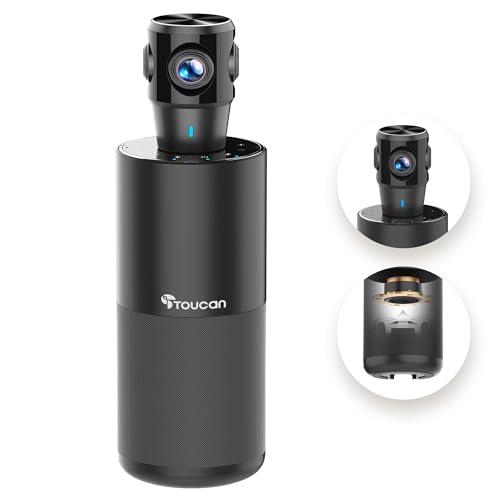
| TOUCAN conference camera | 360 conference camera, four noise-reduction mics, speaker, AI tracking, 1080p | Mid-range | |
The price column shows a general tier only. Prices move often, so tap a link for the live figure on Amazon.
How to choose a 360 camera
Start by naming the job. An immersive capture camera and a 360 room camera both say “360” on the box, but they solve opposite problems: one wraps a sphere of video around a moving subject, the other shows everyone or everything around a fixed point. Once the use case is clear, a handful of specs decide which model actually delivers.
Decide: immersive capture or room coverage
Dual-lens action cameras, the Insta360 X-series, DJI Osmo 360, and AKASO 360 here, stitch two ultra-wide lenses into a full sphere you reframe afterward into flat, shareable video. They are the tool for vlogs, sports, travel, and walk-through virtual tours. Room cameras work differently: the j5create and TOUCAN are conference webcams that capture a meeting table for video calls, and the Cinnado is a motorized security camera that pans and tilts to watch a space. They cannot produce reframable immersive footage, and the capture cameras are not meant to live on a desk for calls. Match the device to the task first; everything else is secondary.
Resolution and sensor size
With 360 footage you only ever watch a cropped slice of the full sphere, so resolution counts double. 5.7K is the practical floor for sharp reframed video, while 8K, on the X5, X4 Air, the X4 bundle, and the Osmo 360, gives noticeably more detail and bigger crops without turning soft. Sensor size matters just as much: larger sensors gather more light for cleaner low-light shots. The X5’s dual 1/1.28-inch sensors and the Osmo 360’s 1-inch imaging lead the pack here, with AKASO’s dual 1/2-inch 48MP sensors a capable step down.
Stabilization and horizon lock
Smooth footage is what separates a watchable clip from a queasy one. Insta360’s FlowState stabilization and AKASO’s 360 SuperSmooth flatten bumps without a gimbal, and full 360 horizon lock keeps the frame level even if the camera flips or spins completely, vital on a motorcycle, a bike, or skis. For anything fast-moving, take strong stabilization and horizon lock as non-negotiable.
The invisible selfie stick and reframing
The signature 360 trick is the invisible selfie stick: because the camera films everything, the pole holding it falls into the blind spot between the lenses and disappears, leaving a floating, drone-like third-person view. Pair that with shoot-first, frame-later reframing in the companion app and you stop aiming the camera entirely, just record, live the moment, and pick angles afterward with AI-assisted tools. Note that the selfie stick is often sold separately, so budget for one if that look matters.
Battery, storage, durability, and audio
Runtime decides how much you capture between charges; the X5 bundle’s 208 minutes and DJI’s up to 190 lead, and fast charging shortens downtime. Storage is the quiet differentiator, the Osmo 360 bakes in 105GB so you can shoot without a card, while the rest rely on microSD. For the outdoors, check waterproofing (the X5 dives to 49ft without a case) and lens protection; replaceable lenses on the X5 and X4 Air are a real money-saver since the exposed glass is the first thing to scratch. Finally, multi-mic arrays with wind guards keep narration clear, which matters for vlogs and tours alike.
Insta360 X5 (8K30 360, Dual 1/1.28″ Sensors, Triple AI Chip)
The best seller in this group is also the most capable immersive camera here. Dual 1/1.28-inch sensors shoot up to 8K30 360 video with strong clarity, color, and dynamic range, while a triple AI chip design drives the noise reduction that makes the X5 a standout in dim and night scenes, historically the weak spot of 360 cameras. It nails the fundamentals too: FlowState stabilization with full 360 horizon lock, the invisible selfie-stick effect with AI reframing, an InstaFrame mode that spits out a ready-to-share flat video instantly, and a 4-mic array with a new wind guard for clear voices. Tough, fully replaceable lenses mean a scratch costs a few dollars instead of the whole camera.
Pros
- 8K30 360 video from large dual 1/1.28-inch sensors
- Triple AI chip delivers leading low-light performance
- Replaceable lenses guard against costly scratch damage
- FlowState stabilization with full 360 horizon lock
- InstaFrame mode outputs a flat, shareable clip instantly
Cons
- Premium tier, the priciest standalone camera here
- Invisible selfie stick is sold separately
- 8K footage needs ample storage and a capable editing device
Best for: creators who want the sharpest, most low-light-capable immersive video and reframed shots.
Premium tier. Check price on Amazon
Insta360 X5 Essentials Bundle (X5 Plus Extras, 208-Min Battery)
This is the same flagship X5, sold as a bundle so you can start shooting properly out of the box rather than buying accessories piecemeal. Every X5 strength carries over, 8K30 360 capture on dual 1/1.28-inch sensors, triple AI chip low-light processing, FlowState stabilization with 360 horizon lock, replaceable lenses, and the wind-guarded 4-mic array. The bundle also spells out the endurance credentials: waterproof to 49ft without a case, up to 208 minutes of runtime on the upgraded battery, and fast charging to 80 percent in about 20 minutes. If you know you will need the extras anyway, buying them together usually beats assembling the same kit later.
Pros
- Flagship X5 performance with bundled accessories included
- Up to 208 minutes of runtime per the upgraded battery
- Fast charges to 80 percent in roughly 20 minutes
- Waterproof to 49ft without a separate dive case
- Replaceable lenses and triple AI chip low-light imaging
Cons
- Highest price in this comparison
- Bundle contents may overlap with gear you already own
- 8K editing is demanding on storage and hardware
Best for: buyers who want the top camera and the accessories sorted in a single purchase.
Premium tier. Check price on Amazon
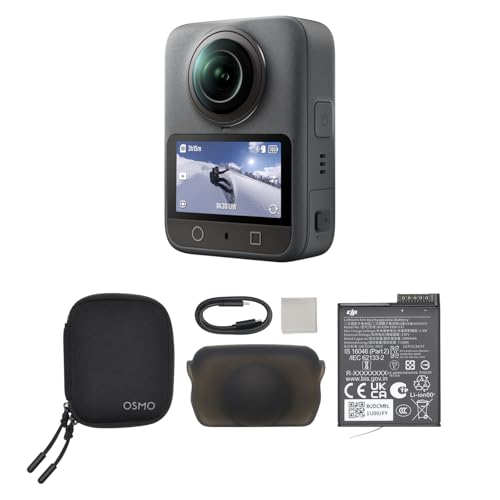
DJI Osmo 360 (1-Inch Imaging, Native 8K30, 105GB Built-In)
DJI’s entry counters the X5 with the largest imaging in the group, a 1-inch 360 sensor design that pulls in more light for sharper low-light shots, alongside native 8K30 360 video and enormous 120MP 360 photos. Its standout convenience is 105GB of built-in storage with up to 190 minutes of recording, so you can shoot all day without a memory card. A 1.2m invisible selfie stick turns it into a self-following cameraman, super-smooth 4K120 captures slow-motion action, and a magnetic quick-release swaps between 360 and single-lens vlogging in seconds. Four mics handle directional, true-to-life sound and connect to DJI wireless mics directly, and the Mimo app’s Pano tools simplify cinematic editing.
Pros
- Large 1-inch 360 imaging for strong low-light detail
- Native 8K30 video plus 120MP 360 photos
- 105GB built-in storage, no memory card required
- Up to 190 minutes recording and 4K120 slow motion
- Magnetic quick-release between 360 and single-lens modes
Cons
- Ties into the DJI Mimo app and accessory ecosystem
- Invisible selfie stick adds cost if not bundled
- Large built-in storage means offloading big files regularly
Best for: shooters who want big-sensor quality and card-free, all-day capture.
Mid-range tier. Check price on Amazon
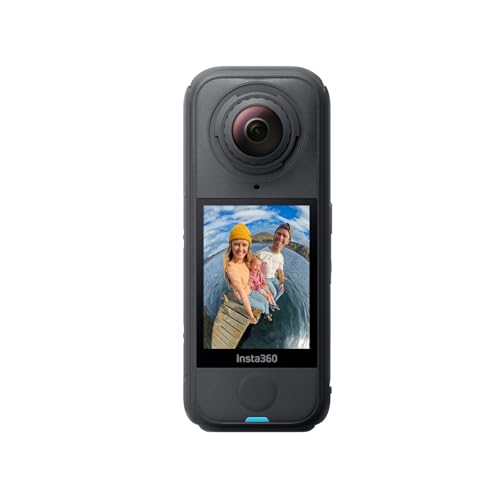
Insta360 X3 (5.7K 360 Active HDR, 4K Single-Lens, Touchscreen)
The X3 is the proven, lower-cost route into Insta360’s ecosystem and still a strong all-rounder. It captures 5.7K 360 Active HDR video, the practical floor for crisp reframing, and doubles as a single-lens action camera at 4K30 or a super-wide 170-degree MaxView at 2.7K60. A generous 2.29-inch touchscreen makes framing and playback easy right on the camera, while FlowState stabilization and horizon lock keep footage smooth and level. It does the invisible selfie stick and AI-powered reframing that define the format, just at lower resolution than the 8K models, which keeps file sizes and editing demands more manageable.
Pros
- 5.7K 360 Active HDR with reliable reframing quality
- Doubles as a 4K single-lens and 170-degree wide camera
- Large 2.29-inch touchscreen for on-camera framing
- FlowState stabilization and horizon lock included
- Lighter files and easier editing than 8K models
Cons
- 5.7K resolution trails the newer 8K cameras here
- Older sensors are weaker in low light than the X5
- Invisible selfie stick is not included
Best for: first-time 360 buyers who want the signature features at a friendlier price.
Mid-range tier. Check price on Amazon
Insta360 X4 Air (Ultralight 165g, 8K30 360, Replaceable Lenses)
The X4 Air chases a specific goal: 8K detail in the lightest possible body. At just 165 grams it nearly disappears in a pocket or on the end of a stick, yet its dual lenses still shoot 8K30 360 video with 8K30 Active HDR for balanced highlights and shadows in tricky light. It keeps the format essentials, the invisible selfie-stick effect, shoot-first-frame-later reframing, FlowState stabilization with 360 horizon lock, and AI-powered one-tap editing templates, and it adds rugged, easily replaceable lenses so a scratch is a cheap fix. For travel and everyday carry where weight is the enemy, this is the most portable 8K option in the lineup.
Pros
- Ultralight 165g body for travel and all-day carry
- 8K30 360 video with 8K30 Active HDR
- Replaceable lenses keep scratch repairs cheap
- FlowState stabilization with 360 horizon lock
- AI editing templates speed up sharing
Cons
- Smaller sensors than the X5 limit low-light gains
- Invisible selfie stick is sold separately
- Light build trades some of the X5’s ruggedness
Best for: travelers and vloggers who want 8K capture in the lightest body possible.
Mid-range tier. Check price on Amazon
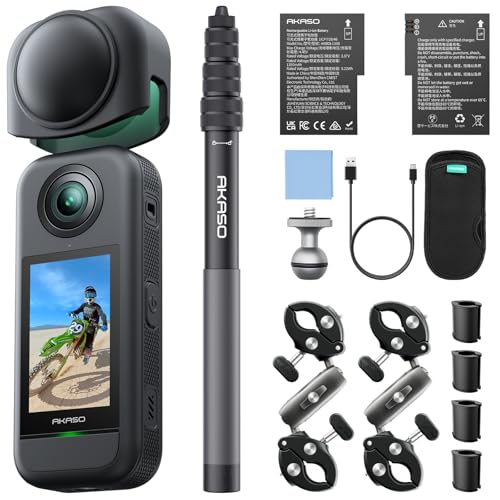
AKASO 360 (5.7K 360, Dual 1/2″ 48MP Sensors, AI Tracking)
AKASO’s 360 is the budget-friendly way to get the full 360 feature set, and it does not skimp on the headline tricks. Dual 1/2-inch 48MP sensors capture 5.7K 360 video and unusually sharp 72MP 360 photos, while 360 SuperSmooth in-app stabilization and 360 horizon lock keep footage level through flips and spins, no gimbal required. It covers the invisible selfie-stick effect, shoot-first-frame-later reframing, and AI subject tracking that keeps you centered in the frame. Sold as a motorcycle combo, it is squarely aimed at riders and action users who want immersive capture without the flagship price.
Pros
- 5.7K 360 video and sharp 72MP 360 photos
- Dual 1/2-inch 48MP sensors for more detail
- 360 SuperSmooth stabilization with horizon lock
- AI subject tracking keeps you centered
- Budget tier with the core 360 feature set
Cons
- 5.7K trails the 8K cameras for crop headroom
- Stabilization is applied in-app rather than in-camera
- Invisible selfie stick is not included
Best for: motorcyclists and action users who want immersive 360 shots on a tighter budget.
Budget tier. Check price on Amazon
Insta360 X4 Standard Bundle (8K or 5.7K60 360, Cold-Resistant)
The X4 bundle is the rugged-endurance pick among the Insta360 cameras. It shoots 8K 360 video or a smoother 5.7K60, plus a 4K60 single-lens mode and a 170-degree 4K30 MaxView, with Active HDR keeping colors accurate in action scenes. Built for harsh conditions, it shrugs off temperatures down to -4F, dives to 33ft without a case (164ft with the dive case), and uses upgraded, easy on-off lens guards. A larger 2290mAh battery delivers up to 135 minutes, 67 percent longer than the X3, with fast charging to get you back out quickly. It is a sensible step up from the X3 for anyone who films in cold or demanding environments.
Pros
- 8K or smoother 5.7K60 360 video options
- Cold-resistant to -4F and waterproof to 33ft uncased
- 4K60 single-lens and 170-degree MaxView modes
- Upgraded easy-on lens guards protect the optics
- Larger battery runs up to 135 minutes with fast charging
Cons
- Heavier than the featherweight X4 Air
- Lens guards protect but are not as cheap as full lens swaps
- Selfie stick not included in the standalone version
Best for: cold-weather and rough-condition shooting where durability and battery life matter most.
Mid-range tier. Check price on Amazon
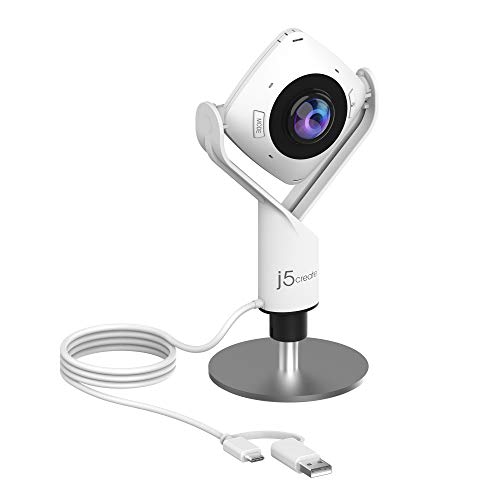
j5create JVCU360 (360 Conference Webcam, Omnidirectional Mic)
This one is a different animal: a 360-degree conference webcam, not an immersive capture camera. Set it in the middle of a table and its omnidirectional view and built-in mic bring everyone in the room into the call, with six display modes for different seating layouts and a touch bar to specify who is speaking. It outputs Full HD 1080p at 30fps, connects over USB-C as a plug-and-play UVC/UAC device, and works with the usual conferencing apps, Zoom, Microsoft Teams, Google Meet, and more. It will not produce reframable 360 video for editing, but for hybrid meetings it solves a real problem cheaply.
Pros
- 360 table view captures the whole meeting room
- Built-in omnidirectional microphone for group audio
- Six display modes for different seating arrangements
- Plug-and-play USB-C, broad conferencing-app support
- Budget tier and simple to deploy
Cons
- Conference webcam, not an immersive capture camera
- 1080p only; no reframable 360 video output
- May need a firmware update for full functionality
Best for: small meeting rooms that need every seat visible on hybrid video calls.
Budget tier. Check price on Amazon
Cinnado D1 (2K Pan-and-Tilt 360 Security Camera)
The Cinnado D1 is a 360-degree indoor security camera, achieving its full-room view by motorized pan and tilt rather than dual-lens capture. It streams crisp 2K video to a phone app and sweeps to cover every corner on demand, with four 940nm IR lights for clear night vision. Smart motion detection sends instant push alerts, records 10-second clips, and can trigger a siren, while two-way audio lets you talk to pets, kids, or visitors. It supports microSD and optional encrypted cloud storage for 24/7 recording, and works with Alexa and Google Assistant. Note it is wired and 2.4GHz only, and like the conferencing webcams, it is for monitoring, not immersive video.
Pros
- 2K video with motorized 360 pan-and-tilt coverage
- Night vision via four infrared lights
- Motion alerts, clip recording, and a deterrent siren
- Two-way audio plus microSD and cloud storage options
- Works with Alexa and Google Assistant
Cons
- Security camera, not an immersive capture device
- Wired indoor use only; not battery powered
- Connects to 2.4GHz Wi-Fi only
Best for: watching a room, nursery, or pets with full pan-and-tilt coverage and alerts.
Budget tier. Check price on Amazon
TOUCAN 360 Conference Camera (Four Mics, Speaker, AI Tracking)
The TOUCAN is the meeting-room counterpart to the j5create, a 360-degree conference camera built to make hybrid calls feel face to face. It captures omnidirectional 1080p video so everyone around the table is visible, with AI tracking to follow the active speaker, four noise-reduction microphones for clear voices, and a built-in speaker so it works as an all-in-one call device. Plug-and-play setup means no fussy install, and it integrates with Zoom, Microsoft Teams, and other platforms across PC, Mac, and tablet. It scales from a small huddle room to a larger conference space, but like the j5create it is a meeting tool, not a camera for immersive footage.
Pros
- 360 omnidirectional 1080p view of the whole table
- AI tracking follows the active speaker
- Four noise-reduction mics plus a built-in speaker
- Plug-and-play across PC, Mac, and tablet
- Works with Zoom, Teams, and other platforms
Cons
- Conference camera, not an immersive capture device
- 1080p only; no reframable 360 video
- Mid-range price for a meeting-only tool
Best for: teams that want an all-in-one camera, mics, and speaker for conference rooms.
Mid-range tier. Check price on Amazon
The verdict
Best overall
The Insta360 X5 is the clear top pick. It is the best seller here and the most complete immersive camera, pairing 8K30 360 video from large dual 1/1.28-inch sensors with a triple AI chip that finally tames low light, the historic weak spot of the format. Add FlowState stabilization with full horizon lock, the invisible selfie-stick effect with AI reframing, instant flat-video output, and replaceable lenses that make scratches a cheap fix, and it does nearly everything well. Check price on Amazon
Best value
The AKASO 360 wins on value. It delivers the full 360 experience, 5.7K video, sharp 72MP photos, SuperSmooth stabilization with horizon lock, the invisible selfie-stick effect, and AI subject tracking, from the Budget tier. You step down from 8K and the stabilization is applied in-app, but for immersive capture without flagship pricing, it gives up little that matters day to day. Check price on Amazon
Best premium
The DJI Osmo 360 is the premium alternative for image quality. Its 1-inch 360 imaging is the largest here for low-light detail, it shoots native 8K30 plus 120MP photos, and 105GB of built-in storage lets you film all day with no memory card. For shooters invested in card-free convenience and big-sensor clarity, it is the standout. If you would rather have the bundled, dive-ready flagship kit, the Insta360 X5 Essentials Bundle is the premium choice there. Check price on Amazon
Frequently asked questions
How does an invisible selfie stick work?
A 360 camera films everything around it with two ultra-wide lenses, and the thin pole holding it sits in the small blind spot directly between those lenses. When the software stitches the two views into one sphere, the stick falls into that gap and disappears, leaving a floating, drone-like third-person shot. The selfie stick is often sold separately, so budget for one if that look is the reason you want a 360 camera.
What resolution do I actually need for 360 video?
Because you only ever watch a cropped slice of the full sphere, effective resolution is lower than the headline number. 5.7K is the practical minimum for sharp reframed video, which is why the X3 and AKASO hold up well. Stepping to 8K, on the X5, X4 Air, X4 bundle, and Osmo 360, gives noticeably more detail and lets you crop in further without the image turning soft, at the cost of larger files and heavier editing.
Are conference webcams and security cameras the same as immersive 360 cameras?
No, and the distinction matters. The j5create and TOUCAN are 360 conference webcams that show a whole meeting room on video calls, and the Cinnado is a pan-and-tilt security camera that sweeps a space. None of them produce the reframable spherical footage that the dual-lens action cameras capture. If your goal is immersive video, virtual tours, or the invisible selfie-stick effect, choose one of the capture cameras; the room cameras solve a different problem.
Can a 360 camera shoot normal flat video too?
Yes. The capture cameras here all reframe their sphere into standard flat clips, and several double as conventional action cameras, the X3 and X4 offer 4K single-lens and ultra-wide MaxView modes, and the Osmo 360 swaps to a single lens in seconds. So you can get the impossible 360 angles when you want them and ordinary point-and-shoot footage the rest of the time from one device.
Do I need a powerful computer or phone to edit 360 footage?
The companion apps do the heavy lifting and make basic reframing easy on a phone, but 8K files are large and demanding. For smooth editing, especially with the X5, X4 Air, X4 bundle, or Osmo 360, a recent phone or a reasonably capable computer helps a lot, and plenty of fast storage is essential. The 5.7K X3 and AKASO produce lighter files that are friendlier to modest hardware.
This article may contain affiliate links; see our Affiliate Disclosure.