Go looking for a 56V or 80V trimmer here and you will not find one. Not a single listing on this page states either voltage. What they state instead is 20V, 21V and 40V, and the best-selling trimmer in the category runs on the smallest of those. That gap between what people search for and what people buy is the most useful thing on this page.




Voltage is a proxy anyway. What actually cuts a thick weed is the torque reaching the string and how thick that string is, and those two numbers are published far less often than the ones on the front of the box.
At a glance
| Trimmer | Standout feature | Price tier | Link |
|---|---|---|---|
| KOMASTY 20V | Cheapest here; two batteries, folds three ways | Budget | |
| HTCFLY 21V | The only 21V here, which is the same pack | Budget | |
| BLACK+DECKER 20V MAX | Talks about torque instead of RPM | Mid-range | |
| WORX 20V | The best seller here; head tilts 90 degrees | Mid-range | |
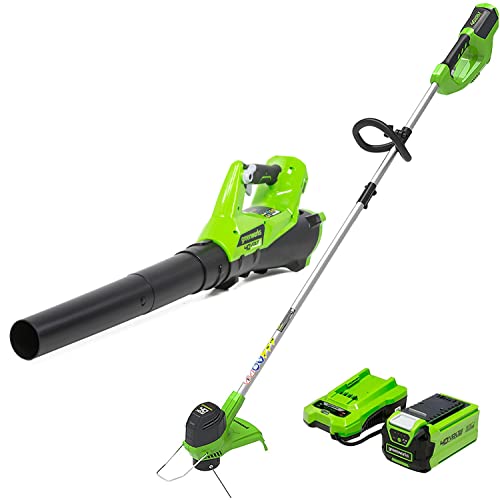
| Greenworks 40V | The highest voltage here; blower included | Mid-range | |
| EGO POWER+ 15-Inch | Brushless, weather rated, 0.095 inch line | Premium | |
| EGO POWER+ 16-Inch | Loads its own line at the push of a button | Premium | |
How to choose a battery string trimmer
20V and 21V are the same battery
HTCFLY calls its pack 21V and everybody else calls theirs 20V, and this is not a difference in the hardware. A five-cell lithium pack sits at about 20 volts nominal and rises to roughly 21 when fully charged, so a brand can print either number plainly and pick whichever reads better. Nothing about the tool changes. It is worth knowing because it is the clearest example of how voltage is marketed in this category, and it is why 40V from Greenworks is a genuine step and 21V from HTCFLY is not.
The line thickness is the specification that cuts
Two trimmers here tell you what string they throw, and the difference is enormous. EGO’s 15-inch uses 0.095 inch line. Greenworks uses .065. That is nearly fifty per cent thicker, which is the difference between slicing a bramble and bouncing off it, and it is also why thicker line lasts longer before it wears back into the spool. Everyone else stays quiet. If you are cutting grass, .065 is fine and cheaper to refill. If you are cutting the stuff choking a fence line, the number matters more than the voltage.
RPM without torque is a number, not a claim
Notice which brands lead with revolutions. KOMASTY quotes 9,500 RPM and HTCFLY 9,000, and both are among the cheapest here. The premium tools do not quote RPM at all. That is because a motor spinning fast with little behind it stalls the moment the string meets something thick, and free-running speed is measured with the string touching nothing. BLACK+DECKER is the only brand here talking about the other half, describing a PowerDrive Transmission that boosts torque at the string. Torque is what does not stop.
Brushless is the real efficiency difference
EGO’s 15-inch is the only trimmer here naming a brushless motor, and it explains the consequences properly: longer run times from the same battery, lower vibration through your hands, and a longer motor life because there are no brushes to wear out. It also carries an IPX4 weather rating, which nothing else here mentions on a tool that lives in wet grass. Brushed motors are cheaper and that is why the budget end uses them. Over a few seasons, the difference shows up as a tool that still runs.
Reloading line is the job everyone hates
Winding a spool by hand, in a hedge, with the light going, is the reason trimmers end up in the shed. Every brand here has an answer and they are not equal. The cheap tools use automatic feed, which dispenses line as you work: KOMASTY senses length and feeds, HTCFLY pushes out about half an inch each time you pull the trigger. WORX uses a push-button command feed. EGO’s 16-inch goes furthest with POWERLOAD, where you thread the line through and press a button and the tool winds itself, plus LINE IQ that monitors and feeds automatically as you cut.
Two batteries beats a bigger one
Runtime claims are shorter than you expect in this category, and the real ones say so: KOMASTY quotes 30 minutes and ships two 2.0Ah packs to cover it, while EGO’s 16-inch claims up to 60 minutes on one. For most gardens, a second battery on charge is worth more than a bigger single, because you keep working rather than stopping for an hour. Look at what is in the box: the cheap trimmers here include two batteries and a charger, and the premium ones often quote a runtime that depends on a battery sold separately.
KOMASTY 20V
The cheapest trimmer here and the second best-selling, which together explain a lot about this category. Two 2.0Ah batteries and a charger come in the box, covering a stated 30 minutes of work with a spare already on charge, which is the plain way to sell runtime. The shaft folds 180 degrees in three different ways, so it hangs in a cupboard rather than leaning in a corner, and that is a real consideration in a flat. The motor spins to 9,500 RPM and the automatic feed detects line length and feeds without bumping.
Pros:
- Cheapest trimmer here; the second best seller
- Two 2.0Ah batteries and a charger included
- Shaft folds 180 degrees three ways; stores in a cupboard
- Automatic line feed with no bumping
Cons:
- 30 minutes of runtime; the shortest stated here
- Leads with RPM, which says nothing about torque
- No line thickness published
Best for: a small garden and a cupboard rather than a shed.
HTCFLY 21V
The only 21V trimmer on this page, and it is worth understanding that this is the same battery everyone else calls 20V, quoted at its fully charged figure rather than its nominal one. Both numbers are true. Beyond the label it is a capable cheap tool: 9,000 RPM through a 12-inch swath, two 2.0Ah batteries, and a genuinely thoughtful adjustment set with a handle that rotates 180 degrees and a cutting angle that swings through 80. The line feed pushes out about half an inch every time you pull the trigger, which is predictable rather than clever.
Pros:
- Two 2.0Ah batteries included
- Handle rotates 180 degrees; cutting angle adjusts through 80
- Predictable line feed on every trigger pull
- Very cheap; switches to edging with one button
Cons:
- 21V is the same pack everyone else calls 20V
- Leads with RPM; no torque or line thickness given
- Sells well behind the cheaper KOMASTY
Best for: awkward angles, at the cheap end, once you ignore the label.
BLACK+DECKER 20V MAX
The only trimmer here that talks about the right thing. Its PowerDrive Transmission is described as boosting torque at the string, which is what actually keeps a trimmer cutting when the string meets a thick stem rather than spinning freely in air. Everyone at this price quotes RPM instead. It also names its battery, the LBXR2520, and quantifies what it does: 66% more runtime than the standard pack, which is a specific claim rather than extended. Two speeds trade power against runtime, the AFS system feeds line automatically, and it converts to a wheeled edger.
Pros:
- The only trimmer here describing torque rather than RPM
- Names its battery and quantifies the gain: 66% more runtime
- Two speeds; trade power against runtime
- Automatic line feed; converts to a wheeled edger
Cons:
- No line thickness published
- Brushed motor; no weather rating stated
- Sells poorly for such a well-known name
Best for: thick stems, from the one brand describing what cuts them.
WORX 20V
The best-selling trimmer in this category, and the features are the practical kind rather than the impressive kind. The head tilts 90 degrees, which is what lets you cut a bank, a ditch or under a bench instead of standing at the wrong angle wishing it would. It converts from trimmer to edger in seconds, on rubberized wheels that guide the cut and give you a straight line rather than a wobble. Command Feed puts line out at the push of a button, so nothing is bumped on the ground. It is a 20V tool, which is what most people actually buy.
Pros:
- The best-selling trimmer in this category
- Head tilts 90 degrees; cuts banks and awkward angles
- Rubberized wheels guide the edger for straight lines
- Push-button command feed; no bumping
Cons:
- 20V; no line thickness or motor type published
- No runtime figure stated
- Costs more than double the cheapest 20V trimmers
Best for: most gardens, which is what the sales say.
Greenworks 40V
The highest voltage on this page and the only genuine step up from the 20V crowd. Forty volts is twice the platform, and Greenworks sells the consequence rather than the number: a 12-inch commercial-grade head with .065 auto-feed that it says will slice through inch-thick weeds. The kit adds a blower at 110MPH and 390CFM for the driveway afterwards, on the same 2.0Ah battery, and that battery then powers the rest of the 40V range, which is the real argument for picking a platform rather than a tool. Sixty-minute charge.
Pros:
- 40V; the only genuine voltage step here
- Publishes its line: .065 auto-feed
- Blower included at 110MPH and 390CFM
- Battery powers the whole 40V range
Cons:
- .065 line; EGO throws nearly 50% thicker
- 2.0Ah is a small battery for 40V
- No motor type or runtime published
Best for: buying into a platform rather than a single tool.
EGO POWER+ 15-Inch
The best-specified trimmer here on the numbers that decide whether it cuts. The line is 0.095 inch, professional grade and dual feed on a spiral twist, which is the thickest string on this page by a wide margin and the reason it goes through weeds rather than round them. The motor is brushless, and EGO spells out what that buys: longer runtime from the same charge, low vibration, and a motor that outlives a brushed one. It carries an IPX4 weather rating, which nothing else here mentions on a tool used in wet grass. Rapid-Reload lines up arrows and threads through. Variable speed throughout.
Pros:
- 0.095 inch line; the thickest here by a wide margin
- Brushless motor; longer runtime, low vibration, longer life
- IPX4 weather rated; the only rating on this page
- 15-inch swath with variable speed control
Cons:
- No runtime figure published
- Costs well over the 20V trimmers
- Rapid-Reload still means threading it yourself
Best for: thick weeds, in the wet, for several seasons.
EGO POWER+ 16-Inch
The one that abolishes the worst job in gardening. POWERLOAD means you thread the line through the head and press a button, and the tool winds its own spool, which anyone who has knelt in a hedge doing it by hand will recognize as the entire product. LINE IQ then monitors and feeds the line as you cut, so it maintains its length without you bumping the head on anything. The shaft is telescopic carbon fiber, so it adjusts to your height and weighs less doing it, and EGO quotes up to 60 minutes of runtime, the longest here.
Pros:
- POWERLOAD winds its own spool at the push of a button
- LINE IQ monitors and feeds the line automatically as you cut
- Telescopic carbon fiber shaft; adjusts to your height
- Up to 60 minutes; the longest stated runtime here
Cons:
- The most expensive trimmer here by a wide margin
- No line thickness published, unlike the 15-inch
- The 60 minute figure depends on which battery you fit
Best for: never winding a spool by hand again.
The verdict
The premise is worth restating: nothing here is 56V or 80V, and the best-selling trimmer in the category is 20V. Voltage is a proxy anyway. Line thickness and torque are what cut.
Best overall: EGO POWER+ 15-Inch. It publishes the two things that matter and nobody else does. The line is 0.095 inch, nearly half again thicker than the .065 elsewhere, which is the difference between cutting a bramble and bouncing off it. The motor is brushless, which EGO explains plainly as longer runtime, less vibration and a longer life, and it carries an IPX4 rating on a tool used in wet grass. Everything else here is quieter about both.
Best value: KOMASTY 20V. The cheapest trimmer here and the second best-selling, with two 2.0Ah batteries and a charger in the box, which is the plain way to sell a 30 minute runtime: keep one on charge and keep working. The shaft folds 180 degrees three ways so it lives in a cupboard. It leads with RPM, which tells you nothing, and for a small garden none of that matters.
Best premium: EGO POWER+ 16-Inch. POWERLOAD is the feature worth paying for, because winding a spool by hand in a hedge is why trimmers end up abandoned in sheds. Thread the line, press a button, done. LINE IQ then keeps the length right while you cut, and the telescopic carbon fiber shaft fits you rather than the other way round. Up to 60 minutes, on a battery you should check is included.
FAQ
Where are the 56V and 80V trimmers?
Not on this page. No listing here states either voltage. What is stated is 20V, 21V and 40V, and the best seller in the category is 20V. If you specifically need a higher-voltage platform, you are shopping for a brand ecosystem rather than a trimmer, and this is not the page for it.
Is 21V better than 20V?
It is the same battery. A five-cell lithium pack sits around 20 volts nominal and about 21 fully charged, so brands print whichever number they prefer. HTCFLY says 21V and everyone else says 20V, and nothing about the tool differs. Greenworks at 40V is a real step; 21V is not.
What actually decides whether it cuts thick weeds?
The line and the torque. EGO’s 0.095 inch string is nearly 50% thicker than the .065 on the budget tools, which is the difference at a fence line. BLACK+DECKER is the only brand here describing torque at the string. RPM, which the cheap tools lead with, is measured with the string touching nothing.
Does brushless matter?
Over a few seasons, yes. EGO’s 15-inch is the only trimmer here naming one and explains it correctly: more runtime from the same battery, less vibration, and no brushes to wear out. Brushed motors are cheaper, which is why the whole budget end uses them.
How much runtime do I need?
Less than you think, if you have a spare. KOMASTY quotes 30 minutes and ships two batteries so one charges while you work. EGO’s 16-inch claims up to 60 on one. Check what is in the box, because a runtime figure often assumes a battery that is sold separately.
This article may contain affiliate links; see our Affiliate Disclosure.