An induction hob only heats the metal actually touching the glass. That single fact reorders this whole page, because flat bottom is not a yes or no: the flat base on these woks ranges from 5 inches to 6.7, on pans up to 14 inches wide. And one brand is plain enough to tell you its bottom is not completely flat at all.


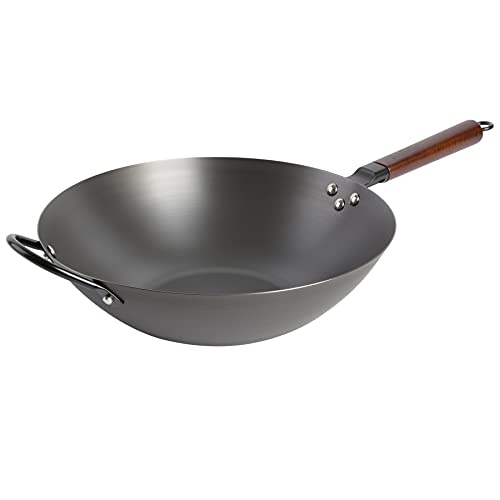


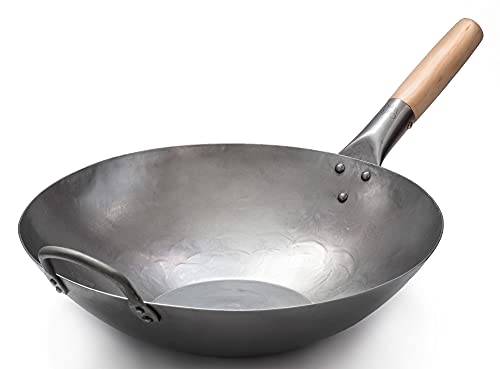
Carbon steel is the right material and everybody here agrees on that. It takes heat a nonstick pan cannot survive, it builds its own slick surface from oil rather than a coating, and it lasts decades. What separates these seven is how much of that steel your hob can actually reach.
At a glance
| Wok | Standout feature | Price tier | Link |
|---|---|---|---|
| EdoEats 12.6-Inch | Cheapest here; nitrided, and names what it lacks | Budget | |
| FGJ 13-Inch | Glass lid included; 5.8 quarts | Budget | |
| Souped Up Recipes | Lid and spatula included; care instructions | Budget | |
| Babish 14-Inch | Biggest pan here on a 6 inch base | Mid-range | |
| SUMEIGUAN 13.5-Inch | 6.7 inch base, the widest; publishes its weight | Mid-range | |
| YOSUKATA 13.5-Inch | Best seller here; seasoned above 600F | Premium | |
| Craft Wok 14-Inch | Hand hammered, and says it is not fully flat | Premium | |
How to choose a wok for induction
The flat base diameter is the whole specification
Induction generates heat in the metal directly above the coil, and only where the pan touches. So on a 14-inch wok with a 6-inch flat base, you have a 6-inch frying pan with very tall sloped sides that get their heat second-hand by conduction. That is not a flaw, it is how a flat-bottom wok works on an electric hob, and it is why the base measurement matters more than the pan measurement. SUMEIGUAN publishes 6.7 inches, the widest here. Babish publishes 6. EdoEats publishes 5. Everyone else leaves it out.
One brand admits its bottom is not flat
Craft Wok says something in its own listing that its competitors would never print: the wok has a flattened bottom suitable for flat electric and flat induction stoves, and it is not 100% flat. That is fair and it is important. A base with any curve rocks on a glass hob, contacts less metal, and heats a ring rather than a circle. For a gas ring, where flame wraps up the sides, none of that matters and a hand-hammered wok is a joy. For the exact use this page is about, that sentence is a warning, and Craft Wok deserves credit for printing it.
Nitriding is not seasoning
EdoEats is the only wok here with a nitrided surface, and it is worth understanding as a different thing entirely. Seasoning is polymerized oil, built up in layers, that you can strip by scrubbing or lose to a tomato sauce. Nitriding is a heat process that alters the steel itself for rust resistance, underneath any seasoning, and it does not wash off. EdoEats also does the thing nobody else bothers with and names what is absent: no PTFE, no PFOA, no Teflon, no PFAS-based coating, just factory seasoning on sealed steel.
Gauge decides how it behaves
Two brands here name a thickness properly. Craft Wok is 15 gauge, which it helpfully translates to 1.8mm, and EdoEats is also 1.8mm. YOSUKATA’s blue steel version quotes 15 gauge. Thicker steel holds heat, so it recovers faster when a pile of cold vegetables lands in it, and it takes longer to get going and weighs more in your wrist. Thinner steel responds instantly and drops temperature the moment you load it. Neither is better. On induction, where the heat arrives through a small circle, the thicker pan spreads it further.
Weight is the number for a pan you toss
A wok is the only pan you throw food in the air with, so its weight is not a footnote. SUMEIGUAN is the only brand here that publishes one, at 3.68 lbs or about 1.7 kilos, which is genuinely manageable one-handed. Everyone else says lightweight or heavy-duty and expects you to guess. On a 14-inch pan in heavy gauge, that guess can be wrong by a lot. If you plan to toss rather than stir, ask before ordering, because a wok too heavy to lift is a large frying pan.
Check what comes with it and what the handle is
The extras here are worth counting. FGJ includes a glass lid, which turns a stir-fry pan into something you can braise or steam in. Souped Up Recipes includes a lid and a spatula and, more usefully, both written and video care instructions aimed squarely at people whose last carbon steel wok went rusty. Craft Wok fits a steel helper handle opposite the wooden one, which is what lets you lift a full 14-inch pan with two hands and hang it on a hook afterwards. SUMEIGUAN uses solid wood, long, and stays cool.
EdoEats 12.6-Inch
The cheapest wok here and the most precisely described. It is 1.8mm carbon steel with a nitrided surface, which is a heat care for rust resistance built into the steel rather than a layer of oil on top of it, and that is a genuinely different proposition from seasoning alone. EdoEats then names what is absent, which almost nobody does: no PTFE, no PFOA, no Teflon, no PFAS-based coating. It publishes everything else too, 21.7 by 12.6 by 3.1 inches overall with a 7.9-inch riveted wooden handle and a steel helper loop. The flat base is 5 inches, the smallest here.
Pros:
- Cheapest wok on this page
- Nitrided surface; rust resistance in the steel, not just the oil
- Names what is absent: no PTFE, PFOA, Teflon or PFAS coating
- Publishes full dimensions, handle length and base size
Cons:
- 5-inch flat base; the smallest contact patch here
- 12.6 inches; the smallest pan on this page
- Barely sells; an unknown brand
Best for: knowing exactly what you are buying, cheaply.
FGJ 13-Inch
Thirteen inches and 5.8 quarts of pre-seasoned carbon steel with a glass lid, and the lid is the reason to look. A wok with a lid stops being a stir-fry pan and starts being the most versatile thing in the kitchen: you can steam in it, braise in it, and finish a curry under cover, and glass means you can see it happening without letting the heat out. FGJ says the flat bottom suits just about any cooktop from gas to induction, and the steel is premium black carbon that heats quickly and builds its own nonstick from use.
Pros:
- Glass lid included; steam and braise as well as fry
- 5.8 quart capacity across 13 inches
- Pre-seasoned; naturally nonstick with use
- Cheap, and it sells reasonably well
Cons:
- No flat base diameter published
- No gauge or weight stated
- Premium carbon steel is not a specification
Best for: one pan that fries, steams and braises.
Souped Up Recipes
The one that expects you to fail and helps you not to. Alongside a 12.5-inch pre-seasoned wok, a lid and a spatula, it includes written and video care instructions, and the listing names the reason: people whose last carbon steel wok went rusty. That is the actual failure mode of this entire category and nobody else on this page addresses it at all. The steel has no Teflon coating and takes very high heat without complaint, and it is built specifically for electric, induction and gas alike. Instructions are not a glamorous feature. They are why the pan survives.
Pros:
- Written and video care instructions; addresses the real failure
- Lid and spatula included
- Built for electric, induction and gas explicitly
- No Teflon; takes very high heat and scratches
Cons:
- 12.5 inches; small for a family stir-fry
- No flat base diameter, gauge or weight published
- Sells modestly
Best for: a first carbon steel wok that does not end up rusty.
Babish 14-Inch
The biggest pan here and one of only three telling you the number that matters: 14 inches across, on a 6-inch flat bottom. That ratio is the real picture of a flat-bottom wok on induction, and Babish printing it in the first line rather than burying it is worth noticing. The steel is heavy gauge for rapid, even heat, and the handles are riveted wood, which stay cool and do not work loose the way a screwed handle eventually does. It absorbs oil to build its own nonstick surface, which is the whole point of carbon steel.
Pros:
- Publishes its flat bottom: 6 inches, on a 14-inch pan
- The largest pan here; room for a family portion
- Riveted wooden handles; cool and secure
- Heavy gauge for rapid, even heat
Cons:
- 14 inches with a 6-inch base; most of the pan heats indirectly
- Heavy gauge and no weight published
- Sells modestly
Best for: a big pan, with the base size stated up front.
SUMEIGUAN 13.5-Inch
The best-judged wok here for the job in the title. Its flat base is 17cm, or 6.7 inches, which is the widest on this page and therefore the most metal your induction coil can actually reach, and SUMEIGUAN explains why it did that: heat stability and room to work. It is also the only brand publishing a weight, 3.68 lbs or about 1.7 kilos, which is light enough to toss one-handed on a 13.5-inch pan. The handle is extra long solid wood that stays cool at high heat. Pre-seasoned against the rust that ends most carbon steel woks.
Pros:
- 6.7 inch flat base; the widest contact patch here
- The only wok publishing its weight: 3.68 lbs
- Light enough to toss one-handed at 13.5 inches
- Extra long solid wood handle stays cool
Cons:
- No gauge published
- Lighter means less heat retention when food lands
- No lid included
Best for: induction, where the base size is the specification.
YOSUKATA 13.5-Inch
The best-selling wok here, and the seasoning claim is the specific one: pre-seasoned at over 600F using their own technique, which is a temperature rather than an assurance and is hot enough to polymerize oil properly rather than just coat it. That matters because a badly seasoned wok arrives sticky and stays sticky. It is high-grade black carbon steel with an ergonomic handle, 13.5 inches across, and YOSUKATA is right that it is not only a stir-fry pan: pan-frying, braising and deep-frying all suit the shape. No base diameter, gauge or weight is published.
Pros:
- The best-selling wok on this page
- Pre-seasoned at a stated temperature, over 600F
- High-grade black carbon steel; ergonomic handle
- 13.5 inches; suits frying, braising and deep-frying
Cons:
- No flat base diameter published, which is the induction number
- No gauge or weight stated
- Costs well over the cheaper woks here
Best for: arriving properly seasoned, which is where most woks fail.
Craft Wok 14-Inch
The most accurate listing on this page and the one to think hardest about. Craft Wok tells you plainly that the bottom is flattened and not 100% flat, which no competitor would print and which is exactly what you need to know before putting it on a glass hob. It is 14 inches of 15 gauge, 1.8mm, commercial-grade steel, hand hammered in Guangzhou, and the hammering is not decoration: it work-hardens the metal and gives food texture to climb. A steel helper handle opposite the wooden one lets you lift it full and hang it after. On gas, this is a wonderful pan.
Pros:
- States plainly that the bottom is not 100% flat
- Hand hammered in Guangzhou; commercial grade
- 15 gauge, 1.8mm, with the translation given
- Steel helper handle for lifting full and hanging up
Cons:
- Not fully flat is a real problem on an induction hob
- The most expensive wok here; no weight published
- Sells poorly outside professional kitchens
Best for: a gas ring, where the flame wraps the sides anyway.
The verdict
One measurement decides this page and only three woks publish it. Induction heats the metal touching the glass, so a 14-inch pan on a 5-inch base is a small frying pan with tall sides. Find the base diameter, then choose.
Best overall: SUMEIGUAN 13.5-Inch. Its flat base is 6.7 inches, the widest here, which on an induction hob means more of the pan is actually being heated rather than waiting for conduction. It is also the only wok on this page that tells you what it weighs, 3.68 lbs, which is the number that decides whether you toss food or push it around. Long solid wood handle, pre-seasoned against rust, and no lid.
Best value: EdoEats 12.6-Inch. The cheapest wok here and the most precisely described: 1.8mm steel with a nitrided surface, which resists rust in the metal itself rather than relying on a layer of oil you can scrub off. It names what is absent, no PTFE, PFOA, Teflon or PFAS coating, and publishes its dimensions, handle length and 5-inch base. That base is the smallest here, and at least you know it.
Best premium: YOSUKATA 13.5-Inch. The best seller, and the reason is the part that ruins most carbon steel woks: seasoning. YOSUKATA quotes a temperature, over 600F, which is hot enough to polymerize oil into a real surface rather than leave it sticky, and a wok that arrives properly seasoned is a wok you keep. It publishes no base diameter, which on this page is the one thing worth asking about.
FAQ
Why does the flat base size matter so much?
Because induction only heats metal touching the glass. A 14-inch wok on a 6-inch base is a 6-inch pan with tall sloped sides that get heat second-hand. SUMEIGUAN publishes 6.7 inches, Babish 6, EdoEats 5. The other four do not say, and it is the number that decides how the pan cooks.
Is any of these not actually flat?
Craft Wok says so itself: flattened, and not 100% flat. That is fair and it matters, because a base with any curve rocks on glass and heats a ring rather than a circle. On a gas ring it is irrelevant and the wok is superb. On induction, believe the warning.
What is nitriding, and is it better than seasoning?
Different, not better. Seasoning is polymerized oil you can scrub off or lose to an acidic sauce. Nitriding, which only EdoEats has here, is a heat process that changes the steel itself for rust resistance underneath any seasoning. Most woks rust because the seasoning failed; nitriding gives you a second line.
How heavy should a wok be?
Light enough to lift with food in it. Only SUMEIGUAN says, at 3.68 lbs for a 13.5-inch pan, which is tossable one-handed. Everyone else says lightweight or heavy-duty. On a 14-inch heavy-gauge pan that guess can be badly wrong.
Why do carbon steel woks go rusty?
Because the seasoning is a layer of oil, and water plus time beats it. Souped Up Recipes is the only brand here that names the problem and ships written and video care instructions to answer it. YOSUKATA’s answer is arriving properly seasoned in the first place, at a stated 600F.
This article may contain affiliate links; see our Affiliate Disclosure.