The best-selling product on this page is not a cable machine. It is a pulley, a cable and a loading pin, and it assumes you already own a rack to hang it from and a pile of weight plates to thread onto it. That is a genuinely good product and a very different purchase, and it is the first thing to sort out.


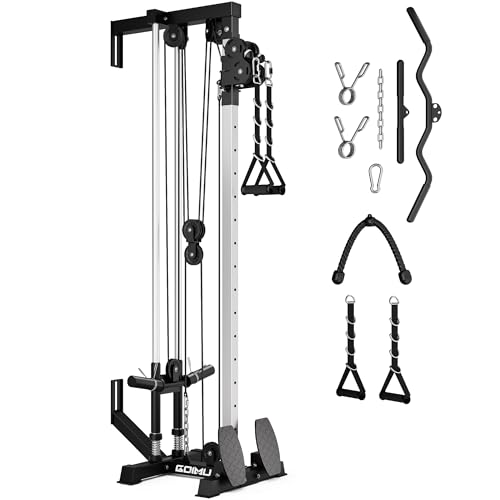
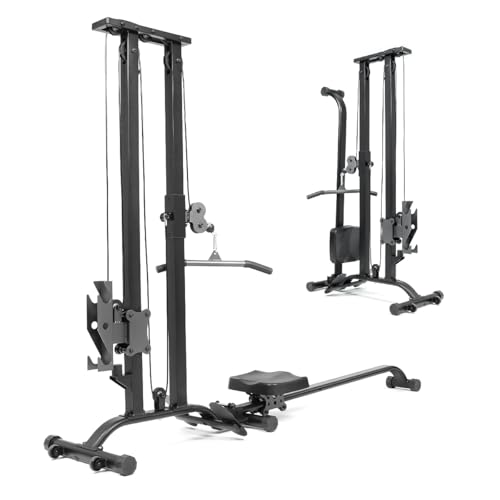


Three shapes solve this problem. A pulley kit hangs off a rack you already own. A wall-mounted station bolts to your studs and takes almost no floor. A freestanding tower needs nothing but space. All of them are plate-loaded, none of them include the plates, and the specification that decides how usable they are is one almost nobody talks about.
At a glance
| Machine | Standout feature | Price tier | Link |
|---|---|---|---|
| Mikolo Pulley System | Best seller here; needs your own rack and plates | Budget | |
| GDLF LAT Tower | Freestanding, with a seat and thigh rollers | Mid-range | |
| VEVOR Wall-Mount | Takes both 1 inch and 2 inch plates | Mid-range | |
| Goimu WM1 | Switches between 1:1 and 2:1 pulley ratios | Mid-range | |
| TOUSAINS CR63 | Folds away, and publishes its ceiling height | Premium | |
| GOIMU LS01 Tower | Three stations in just over 3 square feet | Premium | |
| Mikolo Wall-Mount | Nineteen positions and 2,200 lb rated cables | Premium | |
| JELENS CC01 | Freestanding with pull-up bars; commercial steel | Premium | |
How to choose a compact cable machine
The pulley ratio is the spec nobody explains
Goimu names it and it is the most useful thing on this page: its wall station switches between a 1:1 ratio for heavy lifts and a 2:1 ratio for lighter, higher-rep work. Here is why that matters. On a 2:1 pulley, the weight you feel is roughly half what is on the pin, so a 45 pound plate gives about 22 pounds of resistance and the cable travels twice as far. That is exactly what you want for lateral raises and face pulls, and exactly what you do not want for rows. A machine stuck on one ratio is either always too heavy or always too light for half your exercises.
Wall-mount means studs, and studs mean commitment
The wall stations here take up almost nothing, around three square feet, because they hang on your wall. That is only true if your wall can hold them, which means bolting into structural timber or masonry, not plasterboard, and it means the machine lives there permanently. Mikolo, Goimu and VEVOR all take this route. If you rent, or the only clear wall is a stud partition you are unsure about, the freestanding towers exist for a reason.
Check your ceiling before you check anything else
A lat pulldown needs the top pulley above your seated reach, and that is where home gyms fail. Exactly one brand here does the arithmetic for you: TOUSAINS states its machine is 62.9 inches tall and fits standard seven-foot ceilings. Nobody else publishes a height at all, on a product whose entire purpose is pulling from overhead. Measure your basement or garage ceiling first, especially if there are joists, pipes or a garage door track in the way.
The plates are not included, and the pins are not universal
Every machine here is plate-loaded and none of them ship plates, so budget for those separately and be careful about the hole size. Standard plates come with one-inch holes, Olympic plates with two-inch, and they do not interchange without an adapter. VEVOR is the only brand here solving it outright with a dual-size plate holder that takes both without adapters. On everything else, check which pin you are getting against the plates you own.
Steel gauge is the real durability number
Lower gauge means thicker steel, which is counterintuitive and worth knowing. Mikolo and Goimu both use 14-gauge tubing on their wall stations. JELENS and VEVOR both quote 50 by 50 mm square tube with a 1.5 mm wall, which is a more precise way of saying the same kind of thing. Goimu’s tower quotes 2 mm. Alongside that, look for the cable rating: Mikolo publishes 2,200 pounds on nylon-coated aircraft cable, which is the only cable specification anyone here gives you.
Footprint claims are for the machine, not for you
Goimu quotes 3.12 square feet and TOUSAINS folds to 2.92, and both are true and both are misleading. A cable crossover needs room to stand between the pulleys and swing your arms, and JELENS is the only brand plain enough to describe that instead, quoting a 64 inch training space at the front created by its triangular base. Measure the space you will actually occupy while using it, not the rectangle it occupies while switched off.
Mikolo Pulley System
The best seller here by a wide margin, and it costs a fraction of everything else because it is a fraction of a machine: a high-strength sheathed cable, a heavy alloy buckle, a loading pin and two handles. You thread the pin through a weight plate you already own and hang the whole thing from a rack you already own, and you have a functioning cable station. Two cable lengths are included, 70 and 90 inches, so you can set it high for pulldowns or low for curls, and the breakproof ball design guards against the cable letting go. It assembles in minutes.
Pros:
- The best-selling product here, at a fraction of the price
- Two cable lengths, 70 and 90 inches, for high or low work
- Heavy-duty alloy buckle and breakproof cable design
- Assembles in minutes; packs away in a drawer
Cons:
- Not a machine: you supply the rack and the plates
- No frame, no seat, no adjustable pulley positions
- Only as stable as whatever you hang it from
Best for: anyone who already owns a power rack and plates.
GDLF LAT Tower
A proper freestanding lat tower, and the parts that matter are the ones that hold you down. Four-position thigh rollers lock you into the seat, which is what stops you simply lifting off the bench instead of pulling the bar down, and the seat itself adjusts through four heights. High and low pulley stations cover lats, biceps, forearms, shoulders, traps and triceps. It is the traditional shape, it needs floor space rather than a wall, and it does the two exercises it was designed for properly rather than gesturing at ten.
Pros:
- Four-position thigh rollers actually anchor you for pulldowns
- Four seat heights to suit different users
- High and low pulley stations included
- Freestanding; no wall or rack needed
Cons:
- No published height, footprint or weight rating
- Takes real floor space and does not fold
- Sells poorly against the wall-mounted options
Best for: lat pulldowns and rows, done properly, if you have the floor.
VEVOR Wall-Mount
The one that solves the plate problem. Its dual-size holder takes both two-inch Olympic and one-inch standard plates without adapters, which sounds trivial until you own the wrong ones. Beyond that it is a well-specified wall station: high and low independent pulleys, an ab-crunch function, and eighteen height settings so the cable angle actually matches the exercise. The frame is 50 by 50 mm tube in 1.5 mm carbon steel rated to 500 pounds, and a full accessory set is included: lat bar, tricep rope, ankle strap, straight bar and D-handles.
Pros:
- Takes both 1 inch and 2 inch plates without adapters
- Eighteen height settings on independent high and low pulleys
- Full accessory set included: five attachments
- Publishes its steel spec and a 500 lb rating
Cons:
- Barely sells; the least proven pick here
- Wall-mounted, so it needs a structural wall
- No pulley ratio option published
Best for: a garage with a solid wall and a mixed pile of plates.
Goimu WM1
The cleverest machine here, because of one feature nobody else offers: a cable adapter that switches the pulley between 1:1 for heavy lifts and 2:1 for lighter endurance work and drop sets. That doubles the useful resistance range from the same plates and it is genuinely how commercial machines feel right across every exercise. Seventeen pulley positions cover the angles, the frame is industrial 14-gauge steel bolted to the wall with a patent-pending pulley system and reinforced brackets against sway, and the whole thing occupies a bit over three square feet.
Pros:
- Switches between 1:1 and 2:1 pulley ratios; unique here
- Seventeen pulley positions
- Industrial 14-gauge steel with anti-sway brackets
- Just over three square feet of wall
Cons:
- Needs a genuinely structural wall
- No cable rating or plate size published
- Sells modestly
Best for: wanting the resistance to suit the exercise, not the other way round.
TOUSAINS CR63
The only machine here that folds and the only one that tells you whether it fits: 62.9 inches tall, designed for standard seven-foot ceilings, folding down to 2.92 square feet so it slides against a wall or into a closet corner. It carries 330 pounds of plates, switches between cable machine and rowing modes in seconds through a quick-change cable system, and loads two dumbbells at once where most rivals take one, which widens the resistance range considerably. For a flat rather than a garage, this is the design that actually works.
Pros:
- Folds to under three square feet; slides behind a door
- The only machine here publishing its height and ceiling requirement
- Switches between cable and rowing modes in seconds
- Loads two dumbbells at once; rated to 330 lbs
Cons:
- Sells poorly against the wall-mounted stations
- Folding mechanisms are more to go wrong over time
- 62.9 inches limits overhead pulldown travel
Best for: a flat with a normal ceiling and no dedicated gym room.
GOIMU LS01 Tower
A freestanding tower with three stations in a footprint of just over three square feet, which is the wall-mount advantage without the wall. High pulley for pulldowns and overhead work, low pulley for rows and curls, and an additional pulley cable for the rest. A padded seat adjusts through three heights, and the frame uses 2 mm steel tubing, thicker than the 1.5 mm elsewhere. The accessories are included and sensible: a lat bar for wide work and a cable bar among them. It is the best-selling proper machine on this page.
Pros:
- The best-selling actual machine here
- Three pulley stations in just over three square feet
- 2 mm steel tubing; thicker than most rivals
- Freestanding, so no structural wall needed; attachments included
Cons:
- No height published; check your ceiling
- No pulley ratio option
- Does not fold
Best for: a small gym with no wall to bolt to.
Mikolo Wall-Mount
The most positions and the only published cable rating. Nineteen height settings on a dual adjustable pulley cover unilateral and bilateral work at any angle you like, on a commercial-grade 14-gauge powder-coated frame with nylon-coated aircraft-quality cables rated at 2,200 pounds, which is the only cable specification anyone on this page will give you. Two details show real thought: a large footboard for seated cable rows, so you have something to brace against, and weight pegs angled upward by ten degrees so plates cannot slide off. Eight months of component replacement.
Pros:
- Nineteen pulley positions; the most here
- Publishes a 2,200 lb cable rating on aircraft-quality cable
- Large footboard for seated rows; angled pegs stop plates slipping
- Commercial-grade 14-gauge powder-coated steel
Cons:
- Needs a structural wall
- No pulley ratio switch
- No height or plate size published
Best for: the most adjustable wall station, on a wall you trust.
JELENS CC01
The most machine here, and the only brand describing the space you will use rather than the space it occupies: a triangular base creating 64 inches of open training area at the front, which is what a crossover actually needs. It is a full functional trainer with high and low pulleys, pull-up bars on top, and a complete accessory set including a pulldown bar. The frame is gym-grade 50 by 50 mm commercial square tubing with a 1.5 mm wall and a powder coat, and the pulleys run PU-coated steel cables for a smoother pull than bare wire.
Pros:
- Describes its usable training space, not just its footprint
- Pull-up bars built in; a genuine functional trainer
- Gym-grade 50 by 50 mm commercial tubing
- PU-coated cables and upgraded pulleys for a smoother pull
Cons:
- Most expensive machine here by a wide margin
- Barely sells; the least proven pick on the page
- A 64 inch training space means it is not really compact
Best for: a garage gym with the room to use it properly.
The verdict
Best overall: Goimu WM1. It is the only machine here that lets you change the pulley ratio, and that single feature does more for a home gym than another five positions or another millimeter of steel. Switch to 2:1 and a 45 pound plate becomes a sensible lateral raise; switch back to 1:1 and it is a real row. Add seventeen positions, 14-gauge steel and a bit over three square feet of wall, and it does what a commercial machine does with a fraction of the plates.
Best value: Mikolo Pulley System. The best-selling product here for a reason: if you already own a rack and some plates, it turns them into a cable station for almost nothing, with two cable lengths for high and low work and a properly engineered buckle. Be completely clear about what it is not. There is no frame, no seat and no wall bracket, and it is only as safe as whatever you hang it from.
Best premium: TOUSAINS CR63. It is the only machine on this page that will tell you whether it fits your room, at 62.9 inches tall for a seven-foot ceiling, and the only one that folds to under three square feet when you are done. It carries 330 pounds, switches to a rower in seconds and loads two dumbbells where rivals take one. For a home rather than a garage, that combination is the whole point.
FAQ
Do these come with weights?
None of them. Every machine here is plate-loaded and you supply the plates, so budget separately and check the pin. Standard plates have one-inch holes and Olympic plates two-inch, and they do not interchange. VEVOR is the only one here with a dual-size holder that takes both without an adapter.
What does the pulley ratio change?
How heavy the weight feels. On a 2:1 pulley the resistance is roughly half what is on the pin and the cable travels twice as far, which suits lateral raises and face pulls. On 1:1 you feel the full plate, which suits rows and pulldowns. Goimu’s WM1 is the only machine here that switches between them.
Will it fit my ceiling?
Measure first, because almost nobody tells you. TOUSAINS is the exception, publishing 62.9 inches and stating it suits standard seven-foot ceilings. Everything else leaves you guessing on a product designed for pulling from overhead. Check for joists, pipes and garage door tracks too.
Wall-mounted or freestanding?
Wall-mounted saves the most space and needs a wall that can genuinely take the load, bolted into structure rather than plasterboard, permanently. Freestanding towers like the GOIMU LS01 and GDLF need floor instead and can move. If you rent, or the only clear wall is a partition, freestanding is the answer.
Is the cheapest option really a cable machine?
No, and that is fine if you know. The Mikolo pulley system is a cable, a pulley and a loading pin that hangs from a rack you already own and loads plates you already own. It is the best-selling thing here and it is an accessory for an existing gym, not a machine for an empty room.
This article may contain affiliate links; see our Affiliate Disclosure.