Count the XLR sockets, not the marketing. Half the interfaces sold as two-channel have one microphone input and one instrument jack, which is two inputs and one microphone. If you and someone else both need to talk into a mic at once, that distinction is the entire purchase.





An interface does three jobs: it powers a microphone, it turns what the microphone hears into numbers your computer understands, and it plays the result back to your headphones without a delay you can hear. All eight below do all three. What separates them is how many microphones they will power at once, whether they speak MIDI, and how good the preamp is before you have spent anything.
At a glance
| Interface | Standout feature | Price tier | Link |
|---|---|---|---|
| BOMGE M12 | Cheapest here, with two XLR inputs | Budget | |
| Behringer UM2 | A serious preamp for pocket money | Budget | |
| M-Audio M-Track Solo | One mic, one line, and a software bundle | Budget | |
| Mackie Onyx Artist | Boutique preamp; 24-bit/192kHz | Budget | |
| M-Audio M-Track Duo | Two real combo inputs, cheaply | Budget | |
| Mackie Onyx Producer 2X2 | Two Onyx preamps plus MIDI, at 192kHz | Mid-range | |
| PreSonus AudioBox 96 | Two Class-A preamps, MIDI and Studio One | Mid-range | |
| Focusrite Scarlett Solo | One of the best-selling music products anywhere | Premium | |
How to choose an interface
Count the XLR sockets
This is the check that decides everything. The M-Track Duo has dual XLR combo inputs, the Onyx Producer has two Onyx preamps, and the AudioBox 96 has two Class-A preamps: those are genuinely two-microphone interfaces. The Scarlett Solo, the M-Track Solo, the Onyx Artist and the Behringer UM2 each give you one microphone input plus an instrument jack, which is two inputs and one microphone. For solo vocals or a guitar, that is plenty. For an interview, a duet or a podcast with a guest in the room, it is not, and no amount of gain solves it.
Phantom power is not optional, and everyone has it
A condenser microphone needs 48 volts sent up the cable to work at all, and every interface here supplies it. That is worth stating because it is the thing that separates a real interface from a USB dongle: no phantom power means no condenser, which means no studio microphone. If you are comparing something to these that connects a 3.5 mm jack and mentions no XLR, it is a sound card, not an interface.
The sample rate argument is mostly settled
The spread here is real: 48 kHz on the M-Audio pair and the Behringer, 96 on the PreSonus, 192 on both Mackies and the Scarlett. Higher numbers capture more, and for recording voices and instruments to release on streaming, 48 kHz is entirely sufficient and always has been. Do not let 192 kHz sell you an interface with the wrong number of inputs. It is a real specification answering a question most people are not asking.
MIDI is the port people forget until they need it
Only the Onyx Producer and the AudioBox 96 have MIDI in and out. If you own a keyboard or a drum machine with the old five-pin sockets rather than USB, that port is the difference between plugging in and buying another box. Modern controllers mostly connect over USB and do not need it. Older ones absolutely do, and it is not something you can add later.
The preamp is what you are actually buying
Everything else in these boxes is roughly the same silicon. The preamp is where brands spend money and it is where the sound comes from. Behringer fits its XENYX preamp and quotes a 100 dB dynamic range, which is a real number and a genuinely good one at this price. Mackie calls its Onyx preamps boutique with class-leading dynamic range. PreSonus fits Class-A designs. Focusrite offers a switchable Air mode to brighten a vocal. Those are the differences you will hear.
Look at what software comes free
Every interface here bundles a way to actually record something, which matters if you own none. Focusrite includes Pro Tools Intro, Ableton Live Lite, Cubase LE and a suite of effects. PreSonus includes Studio One Artist and Ableton Live Lite. Both M-Audio units bring MPC Beats. Mackie includes a collection of 23 plugins and instruments. That bundle is a genuine part of the value, and it is why the sticker price is not the whole comparison.
BOMGE M12
The cheapest way to get two XLR inputs and phantom power, which on paper undercuts everything else here by a wide margin. It is really a small mixer with a USB output: two balanced XLR inputs, left and right outputs, a condenser mic input and a headphone output, with a gain meter running from minus 36 to plus 10 dB on each channel so you can see what you are doing rather than guess. It takes guitar or bass, and the 48 volt supply is there. It sells the least of anything here by a long way, which is the caution that comes with the price.
Pros:
- Two XLR inputs for the least money here
- 48 volt phantom power on a genuinely cheap box
- Gain metering on every input and output
- Doubles as a small live mixer
Cons:
- Sells far behind everything else here
- No sample rate published
- No software bundle
Best for: two microphones on the smallest possible budget.
Behringer UM2
The one that has been the answer to “cheapest thing that actually works” for years. Its XENYX microphone preamp is the real feature, quoted at 100 dB of dynamic range, which is a serious specification to find in a box this cheap and the reason people keep recommending it. Direct monitor select lets a performer hear themselves without the round-trip delay that ruins takes. It runs at 48 kHz and works with essentially every recording program. It is one XLR plus an instrument input, so it is not a two-microphone interface whatever the 2×2 in the name suggests.
Pros:
- XENYX preamp with a quoted 100 dB dynamic range
- Direct monitoring so performers hear themselves cleanly
- Works with essentially every recording program
- Extremely cheap for the preamp you get
Cons:
- One microphone input; the 2×2 refers to ins and outs
- 48 kHz only
- No software bundle mentioned
Best for: one microphone, one guitar, and the best preamp per pound here.
M-Audio M-Track Solo
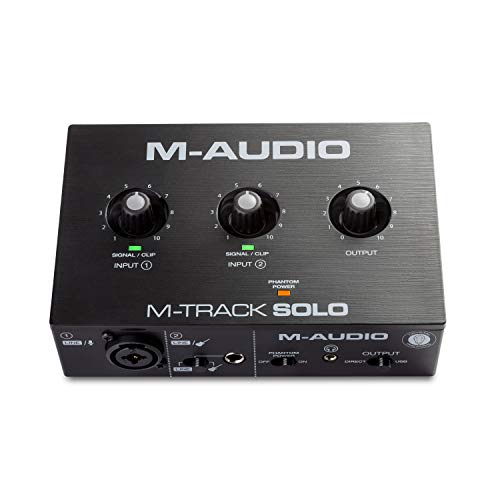
A single combo XLR and line input with phantom power, M-Audio’s transparent Crystal preamp, and MPC Beats software in the box so you have somewhere to put the recording. It runs at 48 kHz, which is the right resolution for almost everything anyone does with an interface like this. Note the outputs, because they are the difference from its bigger sibling: an eighth-inch headphone jack and RCA line outs, rather than the quarter-inch sockets studio monitors expect. That is a cable or an adapter you had not budgeted for.
Pros:
- Combo XLR and line input with phantom power
- Transparent Crystal preamp
- MPC Beats software included
- Cheap, small and bus powered
Cons:
- One microphone input
- Eighth-inch headphone jack and RCA outs, not quarter-inch
- 48 kHz only
Best for: a first interface for one voice, feeding headphones and a hi-fi.
Mackie Onyx Artist
Mackie’s entry point, and it puts the money where it counts: a boutique-quality Onyx microphone preamp with what Mackie calls class-leading fidelity and dynamic range, plus 48 volt phantom power for condensers. It records at 24-bit and up to 192 kHz, which is more than the cheap M-Audio and Behringer boxes offer. A quarter-inch TRS input with a Hi-Z switch takes a guitar or bass properly, there is zero-latency direct monitoring, and it is bus powered with no adapter to lose. The Musician Collection of 23 plugins and instruments comes with it.
Pros:
- Boutique Onyx preamp at a budget price
- 24-bit and up to 192 kHz recording
- Hi-Z switch for guitar and bass; zero-latency monitoring
- 23 plugins and instruments included; bus powered
Cons:
- One microphone input; the 1X2 says so plainly
- No MIDI
- Sells behind the M-Audio and Focusrite options
Best for: one microphone, with the best converters at this price.
M-Audio M-Track Duo
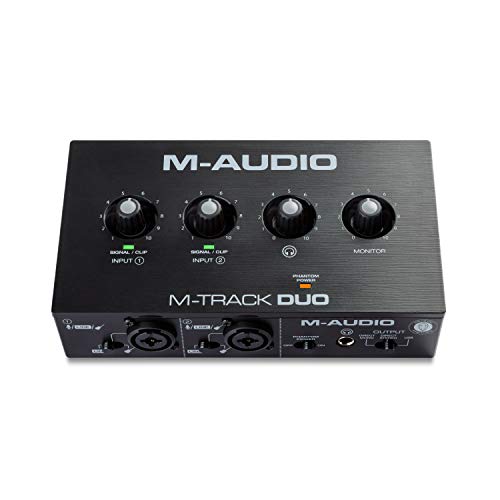
The cheapest interface here with two genuine microphone inputs, and that is the whole argument. Two combo XLR, line and instrument sockets with phantom power mean two people can speak, or a voice and a guitar can be recorded on separate tracks and mixed later rather than committed together. Crystal preamps keep it transparent, and the outputs are the ones you want: a quarter-inch headphone jack and stereo quarter-inch line outs that plug straight into studio monitors. MPC Beats is included. It runs at 48 kHz.
Pros:
- Two combo XLR, line and instrument inputs with phantom power
- Cheapest true two-microphone interface here
- Quarter-inch headphone and stereo line outputs
- Strong seller; MPC Beats included
Cons:
- 48 kHz only, where Mackie and Focusrite reach 192
- No MIDI ports
- Plastic build at a plastic price
Best for: two microphones, two tracks, without spending properly.
Mackie Onyx Producer 2X2
The Onyx Artist with the two things it was missing: a second preamp and MIDI. Two boutique Onyx microphone preamps with 48 volt phantom power, XLR and TRS combo inputs that accept microphone, line or Hi-Z instrument signals, 24-bit recording at up to 192 kHz, and MIDI in and out for the keyboard in your loft with the five-pin sockets. Zero-latency direct monitoring, dedicated outputs for studio monitors, a strong headphone output, and it runs off the USB bus with no adapter. The 23-piece Musician Collection comes with it.
Pros:
- Two boutique Onyx preamps with phantom power
- MIDI in and out; one of only two here
- 24-bit at up to 192 kHz
- Combo inputs take mic, line or instrument; bus powered
Cons:
- Sells well behind the PreSonus at the same price
- 192 kHz is a number most people will never use
- No high-end preamp mode or character switch
Best for: two microphones and a MIDI keyboard, at the highest resolution here.
PreSonus AudioBox 96
The most complete package here for the money. Two Class-A microphone preamps, two high-headroom instrument inputs for guitar and bass, MIDI in and out, and studio-grade converters at 24-bit and 96 kHz. That is a genuine two-microphone interface with the port most rivals skip. The software is the other half of the value: Studio One Artist is a full recording program rather than a limited edition, alongside Ableton Live Lite and a plug-in suite, so this box is a working studio the day it arrives.
Pros:
- Two Class-A microphone preamps plus two instrument inputs
- MIDI in and out
- Studio One Artist included; a full program, not a trial
- 24-bit and 96 kHz converters; strong seller
Cons:
- 96 kHz rather than the 192 the Mackies offer
- Costs nearly half again the M-Track Duo
- No preamp character or Air-style switch
Best for: everything you need to start, in one box, properly.
Focusrite Scarlett Solo
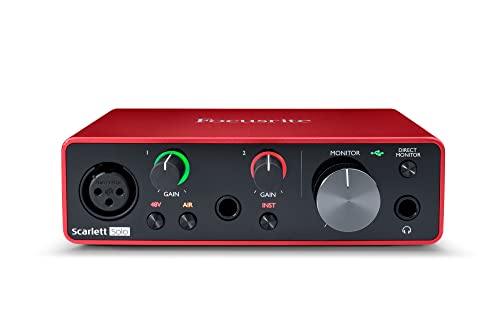
One of the best-selling music products on the market, and deservedly: the third-generation Scarlett preamp is genuinely good, with a switchable Air mode that brightens a vocal in a way people like enough to leave on. High-performance converters, two low-noise balanced outputs for monitors, and a software bundle that is the most generous here, with Pro Tools Intro, Ableton Live Lite, Cubase LE and the Hitmaker Expansion effects. It is a Solo, which means one microphone input alongside the instrument input. For a singer with a guitar, that is exactly right.
Pros:
- Among the best-selling music products available
- Switchable Air mode brightens vocals
- The most generous software bundle here
- Low-noise balanced outputs; high-performance converters
Cons:
- One microphone input, despite the price
- Most expensive interface here
- No MIDI
Best for: one voice, one guitar, and never wondering if the gear is the problem.
The verdict
Best overall: M-Audio M-Track Duo. It is the cheapest interface here with two real combo XLR inputs and phantom power on both, which is the thing most people in this price bracket actually need and often discover too late. The outputs are proper quarter-inch jacks that plug into monitors without an adapter, the Crystal preamps are clean, and MPC Beats is in the box. It runs at 48 kHz, which is enough for anything you are going to release.
Best value: Behringer UM2. A XENYX preamp with a quoted 100 dB dynamic range, for less than most microphone cables cost. It has one microphone input despite the 2×2 in its name, and 48 kHz is its ceiling. What it does have is a preamp that has been quietly making people’s first recordings sound better than they had any right to for years, plus direct monitoring so the performer hears themselves cleanly.
Best premium: PreSonus AudioBox 96. Two Class-A preamps, two instrument inputs, MIDI in and out, 96 kHz converters and Studio One Artist, which is a complete recording program rather than a cut-down one. That is a studio in a box for less than the Focusrite that only takes one microphone. If you are starting from nothing and want to stop shopping, this is the one.
FAQ
What does 2-channel actually mean?
Not what you would assume. Count the XLR sockets: the M-Track Duo, Onyx Producer and AudioBox 96 have two, so two microphones work at once. The Scarlett Solo, M-Track Solo, Onyx Artist and Behringer UM2 have one XLR plus an instrument jack, which is two inputs and one microphone. Behringer’s 2×2 refers to two in and two out.
Do I need 192 kHz?
Almost certainly not. Both Mackies and the Scarlett reach it; the M-Audio pair and the Behringer stop at 48 kHz, and 48 is what most released music is recorded and delivered at. Do not trade away a second microphone input for a sample rate you will never select.
Will it power my condenser mic?
Yes, all of these supply the 48 volts a condenser needs. That is the line between an interface and a USB sound card: if a device has no XLR socket and no phantom power, it cannot run a studio microphone at all, whatever the listing calls it.
Do I need MIDI?
Only if you own something with five-pin MIDI sockets, like an older keyboard or drum machine. Modern controllers connect over USB and need nothing. The Onyx Producer and the AudioBox 96 are the only two here with the ports, and it is not something you can add afterwards.
Does the free software matter?
A lot, if you own none. Focusrite bundles Pro Tools Intro, Ableton Live Lite, Cubase LE and an effects suite. PreSonus includes Studio One Artist, which is a full program rather than a limited version, plus Ableton Live Lite. Mackie gives you 23 plugins and instruments, and both M-Audio boxes include MPC Beats.
This article may contain affiliate links; see our Affiliate Disclosure.