One dripper has a single large hole and a 60 degree cone. The other has a flat bottom and three small ones. That is the entire argument, and it decides whether the machine forgives your pour or exposes it.


Both make excellent coffee and neither is better. They ask different things of you. The V60 hands you every variable and lets you ruin it; the Wave takes some of them away and hands back consistency. What follows is what the geometry actually does, what the filters will cost you forever, and which material stops stealing your heat.
At a glance
| Item | Standout feature | Price tier | Link |
|---|---|---|---|
| Hario V60 Plastic 02 | Cheapest dripper, and plastic steals no heat | Budget | |
| Kalita Wave Filters 185 | Best seller here; the recurring cost of a Wave | Budget | |
| Kalita Wave 185 Glass | Flat bed and three holes; forgives a rough pour | Budget | |
| Hario V60 02 White | The best-selling dripper here | Budget | |
| Hario Switch 02 | A valve, so it does immersion and pour-over | Mid-range | |
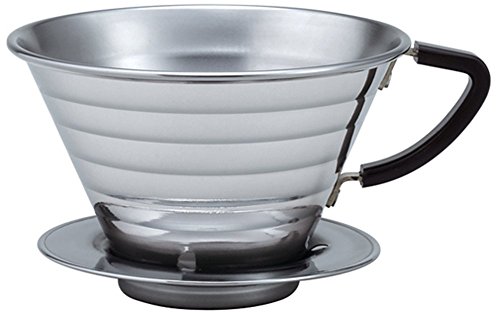
| Kalita Wave 185 Steel | Stainless; will outlive the kitchen | Premium | |
How to choose between them
Three small holes versus one big one
The V60 is a 60 degree cone with a single large opening and spiral ribs, and it drains as fast as your grind and your pouring let it. That is the appeal: every variable is yours. It is also the problem, because a careless pour digs a channel through the bed and the water escapes down it, and the cup arrives thin and sour with no clue why. The Kalita Wave’s three small holes restrict the flow deliberately. Kalita explains the mechanism in its own listing: the dripper and filter together create a pool of water sitting on top of the coffee bed, which controls agitation. Water leaves slowly and evenly, so an uneven pour matters much less.
Flat bed or cone, and what that does to the coffee
A cone concentrates the grounds into a deep point, so water travels through more coffee at the tip than at the rim. A flat bottom spreads the bed evenly, so every part of it sees a similar amount of water. That is why flat-bottom brews taste more even and repeatable, and why cone brews, done well, can be more expressive: the uneven extraction is part of the character. Kalita publishes the dimensions, a 2 inch dripping area within a 4 inch bottom, which is why the Wave sits on most cups and carafes.
The filter is a lifelong subscription, and the Wave’s is proprietary
This is the cost nobody mentions. Kalita’s own filter listing says it plainly: for best results use Kalita Wave filters with the same size Kalita Wave dripper. The wavy pleated shape is the design, and nothing else fits, so buying a Wave means buying Wave filters forever. They are made in Japan from thick, oxygen-bleached stock and they are excellent, and they are also the best-selling item on this whole page, which tells you how many people are on that subscription. V60 filters are proprietary cones too, but they are cheaper and stocked almost everywhere.
Sizes: two systems, neither obvious
Hario numbers by 01, 02 and 03, and helpfully spells out what they mean: 01 does one to two cups, 02 does one to four, 03 does one to six. Kalita numbers by 155 and 185, referring to the dripper diameter in millimeters, and the 185 makes 16 to 26 ounces. For most households the answer is a V60 02 or a Wave 185. Buy your filters in the same number as your dripper, because they do not cross over and half a millimeter matters.
Material decides how much heat you lose
Pour water at brewing temperature into a cold ceramic or steel dripper and the dripper takes some of that heat before your coffee does. Plastic barely does, which is the quiet argument for the cheapest dripper on this page, and Hario points to the same thing from a different angle: light and sturdy, perfect for travel. Glass and ceramic look better and hold heat once warmed. Steel is the toughest. The fix for all of them is the same: run hot water through the empty dripper first, which also rinses the paper.
There is a third answer
Hario’s Switch is a V60 cone with a stainless ball valve in the bottom, operated by a plastic switch. Closed, it holds the water and you have an immersion brewer, steeping like a French press with full control of contact time. Open, it drains and you have a normal V60. That sidesteps the entire cone-versus-flat argument by letting you do the one thing neither dripper can: decide the brew is a steep today.
Hario V60 Plastic 02
The cheapest dripper here and, on the one measure that matters most, arguably the best: plastic has almost no thermal mass, so it does not rob heat from your water on the way through. Every ceramic and steel dripper needs preheating to do what this one does cold. It is the standard 60 degree cone with the spiral ribs and single large opening, sturdy, light, and Hario is clear that a size 02 covers one to four cups. It is the travel option and the daily driver at once, and the only thing it lacks is presence on the counter.
Pros:
- Cheapest dripper here
- Plastic steals almost no heat from the brew
- Light and sturdy enough to travel with
- Hario clearly explains what the size numbers mean
Cons:
- The cone punishes an uneven pour
- Plastic will stain and eventually look tired
- Sells behind the ceramic version
Best for: the best coffee per pound, and a bag you travel with.
Kalita Wave Filters 185
The best-selling item on this page, which is worth pausing on: the consumable outsells every dripper. That is what a proprietary filter system looks like from the outside. They are made in Japan from thick paper stock and oxygen bleached rather than chlorine bleached, so the paper does not put anything into your cup. The wave shape is the functional part, reducing contact between the coffee and the filter wall so extraction stays even. Buy them in the same number as your dripper. Nothing else fits, and that is the deal.
Pros:
- The best seller on this page by a distance
- Made in Japan from thick, oxygen-bleached stock
- The wave shape is functional, not decorative
- 100 in a box, so a long time between orders
Cons:
- Proprietary; nothing else fits a Wave
- Dearer per filter than common V60 papers
- Must match the dripper size exactly
Best for: anyone who owns a Wave, permanently.
Kalita Wave 185 Glass
The forgiving one, in heat-resistant glass. Its three small holes and flat bed do the work your technique would otherwise have to: water pools briefly on top of the coffee, agitation stays controlled, and the bed extracts evenly whether or not your kettle hand is steady. Kalita publishes the numbers, a 2 inch dripping area inside a 4 inch base, so it sits on most cups and carafes without a stand. The 185 makes 16 to 26 ounces, which is two decent mugs. It is used in competition and it is also the easiest dripper here to get right on a Tuesday.
Pros:
- Three holes and a flat bed forgive an uneven pour
- Publishes its dimensions; fits most cups and carafes
- Makes 16 to 26 oz; enough for two
- Heat-resistant glass, and it looks the part
Cons:
- Locked into Kalita’s proprietary wave filters
- Glass needs preheating and can break
- Sells well behind the Hario drippers
Best for: a consistent cup without practicing your pour.
Hario V60 02 White
The best-selling dripper here, and the icon of the whole category: the white V60 in size 02, the one in every cafe photograph. It is worth noting that Hario’s listing for it contains exactly one word of description, which is not a specification so much as a shrug from a company that assumes you already know. What you are buying is the standard 60 degree cone with spiral ribs and a large single opening, in the classic white finish, at size 02 for one to four cups. It wants preheating and it wants a steady hand.
Pros:
- The best-selling dripper on this page
- The classic V60 shape and finish
- Size 02 covers one to four cups
- Filters are cheap and stocked everywhere
Cons:
- Hario’s listing tells you essentially nothing
- Needs preheating, unlike the plastic version
- The cone exposes every flaw in your pour
Best for: wanting the real thing, and willing to learn the pour.
Hario Switch 02
The clever one. It is a V60 cone in Hario’s heatproof glass with a stainless steel ball valve in the base, worked by a plastic switch. Flick it closed and the water stays put, so you are steeping like a French press with total control over contact time and nothing to get wrong. Flick it open and it drains through the paper as a normal V60. That combination means you can brew by immersion on a morning when precision is not happening, and by percolation when it is, from one device. It ships with 40 V60 papers and takes standard 02 filters.
Pros:
- Immersion and pour-over from one dripper
- Steeping removes pour technique from the equation entirely
- Stainless ball valve in Hario’s heatproof glass
- Takes standard 02 V60 filters; 40 included
Cons:
- The most expensive Hario option here
- A valve is one more thing to clean and eventually fail
- Glass, so preheat it and do not drop it
Best for: wanting both brewing methods without owning both brewers.
Kalita Wave 185 Steel
The Wave in polished stainless, made in Japan, and the argument is durability: it is tougher than ceramic or glass and it will not chip, crack or shatter, which over a decade of daily use is not nothing. Same flat bed, same three holes, same forgiving behavior, same 2 inch dripping area in a 4 inch base. It is the most expensive item here by a distance, and metal has real thermal mass, so it wants a proper preheat before the first pour or it will drink some of your heat. Kalita is a family firm and stands behind it.
Pros:
- Stainless steel; tougher than ceramic or glass
- The same forgiving flat bed and three-hole flow
- Made in Japan; effectively unbreakable
- Fits most cups and carafes
Cons:
- The most expensive dripper here by a wide margin
- Metal needs a real preheat or it takes your heat
- Barely sells; the least proven pick on this page
Best for: buying one dripper and never buying another.
The verdict
Best overall: Kalita Wave 185 Glass. For most people, most mornings, the flat bed and three small holes are simply the better tool. They pool the water briefly, control the agitation and extract the bed evenly, which means the cup is good whether or not you poured beautifully. Kalita publishes its dimensions, it fits ordinary cups, and the 185 makes enough for two. The catch is fair and permanent: you are buying Kalita’s filters forever.
Best value: Hario V60 Plastic 02. The cheapest dripper on this page, and plastic is not a compromise here, it is an advantage: almost no thermal mass, so it takes no heat from your water while every ceramic and steel dripper needs preheating to match it. It is light enough to travel and cheap enough to own alongside something prettier. You do have to learn the pour, because the cone will tell you when you have not.
Best premium: Hario Switch 02. It refuses the question. Close the valve and steep like a French press with contact time as your only variable; open it and it is a V60. That means a good cup on a morning when your technique is not available, and an expressive one when it is, from a single device. It takes standard V60 papers and ships with forty.
FAQ
Which is easier to get right?
The Kalita Wave, clearly. Its three small holes restrict the flow so water pools on the bed and extracts it evenly, which Kalita describes as controlling agitation. The V60’s single large hole drains as fast as your pour allows, so a rushed or uneven pour channels and the cup goes thin. The Wave takes variables away; the V60 hands them all to you.
Can I use ordinary filters in a Kalita Wave?
No. Kalita’s own guidance is to use Wave filters in the same size as the dripper, because the pleated wave shape is what holds the paper off the walls and makes the design work. That is a permanent running cost, and it is why the filters outsell every dripper on this page. V60 papers are cheaper and far more widely stocked.
Which size do I need?
For a V60, size 02 covers one to four cups and is the standard choice; 01 is one to two and 03 is up to six. For a Kalita, the 185 makes 16 to 26 ounces. Whatever you buy, buy filters in the same number, since the sizes do not interchange.
Does the material change the coffee?
Yes, through heat. Ceramic, glass and steel all absorb heat from your water before the coffee does, which is why they want a hot rinse first. Plastic barely does, which makes the cheapest dripper here surprisingly competitive. Preheat everything except the plastic and the difference largely disappears.
Is there a way to avoid choosing?
The Hario Switch. It is a V60 cone with a ball valve, so closed it steeps like an immersion brewer and open it drains like a normal V60. That gives you a repeatable cup on a bad morning and an expressive one on a good one, from one device, using standard V60 papers.
This article may contain affiliate links; see our Affiliate Disclosure.