Look at your cable bill and find the equipment rental line. It is a small number that never stops, and over the life of one modem it quietly adds up to more than the modem costs. Buying your own box is one of the few purchases that pays for itself and then keeps paying.


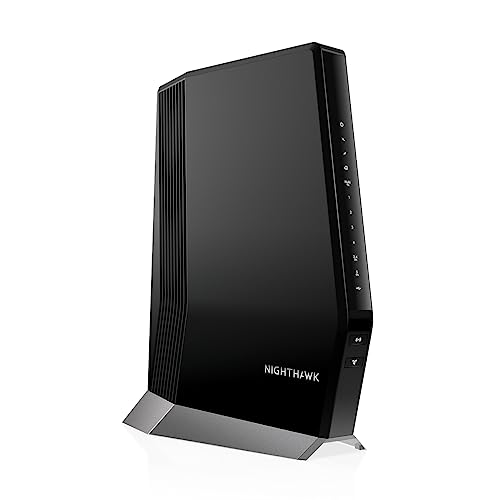


A combo unit does two jobs in one box: it terminates the coax coming in from the street, and it broadcasts the WiFi your household actually uses. That saves a power outlet, a shelf, and a cable. What separates a good one from a bad one is the modem standard inside it, whether your provider has approved that exact model, and whether its WiFi can cover your home. Everything below works on cable, and nothing below works on fiber, DSL, or satellite.
At a glance
| Product | Standout feature | Price tier | Link |
|---|---|---|---|
| NETGEAR Nighthawk CAX30 | DOCSIS 3.1 with WiFi 6, the popular middle ground | Premium | |
| ARRIS SURFboard G34 | DOCSIS 3.1 and WiFi 6 at the lowest price | Mid-range | |
| NETGEAR Nighthawk CAX80 | AX6000 WiFi and a 2.5 Gig multi-gig port | Premium | |
| NETGEAR Nighthawk C7000 | Cheapest way in, WiFi 5 and DOCSIS 3.0 | Budget | |
| ARRIS SURFboard G36 | Higher rated plan speed than the G34 | Mid-range | |
How to choose a cable modem-router combo
Check your provider’s approved list first, not last
This is the step that turns a good purchase into a returned parcel. Cable providers publish a list of modems they will activate, by exact model number, and a device that is not on it may simply refuse to come online no matter how new it is. Approval is also per plan tier, so a modem approved for a provider’s mid plan can be rejected on their gigabit one. Look up the specific model against your specific plan before you order. Every maker here says the same thing in their own listing, which should tell you how often people skip it.
DOCSIS 3.1 versus 3.0 is the decision that ages
DOCSIS is the standard the modem speaks to the cable network. Version 3.0 is the older one and it works fine on mid-tier plans today. Version 3.1 is the current one, it handles gigabit and beyond, and it is what providers are building toward. If you are buying a box you intend to keep for years, 3.1 is the one that survives your next plan upgrade. Buying 3.0 now to save a little is a decision you may have to make again sooner than you would like.
Channel bonding, briefly
You will see numbers like 32×8 and 24×8. They describe how many downstream and upstream channels the modem can bundle together, and more channels means more headroom when the neighborhood is busy. A 32×8 modem has more room to breathe at peak hour than a 24×8 one. It is not the first thing to sort on, but it is a fair tiebreaker between two otherwise similar boxes.
Coverage claims are measured in a good house, not yours
Square-footage figures assume a friendly layout. Plaster, brick, foil-backed insulation, and a floor between you and the box all take a bite. Take coverage numbers as a ranking rather than a promise: a unit rated for 2,500 square feet will genuinely reach further than one rated for 1,800, but neither will read as advertised through a brick chimney breast. The device count matters as much in a full house, once you tally phones, TVs, consoles, speakers, and every smart plug.
The real case against a combo
One box is neat, but it welds two components together that age at different rates. WiFi standards move quickly; DOCSIS moves slowly. With separate units you upgrade the router and keep the modem, whereas with a combo you replace both or neither. A combo also puts your WiFi wherever the coax happens to enter, which is frequently a corner of the house or behind a television. If your coax lands somewhere terrible, separates or a mesh system will serve you better. Buy a combo for tidiness and simplicity, with your eyes open.
Voice service is the usual dealbreaker
If your cable plan bundles home phone, none of these will work for it. Voice needs a modem with telephony built in, and every unit here excludes bundled voice explicitly. Fiber, DSL, and satellite customers are out too. This is cable internet only, and the listings are unusually clear about it.
Multi-gig ports and what they are for
Most of these give you four gigabit Ethernet ports, which is plenty for a console, a desktop, and a TV. A 2.5 Gig port is a different thing: it lets a single wired device exceed gigabit, and it matters if you run a fast NAS, move very large files, or are on a plan faster than a gigabit. If none of that describes you, it is a feature you will never notice.
NETGEAR Nighthawk CAX30
The runaway best seller of this group, and the reason is that it lands in the middle of everything without a glaring weakness. Inside is DOCSIS 3.1 with 32×8 channel bonding, so it is ready for gigabit plans, paired with dual-band WiFi 6 rated AX2700, covering up to 2,000 square feet and 25 devices. Connectivity is four gigabit Ethernet ports with port aggregation support, plus a USB 3.0 port for a drive or a printer. Setup runs through the Nighthawk app, which is genuinely one of the more painless activation flows. NETGEAR Armor is bundled as a security suite with a thirty-day trial, and it is a subscription after that, which is worth knowing before the reminder appears. It replaces both your rented modem and your router, and it works with Xfinity, Spectrum, Cox and other cable providers, but not with Verizon, AT and T, CenturyLink, DSL, DirecTV, DISH, or any bundled voice plan.
Pros
- DOCSIS 3.1 with 32×8 channel bonding, gigabit ready
- Dual-band WiFi 6 at AX2700, up to 2,000 square feet
- Handles 25 concurrent devices
- Four gigabit Ethernet ports with port aggregation
- USB 3.0 port for storage or a printer
- Nighthawk app makes setup straightforward
- Works with Xfinity, Spectrum, and Cox
Cons
- NETGEAR Armor is a subscription after the trial
- No multi-gig Ethernet port
- Costs more than the ARRIS units with similar WiFi
- No support for bundled voice service
Best for: most cable households on a gigabit or near-gigabit plan in a mid-sized home.
ARRIS SURFboard G34
The value play, and a strong one. It brings DOCSIS 3.1 and dual-band WiFi 6 at AX3000, a higher WiFi rating than the best seller, for meaningfully less money. Its listing quotes a 1 Gbps maximum internet speed, which covers the plan most people are actually on. Four gigabit Ethernet ports handle wired devices. The design is compact with simple LED indicators for power, upstream, downstream, and online status, which sounds trivial until you are diagnosing a dropout at eleven at night and those four lights tell you instantly whether the problem is your house or the street. Every SURFboard modem is CableLabs certified, and this one is tested and qualified for Cox, Xfinity, and Spectrum. Not for fiber, DSL, or satellite.
Pros
- DOCSIS 3.1 and WiFi 6 at the lowest price here
- AX3000 dual-band WiFi, rated above the best seller
- Four gigabit Ethernet ports
- Clear LED indicators for fast fault-finding
- CableLabs certified, qualified for Cox, Xfinity, Spectrum
- Compact, space-saving design
- Simple activation process
Cons
- Listing quotes a 1 Gbps maximum plan speed
- No USB port
- No multi-gig Ethernet port
- Coverage area not published
Best for: anyone who wants current modem and WiFi standards without paying the premium.
NETGEAR Nighthawk CAX80
The most capable box here and priced accordingly. WiFi steps up to AX6000, rated to around 6 Gbps across dual bands, covering up to 2,500 square feet and 30 devices. DOCSIS 3.1 with 32×8 bonding supports cable plans up to 2 Gbps, so it has real headroom above a gigabit. The interesting port is the 2.5 Gig multi-gig connection, usable as a LAN or internet port and supporting aggregation, sitting alongside four gigabit ports and USB 3.0. That is what lets one wired machine exceed a gigabit, and it is the feature that separates this from everything else on the page. Automatic firmware updates and NETGEAR’s Advanced Router Protection are built in, with Armor on the usual thirty-day trial. Cable only, no voice, same provider exclusions as its smaller sibling.
Pros
- AX6000 WiFi 6, the fastest wireless here
- Covers up to 2,500 square feet and 30 devices
- Supports cable plans up to 2 Gbps
- 2.5 Gig multi-gig port plus four gigabit ports
- USB 3.0 and port aggregation support
- DOCSIS 3.1 with 32×8 channel bonding
- Automatic firmware updates built in
Cons
- By far the most expensive option here
- Wasted on a sub-gigabit plan
- Armor becomes a subscription after the trial
- Large box to find a home for
Best for: big homes, multi-gig plans, and wired setups that need to beat a gigabit.
NETGEAR Nighthawk C7000
The cheapest route out of rental fees, with the trade-offs stated plainly. This is DOCSIS 3.0 with 24×8 bonding and WiFi 5 at AC1900, covering up to 1,800 square feet and 30 devices, which is entirely adequate for streaming, video calls, and a house full of ordinary devices. It works with Xfinity up to 800Mbps and Cox up to 500Mbps, and NETGEAR points anyone on a gigabit plan to the CAX30 instead. One caveat deserves flagging: NETGEAR’s own listing states that Spectrum support for this model is being retired, so Spectrum customers should look elsewhere on this page. Four gigabit Ethernet ports, a USB 2.0 port, Beamforming+, guest WiFi, WPA2, and automatic firmware updates round it out, with setup through the Nighthawk app or a browser.
Pros
- Cheapest way to stop renting equipment
- AC1900 WiFi 5 handles streaming and video calls fine
- Covers up to 1,800 square feet and 30 devices
- Four gigabit Ethernet ports plus USB 2.0
- Guest network and automatic firmware updates
- Setup via app or plain web browser
Cons
- DOCSIS 3.0, not ready for gigabit plans
- Spectrum support is being retired per NETGEAR
- WiFi 5 rather than WiFi 6
- 24×8 bonding leaves less peak-hour headroom
Best for: Xfinity or Cox customers on a mid-tier plan who want the bill to shrink now.
ARRIS SURFboard G36
The G34’s bigger sibling, rated for plans up to 1.2 Gbps rather than 1 Gbps, with the same DOCSIS 3.1 modem and the same dual-band WiFi 6 at AX3000. That extra 200 Mbps of rated headroom is the whole difference in a sentence, and whether it is worth the step up depends entirely on whether your provider sells a plan that needs it. ARRIS leans on ubiquity here, noting the brand sits in over 260 million homes, and the pitch is the same as its cheaper sibling: own the box, stop paying the rental line on your bill. It works with Xfinity, Spectrum, and Cox, with the usual instruction to confirm your exact plan supports the model.
Pros
- Rated for cable plans up to 1.2 Gbps
- DOCSIS 3.1 for current and future plans
- Dual-band WiFi 6 at AX3000
- Works with Xfinity, Spectrum, and Cox
- Long-established, widely deployed hardware
- Ends the monthly equipment rental charge
Cons
- Costs noticeably more than the G34 for a modest speed bump
- Same WiFi rating as the cheaper G34
- No multi-gig port
- Coverage area not published
Best for: subscribers on a plan just above a gigabit who want ARRIS simplicity.
The verdict
Best Overall: NETGEAR Nighthawk CAX30. It outsells everything else here by a distance, and it is easy to see why. DOCSIS 3.1 with 32×8 bonding, WiFi 6, 2,000 square feet, 25 devices, port aggregation, USB 3.0, and an app that gets you online without a support call. Nothing about it is extreme, which is exactly what most households need.
Best Value: ARRIS SURFboard G34. The cheapest box here with both current standards, DOCSIS 3.1 and WiFi 6, and its AX3000 rating is actually above the best seller’s. If your plan sits at a gigabit or below, this is the one that gets you everything that matters for the least money.
Best Premium: NETGEAR Nighthawk CAX80. AX6000 WiFi, 2,500 square feet, 30 devices, support for plans to 2 Gbps, and the only 2.5 Gig port on this page. Buy it for a large home or a genuinely fast plan, and skip it entirely if neither applies.
The C7000 remains a reasonable buy for Xfinity or Cox customers on a mid-tier plan who want the rental line gone today, provided you accept DOCSIS 3.0 and are not on Spectrum.
Frequently asked questions
Will buying my own modem really save money?
Yes, on cable. The rental fee is a recurring monthly charge, and a purchased combo typically pays for itself within a couple of years, then keeps saving. ARRIS makes exactly this argument in its own listing. Return the rented unit and get a receipt, because unreturned-equipment charges are a common and annoying way to lose the saving.
Do these work with Verizon, AT and T, or DSL?
No. Every unit here is cable only. Fiber, DSL, and satellite services use entirely different equipment, and bundled home phone needs a modem with telephony built in, which none of these have.
Is a combo better than a separate modem and router?
Neater, not better. A combo saves space, a cable, and an outlet, and it is simpler to set up. Separates let you upgrade the WiFi without touching the modem, and let you put the router somewhere central rather than wherever the coax enters. If your coax lands in a far corner, separates or mesh will beat any combo.
What happens if my provider does not approve the model?
It usually will not activate at all. Approval is checked by model, and often by plan tier as well, so check both against your provider’s published list before buying rather than after. This is the single most common cause of a returned modem.
Do I need WiFi 6?
Not urgently, but it is worth having. WiFi 6 handles many devices at once far more gracefully than WiFi 5, which is what a modern house full of phones, TVs, and smart plugs actually stresses. Since it costs little extra on the value pick here, there is not much reason to buy WiFi 5 new.
This article may contain affiliate links; see our Affiliate Disclosure.